<p>If you have ever typed <a href="https://thebouncykingdom.net/bounce-house-rental-guide/"><strong>whats a bounce house</strong></a> into a search bar, you are not alone. Parents, event planners, school organizers, and first-time renters ask this question all the time, especially when they want to add something fun, active, and memorable to an event.</p>
<p>A bounce house, also called a <strong>bouncy house</strong>, <strong>inflatable castle</strong>, <strong>jump house</strong>, or <strong>moon bounce</strong>, is an air-filled structure made for jumping and play. You usually see one at birthday parties, school fairs, church festivals, neighborhood block parties, and company family events. Kids love them because they turn an ordinary yard or event space into a play zone in minutes.</p>
<p>But there is more to a bounce house than just fun. You need to know how it works, what size to choose, how much it costs, and most importantly, how to use it safely. That matters whether you plan to rent one for a weekend party or buy one for frequent use.</p>
<p>In this complete guide, you will learn the basics in plain language. We will cover what a bounce house is, how it stays inflated, the main styles available, safety rules, setup tips, rental costs, and how to choose the right option for your event. By the end, you will feel much more confident about your next booking or purchase.</p>
<h2 id="what-is-a-bounce-house-">What is a bounce house?</h2>
<p><img class="aligncenter wp-image-7051 size-full" src="https://comeawayhome.co.uk/wp-content/uploads/2026/05/b0324c74-6d77-492c-9aaa-68c47b4181da-ezgif.com-jpg-to-webp-converter.webp" alt="whats a bounce house" width="700" height="700" /></p>
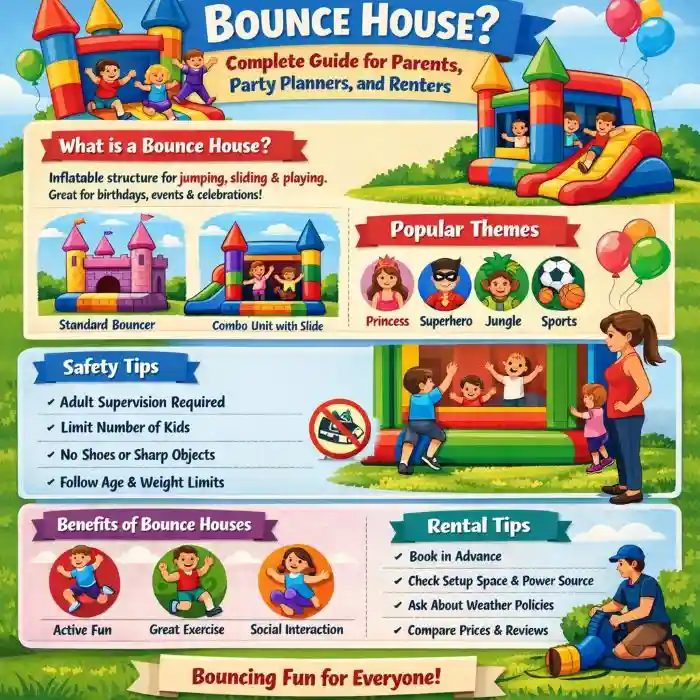
<p>If you are asking <strong>whats a bounce house</strong>, the simplest answer is this: it is an <strong>inflatable, air-supported play structure</strong> designed for jumping, bouncing, and active fun. A motorized blower fills the structure with air and keeps it firm while people use it. As long as the blower runs and the unit stays properly anchored, the bounce <a href="https://comeawayhome.co.uk/appomattox-court-house/">house</a> keeps its shape.</p>
<h3 id="alternate-names-and-common-uses">Alternate names and common uses</h3>
<p>A bounce house goes by many names. Depending on where you live or what company you talk to, you may hear:</p>
<ul>
<li><strong>Bouncy house</strong></li>
<li><strong>Bouncy castle</strong></li>
<li><strong>Jump house</strong></li>
<li><strong>Inflatable jump house</strong></li>
<li><strong>Moon bounce</strong></li>
<li><strong>Inflatable castle</strong></li>
</ul>
<p>These names usually describe the same basic idea, though the shape or design may differ slightly. Some look like castles, some look like simple squares, and others include slides, obstacle areas, or basketball hoops.</p>
<p>Bounce houses are popular because they fit so many kinds of events. You will often see them at backyard birthday parties, school carnivals, daycare celebrations, sports banquets, family reunions, and community fundraisers. They also show up at brand events and large public gatherings because they attract attention and keep children entertained.</p>
<h3 id="materials-and-construction">Materials and construction</h3>
<p>Most bounce houses are made from strong synthetic materials such as <strong>PVC vinyl</strong>, <strong>commercial vinyl</strong>, or <strong>reinforced nylon</strong>. Commercial units usually use heavier material because they handle more traffic and more frequent setup. Backyard models are often lighter and easier to store, but they may not hold up as well under repeated use.</p>
<p>A typical unit includes:</p>
<ul>
<li>An inflatable jumping area</li>
<li>Reinforced seams</li>
<li>Mesh sides or netting for visibility and airflow</li>
<li>Anchor points for stakes or sandbags</li>
<li>An entrance and exit area</li>
<li>A blower tube that connects to the air motor</li>
</ul>
<h3 id="a-quick-history">A quick history</h3>
<p>The basic idea of inflatable play equipment has been around for decades. It grew in popularity as party rental businesses expanded and more families wanted simple backyard entertainment. Over time, designs became safer, more colorful, and more specialized. Today, bounce houses are a party staple because they offer movement, excitement, and a clear activity center for children.</p>
<p>So, when someone asks <strong>whats a bounce house</strong>, the real answer is more than “a thing kids jump in.” It is a portable inflatable attraction built for fun, structured play, and event energy.</p>
<h2 id="how-a-bounce-house-works">How a bounce house works</h2>
<p>A bounce house looks simple from the outside, but its design is clever. It works by using a <strong>continuous flow of air</strong> to stay inflated. In most models, a blower pushes air into the unit the entire time it is in use. That steady airflow keeps the walls upright and the floor springy enough for jumping.</p>
<h3 id="continuous-blower-systems">Continuous blower systems</h3>
<p>Most modern bounce houses do not trap air inside like a sealed balloon. Instead, they use a blower that runs nonstop during use. Small amounts of air naturally escape through seams and fabric pores, so the blower keeps replacing that air. This is normal. It is also why the unit softens quickly if the blower stops.</p>
<p>That blower is a key part of the setup. Without it, the bounce house cannot stand or function properly. When people ask <strong>whats a bounce house</strong> and how it works, the blower is one of the most important parts of the answer.</p>
<h3 id="anchoring-and-power-needs">Anchoring and power needs</h3>
<p>A bounce house must stay in place while people jump inside it. That is why installers use <strong>ground stakes</strong> on grass or <strong>sandbags and weighted anchors</strong> on hard surfaces. Anchoring is not optional. It protects the unit from shifting, tipping, or lifting in gusty conditions.</p>
<p>Most bounce houses also need access to a <strong>standard electrical outlet</strong>. The blower plugs into power, and some setups may need a heavy-duty extension cord. If your event is in a park or open field, a generator may be required instead.</p>
<h3 id="space-setup-time-and-weather">Space, setup time, and weather</h3>
<p>A typical setup takes about <strong>15 to 30 minutes</strong>, depending on the unit size, location, and access. The area must be flat, clear, and large enough not only for the bounce house itself but also for safety space around it.</p>
<p>Weather matters too. Rain can create slippery surfaces, and wind can become dangerous fast. Many operators stop use when winds become too strong, often around <strong>15 to 20 mph</strong>, though the final rule should always follow the manufacturer and local safety standards.</p>
<h2 id="types-and-styles-of-bounce-houses">Types and styles of bounce houses</h2>
<p>Not all bounce houses are the same. Some are simple and compact. Others are large, themed, and packed with extra features. If you want the best match for your event, it helps to understand the main categories.</p>
<h3 id="standard-themed-combo-and-water-units">Standard, themed, combo, and water units</h3>
<p>The most basic model is the <strong>standard rectangular or square bounce house</strong>. It is usually designed for jumping only. This style works well for smaller birthdays, short events, and families who want a simple, affordable option.</p>
<p>Then you have <strong>themed bounce houses</strong>. These often feature castles, princess colors, superhero graphics, cartoon-style designs, or sports themes. They offer the same basic function but add a stronger visual impact, which can make party photos look more exciting.</p>
<p>A step up from the standard design is the <strong>combo unit</strong>. These inflatables combine a bouncing area with one or more extra attractions such as a slide, climbing wall, basketball hoop, or obstacle path. Combo units are very popular because they keep children engaged longer.</p>
<p>For summer parties, <strong>water or wet combo inflatables</strong> add splash features. These may include water slides, splash pools, or misting systems. They are fun, but they also require more attention to drainage, cleanup, and slip prevention.</p>
<h3 id="commercial-vs-consumer-models">Commercial vs. consumer models</h3>
<p>Consumer models are made for occasional home use. They are often smaller, lighter, and more affordable. Commercial-grade models are heavier, tougher, and built for rental businesses, schools, churches, and frequent events. They cost more, but they usually last longer under repeated use.</p>
<h3 id="bounce-house-types-at-a-glance">Bounce House Types at a Glance</h3>
<table>
<thead>
<tr>
<th>Type</th>
<th>Typical Size</th>
<th>Capacity</th>
<th>Best For</th>
<th>Typical Rental Price Range</th>
</tr>
</thead>
<tbody>
<tr>
<td>Standard bounce house</td>
<td>13×13 ft</td>
<td>6–8 young kids</td>
<td>Backyard birthdays, small family events</td>
<td>$150–$300</td>
</tr>
<tr>
<td>Themed bounce house</td>
<td>13×13 to 15×15 ft</td>
<td>6–8 kids</td>
<td>Character parties, themed birthdays</td>
<td>$175–$325</td>
</tr>
<tr>
<td>Combo with slide</td>
<td>15×15 to 18×18 ft</td>
<td>6–10 kids</td>
<td>Larger parties, mixed-age play</td>
<td>$250–$450</td>
</tr>
<tr>
<td>Water or wet combo</td>
<td>15×15 ft plus slide area</td>
<td>6–10 kids</td>
<td>Summer events, outdoor celebrations</td>
<td>$300–$600</td>
</tr>
<tr>
<td>Commercial castle or large inflatable</td>
<td>20×20+ ft</td>
<td>8–12 users, depending on rules</td>
<td>Schools, festivals, corporate events</td>
<td>$400–$900</td>
</tr>
</tbody>
</table>
<p>These numbers are general estimates, and pricing changes by city, season, delivery distance, and add-ons.</p>
<p>Knowing the styles helps you answer more than just <strong>whats a bounce house</strong>. It helps you decide which type of inflatable actually fits your space, budget, and guest list.</p>
<h2 id="safety-rules-inspections-and-common-hazards">Safety: rules, inspections, and common hazards</h2>
<p>Fun should never come before safety. Bounce houses are enjoyable, but they are not risk-free. Good safety starts before the first child jumps inside and continues until the unit is fully packed away.</p>
<h3 id="pre-rental-inspection-checklist">Pre-rental inspection checklist</h3>
<p>Before anyone uses a bounce house, inspect it carefully. Look at the seams, the entrance, the blower tube, the netting, and the anchor points. The unit should feel firm and stable once inflated. You should not see ripped mesh, loose stitching, or a blower that sounds unreliable.</p>
<p>Use this quick checklist before use:</p>
<ul>
<li><strong>Check the seams</strong> for tears, holes, or weak spots.</li>
<li><strong>Confirm the blower</strong> is running properly and secured.</li>
<li><strong>Inspect the anchors</strong> to make sure stakes or weights are in place.</li>
<li><strong>Look at the netting</strong> for damage or loose sections.</li>
<li><strong>Clear the area</strong> of rocks, branches, sharp objects, and overhead hazards.</li>
<li><strong>Confirm the surface</strong> is flat and suitable for installation.</li>
</ul>
<p>These simple checks can prevent many common problems.</p>
<h3 id="supervision-and-bounce-rules">Supervision and bounce rules</h3>
<p>A bounce house should always have <strong>active adult supervision</strong>. That means a responsible adult is close enough to watch behavior, manage turns, and stop unsafe play right away.</p>
<p>Children should remove shoes, glasses if needed, and any sharp items before entering. Food, drinks, toys, and rough play should stay out. Flips, wrestling, climbing on the walls, and piling on top of one another greatly increase the chance of injury.</p>
<p>Age and size grouping matters too. A small child bouncing next to a much larger child can get knocked down easily. Try to group users by similar age, height, and weight whenever possible.</p>
<h3 id="weather-cleaning-and-public-event-concerns">Weather, cleaning, and public-event concerns</h3>
<p>Weather is one of the biggest bounce house hazards. Strong wind can turn an inflatable into a serious danger if it is not properly anchored or if conditions change suddenly. Rain can make entrances slippery and create electrical concerns around the blower. If conditions look questionable, it is better to pause or cancel than take a risk.</p>
<p>Cleaning also matters. A good rental company should sanitize the unit between uses, especially if the inflatable was used with water. Moisture left inside can lead to mildew, odor, and fabric damage.</p>
<p>For school events, public fairs, and corporate gatherings, insurance and permits may also come into play. Local rules differ, so ask about them in advance. A professional provider should understand what is required and should be able to explain their process clearly.</p>
<p>In short, if you are searching for <strong>whats a bounce house safety</strong> advice, the best answer is simple: inspect it, anchor it, supervise it, and respect the weather.</p>
<h2 id="renting-vs-buying-costs-and-considerations">Renting vs. buying: costs and considerations</h2>
<p>For many people, the next question after <strong>whats a bounce house</strong> is this: should I rent one or buy one? The answer depends on how often you plan to use it, how much storage space you have, and how much work you want to handle yourself.</p>
<h3 id="rental-pricing-explained">Rental pricing explained</h3>
<p>Renting makes sense for one-time or occasional events. It gives you access to different styles without the responsibility of maintenance or storage. In many areas, a standard bounce house rental may cost around <strong>$150 to $300</strong> for a typical event. Combo units often range from <strong>$250 to $450</strong>, while larger commercial or water inflatables can run <strong>$300 to $900 or more</strong>.</p>
<p>Several things affect rental cost:</p>
<ul>
<li>Size of the inflatable</li>
<li>Length of rental time</li>
<li>Delivery distance</li>
<li>Setup and teardown service</li>
<li>Water features</li>
<li>Holiday or peak-season demand</li>
<li>Generator or extra equipment needs</li>
</ul>
<p>Half-day packages are common, but some companies offer full-day or weekend pricing.</p>
<h3 id="buying-costs-and-long-term-value">Buying costs and long-term value</h3>
<p>Buying a bounce house can be a smart move if you host frequent events, run a party business, or manage a school, church, or community center. A small consumer model may start around a few hundred dollars. A stronger mid-range inflatable often costs more, and a true commercial-grade unit can cost several thousand dollars or more.</p>
<p>Buying gives you full control, but it also creates responsibility. You need space to store the unit, a safe place to dry it after use, repair supplies for minor damage, and a plan for blower maintenance.</p>
<h3 id="pros-and-cons-to-think-through">Pros and cons to think through</h3>
<p>Renting is easier. Buying can be cheaper over time if you use the unit often. Renting offers more variety. Buying gives you availability whenever you want it. Renting usually includes delivery and setup. Buying means you or your staff must handle every step yourself.</p>
<p>Before choosing a rental company, ask about cleanliness, insurance, setup service, cancellation rules, and how they handle weather delays. A good company will answer clearly and confidently.</p>
<h2 id="how-to-choose-the-right-bounce-house">How to choose the right bounce house</h2>
<p>Choosing the right bounce house is easier when you focus on the practical details first. The best-looking inflatable is not always the best choice for your event.</p>
<h3 id="a-simple-checklist-for-buyers-and-renters">A simple checklist for buyers and renters</h3>
<p>Use this checklist before you book or buy:</p>
<ul>
<li><strong>Match the size to your space.</strong> Measure your yard or venue carefully. Leave room around the unit for safe entry, exits, and supervision.</li>
<li><strong>Match the capacity to your guest list.</strong> A small bounce house can feel crowded fast if too many children arrive at once.</li>
<li><strong>Choose an age-appropriate design.</strong> Toddlers, younger kids, and older children often need different sizes and play styles.</li>
<li><strong>Think about the event theme.</strong> A princess castle, superhero design, or colorful combo may fit your party better than a plain model.</li>
<li><strong>Check the material quality.</strong> If you plan frequent use, stronger commercial-grade material is often worth the extra cost.</li>
<li><strong>Ask about the blower and setup needs.</strong> Confirm power requirements, extension cord needs, and whether one or two blowers are required.</li>
<li><strong>Review warranty or service support.</strong> If you are buying, check for repair kits, replacement parts, and blower availability.</li>
<li><strong>Ask about setup, teardown, and cancellation policies.</strong> If you are renting, know exactly what is included.</li>
</ul>
<p>When you answer <strong>whats a bounce house</strong> in a practical sense, this is part of the answer too: it is an event tool, and like any tool, it only works well if you choose the right one for the job.</p>
<h2 id="setup-teardown-and-maintenance-tips">Setup, teardown, and maintenance tips</h2>
<p>A bounce house may look easy to handle, but proper setup and teardown protect both users and the unit itself. A few careful steps can extend the life of the inflatable and reduce safety issues.</p>
<h3 id="safe-setup-basics">Safe setup basics</h3>
<p>Start by preparing the site. Remove rocks, sticks, toys, and anything sharp. If needed, place a tarp or protective ground cover down first. Unroll the bounce house fully, position it correctly, and make sure the entrance faces a safe, open direction.</p>
<p>Next, attach the blower tube securely. Turn the blower on and allow the unit to inflate completely. Once it is upright, anchor it immediately using stakes or approved weights. Do not allow children inside until the unit is fully inflated, checked, and stable.</p>
<p>Power matters here. Use the correct extension cord length and gauge if a cord is necessary. If the outlet is far away, make sure the connection remains dry and protected. For outdoor locations, a GFCI-protected outlet is a smart choice.</p>
<h3 id="teardown-and-care-after-use">Teardown and care after use</h3>
<p>When the event ends, remove all children and loose items first. Turn off the blower, let the bounce house deflate fully, and inspect it for dirt, moisture, or damage. If the unit is wet, dry it as much as possible before folding. Storing it wet can lead to mildew, odor, and material breakdown.</p>
<p>Fold it carefully and avoid forcing bulky corners into a tight roll. Store it in a cool, dry place away from pests and standing moisture.</p>
<p>Small seam issues may be handled with a repair patch or kit, but major tears, blower failures, or electrical issues should be left to a professional. Trying to force a damaged unit back into service can make the problem worse.</p>
<p>Teardown safety matters too. Never let children play on a unit while it is deflating. It can collapse unpredictably and create a trapping risk.</p>
<h2 id="common-myths-and-misconceptions">Common myths and misconceptions</h2>
<p>There are a lot of assumptions about inflatables, and not all of them are true. Clearing up these myths can help you make safer and smarter decisions.</p>
<h3 id="quick-myth-busting-facts">Quick myth-busting facts</h3>
<ul>
<li><strong>Myth: A bounce house is basically the same as a trampoline.</strong><br />
<strong>Fact:</strong> It is not. A trampoline uses a stretched jumping surface and springs, while a bounce house uses air-filled flooring and walls. The risks, setup needs, and supervision rules are different.</li>
<li><strong>Myth: All bounce houses are equally safe.</strong><br />
<strong>Fact:</strong> Material strength, design quality, anchoring systems, maintenance, and supervision all make a big difference.</li>
<li><strong>Myth: Light rain is no big deal.</strong><br />
<strong>Fact:</strong> Even light moisture can create slippery surfaces and increase electrical concerns around the blower and cords.</li>
<li><strong>Myth: Bigger is always better.</strong><br />
<strong>Fact:</strong> A larger inflatable needs more space, better supervision, stronger planning, and often a higher budget.</li>
<li><strong>Myth: Any flat area will work.</strong><br />
<strong>Fact:</strong> The space must be flat, clear, safe, and suitable for proper anchoring.</li>
</ul>
<p>If you are still wondering <strong>whats a bounce house</strong> in real-life terms, it is not just a toy you drop anywhere. It is a large inflatable activity structure that works best when people use it with planning and common sense.</p>
<h2 id="best-practices-for-party-planners">Best practices for party planners</h2>
<p>If you are planning an event, a bounce house can be one of the easiest ways to create energy and keep children occupied. Still, the best results come from planning ahead rather than making a last-minute booking.</p>
<h3 id="booking-layout-and-event-flow">Booking, layout, and event flow</h3>
<p>Try to reserve your inflatable <strong>2 to 6 weeks in advance</strong>, especially during spring, summer, and holiday weekends. Popular units and themed combos often book fast.</p>
<p>Think carefully about layout. The bounce house should sit in a visible area where adults can monitor it easily. Leave enough room for a line, shoes, entrances, and exits. Keep it away from food tables, grills, parking areas, and heavy foot traffic.</p>
<p>It also helps to assign one or two adults as monitors. That keeps children rotating smoothly and stops overcrowding before it starts.</p>
<h3 id="a-simple-event-timeline">A simple event timeline</h3>
<p>A clear timeline can make the whole attraction run better. Here is a simple example:</p>
<p>Arrival and site check happen first. Setup and inflation come next. Then you run a quick safety test before guests enter. During the event, the monitor manages turns and keeps the rules simple. At the end, you clear the area, stop play, and begin teardown only after all children are away from the unit.</p>
<p>Communication with the rental company matters too. Confirm the delivery window, weather policy, liability paperwork, and pickup time before the day of the event. Small details like these prevent stressful surprises.</p>
<h2 id="who-uses-bounce-houses-">Who uses bounce houses?</h2>
<p>Bounce houses appeal to more than just parents planning birthdays. They serve a wide range of users because they are flexible, portable, and easy to build around an event theme.</p>
<h3 id="common-audiences-and-use-cases">Common audiences and use cases</h3>
<p>Private families use them for birthdays, graduation parties, and backyard celebrations. Schools use them for field days, reward events, and fairs. Churches and community centers use them for festivals, outreach events, and fundraisers. Businesses may rent them for family days, seasonal celebrations, or public promotions.</p>
<p>Some organizations also look for more inclusive features. Depending on the supplier, there may be options with easier entry points, wider openings, or quieter play windows for children who need a calmer environment.</p>
<p>Seasonal demand changes too. Dry bounce houses stay popular year-round in many areas, while wet combos and water slides often peak in warm weather. That is why early booking matters in summer.</p>
<p>So, <strong>whats a bounce house</strong> used for? Almost any event that needs kid-friendly entertainment, visual excitement, and active play can benefit from one.</p>
<h2 id="faq">FAQ</h2>
<h3 id="what-s-a-bounce-house-and-how-does-it-work-">What’s a bounce house and how does it work?</h3>
<p>A bounce house is an inflatable play structure that stays filled with air through a running blower. If you are asking <strong>whats a bounce house</strong>, think of it as a soft, air-supported jumping area that uses steady airflow, secure anchors, and open play space to create safe fun.</p>
<h3 id="is-a-bounce-house-safe-for-kids-">Is a bounce house safe for kids?</h3>
<p>Yes, a bounce house can be safe for kids when adults supervise it closely, the unit is properly anchored, and clear rules are followed. Safety improves when children are grouped by similar age and size, shoes are removed, and use stops during bad weather.</p>
<h3 id="how-much-does-it-cost-to-rent-a-bounce-house-">How much does it cost to rent a bounce house?</h3>
<p>Rental prices usually range from about <strong>$150 to $300</strong> for a basic unit, while combos and larger inflatables can cost <strong>$250 to $900 or more</strong>. Final price depends on size, rental length, delivery distance, season, and extra features like slides or water use.</p>
<h3 id="can-adults-use-a-bounce-house-">Can adults use a bounce house?</h3>
<p>Some adults can use certain commercial-grade bounce houses, but not all units are designed for adult weight or movement. Always check the manufacturer’s limits and the rental company’s rules. If adult use is important, ask for a unit specifically rated for larger users.</p>
<h3 id="how-long-does-setup-take-for-a-bounce-house-">How long does setup take for a bounce house?</h3>
<p>Most bounce houses take about <strong>15 to 30 minutes</strong> to set up once the site is ready. Larger combos or difficult locations may take longer. If you are wondering <strong>whats a bounce house</strong> setup process like, it usually includes placement, inflation, anchoring, inspection, and a final safety check.</p>
<h2 id="final-thoughts">Final thoughts</h2>
<p>A bounce house is one of the simplest ways to bring movement, laughter, and excitement to an event. Once you understand the basics, choosing the right one becomes much easier. Focus on <strong>size, safety, supervision, and setup</strong>, and you will make a smarter decision for your party or program.</p>
<h2 id="call-to-action">Call to action</h2>
<p>Ready to add a bounce house to your next event? Take a few minutes to compare your space, guest list, and budget, then speak with a trusted rental provider or supplier. Ask the right safety questions, confirm the details early, and choose a unit that gives your guests fun <strong>and</strong> peace of mind.</p>
<p><a href="https://comeawayhome.co.uk/">House</a></p>
If you have ever typed whats a bounce house into a search bar, you are not alone. Parents, event planners, school organizers, and first-time renters ask this question all the time, especially when they want to add something fun, active, and memorable to an event.
A bounce house, also called a bouncy house, inflatable castle, jump house, or moon bounce, is an air-filled structure made for jumping and play. You usually see one at birthday parties, school fairs, church festivals, neighborhood block parties, and company family events. Kids love them because they turn an ordinary yard or event space into a play zone in minutes.
But there is more to a bounce house than just fun. You need to know how it works, what size to choose, how much it costs, and most importantly, how to use it safely. That matters whether you plan to rent one for a weekend party or buy one for frequent use.
In this complete guide, you will learn the basics in plain language. We will cover what a bounce house is, how it stays inflated, the main styles available, safety rules, setup tips, rental costs, and how to choose the right option for your event. By the end, you will feel much more confident about your next booking or purchase.
What is a bounce house?
If you are asking whats a bounce house, the simplest answer is this: it is an inflatable, air-supported play structure designed for jumping, bouncing, and active fun. A motorized blower fills the structure with air and keeps it firm while people use it. As long as the blower runs and the unit stays properly anchored, the bounce house keeps its shape.
Alternate names and common uses
A bounce house goes by many names. Depending on where you live or what company you talk to, you may hear:
- Bouncy house
- Bouncy castle
- Jump house
- Inflatable jump house
- Moon bounce
- Inflatable castle
These names usually describe the same basic idea, though the shape or design may differ slightly. Some look like castles, some look like simple squares, and others include slides, obstacle areas, or basketball hoops.
Bounce houses are popular because they fit so many kinds of events. You will often see them at backyard birthday parties, school carnivals, daycare celebrations, sports banquets, family reunions, and community fundraisers. They also show up at brand events and large public gatherings because they attract attention and keep children entertained.
Materials and construction
Most bounce houses are made from strong synthetic materials such as PVC vinyl, commercial vinyl, or reinforced nylon. Commercial units usually use heavier material because they handle more traffic and more frequent setup. Backyard models are often lighter and easier to store, but they may not hold up as well under repeated use.
A typical unit includes:
- An inflatable jumping area
- Reinforced seams
- Mesh sides or netting for visibility and airflow
- Anchor points for stakes or sandbags
- An entrance and exit area
- A blower tube that connects to the air motor
A quick history
The basic idea of inflatable play equipment has been around for decades. It grew in popularity as party rental businesses expanded and more families wanted simple backyard entertainment. Over time, designs became safer, more colorful, and more specialized. Today, bounce houses are a party staple because they offer movement, excitement, and a clear activity center for children.
So, when someone asks whats a bounce house, the real answer is more than “a thing kids jump in.” It is a portable inflatable attraction built for fun, structured play, and event energy.
How a bounce house works
A bounce house looks simple from the outside, but its design is clever. It works by using a continuous flow of air to stay inflated. In most models, a blower pushes air into the unit the entire time it is in use. That steady airflow keeps the walls upright and the floor springy enough for jumping.
Continuous blower systems
Most modern bounce houses do not trap air inside like a sealed balloon. Instead, they use a blower that runs nonstop during use. Small amounts of air naturally escape through seams and fabric pores, so the blower keeps replacing that air. This is normal. It is also why the unit softens quickly if the blower stops.
That blower is a key part of the setup. Without it, the bounce house cannot stand or function properly. When people ask whats a bounce house and how it works, the blower is one of the most important parts of the answer.
Anchoring and power needs
A bounce house must stay in place while people jump inside it. That is why installers use ground stakes on grass or sandbags and weighted anchors on hard surfaces. Anchoring is not optional. It protects the unit from shifting, tipping, or lifting in gusty conditions.
Most bounce houses also need access to a standard electrical outlet. The blower plugs into power, and some setups may need a heavy-duty extension cord. If your event is in a park or open field, a generator may be required instead.
Space, setup time, and weather
A typical setup takes about 15 to 30 minutes, depending on the unit size, location, and access. The area must be flat, clear, and large enough not only for the bounce house itself but also for safety space around it.
Weather matters too. Rain can create slippery surfaces, and wind can become dangerous fast. Many operators stop use when winds become too strong, often around 15 to 20 mph, though the final rule should always follow the manufacturer and local safety standards.
Types and styles of bounce houses
Not all bounce houses are the same. Some are simple and compact. Others are large, themed, and packed with extra features. If you want the best match for your event, it helps to understand the main categories.
Standard, themed, combo, and water units
The most basic model is the standard rectangular or square bounce house. It is usually designed for jumping only. This style works well for smaller birthdays, short events, and families who want a simple, affordable option.
Then you have themed bounce houses. These often feature castles, princess colors, superhero graphics, cartoon-style designs, or sports themes. They offer the same basic function but add a stronger visual impact, which can make party photos look more exciting.
A step up from the standard design is the combo unit. These inflatables combine a bouncing area with one or more extra attractions such as a slide, climbing wall, basketball hoop, or obstacle path. Combo units are very popular because they keep children engaged longer.
For summer parties, water or wet combo inflatables add splash features. These may include water slides, splash pools, or misting systems. They are fun, but they also require more attention to drainage, cleanup, and slip prevention.
Commercial vs. consumer models
Consumer models are made for occasional home use. They are often smaller, lighter, and more affordable. Commercial-grade models are heavier, tougher, and built for rental businesses, schools, churches, and frequent events. They cost more, but they usually last longer under repeated use.
Bounce House Types at a Glance
| Type |
Typical Size |
Capacity |
Best For |
Typical Rental Price Range |
| Standard bounce house |
13×13 ft |
6–8 young kids |
Backyard birthdays, small family events |
$150–$300 |
| Themed bounce house |
13×13 to 15×15 ft |
6–8 kids |
Character parties, themed birthdays |
$175–$325 |
| Combo with slide |
15×15 to 18×18 ft |
6–10 kids |
Larger parties, mixed-age play |
$250–$450 |
| Water or wet combo |
15×15 ft plus slide area |
6–10 kids |
Summer events, outdoor celebrations |
$300–$600 |
| Commercial castle or large inflatable |
20×20+ ft |
8–12 users, depending on rules |
Schools, festivals, corporate events |
$400–$900 |
These numbers are general estimates, and pricing changes by city, season, delivery distance, and add-ons.
Knowing the styles helps you answer more than just whats a bounce house. It helps you decide which type of inflatable actually fits your space, budget, and guest list.
Safety: rules, inspections, and common hazards
Fun should never come before safety. Bounce houses are enjoyable, but they are not risk-free. Good safety starts before the first child jumps inside and continues until the unit is fully packed away.
Pre-rental inspection checklist
Before anyone uses a bounce house, inspect it carefully. Look at the seams, the entrance, the blower tube, the netting, and the anchor points. The unit should feel firm and stable once inflated. You should not see ripped mesh, loose stitching, or a blower that sounds unreliable.
Use this quick checklist before use:
- Check the seams for tears, holes, or weak spots.
- Confirm the blower is running properly and secured.
- Inspect the anchors to make sure stakes or weights are in place.
- Look at the netting for damage or loose sections.
- Clear the area of rocks, branches, sharp objects, and overhead hazards.
- Confirm the surface is flat and suitable for installation.
These simple checks can prevent many common problems.
Supervision and bounce rules
A bounce house should always have active adult supervision. That means a responsible adult is close enough to watch behavior, manage turns, and stop unsafe play right away.
Children should remove shoes, glasses if needed, and any sharp items before entering. Food, drinks, toys, and rough play should stay out. Flips, wrestling, climbing on the walls, and piling on top of one another greatly increase the chance of injury.
Age and size grouping matters too. A small child bouncing next to a much larger child can get knocked down easily. Try to group users by similar age, height, and weight whenever possible.
Weather, cleaning, and public-event concerns
Weather is one of the biggest bounce house hazards. Strong wind can turn an inflatable into a serious danger if it is not properly anchored or if conditions change suddenly. Rain can make entrances slippery and create electrical concerns around the blower. If conditions look questionable, it is better to pause or cancel than take a risk.
Cleaning also matters. A good rental company should sanitize the unit between uses, especially if the inflatable was used with water. Moisture left inside can lead to mildew, odor, and fabric damage.
For school events, public fairs, and corporate gatherings, insurance and permits may also come into play. Local rules differ, so ask about them in advance. A professional provider should understand what is required and should be able to explain their process clearly.
In short, if you are searching for whats a bounce house safety advice, the best answer is simple: inspect it, anchor it, supervise it, and respect the weather.
Renting vs. buying: costs and considerations
For many people, the next question after whats a bounce house is this: should I rent one or buy one? The answer depends on how often you plan to use it, how much storage space you have, and how much work you want to handle yourself.
Rental pricing explained
Renting makes sense for one-time or occasional events. It gives you access to different styles without the responsibility of maintenance or storage. In many areas, a standard bounce house rental may cost around $150 to $300 for a typical event. Combo units often range from $250 to $450, while larger commercial or water inflatables can run $300 to $900 or more.
Several things affect rental cost:
- Size of the inflatable
- Length of rental time
- Delivery distance
- Setup and teardown service
- Water features
- Holiday or peak-season demand
- Generator or extra equipment needs
Half-day packages are common, but some companies offer full-day or weekend pricing.
Buying costs and long-term value
Buying a bounce house can be a smart move if you host frequent events, run a party business, or manage a school, church, or community center. A small consumer model may start around a few hundred dollars. A stronger mid-range inflatable often costs more, and a true commercial-grade unit can cost several thousand dollars or more.
Buying gives you full control, but it also creates responsibility. You need space to store the unit, a safe place to dry it after use, repair supplies for minor damage, and a plan for blower maintenance.
Pros and cons to think through
Renting is easier. Buying can be cheaper over time if you use the unit often. Renting offers more variety. Buying gives you availability whenever you want it. Renting usually includes delivery and setup. Buying means you or your staff must handle every step yourself.
Before choosing a rental company, ask about cleanliness, insurance, setup service, cancellation rules, and how they handle weather delays. A good company will answer clearly and confidently.
How to choose the right bounce house
Choosing the right bounce house is easier when you focus on the practical details first. The best-looking inflatable is not always the best choice for your event.
A simple checklist for buyers and renters
Use this checklist before you book or buy:
- Match the size to your space. Measure your yard or venue carefully. Leave room around the unit for safe entry, exits, and supervision.
- Match the capacity to your guest list. A small bounce house can feel crowded fast if too many children arrive at once.
- Choose an age-appropriate design. Toddlers, younger kids, and older children often need different sizes and play styles.
- Think about the event theme. A princess castle, superhero design, or colorful combo may fit your party better than a plain model.
- Check the material quality. If you plan frequent use, stronger commercial-grade material is often worth the extra cost.
- Ask about the blower and setup needs. Confirm power requirements, extension cord needs, and whether one or two blowers are required.
- Review warranty or service support. If you are buying, check for repair kits, replacement parts, and blower availability.
- Ask about setup, teardown, and cancellation policies. If you are renting, know exactly what is included.
When you answer whats a bounce house in a practical sense, this is part of the answer too: it is an event tool, and like any tool, it only works well if you choose the right one for the job.
Setup, teardown, and maintenance tips
A bounce house may look easy to handle, but proper setup and teardown protect both users and the unit itself. A few careful steps can extend the life of the inflatable and reduce safety issues.
Safe setup basics
Start by preparing the site. Remove rocks, sticks, toys, and anything sharp. If needed, place a tarp or protective ground cover down first. Unroll the bounce house fully, position it correctly, and make sure the entrance faces a safe, open direction.
Next, attach the blower tube securely. Turn the blower on and allow the unit to inflate completely. Once it is upright, anchor it immediately using stakes or approved weights. Do not allow children inside until the unit is fully inflated, checked, and stable.
Power matters here. Use the correct extension cord length and gauge if a cord is necessary. If the outlet is far away, make sure the connection remains dry and protected. For outdoor locations, a GFCI-protected outlet is a smart choice.
Teardown and care after use
When the event ends, remove all children and loose items first. Turn off the blower, let the bounce house deflate fully, and inspect it for dirt, moisture, or damage. If the unit is wet, dry it as much as possible before folding. Storing it wet can lead to mildew, odor, and material breakdown.
Fold it carefully and avoid forcing bulky corners into a tight roll. Store it in a cool, dry place away from pests and standing moisture.
Small seam issues may be handled with a repair patch or kit, but major tears, blower failures, or electrical issues should be left to a professional. Trying to force a damaged unit back into service can make the problem worse.
Teardown safety matters too. Never let children play on a unit while it is deflating. It can collapse unpredictably and create a trapping risk.
Common myths and misconceptions
There are a lot of assumptions about inflatables, and not all of them are true. Clearing up these myths can help you make safer and smarter decisions.
Quick myth-busting facts
- Myth: A bounce house is basically the same as a trampoline.
Fact: It is not. A trampoline uses a stretched jumping surface and springs, while a bounce house uses air-filled flooring and walls. The risks, setup needs, and supervision rules are different.
- Myth: All bounce houses are equally safe.
Fact: Material strength, design quality, anchoring systems, maintenance, and supervision all make a big difference.
- Myth: Light rain is no big deal.
Fact: Even light moisture can create slippery surfaces and increase electrical concerns around the blower and cords.
- Myth: Bigger is always better.
Fact: A larger inflatable needs more space, better supervision, stronger planning, and often a higher budget.
- Myth: Any flat area will work.
Fact: The space must be flat, clear, safe, and suitable for proper anchoring.
If you are still wondering whats a bounce house in real-life terms, it is not just a toy you drop anywhere. It is a large inflatable activity structure that works best when people use it with planning and common sense.
Best practices for party planners
If you are planning an event, a bounce house can be one of the easiest ways to create energy and keep children occupied. Still, the best results come from planning ahead rather than making a last-minute booking.
Booking, layout, and event flow
Try to reserve your inflatable 2 to 6 weeks in advance, especially during spring, summer, and holiday weekends. Popular units and themed combos often book fast.
Think carefully about layout. The bounce house should sit in a visible area where adults can monitor it easily. Leave enough room for a line, shoes, entrances, and exits. Keep it away from food tables, grills, parking areas, and heavy foot traffic.
It also helps to assign one or two adults as monitors. That keeps children rotating smoothly and stops overcrowding before it starts.
A simple event timeline
A clear timeline can make the whole attraction run better. Here is a simple example:
Arrival and site check happen first. Setup and inflation come next. Then you run a quick safety test before guests enter. During the event, the monitor manages turns and keeps the rules simple. At the end, you clear the area, stop play, and begin teardown only after all children are away from the unit.
Communication with the rental company matters too. Confirm the delivery window, weather policy, liability paperwork, and pickup time before the day of the event. Small details like these prevent stressful surprises.
Who uses bounce houses?
Bounce houses appeal to more than just parents planning birthdays. They serve a wide range of users because they are flexible, portable, and easy to build around an event theme.
Common audiences and use cases
Private families use them for birthdays, graduation parties, and backyard celebrations. Schools use them for field days, reward events, and fairs. Churches and community centers use them for festivals, outreach events, and fundraisers. Businesses may rent them for family days, seasonal celebrations, or public promotions.
Some organizations also look for more inclusive features. Depending on the supplier, there may be options with easier entry points, wider openings, or quieter play windows for children who need a calmer environment.
Seasonal demand changes too. Dry bounce houses stay popular year-round in many areas, while wet combos and water slides often peak in warm weather. That is why early booking matters in summer.
So, whats a bounce house used for? Almost any event that needs kid-friendly entertainment, visual excitement, and active play can benefit from one.
FAQ
What’s a bounce house and how does it work?
A bounce house is an inflatable play structure that stays filled with air through a running blower. If you are asking whats a bounce house, think of it as a soft, air-supported jumping area that uses steady airflow, secure anchors, and open play space to create safe fun.
Is a bounce house safe for kids?
Yes, a bounce house can be safe for kids when adults supervise it closely, the unit is properly anchored, and clear rules are followed. Safety improves when children are grouped by similar age and size, shoes are removed, and use stops during bad weather.
How much does it cost to rent a bounce house?
Rental prices usually range from about $150 to $300 for a basic unit, while combos and larger inflatables can cost $250 to $900 or more. Final price depends on size, rental length, delivery distance, season, and extra features like slides or water use.
Can adults use a bounce house?
Some adults can use certain commercial-grade bounce houses, but not all units are designed for adult weight or movement. Always check the manufacturer’s limits and the rental company’s rules. If adult use is important, ask for a unit specifically rated for larger users.
How long does setup take for a bounce house?
Most bounce houses take about 15 to 30 minutes to set up once the site is ready. Larger combos or difficult locations may take longer. If you are wondering whats a bounce house setup process like, it usually includes placement, inflation, anchoring, inspection, and a final safety check.
Final thoughts
A bounce house is one of the simplest ways to bring movement, laughter, and excitement to an event. Once you understand the basics, choosing the right one becomes much easier. Focus on size, safety, supervision, and setup, and you will make a smarter decision for your party or program.
Call to action
Ready to add a bounce house to your next event? Take a few minutes to compare your space, guest list, and budget, then speak with a trusted rental provider or supplier. Ask the right safety questions, confirm the details early, and choose a unit that gives your guests fun and peace of mind.
House