
If you have ever searched “what is a guesthouse”, you are not alone. Many travelers see the word while booking a trip and wonder how it compares to a hotel, a bed and breakfast, or even a hostel. The term sounds simple, but it can mean slightly different things depending on the country, the property, and the style of stay.
In the most basic sense, a guesthouse is a small lodging property that offers rooms for short-term stays. It is usually smaller, quieter, and more personal than a hotel. Some guesthouses operate in private homes. Others work from converted villas, townhouses, or small standalone buildings. Some are very basic and budget-friendly, while others feel stylish and almost luxurious.
People often search for what is a guesthouse because they want better value, a more relaxed atmosphere, or a stay that feels less corporate than a hotel. A guesthouse can offer comfort, privacy, and local charm without the higher price tag that often comes with larger accommodations.
In this guide, you will learn the full guesthouse meaning, how guesthouse accommodation works, the main features, the different types of guesthouse properties, and how a guesthouse compares with a hotel, bed and breakfast, and hostel. You will also see the benefits for travelers, what property owners gain from running one, and what to check before you book.
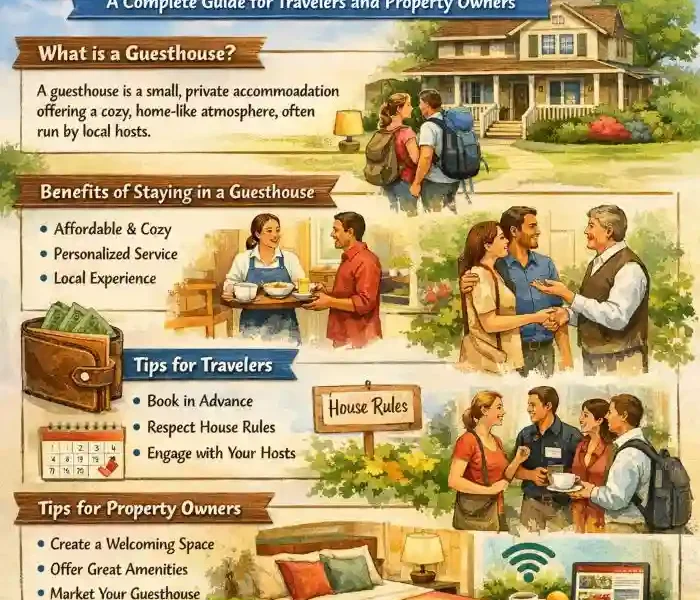
What Is a Guesthouse?
A simple definition
A guesthouse is a small accommodation business that offers rooms or units to paying guests. Most guesthouses are designed for short stays, although some also welcome weekly or monthly guests.
The key idea is simple: a guesthouse gives you a place to stay that often feels more personal, more homelike, and more intimate than a standard hotel.
Why guesthouses are different from big hotels
When you picture a hotel, you might imagine a large building, a front desk open all day, dozens or hundreds of rooms, and a fairly standard experience. A guesthouse is usually much smaller.
That smaller size changes everything.
It often means the host knows the guests by name. It may mean fewer rooms, less noise, and a slower pace. It can also mean more thoughtful service, such as local travel tips, flexible check-in arrangements, or breakfast made with more personal care.
What a guesthouse can look like
A guesthouse does not always follow one exact model. In one city, it may be a restored old home with six rooms. In another place, it may be a modern property with private suites. In rural areas, it could be a countryside home with a garden and scenic views.
That is why the answer to what is a guesthouse is broad but still clear. It is a small lodging option that sits somewhere between a private home and a hotel.
Why guesthouses are popular
Guesthouses are common in many parts of the world because they meet a real need. Travelers want places that feel comfortable, affordable, and welcoming. Property owners want accommodation models that are easier to manage than full hotels.
For many people, guesthouse accommodation offers the best balance. You get more warmth and character than a chain hotel, while still having more structure and service than a typical home rental.
How a Guesthouse Works
Booking and arrival
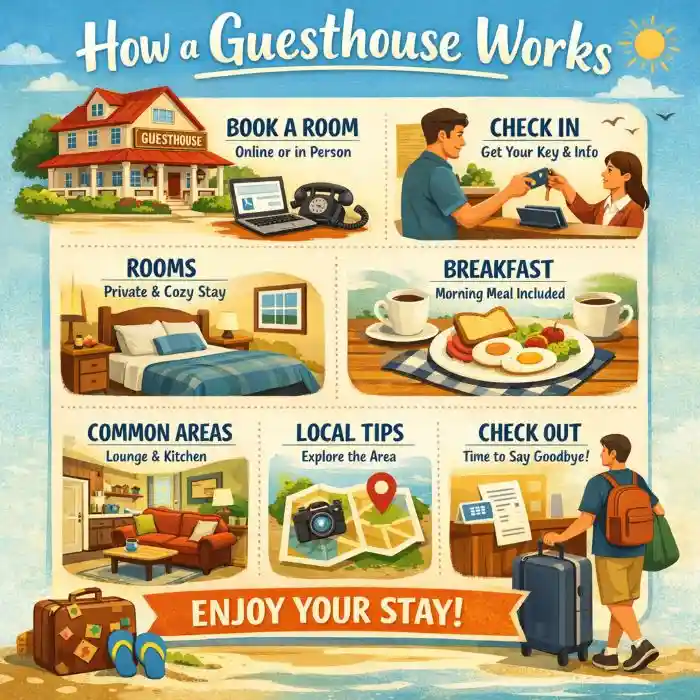
Most guesthouses allow guests to book online, by phone, or through travel booking platforms. Some are very modern in how they operate, with instant booking, online payments, and self-check-in instructions. Others are more traditional and may confirm details by message or email.
When you arrive, the check-in process is usually straightforward. In a family-run property, the owner or host may greet you personally. In a professionally managed guesthouse, there may be a reception desk, even if it is much smaller than a hotel lobby.
The stay experience
A guesthouse stay often feels more relaxed and more personal than a hotel stay. You may be shown around the property. The host may explain breakfast times, house rules, parking details, or how to use shared spaces.
Some guesthouses offer private rooms with private bathrooms. Others offer private rooms with shared bathrooms. In some properties, guests also share a lounge, dining room, garden, or kitchen.
This setup can create a more social and welcoming environment, but it depends on the property. Some guesthouses are social and chatty. Others are very quiet and private.
Services you can expect
Guesthouses usually offer the basics you need for a comfortable stay. This often includes:
- A furnished room
- Clean bedding and towels
- Wi-Fi
- Housekeeping
- Breakfast or tea and coffee
- Heating or air conditioning, depending on the area
Some properties also include laundry service, airport transfers, kitchen access, or help with tours and transport.
Family-run vs professionally managed guesthouses
Many guesthouses are family-run, which gives them a warm and personal feel. The people serving breakfast may be the same people who own the property. That can make the experience feel genuine and local.
Other guesthouses are run as polished hospitality businesses. These may have stronger systems, more formal operations, and a more hotel-like structure, but they still keep the smaller scale and more intimate atmosphere that define guesthouse accommodation.
Key Features of a Guesthouse
Small number of rooms
One of the clearest signs of a guesthouse is size. Most have far fewer rooms than a hotel. That smaller layout helps create a calm, less crowded environment.
For you as a guest, this often means less waiting, fewer strangers, and a more peaceful stay.
Personal service
Personal service is one of the biggest guesthouse benefits. In many places, the host will answer questions directly, recommend nearby restaurants, or help you understand the neighborhood.
This kind of hospitality often feels more sincere because it is less scripted than hotel service.
Home-like atmosphere
A guesthouse often feels closer to staying in a home than in a commercial building. The furniture may be more unique. The decoration may reflect local style. Common areas might feel warm and lived-in rather than polished and corporate.
That home-like atmosphere matters. It helps many travelers feel relaxed, especially during longer stays.
Affordable pricing
A guesthouse is often a form of budget accommodation, though not always the cheapest option. Because guesthouses usually have lower overhead costs than large hotels, many can offer competitive prices.
You may not get a fitness center, conference room, or rooftop bar, but you may get a very comfortable room at a much better rate.
Shared or private bathrooms
Bathroom setup is one of the most important details to check. Some guesthouses have ensuite bathrooms in every room. Others use shared bathrooms, especially older or more budget-friendly properties.
Neither option is automatically better. It depends on your comfort level, your budget, and the kind of trip you are taking.
Basic but useful amenities
Guesthouses usually focus on what travelers actually use. That often includes Wi-Fi, bedding, breakfast, housekeeping, tea and coffee, parking, and climate control.
The amenities may be simpler than in a hotel, but they are often enough for a pleasant and practical stay.
Quiet and cozy environment
Because guesthouses are smaller, they are often quieter. That makes them a good choice if you want to sleep well, work remotely, or enjoy a more peaceful trip.
If you are tired of busy lobbies and noisy hallways, this can be a major advantage.
Local hospitality
A guesthouse often reflects the personality of its owner and its location. You may notice local food at breakfast, regional decor, or helpful advice that only a local host could give.
That is a big reason many travelers choose this type of small lodging over bigger brands.
Types of Guesthouse Properties
Traditional guesthouses
Traditional guesthouses are usually simple, comfortable, and practical. They often operate in older homes or classic local buildings.
These properties usually focus on value, cleanliness, and warmth rather than luxury. If you want a straightforward stay with character, this type can be ideal.
Family-run guesthouses
Family-run guesthouses are often loved for their charm. The owners may live on-site or nearby. They may prepare meals, greet guests in person, and take pride in making visitors feel welcome.
This type often gives you the strongest local connection. It can feel very personal in the best way.
Boutique guesthouses
Boutique guesthouses are smaller properties with a more stylish or curated design. They may have unique rooms, modern interiors, quality linens, and a polished brand identity.
These are great if you want a guesthouse feel but still care a lot about aesthetics and thoughtful details.
Rural or countryside guesthouses
These guesthouses are usually located outside busy city centers. They may sit near mountains, farms, lakes, or coastal areas. The appeal here is peace, scenery, and a slower pace.
If you want to wake up to quiet surroundings and fresh air, this type is hard to beat.
Urban guesthouses
Urban guesthouses are found in towns and cities. They are often located in residential neighborhoods, historic districts, or central tourist areas.
They can be a smart choice if you want a local neighborhood feel while staying close to restaurants, attractions, and public transport.
Luxury guesthouses
Not every guesthouse is budget-focused. Some operate at a high level with elegant design, premium rooms, gourmet breakfast, and very attentive service.
These properties still keep the smaller scale of a guesthouse, but they offer a more upscale experience.
How the types differ
The main differences between the types of guesthouse properties usually come down to:
- Style
- Service level
- Price
- Location
- Amenities
A family-run countryside guesthouse will feel very different from a luxury urban boutique guesthouse, even though both fit the guesthouse category.
Guesthouse vs Hotel, Bed and Breakfast, and Hostel
Why the comparison matters
A lot of travelers do not just want the guesthouse meaning. They want to know how it compares to other choices. That is where the real booking decision happens.
To make this easier, here is a clear comparison.
| Feature | Guesthouse | Hotel | Bed and Breakfast | Hostel |
|---|---|---|---|---|
| Size | Small to medium | Medium to very large | Usually small | Small to large |
| Atmosphere | Personal and cozy | Standardized and formal | Homelike and intimate | Social and casual |
| Price | Often affordable to mid-range | Usually mid-range to luxury | Affordable to mid-range | Usually the cheapest |
| Privacy | Good, depending on room type | High, especially with private rooms | Good, often private rooms | Lower if dorm-style |
| Service style | Personal and local | Professional and standardized | Personal, breakfast-focused | Basic and self-service |
| Amenities | Basic to moderate | Wide range | Usually basic with breakfast | Basic, sometimes shared |
| Bathroom setup | Private or shared | Usually private | Private or shared | Often shared |
| Best for | Travelers wanting comfort and value | Travelers wanting consistency and full services | Travelers wanting a home-style stay | Budget travelers and backpackers |
Guesthouse vs Hotel
Size and structure
A hotel is usually larger and more structured. It may have many floors, many staff members, and a broad range of room categories.
A guesthouse is usually much smaller. Because of that, the experience feels more direct and less formal.
Pricing differences
In many destinations, a guesthouse costs less than a hotel of similar location. That is one reason people searching guesthouse vs hotel are often value-focused travelers.
Hotels usually charge more because they have higher operating costs and often provide more facilities, such as restaurants, room service, gyms, meeting rooms, or 24-hour reception.
Service style
Hotels are built around standard service systems. That can be great if you want predictability.
Guesthouses are usually more personal. The service may feel more flexible, more human, and less scripted.
Amenities and atmosphere
Hotels tend to offer more amenities overall. But a guesthouse often wins on atmosphere. It feels warmer, quieter, and less commercial.
A simple example helps here.
If you are traveling for a conference and need business services, a gym, and late-night room service, a hotel may suit you better. If you are visiting a city for a relaxed holiday and want a quiet room in a charming neighborhood, a guesthouse may be the better fit.
Guesthouse vs Bed and Breakfast
What is a bed and breakfast?
A bed and breakfast, often called a B&B, is a small lodging property that includes a sleeping room and breakfast as a key part of the experience.
It is often home-style, small-scale, and personal.
Where the overlap happens
A guesthouse and a B&B can look very similar. In fact, in some countries the terms overlap so much that they are used almost interchangeably.
Both tend to be smaller than hotels. Both can feel personal and welcoming. Both may be owner-run.
The main difference
The biggest difference is usually the emphasis. A B&B often highlights breakfast and home-style hosting as central parts of the stay.
A guesthouse may offer breakfast too, but it often has a slightly broader identity. It may have more rooms, more independence for guests, and a wider service style.
That is why the comparison bed and breakfast vs guesthouse often depends on local usage rather than strict rules.
Guesthouse vs Hostel
Privacy and comfort
A hostel is typically designed for budget travelers, especially backpackers, students, and people who want the lowest accommodation costs. Many hostels offer dormitory-style rooms with shared bathrooms.
A guesthouse usually offers more privacy, more comfort, and a calmer environment.
Social atmosphere
Hostels are often very social. That can be a huge plus if you want to meet other travelers.
Guesthouses are usually quieter. Some are friendly and social, but they are not usually built around group interaction.
Which one suits you better?
If your main goal is to save as much money as possible and meet lots of people, a hostel may be the right choice.
If you want rest, a private room, and a more peaceful environment, a guesthouse is often the better option.
Benefits of Staying in a Guesthouse
Better value for money
One of the biggest guesthouse benefits is value. You can often get a clean, comfortable, and well-located place to stay without paying hotel rates.
That matters even more on longer trips, where accommodation can become one of your biggest expenses.
Personalized hospitality
Guesthouses often shine when it comes to personal attention. Instead of being one booking among hundreds, you may feel like a welcomed visitor.
That kind of service can improve your whole trip. Good hosts make travel easier, especially when you are in a place that is new to you.
A more local experience
If you want to feel connected to the destination, guesthouses can be a great choice. They are often located in residential or character-filled areas rather than purely commercial zones.
You may get local tips, local food, and local insight that you would miss in a more standardized property.
Peace and quiet
Large hotels can be busy. Hostels can be noisy. Guesthouses are often calmer.
For solo travelers, couples, business travelers, and remote workers, that peace can make a big difference.
Good for many types of travelers
Guesthouses work well for more people than many travelers expect. They suit:
- Budget-conscious travelers
- Couples wanting a cozy stay
- Business travelers who prefer quiet
- Small families needing flexibility
- Long-stay guests wanting comfort without luxury prices
Attractive locations
Many guesthouses are in beautiful settings or charming neighborhoods. Some sit near beaches, hills, historic centers, or scenic villages. Others are in city districts that feel more authentic than major hotel zones.
That can make your stay more memorable without increasing your budget too much.
Who Should Choose a Guesthouse?
Budget-conscious travelers
If you want comfort without paying for extras you may never use, guesthouse accommodation makes a lot of sense. You can save money and still enjoy a pleasant environment.
Travelers who want a local feel
If your idea of a great trip includes neighborhood cafes, real local advice, and less touristy surroundings, a guesthouse can fit beautifully.
Business travelers who value quiet
Not every business traveler wants a large hotel. If you need a calm room, reliable Wi-Fi, and a simple routine, a good guesthouse can work very well.
Couples seeking a cozy stay
Guesthouses often feel more intimate than hotels. That makes them attractive for couples, especially for weekend breaks or scenic trips.
Families who want flexibility
Some guesthouses offer family rooms, kitchen access, laundry options, or garden space. That can be more useful for families than a standard hotel room layout.
Long-stay guests
If you are staying for a week or more, the home-like feel of a guesthouse can become a real advantage. It feels less temporary and more livable.
What Amenities Are Common in a Guesthouse?
Standard amenities you will often find
Most guesthouses provide the essentials for a comfortable stay. The exact list varies, but these are very common:
- Free Wi-Fi
- Private or shared rooms
- Breakfast service
- Heating or air conditioning
- Housekeeping
- Tea, coffee, or light refreshments
- TV or lounge area
- Parking
- Laundry service
- Kitchen access in some properties
Why amenities vary so much
Unlike hotels, guesthouses are not always highly standardized. One property may include breakfast, parking, and laundry. Another may focus only on clean rooms and Wi-Fi.
That is not a problem, but it does mean you should always read the listing carefully. Never assume all guesthouses offer the same setup.
What matters most when choosing
Think about your actual needs.
If you are staying only one night, you may care most about location, cleanliness, and private bathroom access. If you are staying longer, you may want laundry, kitchen access, and reliable internet.
The best guesthouse for you is the one that matches your travel style, not the one with the longest feature list.
Things to Check Before Booking a Guesthouse
Read reviews carefully
Reviews can tell you a lot about the real experience. Look for patterns. If several guests praise the cleanliness, helpful host, and quiet rooms, that is a strong sign.
If multiple reviews mention poor communication or misleading room details, take that seriously.
Confirm the room type
This is very important. Some guesthouses offer ensuite rooms, while others use shared bathrooms. Some have double beds, while others only offer twin beds.
Small differences can affect your comfort more than you think.
Check the location
Do not just look at the city name. Check whether the property is near the places you actually want to visit. Also think about transport, safety, food options, and walkability.
A cheaper guesthouse far from everything may not be better value in the end.
Ask what is included
Before booking, it helps to confirm:
- Whether breakfast is included
- If the bathroom is private or shared
- Whether parking is available
- What the check-in hours are
- If Wi-Fi works well in rooms
- What the cancellation policy says
Compare with similar accommodations
Do not compare a guesthouse only with hotels. Compare it with other guesthouses, B&Bs, and private stays in the same area. That gives you a more realistic sense of value.
Check safety and cleanliness
Look for recent comments about security, door locks, neighborhood conditions, and room cleanliness. These details matter more than fancy photos.
A simple, clean, safe guesthouse is often a better choice than a stylish one with poor maintenance.
Advantages of Guesthouses for Property Owners
Lower operating costs
From an owner’s perspective, a guesthouse can be more manageable than a hotel. It usually requires fewer staff, less infrastructure, and lower daily operating costs.
That makes it an appealing small business model.
Income potential
A guesthouse can create steady rental income, especially in tourist destinations, city centers, scenic areas, or places with regular business travel.
Owners can also adjust room types, pricing, and services depending on demand.
Easier small-scale management
Because a guesthouse is smaller, it is often easier to control quality, monitor cleanliness, and maintain a personal connection with guests.
That can help build strong guest satisfaction over time.
Flexibility and brand personality
Owners have room to shape the experience. They can focus on family hospitality, boutique design, long stays, wellness, rural retreats, or business-friendly comfort.
That flexibility helps a guesthouse stand out in a crowded market.
Strong loyalty through personal service
When guests feel truly welcomed, they often return. They may also leave better reviews and recommend the property to others.
In the guesthouse world, reputation is one of the most valuable business assets.
Challenges of Running a Guesthouse
Cleanliness and maintenance must stay consistent
Because guesthouses are small, every detail becomes more visible. A single issue with cleanliness, plumbing, or maintenance can affect the guest experience right away.
Owners need strong routines and high standards.
Reviews matter a lot
Guesthouses depend heavily on trust. A few poor reviews can have a bigger impact on a small property than on a large hotel brand.
That means service quality must stay consistent, even during busy periods.
Booking management takes time
Even a small property requires constant attention. Owners may need to handle inquiries, payments, scheduling, check-ins, guest questions, and special requests.
That workload can be intense, especially for family-run businesses.
Seasonal demand can create pressure
Many guesthouses face strong high and low seasons. During busy months, the challenge is capacity and service quality. During slow months, the challenge is income stability.
Privacy and hospitality must be balanced
A successful guesthouse should feel warm without feeling intrusive. Some guests love interaction. Others want space.
Good hosts learn how to read that balance well.
Regulations and licensing
Depending on the location, running a guesthouse may require permits, tax registration, safety compliance, insurance, and specific licensing rules.
Owners need to understand these obligations before starting.
Guesthouse Etiquette for Guests
Respect house rules
Every guesthouse has its own rhythm. Some have quiet hours. Some have breakfast schedules. Some limit kitchen use or visitor access.
Following the rules helps everyone enjoy the stay.
Keep noise low
Because guesthouses are smaller and often more residential, noise travels more easily. Be mindful of doors, phone calls, and late-night conversations.
Be considerate in shared spaces
If the property has a shared lounge, kitchen, or bathroom, leave it clean and usable for the next person. Small acts of consideration matter a lot in shared settings.
Communicate clearly
If you are arriving late, tell the host. If you have dietary needs or parking questions, ask ahead of time. Clear communication makes the stay smoother for both sides.
Treat hosts and staff politely
This sounds obvious, but it matters. Guesthouses often run on human connection. Courtesy creates a better experience for everyone involved.
Leave the room tidy
You do not need to deep clean the room, of course. But leaving it reasonably tidy is respectful and helpful.
Follow check-out instructions
Check-out times are important, especially in small properties where the same staff must prepare rooms quickly for incoming guests.
Is a Guesthouse Right for You?
When a guesthouse is a great fit
A guesthouse is usually a strong choice if you want affordability, comfort, personal service, and a more local feel. It works especially well for travelers who value peace, charm, and practical amenities over large-scale facilities.
If you like the idea of staying somewhere that feels less corporate and more human, this option is worth serious consideration.
When a hotel may be better
A hotel may suit you better if you need 24-hour reception, business facilities, room service, a gym, multiple dining options, or a highly standardized experience.
Hotels are also useful when you want lots of facilities in one place and do not want to think much about differences between properties.
When a hostel may be better
A hostel may be the better pick if your main goal is to spend as little as possible or meet lots of fellow travelers in a social setting.
That said, if you need privacy and quiet, a guesthouse will usually feel more comfortable.
The best choice depends on your travel style
There is no one-size-fits-all answer. The best accommodation depends on your budget, your need for privacy, your travel purpose, and the kind of experience you want.
That is why understanding what is a guesthouse is so useful. Once you know what it offers, you can compare it honestly with your other options.
Conclusion
So, what is a guesthouse?
It is a small lodging option that usually offers short-term accommodation in a more personal, cozy, and often more affordable setting than a traditional hotel. A guesthouse can be family-run or professionally managed. It can be simple or upscale. It can be in a city, by the coast, or deep in the countryside. But in most cases, the core idea stays the same: comfortable accommodation with a more intimate and welcoming feel.
For travelers, the main appeal of guesthouse accommodation comes down to value, comfort, and human connection. You often get a quieter environment, better local insight, and a stay that feels more individual. For property owners, a guesthouse can be a flexible and rewarding business model with lower operating costs than a hotel and strong potential for repeat guests.
If you are deciding where to stay next, take a moment to compare your real priorities. Think about your budget, the level of privacy you want, the amenities you actually need, and whether you prefer a personal atmosphere or a more standardized one. Once you do that, you may find that a guesthouse is not just a cheaper alternative. It may be the accommodation style that fits you best.