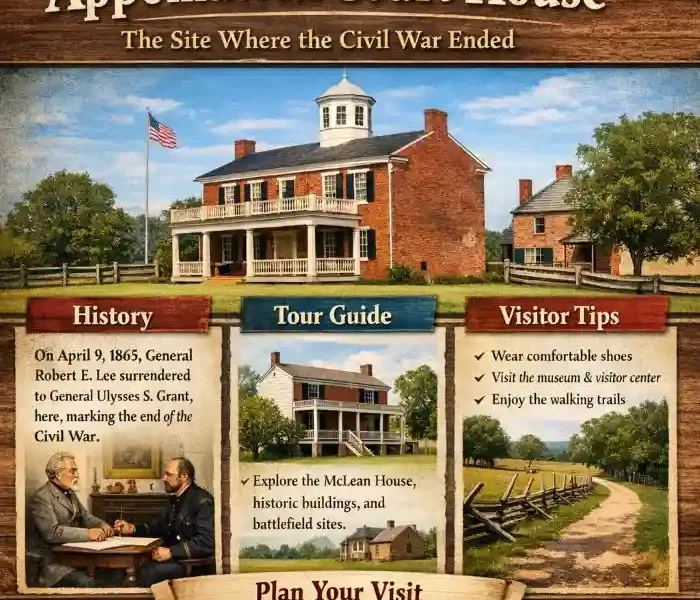
<p>On a quiet April day in 1865, in a small Virginia village with a misleadingly official-sounding name, one of the most important meetings in American history took place. Inside the home of Wilmer McLean, General Robert E. Lee met General Ulysses S. Grant and surrendered the Army of Northern Virginia. That moment at <a href="https://visitfarmville.com/appomattox-court-house-national-historical-park/"><strong>Appomattox Court House</strong></a> did not end every fight everywhere at once, but it marked the turning point that most people remember as the close of the Civil War.</p>
<p>If you have ever wanted to understand why this place matters so much, you are in the right place. This guide gives you a clear and readable look at the history, the meaning, and the visitor experience of <strong>appomattox court house</strong>. You will learn what happened here, why the village became a symbol of reunion and remembrance, and what you can see when you visit today.</p>
<p>You will also find practical travel advice, simple explanations of the major landmarks, a timeline of key events, and answers to common visitor questions. Whether you are planning a trip, writing about Civil War history, or just curious about one of the country’s most famous surrender sites, this article will help you make sense of the place in a way that feels grounded and human.</p>
<h2 id="why-appomattox-court-house-matters">Why Appomattox Court House Matters</h2>
<p><img class="aligncenter wp-image-7048 size-full" src="https://comeawayhome.co.uk/wp-content/uploads/2026/05/09c56a59-2129-442c-b45c-e425df165ff6-ezgif.com-jpg-to-webp-converter.webp" alt="appomattox court house" width="700" height="700" /></p>
<h3 id="the-surrender-that-changed-a-nation">The surrender that changed a nation</h3>
<p>The story of Appomattox Court <a href="https://comeawayhome.co.uk/how-often-do-you-need-to-paint-your-house/">House</a> is really the story of an ending. By early April 1865, the Confederacy was collapsing. Union forces had broken through the defenses around Petersburg and Richmond, and Lee’s army was retreating west, hoping to regroup and find supplies. Grant and his commanders kept pressing forward. The two armies moved across central Virginia in a desperate final campaign.</p>
<p>On <strong>April 9, 1865</strong>, Lee realized escape was no longer possible. He asked for a meeting with Grant, and the two men gathered in the home of Wilmer McLean in <strong>Appomattox Court House</strong>. The terms Grant offered were firm but generous. Confederate soldiers would lay down their arms and be paroled, allowing many of them to return home rather than face prison. Officers could keep their sidearms, and men who owned horses could often take them home for spring planting. That humane tone mattered. It set the emotional tone for the end of the war itself.</p>
<p>This surrender is often remembered as <strong>the</strong> ending of the Civil War, even though some Confederate forces surrendered later in other places. According to the <strong>National Park Service</strong>, the event at Appomattox became the defining symbol of the war’s conclusion because Lee commanded the Confederacy’s most important field army. Once that army surrendered, the broader Confederate cause was effectively finished.</p>
<h3 id="the-cultural-and-symbolic-legacy">The cultural and symbolic legacy</h3>
<p>Appomattox Court House matters not only because something important happened there, but because Americans kept returning to its meaning. For some, the village became a symbol of reunion between North and South. For others, it represented the cost of war, the end of slavery as a protected system, and the beginning of a painful Reconstruction era that the country never fully resolved.</p>
<p>That larger meaning is one reason the site still draws so many visitors. People do not come only to see old buildings. They come to stand where national history became personal. Lee and Grant were famous men, but the surrender also affected farmers, formerly enslaved people, widows, wounded veterans, and families trying to rebuild. The silence of the village today makes that easier to feel.</p>
<p>Modern interpretation has also become more honest and broader. Older versions of the story often focused almost entirely on military honor and reconciliation. Today, historians and site interpreters work harder to explain the full picture, including slavery, emancipation, memory, and the uneven realities of freedom after the war. The <strong>Virginia Department of Historic Resources</strong> has emphasized that sites like Appomattox should be understood not just as military landmarks, but as places connected to bigger questions about race, citizenship, and national identity.</p>
<blockquote><p><strong>“The war is over — the rebels are our countrymen again.”</strong><br />
This line is often linked to Grant’s mood after the surrender, and whether quoted exactly or remembered more broadly, it captures the restrained and serious tone of the moment.</p></blockquote>
<h2 id="timeline-key-events-at-appomattox-court-house">Timeline: Key Events at Appomattox Court House</h2>
<p>To understand the place clearly, it helps to see the story in sequence. Here is a simple timeline of the major moments tied to <strong>Appomattox Court House</strong>:</p>
<ul>
<li><strong>Early 1800s:</strong> The village develops as the county seat of Appomattox County, Virginia. Like many county-seat communities, it includes a courthouse, homes, taverns, stores, and legal offices.</li>
<li><strong>1840s–1850s:</strong> The settlement remains a modest village rather than a large town. The name “Court House” refers to the county-seat community, not just the courthouse building itself.</li>
<li><strong>1861:</strong> The Civil War begins. At first, Appomattox Court House is not a famous battlefield location.</li>
<li><strong>Spring 1865:</strong> The war enters its final phase in Virginia. Lee’s army retreats west after abandoning Richmond and Petersburg.</li>
<li><strong>April 8, 1865:</strong> Union cavalry and infantry move into position near Appomattox Station and Appomattox Court House, cutting off Confederate hopes of escape and resupply.</li>
<li><strong>Morning of April 9, 1865:</strong> Lee’s forces attempt a breakout but find strong Union troops blocking the way. With no realistic path forward, Lee decides to seek terms.</li>
<li><strong>Afternoon of April 9, 1865:</strong> Lee meets Grant at the <strong>McLean House</strong> in Appomattox Court House. Grant writes the surrender terms. Lee accepts them.</li>
<li><strong>April 10–11, 1865:</strong> News of the surrender spreads quickly across the country, shaping public understanding of the war’s end.</li>
<li><strong>April 12, 1865:</strong> Confederate infantry formally stack arms in a surrender ceremony nearby. This becomes one of the most remembered acts of military closure in American history.</li>
<li><strong>Later in 1865:</strong> Other Confederate forces surrender in different parts of the South, completing the military collapse of the Confederacy.</li>
<li><strong>Late 19th century:</strong> The village declines. Rail development shifts commerce away from the old courthouse community. Some buildings fall into disrepair or disappear.</li>
<li><strong>1890s:</strong> Attempts are made to move parts of the McLean House, but the effort fails. The original structure deteriorates badly.</li>
<li><strong>1930s–1940s:</strong> Preservation and reconstruction efforts grow. The federal government begins serious work to protect the village and interpret the site.</li>
<li><strong>20th century to present:</strong> The area becomes <strong>Appomattox Court House National Historical Park</strong>, preserving the surrender village for visitors, researchers, and students. The <strong>National Park Service</strong> continues interpretation and conservation work.</li>
</ul>
<h2 id="appomattox-court-house-then-and-now">Appomattox Court House — Then and Now</h2>
<h3 id="the-1865-village-and-what-happened-to-it">The 1865 village and what happened to it</h3>
<p>One of the first surprises for many visitors is that Appomattox Court House was not a grand courthouse complex or a major city. It was a small village. In 1865, it had the everyday features of a county-seat community: a courthouse, a jail, a few homes, stores, law offices, taverns, and open ground nearby. It was practical, not glamorous.</p>
<p>That ordinary setting is part of what makes the surrender so striking. One of the biggest moments in U.S. history happened in a place that looked, for the most part, like a quiet rural crossroads. The best-known building became the <strong>Wilmer McLean House</strong>, not because it was a government headquarters, but because it happened to be available and suitable for the meeting between Lee and Grant.</p>
<p>After the war, the village did not become a thriving memorial town overnight. In fact, it slowly declined. Rail traffic and local business shifted toward what became the nearby town of Appomattox Station, later just Appomattox. The old courthouse village lost energy and population. Some buildings were altered. Others disappeared. The McLean House itself suffered especially badly, eventually falling into ruin after a failed attempt to dismantle and relocate it.</p>
<p>So when you walk the site today, you are not seeing a village that simply survived untouched from 1865 to the present. You are seeing a place that had to be recovered, interpreted, and in some cases rebuilt.</p>
<h3 id="reconstruction-preservation-and-the-national-historical-park">Reconstruction, preservation, and the National Historical Park</h3>
<p>The story of preservation at Appomattox Court House is almost as interesting as the surrender itself. By the early 20th century, Americans increasingly recognized that this village marked a national turning point. Preservationists, historians, veterans’ groups, and government officials began pushing for stronger protection of the site.</p>
<p>The problem was that the landscape had changed. Some original structures remained, but others had vanished or had been heavily altered. That meant restoration would involve difficult choices. Should the site preserve the ruins exactly as they were found? Should it rebuild lost structures to help visitors picture 1865? How much reconstruction was too much? These questions shaped the park in lasting ways.</p>
<p>The federal government eventually established the protected historic site, and over time it became <strong>Appomattox Court House National Historical Park</strong>. According to the <strong>National Park Service</strong>, the park’s goal is not just to preserve buildings, but to preserve the historic landscape and village setting that help explain the surrender story. That is why roads, fences, fields, and sightlines matter almost as much as the structures themselves.</p>
<p>The reconstructed <strong>McLean House</strong> is one of the clearest examples of this approach. The original house had deteriorated beyond practical use, so the current version was rebuilt based on photographs, measurements, historic evidence, and archaeological work. Some visitors are surprised to learn that it is a reconstruction. But the rebuilding also allows people to step into a space that closely evokes the place where the surrender terms were written.</p>
<h3 id="what-visitors-see-today">What visitors see today</h3>
<p>Today, visitors see a carefully interpreted village landscape that blends original buildings, reconstructed structures, exhibits, open grounds, and walking routes. The courthouse area helps anchor the geography of the village. The McLean House stands as the emotional center of the site. Trails and interpretive signs help visitors imagine troop movements, civilian life, and the tension of the final campaign.</p>
<p>You will also find museum exhibits and orientation materials that explain the surrender, the village, and the wider end of the Civil War. The result is not a theme park version of history. At its best, the site feels calm, spacious, and reflective. It invites you to slow down and think about how large events unfold in small places.</p>
<h4 id="then-vs-now-at-appomattox-court-house">Then vs. Now at Appomattox Court House</h4>
<table>
<thead>
<tr>
<th>Feature</th>
<th>In 1865</th>
<th>What Visitors See Today</th>
<th>Why It Matters</th>
</tr>
</thead>
<tbody>
<tr>
<td><strong>Courthouse village</strong></td>
<td>Active county-seat community with legal and local functions</td>
<td>Preserved and interpreted historic village landscape</td>
<td>Helps visitors understand the site as a living community, not just a surrender room</td>
</tr>
<tr>
<td><strong>McLean House</strong></td>
<td>Private residence where Lee and Grant met</td>
<td>Reconstructed house based on historic evidence</td>
<td>Gives physical shape to the most famous meeting at the site</td>
</tr>
<tr>
<td><strong>Roads and fields</strong></td>
<td>Military approach routes and civilian spaces</td>
<td>Managed historic setting with paths and viewpoints</td>
<td>Shows how geography shaped the final campaign</td>
</tr>
<tr>
<td><strong>Interpretation</strong></td>
<td>No public museum system in 1865</td>
<td>Visitor information, exhibits, ranger programs, signs</td>
<td>Makes complex Civil War history easier to follow</td>
</tr>
<tr>
<td><strong>Meaning of the site</strong></td>
<td>Immediate military and emotional aftermath</td>
<td>National memorial, educational destination, public history site</td>
<td>Connects the surrender to memory, reconciliation, and freedom</td>
</tr>
</tbody>
</table>
<h2 id="visiting-guide-practical-information">Visiting Guide: Practical Information</h2>
<h3 id="getting-there-opening-hours">Getting there & opening hours</h3>
<p>Appomattox Court House is in central Virginia, not far from the modern town of Appomattox. Many travelers reach it by car, often as part of a regional history trip that includes Lynchburg, Richmond, Charlottesville, or other Civil War sites. Driving is the easiest option because the park sits in a rural setting and public transportation choices are limited.</p>
<p>If you are planning your route, give yourself extra time to enjoy the approach. The landscape still feels open and measured, which suits the place. Nearby roads are generally straightforward, but rural driving can feel slower than expected.</p>
<p>As for hours, this is one area where you should always double-check before you go. Grounds, visitor facilities, and ranger-led programming can follow different schedules depending on the season, weather, holidays, and staffing. The safest advice is simple: <strong>assume that outdoor areas may be accessible longer than interior exhibits, and confirm current schedules before departure</strong>. That is especially wise if you are visiting early in the morning, late in the day, or during winter.</p>
<h3 id="tickets-tours-and-ranger-programs">Tickets, tours, and ranger programs</h3>
<p>One reason Appomattox Court House appeals to a wide range of travelers is that it works well for both independent visitors and people who prefer guided interpretation. You can take a self-guided walk through the village, read signs at your own pace, and spend quiet time at the key landmarks. That option is great if you like flexibility or are traveling with children.</p>
<p>Ranger-led programs can add much more depth. A good ranger talk can turn buildings and fields into a vivid narrative. You begin to understand not just what happened, but how quickly events moved and how many people were affected. Program offerings vary by day and season, so it helps to arrive with a flexible plan.</p>
<p>If there are special exhibits, anniversary events, living history presentations, or school-group programs scheduled during your visit, they can enrich the experience. Many national historical park programs are offered without a separate tour fee, but schedules and access can change. In plain terms: <strong>check the current program calendar before you go</strong>.</p>
<h3 id="accessibility-facilities-and-on-site-services">Accessibility, facilities, and on-site services</h3>
<p>For most visitors, the site is approachable and manageable, but it is still smart to plan ahead. Expect walking between major points of interest, some outdoor surfaces, and seasonal weather conditions that can change your comfort level. If anyone in your group has mobility concerns, ask about accessible routes, parking options, and entrance details before you arrive.</p>
<p>Basic visitor needs are usually covered. Parking, restrooms, and orientation support are standard things to look for. Depending on the season and staffing, there may also be printed materials, exhibits, a bookstore area, or staff available to answer questions. Since this is a reflective historic site rather than a large commercial attraction, do not expect heavy food service inside the park itself.</p>
<p>That said, the surrounding area offers lodging, meals, and fuel within a short drive. If you want to move slowly through the site, consider bringing water, wearing comfortable shoes, and planning your lunch in advance. Those small decisions make the day more enjoyable.</p>
<h3 id="best-times-to-visit-suggested-itineraries">Best times to visit & suggested itineraries</h3>
<p>Spring and fall are often the most comfortable seasons for visiting. The weather is usually easier for walking, the fields look beautiful, and the softer light works well for photography. April is especially meaningful because of the anniversary of the surrender, though it can also attract more visitors and special programming.</p>
<p>If you only have <strong>half a day</strong>, focus on the visitor orientation area, the McLean House, the courthouse area, and a short interpretive walk. That gives you the core story without rushing too much. If you have <strong>a full day</strong>, add longer walks, exhibit time, ranger programs, and quiet stops at the lesser-known buildings and views.</p>
<p>For photographers, early morning and late afternoon often create the most atmospheric light. The site’s power comes from space, stillness, and line of sight. Wide shots of the village roads and close interior details of historic rooms both work well. Just remember that indoor photography rules may vary in certain spaces, so ask if needed.</p>
<h2 id="what-to-see-top-sights-and-interpretations">What to See: Top Sights and Interpretations</h2>
<p>If you want a clear list of the highlights, start here. These are the major places most visitors remember after a trip to <strong>appomattox court house</strong>:</p>
<ul>
<li><strong>McLean House</strong><br />
This is the most famous structure at the site because Lee and Grant met here to discuss surrender terms. It matters because it turns a huge national event into a human-scale moment inside a single room.<br />
<strong>Visitor tip:</strong> Spend time not only in the surrender room but also outside the house. The exterior helps you imagine how ordinary the village looked on that extraordinary day.</li>
<li><strong>The Courthouse Area</strong><br />
The courthouse helps explain why the village carried the name “Court House.” It anchors the community setting and reminds you this was a local center of county life before it became famous.<br />
<strong>Visitor tip:</strong> Read the interpretive signs carefully here. They clear up common confusion about the place name.</li>
<li><strong>Museum Exhibits and Orientation Spaces</strong><br />
These exhibits usually provide the best background if you are new to the Appomattox campaign. They place the surrender in the wider story of April 1865 and explain what happened after the meeting.<br />
<strong>Visitor tip:</strong> Start here if possible. Even fifteen minutes of context will make the rest of your visit more meaningful.</li>
<li><strong>Historic Village Buildings</strong><br />
Homes, taverns, offices, and service buildings help visitors see the site as a lived-in village rather than a frozen ceremony ground.<br />
<strong>Visitor tip:</strong> Look for details about civilian life. They add depth to the military story.</li>
<li><strong>Battlefield Viewpoints and Open Fields</strong><br />
These areas help you understand how troop movements, roads, and geography shaped the final hours before surrender.<br />
<strong>Visitor tip:</strong> Pause in silence for a minute. The open land often explains history better than a paragraph can.</li>
<li><strong>Interpretive Trails</strong><br />
Walking trails connect the site’s buildings and landscape, making it easier to follow the sequence of events.<br />
<strong>Visitor tip:</strong> Wear comfortable shoes and allow more time than you think. You will want to stop often.</li>
<li><strong>Monuments and Memorial Markers</strong><br />
These features show how later generations chose to remember the surrender and the war’s ending.<br />
<strong>Visitor tip:</strong> Think of these not just as markers of the past, but as evidence of how memory changed over time.</li>
</ul>
<h2 id="personalities-and-anecdotes">Personalities and Anecdotes</h2>
<h3 id="wilmer-mclean-and-the-ironic-house">Wilmer McLean and the ironic house</h3>
<p>Wilmer McLean is one of the most quoted side characters in Civil War history, and for good reason. A famous line says that the war began in his front yard and ended in his front parlor. The phrase is a little simplified, but the irony is real enough to stick. McLean had once lived near the First Battle of Bull Run, one of the war’s earliest major clashes. Later, he moved to the village of Appomattox Court House, likely hoping for peace and distance from the conflict.</p>
<p>Instead, his home became the setting for the surrender meeting that made history. That twist gives the story emotional texture. It reminds us that civilians did not stand outside the war. They lived with it, moved because of it, and were pulled back into it in unexpected ways.</p>
<p>The McLean House also shows how objects and places become powerful after great events. People later treated the surrender room almost like a national shrine. Furniture associated with the meeting became prized relics. The house itself entered legend.</p>
<h3 id="lee-grant-and-the-human-side-of-surrender">Lee, Grant, and the human side of surrender</h3>
<p>Lee and Grant are often remembered as symbols, but the scene at Appomattox becomes much more powerful when you picture them as tired human beings. Lee arrived in full dress, formal and composed. Grant came mud-splashed and less polished, suffering from a headache that reportedly eased once the meeting began. Their contrast has become part of the story, but what matters most is the tone: serious, restrained, and unexpectedly calm.</p>
<p>Grant did not humiliate Lee. Lee did not stage a dramatic final refusal. The meeting was brief and businesslike. That matters because it shaped how the event entered public memory. Appomattox is not famous for a speech from a balcony or a triumphant parade. It is famous for a room, a conversation, and signed terms.</p>
<p>That human scale is one reason visitors connect with the site so strongly. You do not need to admire every historical figure equally to feel the weight of the moment. You only need to recognize that decisions made in small rooms can change millions of lives.</p>
<h2 id="preservation-controversies-and-historical-debate">Preservation, Controversies, and Historical Debate</h2>
<p>Historic sites are never just about the past. They are also about how later generations choose to tell the past. Appomattox Court House is a good example. For many years, public memory leaned heavily toward a reconciliation story: brave men on both sides, generous surrender terms, and a healed nation. There is truth in that story, but it is incomplete.</p>
<p>The Civil War was also a war about slavery, secession, and power. The surrender at Appomattox happened in a nation where nearly four million enslaved people were moving from bondage toward freedom under uncertain conditions. So modern interpretation has had to widen the lens. A fuller story asks not only how the armies ended their fight, but what kind of country emerged afterward and for whom.</p>
<p>There are also debates about reconstruction and authenticity. When a house is rebuilt, how should it be labeled? When a site restores a landscape, how much interpretation is enough? These are healthy questions. They do not weaken the site. They make it more honest.</p>
<p>If you want deeper study, start with primary documents such as the surrender terms, wartime letters, maps, and official military reports. Then move to respected scholarship and site interpretation from the <strong>National Park Service</strong>, the <strong>Virginia Department of Historic Resources</strong>, and regional historical research collections. The strongest understanding comes from comparing memory with evidence.</p>
<h2 id="nearby-attractions-and-travel-tips">Nearby Attractions and Travel Tips</h2>
<p>A visit to Appomattox Court House works especially well as part of a larger central Virginia history trip. Nearby communities and regional museums can help you connect the surrender story to the broader Civil War landscape. Depending on your route, you can combine the site with battlefield visits, heritage museums, scenic drives, and small-town stops for food and lodging.</p>
<p>If you are building a weekend itinerary, try not to overpack your schedule. Appomattox rewards slow travel. It is better to give the village time than to rush through it between too many other stops. Pairing the site with one or two complementary places usually works better than trying to see everything in a single day.</p>
<p>For practical planning, book lodging ahead during spring anniversary periods, keep your gas tank topped off in rural areas, and check weather forecasts before long walks. If you are traveling with kids, turn the visit into a story hunt: Who was Wilmer McLean? Why is the place called “Court House”? What did surrender actually mean? Those simple questions make the day more engaging.</p>
<h2 id="images-media-and-structured-data">Images, Media, and Structured Data</h2>
<p>For a strong publisher-ready post, visuals matter. Appomattox Court House is especially well suited to a mix of landscape images, building details, and interpretive photos. Aim for a featured image that captures the calm feeling of the village, then support the article with images that explain both the history and the visitor experience.</p>
<p>Recommended images include the <strong>visitor center or orientation area</strong>, the <strong>McLean House exterior</strong>, the <strong>McLean House interior</strong>, the <strong>reconstructed courthouse</strong>, <strong>interpretive signage</strong>, and a <strong>wide battlefield or village panorama</strong>. Historical photos or illustrations can also help if image rights are clear.</p>
<p>Here are a few useful alt text examples:</p>
<ul>
<li><strong>Appomattox Court House McLean House interior</strong></li>
<li><strong>Appomattox Court House reconstructed courthouse</strong></li>
<li><strong>Visitor view across Appomattox Court House historic village</strong></li>
<li><strong>Interpretive sign at Appomattox Court House National Historical Park</strong></li>
<li><strong>Battlefield panorama near Appomattox Court House</strong></li>
</ul>
<p>If you are publishing this article on a website, consider adding <strong>FAQ schema</strong> for the question section and <strong>Event schema</strong> for seasonal ranger programs or anniversary events. A short embedded ranger talk or narrated timeline can also improve engagement.</p>
<h2 id="call-to-action">Call to Action</h2>
<p>If Appomattox Court House has been on your history travel list, this is your sign to move it from “someday” to a real plan. Walk the village, stand in the surrender room, and see how much history can live in one small place.</p>
<p><strong>CTA Button Suggestion:</strong> <strong>Plan Your Visit to Appomattox Court House</strong></p>
<h2 id="frequently-asked-questions">Frequently Asked Questions</h2>
<h3 id="where-is-appomattox-court-house-located-">Where is Appomattox Court House located?</h3>
<p><strong>Appomattox Court House</strong> is located in Appomattox County, Virginia, near the modern town of Appomattox in central Virginia. The historic village is preserved as <strong>Appomattox Court House National Historical Park</strong>.</p>
<h3 id="why-is-appomattox-court-house-important-">Why is Appomattox Court House important?</h3>
<p>Appomattox Court House is important because General Robert E. Lee surrendered the Army of Northern Virginia to General Ulysses S. Grant there on <strong>April 9, 1865</strong>. That event became the most recognized symbol of the Civil War’s end and of the nation’s transition into Reconstruction.</p>
<h3 id="how-long-should-i-spend-visiting-">How long should I spend visiting?</h3>
<p>A good visit usually takes <strong>half a day to a full day</strong>. If you want the highlights only, allow around two to three hours. If you want exhibits, walks, ranger talks, and time to reflect, give yourself most of the day.</p>
<h3 id="is-the-mclean-house-original-">Is the McLean House original?</h3>
<p>The <strong>McLean House</strong> standing at the site today is a <strong>reconstruction</strong>, not the untouched original building. The original house fell into ruin after the war. The current structure was rebuilt using historical research so visitors could better understand the surrender setting.</p>
<h3 id="are-ranger-led-tours-free-">Are ranger-led tours free?</h3>
<p>Many ranger-led programs at national historical parks are often included with site access, but schedules and policies can vary. It is smart to check the current park program listing before your visit to confirm times, availability, and any seasonal changes.</p>
<h3 id="is-photography-allowed-">Is photography allowed?</h3>
<p>Photography is generally one of the joys of visiting <strong>appomattox court house</strong>, especially outdoors. That said, some interior spaces may have rules about flash, tripods, or crowd flow. If you are planning professional equipment or special shoots, check site guidance ahead of time.</p>
<h3 id="what-is-the-best-time-of-year-to-visit-">What is the best time of year to visit?</h3>
<p>Spring and fall are often the best times because the weather is more comfortable for walking and the landscape is especially attractive. April also carries strong historical meaning because it marks the anniversary of the surrender.</p>
<h3 id="why-is-it-called-court-house-if-it-is-a-village-">Why is it called “Court House” if it is a village?</h3>
<p>In Virginia, many county-seat communities were historically referred to as “Court House.” So <strong>Appomattox Court House</strong> does not mean only one building. It refers to the village that served as the county center.</p>
<h2 id="sources-further-reading">Sources & Further Reading</h2>
<p>For readers who want to go deeper, these are strong starting points for reliable information:</p>
<ol>
<li><strong>National Park Service — Appomattox Court House National Historical Park</strong></li>
<li><strong>Virginia Department of Historic Resources — Appomattox historical resources</strong></li>
<li><strong>Appomattox County historical materials and local history collections</strong></li>
<li><strong>Official Records of the War of the Rebellion</strong></li>
<li><strong>Reputable Civil War history books focused on the Appomattox Campaign</strong></li>
<li><strong>Scholarly works on Civil War memory, reconciliation, and Reconstruction</strong></li>
</ol>
<h2 id="on-page-optimization-and-formatting-checklist">On-Page Optimization and Formatting Checklist</h2>
<ul>
<li>Use <strong>appomattox court house</strong> naturally in the title, introduction, one major section heading, and selected subheadings without overusing it.</li>
<li>Keep paragraphs short, readable, and conversational for better user experience on desktop and mobile.</li>
<li>Add <strong>8–12 images</strong> with descriptive alt text, including at least two using the exact focus keyword.</li>
<li>Include <strong>FAQ schema</strong> and <strong>Event schema</strong>, plus <strong>2–3 internal links</strong> such as <strong>Civil War battlefields near Virginia</strong>, <strong>historic sites to visit in Virginia</strong>, and <strong>weekend history road trips in the South</strong>.</li>
</ul>
<p>If you want, I can also turn this into a <strong>fully polished publisher format with featured snippet blocks, image captions, and SEO title variations</strong>.</p>
<p><a href="https://comeawayhome.co.uk/">House</a></p>
On a quiet April day in 1865, in a small Virginia village with a misleadingly official-sounding name, one of the most important meetings in American history took place. Inside the home of Wilmer McLean, General Robert E. Lee met General Ulysses S. Grant and surrendered the Army of Northern Virginia. That moment at Appomattox Court House did not end every fight everywhere at once, but it marked the turning point that most people remember as the close of the Civil War.
If you have ever wanted to understand why this place matters so much, you are in the right place. This guide gives you a clear and readable look at the history, the meaning, and the visitor experience of appomattox court house. You will learn what happened here, why the village became a symbol of reunion and remembrance, and what you can see when you visit today.
You will also find practical travel advice, simple explanations of the major landmarks, a timeline of key events, and answers to common visitor questions. Whether you are planning a trip, writing about Civil War history, or just curious about one of the country’s most famous surrender sites, this article will help you make sense of the place in a way that feels grounded and human.
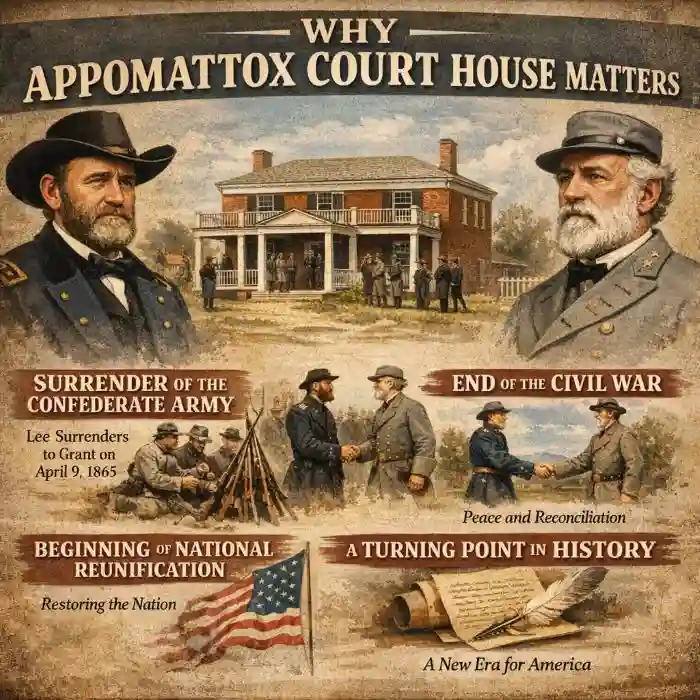
Why Appomattox Court House Matters
The surrender that changed a nation
The story of Appomattox Court House is really the story of an ending. By early April 1865, the Confederacy was collapsing. Union forces had broken through the defenses around Petersburg and Richmond, and Lee’s army was retreating west, hoping to regroup and find supplies. Grant and his commanders kept pressing forward. The two armies moved across central Virginia in a desperate final campaign.
On April 9, 1865, Lee realized escape was no longer possible. He asked for a meeting with Grant, and the two men gathered in the home of Wilmer McLean in Appomattox Court House. The terms Grant offered were firm but generous. Confederate soldiers would lay down their arms and be paroled, allowing many of them to return home rather than face prison. Officers could keep their sidearms, and men who owned horses could often take them home for spring planting. That humane tone mattered. It set the emotional tone for the end of the war itself.
This surrender is often remembered as the ending of the Civil War, even though some Confederate forces surrendered later in other places. According to the National Park Service, the event at Appomattox became the defining symbol of the war’s conclusion because Lee commanded the Confederacy’s most important field army. Once that army surrendered, the broader Confederate cause was effectively finished.
The cultural and symbolic legacy
Appomattox Court House matters not only because something important happened there, but because Americans kept returning to its meaning. For some, the village became a symbol of reunion between North and South. For others, it represented the cost of war, the end of slavery as a protected system, and the beginning of a painful Reconstruction era that the country never fully resolved.
That larger meaning is one reason the site still draws so many visitors. People do not come only to see old buildings. They come to stand where national history became personal. Lee and Grant were famous men, but the surrender also affected farmers, formerly enslaved people, widows, wounded veterans, and families trying to rebuild. The silence of the village today makes that easier to feel.
Modern interpretation has also become more honest and broader. Older versions of the story often focused almost entirely on military honor and reconciliation. Today, historians and site interpreters work harder to explain the full picture, including slavery, emancipation, memory, and the uneven realities of freedom after the war. The Virginia Department of Historic Resources has emphasized that sites like Appomattox should be understood not just as military landmarks, but as places connected to bigger questions about race, citizenship, and national identity.
“The war is over — the rebels are our countrymen again.”
This line is often linked to Grant’s mood after the surrender, and whether quoted exactly or remembered more broadly, it captures the restrained and serious tone of the moment.
Timeline: Key Events at Appomattox Court House
To understand the place clearly, it helps to see the story in sequence. Here is a simple timeline of the major moments tied to Appomattox Court House:
- Early 1800s: The village develops as the county seat of Appomattox County, Virginia. Like many county-seat communities, it includes a courthouse, homes, taverns, stores, and legal offices.
- 1840s–1850s: The settlement remains a modest village rather than a large town. The name “Court House” refers to the county-seat community, not just the courthouse building itself.
- 1861: The Civil War begins. At first, Appomattox Court House is not a famous battlefield location.
- Spring 1865: The war enters its final phase in Virginia. Lee’s army retreats west after abandoning Richmond and Petersburg.
- April 8, 1865: Union cavalry and infantry move into position near Appomattox Station and Appomattox Court House, cutting off Confederate hopes of escape and resupply.
- Morning of April 9, 1865: Lee’s forces attempt a breakout but find strong Union troops blocking the way. With no realistic path forward, Lee decides to seek terms.
- Afternoon of April 9, 1865: Lee meets Grant at the McLean House in Appomattox Court House. Grant writes the surrender terms. Lee accepts them.
- April 10–11, 1865: News of the surrender spreads quickly across the country, shaping public understanding of the war’s end.
- April 12, 1865: Confederate infantry formally stack arms in a surrender ceremony nearby. This becomes one of the most remembered acts of military closure in American history.
- Later in 1865: Other Confederate forces surrender in different parts of the South, completing the military collapse of the Confederacy.
- Late 19th century: The village declines. Rail development shifts commerce away from the old courthouse community. Some buildings fall into disrepair or disappear.
- 1890s: Attempts are made to move parts of the McLean House, but the effort fails. The original structure deteriorates badly.
- 1930s–1940s: Preservation and reconstruction efforts grow. The federal government begins serious work to protect the village and interpret the site.
- 20th century to present: The area becomes Appomattox Court House National Historical Park, preserving the surrender village for visitors, researchers, and students. The National Park Service continues interpretation and conservation work.
Appomattox Court House — Then and Now
The 1865 village and what happened to it
One of the first surprises for many visitors is that Appomattox Court House was not a grand courthouse complex or a major city. It was a small village. In 1865, it had the everyday features of a county-seat community: a courthouse, a jail, a few homes, stores, law offices, taverns, and open ground nearby. It was practical, not glamorous.
That ordinary setting is part of what makes the surrender so striking. One of the biggest moments in U.S. history happened in a place that looked, for the most part, like a quiet rural crossroads. The best-known building became the Wilmer McLean House, not because it was a government headquarters, but because it happened to be available and suitable for the meeting between Lee and Grant.
After the war, the village did not become a thriving memorial town overnight. In fact, it slowly declined. Rail traffic and local business shifted toward what became the nearby town of Appomattox Station, later just Appomattox. The old courthouse village lost energy and population. Some buildings were altered. Others disappeared. The McLean House itself suffered especially badly, eventually falling into ruin after a failed attempt to dismantle and relocate it.
So when you walk the site today, you are not seeing a village that simply survived untouched from 1865 to the present. You are seeing a place that had to be recovered, interpreted, and in some cases rebuilt.
Reconstruction, preservation, and the National Historical Park
The story of preservation at Appomattox Court House is almost as interesting as the surrender itself. By the early 20th century, Americans increasingly recognized that this village marked a national turning point. Preservationists, historians, veterans’ groups, and government officials began pushing for stronger protection of the site.
The problem was that the landscape had changed. Some original structures remained, but others had vanished or had been heavily altered. That meant restoration would involve difficult choices. Should the site preserve the ruins exactly as they were found? Should it rebuild lost structures to help visitors picture 1865? How much reconstruction was too much? These questions shaped the park in lasting ways.
The federal government eventually established the protected historic site, and over time it became Appomattox Court House National Historical Park. According to the National Park Service, the park’s goal is not just to preserve buildings, but to preserve the historic landscape and village setting that help explain the surrender story. That is why roads, fences, fields, and sightlines matter almost as much as the structures themselves.
The reconstructed McLean House is one of the clearest examples of this approach. The original house had deteriorated beyond practical use, so the current version was rebuilt based on photographs, measurements, historic evidence, and archaeological work. Some visitors are surprised to learn that it is a reconstruction. But the rebuilding also allows people to step into a space that closely evokes the place where the surrender terms were written.
What visitors see today
Today, visitors see a carefully interpreted village landscape that blends original buildings, reconstructed structures, exhibits, open grounds, and walking routes. The courthouse area helps anchor the geography of the village. The McLean House stands as the emotional center of the site. Trails and interpretive signs help visitors imagine troop movements, civilian life, and the tension of the final campaign.
You will also find museum exhibits and orientation materials that explain the surrender, the village, and the wider end of the Civil War. The result is not a theme park version of history. At its best, the site feels calm, spacious, and reflective. It invites you to slow down and think about how large events unfold in small places.
Then vs. Now at Appomattox Court House
| Feature |
In 1865 |
What Visitors See Today |
Why It Matters |
| Courthouse village |
Active county-seat community with legal and local functions |
Preserved and interpreted historic village landscape |
Helps visitors understand the site as a living community, not just a surrender room |
| McLean House |
Private residence where Lee and Grant met |
Reconstructed house based on historic evidence |
Gives physical shape to the most famous meeting at the site |
| Roads and fields |
Military approach routes and civilian spaces |
Managed historic setting with paths and viewpoints |
Shows how geography shaped the final campaign |
| Interpretation |
No public museum system in 1865 |
Visitor information, exhibits, ranger programs, signs |
Makes complex Civil War history easier to follow |
| Meaning of the site |
Immediate military and emotional aftermath |
National memorial, educational destination, public history site |
Connects the surrender to memory, reconciliation, and freedom |
Getting there & opening hours
Appomattox Court House is in central Virginia, not far from the modern town of Appomattox. Many travelers reach it by car, often as part of a regional history trip that includes Lynchburg, Richmond, Charlottesville, or other Civil War sites. Driving is the easiest option because the park sits in a rural setting and public transportation choices are limited.
If you are planning your route, give yourself extra time to enjoy the approach. The landscape still feels open and measured, which suits the place. Nearby roads are generally straightforward, but rural driving can feel slower than expected.
As for hours, this is one area where you should always double-check before you go. Grounds, visitor facilities, and ranger-led programming can follow different schedules depending on the season, weather, holidays, and staffing. The safest advice is simple: assume that outdoor areas may be accessible longer than interior exhibits, and confirm current schedules before departure. That is especially wise if you are visiting early in the morning, late in the day, or during winter.
Tickets, tours, and ranger programs
One reason Appomattox Court House appeals to a wide range of travelers is that it works well for both independent visitors and people who prefer guided interpretation. You can take a self-guided walk through the village, read signs at your own pace, and spend quiet time at the key landmarks. That option is great if you like flexibility or are traveling with children.
Ranger-led programs can add much more depth. A good ranger talk can turn buildings and fields into a vivid narrative. You begin to understand not just what happened, but how quickly events moved and how many people were affected. Program offerings vary by day and season, so it helps to arrive with a flexible plan.
If there are special exhibits, anniversary events, living history presentations, or school-group programs scheduled during your visit, they can enrich the experience. Many national historical park programs are offered without a separate tour fee, but schedules and access can change. In plain terms: check the current program calendar before you go.
Accessibility, facilities, and on-site services
For most visitors, the site is approachable and manageable, but it is still smart to plan ahead. Expect walking between major points of interest, some outdoor surfaces, and seasonal weather conditions that can change your comfort level. If anyone in your group has mobility concerns, ask about accessible routes, parking options, and entrance details before you arrive.
Basic visitor needs are usually covered. Parking, restrooms, and orientation support are standard things to look for. Depending on the season and staffing, there may also be printed materials, exhibits, a bookstore area, or staff available to answer questions. Since this is a reflective historic site rather than a large commercial attraction, do not expect heavy food service inside the park itself.
That said, the surrounding area offers lodging, meals, and fuel within a short drive. If you want to move slowly through the site, consider bringing water, wearing comfortable shoes, and planning your lunch in advance. Those small decisions make the day more enjoyable.
Best times to visit & suggested itineraries
Spring and fall are often the most comfortable seasons for visiting. The weather is usually easier for walking, the fields look beautiful, and the softer light works well for photography. April is especially meaningful because of the anniversary of the surrender, though it can also attract more visitors and special programming.
If you only have half a day, focus on the visitor orientation area, the McLean House, the courthouse area, and a short interpretive walk. That gives you the core story without rushing too much. If you have a full day, add longer walks, exhibit time, ranger programs, and quiet stops at the lesser-known buildings and views.
For photographers, early morning and late afternoon often create the most atmospheric light. The site’s power comes from space, stillness, and line of sight. Wide shots of the village roads and close interior details of historic rooms both work well. Just remember that indoor photography rules may vary in certain spaces, so ask if needed.
What to See: Top Sights and Interpretations
If you want a clear list of the highlights, start here. These are the major places most visitors remember after a trip to appomattox court house:
- McLean House
This is the most famous structure at the site because Lee and Grant met here to discuss surrender terms. It matters because it turns a huge national event into a human-scale moment inside a single room.
Visitor tip: Spend time not only in the surrender room but also outside the house. The exterior helps you imagine how ordinary the village looked on that extraordinary day.
- The Courthouse Area
The courthouse helps explain why the village carried the name “Court House.” It anchors the community setting and reminds you this was a local center of county life before it became famous.
Visitor tip: Read the interpretive signs carefully here. They clear up common confusion about the place name.
- Museum Exhibits and Orientation Spaces
These exhibits usually provide the best background if you are new to the Appomattox campaign. They place the surrender in the wider story of April 1865 and explain what happened after the meeting.
Visitor tip: Start here if possible. Even fifteen minutes of context will make the rest of your visit more meaningful.
- Historic Village Buildings
Homes, taverns, offices, and service buildings help visitors see the site as a lived-in village rather than a frozen ceremony ground.
Visitor tip: Look for details about civilian life. They add depth to the military story.
- Battlefield Viewpoints and Open Fields
These areas help you understand how troop movements, roads, and geography shaped the final hours before surrender.
Visitor tip: Pause in silence for a minute. The open land often explains history better than a paragraph can.
- Interpretive Trails
Walking trails connect the site’s buildings and landscape, making it easier to follow the sequence of events.
Visitor tip: Wear comfortable shoes and allow more time than you think. You will want to stop often.
- Monuments and Memorial Markers
These features show how later generations chose to remember the surrender and the war’s ending.
Visitor tip: Think of these not just as markers of the past, but as evidence of how memory changed over time.
Personalities and Anecdotes
Wilmer McLean and the ironic house
Wilmer McLean is one of the most quoted side characters in Civil War history, and for good reason. A famous line says that the war began in his front yard and ended in his front parlor. The phrase is a little simplified, but the irony is real enough to stick. McLean had once lived near the First Battle of Bull Run, one of the war’s earliest major clashes. Later, he moved to the village of Appomattox Court House, likely hoping for peace and distance from the conflict.
Instead, his home became the setting for the surrender meeting that made history. That twist gives the story emotional texture. It reminds us that civilians did not stand outside the war. They lived with it, moved because of it, and were pulled back into it in unexpected ways.
The McLean House also shows how objects and places become powerful after great events. People later treated the surrender room almost like a national shrine. Furniture associated with the meeting became prized relics. The house itself entered legend.
Lee, Grant, and the human side of surrender
Lee and Grant are often remembered as symbols, but the scene at Appomattox becomes much more powerful when you picture them as tired human beings. Lee arrived in full dress, formal and composed. Grant came mud-splashed and less polished, suffering from a headache that reportedly eased once the meeting began. Their contrast has become part of the story, but what matters most is the tone: serious, restrained, and unexpectedly calm.
Grant did not humiliate Lee. Lee did not stage a dramatic final refusal. The meeting was brief and businesslike. That matters because it shaped how the event entered public memory. Appomattox is not famous for a speech from a balcony or a triumphant parade. It is famous for a room, a conversation, and signed terms.
That human scale is one reason visitors connect with the site so strongly. You do not need to admire every historical figure equally to feel the weight of the moment. You only need to recognize that decisions made in small rooms can change millions of lives.
Preservation, Controversies, and Historical Debate
Historic sites are never just about the past. They are also about how later generations choose to tell the past. Appomattox Court House is a good example. For many years, public memory leaned heavily toward a reconciliation story: brave men on both sides, generous surrender terms, and a healed nation. There is truth in that story, but it is incomplete.
The Civil War was also a war about slavery, secession, and power. The surrender at Appomattox happened in a nation where nearly four million enslaved people were moving from bondage toward freedom under uncertain conditions. So modern interpretation has had to widen the lens. A fuller story asks not only how the armies ended their fight, but what kind of country emerged afterward and for whom.
There are also debates about reconstruction and authenticity. When a house is rebuilt, how should it be labeled? When a site restores a landscape, how much interpretation is enough? These are healthy questions. They do not weaken the site. They make it more honest.
If you want deeper study, start with primary documents such as the surrender terms, wartime letters, maps, and official military reports. Then move to respected scholarship and site interpretation from the National Park Service, the Virginia Department of Historic Resources, and regional historical research collections. The strongest understanding comes from comparing memory with evidence.
Nearby Attractions and Travel Tips
A visit to Appomattox Court House works especially well as part of a larger central Virginia history trip. Nearby communities and regional museums can help you connect the surrender story to the broader Civil War landscape. Depending on your route, you can combine the site with battlefield visits, heritage museums, scenic drives, and small-town stops for food and lodging.
If you are building a weekend itinerary, try not to overpack your schedule. Appomattox rewards slow travel. It is better to give the village time than to rush through it between too many other stops. Pairing the site with one or two complementary places usually works better than trying to see everything in a single day.
For practical planning, book lodging ahead during spring anniversary periods, keep your gas tank topped off in rural areas, and check weather forecasts before long walks. If you are traveling with kids, turn the visit into a story hunt: Who was Wilmer McLean? Why is the place called “Court House”? What did surrender actually mean? Those simple questions make the day more engaging.
For a strong publisher-ready post, visuals matter. Appomattox Court House is especially well suited to a mix of landscape images, building details, and interpretive photos. Aim for a featured image that captures the calm feeling of the village, then support the article with images that explain both the history and the visitor experience.
Recommended images include the visitor center or orientation area, the McLean House exterior, the McLean House interior, the reconstructed courthouse, interpretive signage, and a wide battlefield or village panorama. Historical photos or illustrations can also help if image rights are clear.
Here are a few useful alt text examples:
- Appomattox Court House McLean House interior
- Appomattox Court House reconstructed courthouse
- Visitor view across Appomattox Court House historic village
- Interpretive sign at Appomattox Court House National Historical Park
- Battlefield panorama near Appomattox Court House
If you are publishing this article on a website, consider adding FAQ schema for the question section and Event schema for seasonal ranger programs or anniversary events. A short embedded ranger talk or narrated timeline can also improve engagement.
Call to Action
If Appomattox Court House has been on your history travel list, this is your sign to move it from “someday” to a real plan. Walk the village, stand in the surrender room, and see how much history can live in one small place.
CTA Button Suggestion: Plan Your Visit to Appomattox Court House
Frequently Asked Questions
Where is Appomattox Court House located?
Appomattox Court House is located in Appomattox County, Virginia, near the modern town of Appomattox in central Virginia. The historic village is preserved as Appomattox Court House National Historical Park.
Why is Appomattox Court House important?
Appomattox Court House is important because General Robert E. Lee surrendered the Army of Northern Virginia to General Ulysses S. Grant there on April 9, 1865. That event became the most recognized symbol of the Civil War’s end and of the nation’s transition into Reconstruction.
How long should I spend visiting?
A good visit usually takes half a day to a full day. If you want the highlights only, allow around two to three hours. If you want exhibits, walks, ranger talks, and time to reflect, give yourself most of the day.
Is the McLean House original?
The McLean House standing at the site today is a reconstruction, not the untouched original building. The original house fell into ruin after the war. The current structure was rebuilt using historical research so visitors could better understand the surrender setting.
Are ranger-led tours free?
Many ranger-led programs at national historical parks are often included with site access, but schedules and policies can vary. It is smart to check the current park program listing before your visit to confirm times, availability, and any seasonal changes.
Is photography allowed?
Photography is generally one of the joys of visiting appomattox court house, especially outdoors. That said, some interior spaces may have rules about flash, tripods, or crowd flow. If you are planning professional equipment or special shoots, check site guidance ahead of time.
What is the best time of year to visit?
Spring and fall are often the best times because the weather is more comfortable for walking and the landscape is especially attractive. April also carries strong historical meaning because it marks the anniversary of the surrender.
Why is it called “Court House” if it is a village?
In Virginia, many county-seat communities were historically referred to as “Court House.” So Appomattox Court House does not mean only one building. It refers to the village that served as the county center.
Sources & Further Reading
For readers who want to go deeper, these are strong starting points for reliable information:
- National Park Service — Appomattox Court House National Historical Park
- Virginia Department of Historic Resources — Appomattox historical resources
- Appomattox County historical materials and local history collections
- Official Records of the War of the Rebellion
- Reputable Civil War history books focused on the Appomattox Campaign
- Scholarly works on Civil War memory, reconciliation, and Reconstruction
On-Page Optimization and Formatting Checklist
- Use appomattox court house naturally in the title, introduction, one major section heading, and selected subheadings without overusing it.
- Keep paragraphs short, readable, and conversational for better user experience on desktop and mobile.
- Add 8–12 images with descriptive alt text, including at least two using the exact focus keyword.
- Include FAQ schema and Event schema, plus 2–3 internal links such as Civil War battlefields near Virginia, historic sites to visit in Virginia, and weekend history road trips in the South.
If you want, I can also turn this into a fully polished publisher format with featured snippet blocks, image captions, and SEO title variations.
House