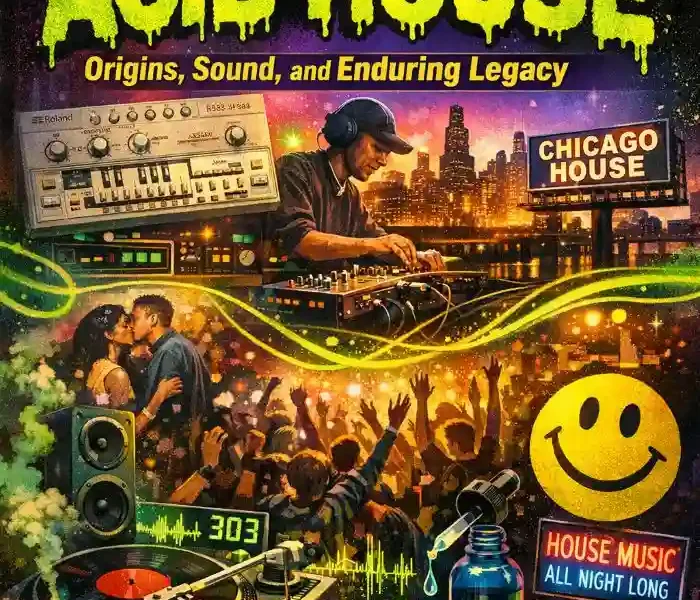
<p>Step into a dimly lit warehouse in 1988. The air is electric, basslines pulse through the crowd, and a sea of ecstatic faces moves in unison to the hypnotic squelch of synthesizers. This is acid house—a genre that didn’t just redefine music but also reshaped culture, nightlife, and the way people came together.</p>
<p>Acid house, a subgenre of house music, is more than just a sound. Born in the underground clubs of Chicago and exploding into the UK rave scene, it became the soundtrack of rebellion, euphoria, and community. At its heart lies the iconic Roland TB-303 synthesizer, whose distorted basslines created a sound unlike anything heard before.</p>
<p>In this guide, we’ll take you through the history, sound, cultural impact, and modern revival of acid house. Whether you’re a seasoned fan or a curious newcomer, this comprehensive exploration will immerse you in the squelchy magic of acid house.</p>
<h2 id="what-is-acid-house-music-">What Is Acid House Music?</h2>
<p><img class="aligncenter wp-image-6900 size-full" src="https://comeawayhome.co.uk/wp-content/uploads/2026/05/d8b0a81c-79d3-4e99-98e9-ec0472ff88f5-ezgif.com-jpg-to-webp-converter.webp" alt="acid house" width="700" height="700" /></p>
<h4 id="defining-the-genre">Defining the Genre</h4>
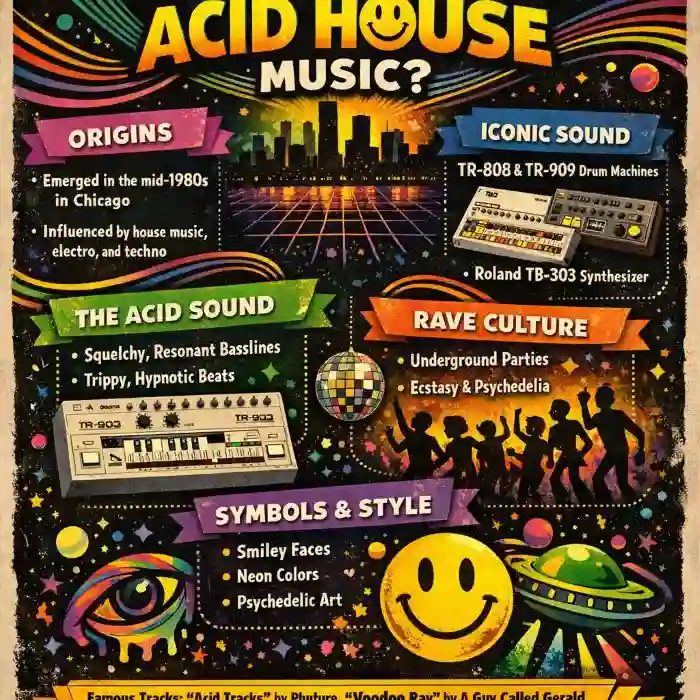
<p><a href="https://en.wikipedia.org/wiki/Acid_house">Acid house</a> music is a genre that fuses minimalistic beats, hypnotic basslines, and sparse, repetitive vocals. Unlike traditional house music, acid house places its focus on creating a trance-like atmosphere through the use of a single, defining instrument: the <strong>Roland TB-303 synthesizer</strong>.</p>
<p>The TB-303’s unique “squelching” sound comes from tweaking its resonance and cutoff filters, creating a warped, liquid-like bassline. This sound became the signature of acid house, giving it an otherworldly, futuristic edge. Tracks typically range in tempo from 120 to 130 beats per minute (BPM), making them ideal for long, marathon dance sessions.</p>
<h4 id="key-characteristics-of-acid-house">Key Characteristics of Acid House</h4>
<ol>
<li><strong>Hypnotic Basslines</strong>: The TB-303’s modulated basslines are the defining feature of acid house.</li>
<li><strong>Minimalist Production</strong>: Tracks rely on stripped-back beats to emphasize the bassline.</li>
<li><strong>Repetitive Vocals</strong>: Sparse and often looped, vocals are used to complement the instrumental layers.</li>
<li><strong>Trippy Atmosphere</strong>: Acid house tracks create a psychedelic vibe, making them perfect for rave environments.</li>
</ol>
<blockquote><p><strong>Fun Fact</strong>: The TB-303 was originally designed to emulate a bass guitar but failed commercially. However, its “failure” became a groundbreaking innovation for acid house producers.</p></blockquote>
<h2 id="the-history-of-acid-house">The History of Acid House</h2>
<p>Let’s explore how acid <a href="https://comeawayhome.co.uk/how-to-get-rid-of-smoke-smell-in-house/">house</a> started, spread, and evolved into the global phenomenon it is today.</p>
<h3 id="chicago-roots-mid-1980s-">Chicago Roots (Mid-1980s)</h3>
<p>Acid house traces its origins to Chicago in the mid-1980s. At the time, house music was thriving in clubs like the legendary <strong>Warehouse</strong>, where Frankie Knuckles was pioneering the sound. Acid house, however, took a distinct turn when a trio called <strong>Phuture</strong> stumbled upon the Roland TB-303.</p>
<p>Their 1987 track, <strong>“Acid Tracks,”</strong> is considered the first-ever acid house record. DJ Pierre, one of Phuture’s members, accidentally discovered the squelchy sound of the 303 while experimenting with its knobs. This “mistake” birthed the acid house sound.</p>
<h4 id="influences">Influences</h4>
<ul>
<li><strong>Italo Disco</strong>: Melodic and electronic dance tracks influenced the structure.</li>
<li><strong>Electro</strong>: Early 1980s electro beats contributed to its rhythm.</li>
<li><strong>Club Culture</strong>: Black and Latino communities in Chicago played a pivotal role in nurturing the house music movement.</li>
</ul>
<h3 id="uk-invasion-and-the-second-summer-of-love-1988-1989-">UK Invasion and the Second Summer of Love (1988-1989)</h3>
<p>Acid house made its way to the UK in the late 1980s, sparking a cultural revolution. DJs like <strong>Danny Rampling</strong> and <strong>Paul Oakenfold</strong> brought acid house records from Chicago and introduced them to British audiences at clubs like <strong>Shoom</strong> and <strong>The Hacienda</strong>.</p>
<p>The summer of 1988, dubbed the <strong>Second Summer of Love</strong>, saw massive acid house parties and outdoor raves. These events, attended by thousands, were fueled by the euphoric combination of music, dance, and ecstasy. The genre’s smiley face logo became a symbol of unity and rebellion.</p>
<h4 id="key-moments">Key Moments</h4>
<ul>
<li>Shoom Club (London): One of the first UK clubs to embrace acid house.</li>
<li>The Hacienda (Manchester): The epicenter of the UK acid house scene.</li>
<li>Tabloid Panic: Media labeled acid house as dangerous, but this only fueled its underground appeal.</li>
</ul>
<h3 id="global-spread-and-decline-1990s-">Global Spread and Decline (1990s)</h3>
<p>By the early 1990s, acid house had spread globally, influencing genres like techno, trance, and hardcore. However, government crackdowns on raves, such as the UK’s <strong>Criminal Justice Act of 1994</strong>, pushed the scene further underground.</p>
<h3 id="-timeline-of-acid-house-milestones-"><strong>Timeline of Acid House Milestones</strong></h3>
<table>
<thead>
<tr>
<th>Era</th>
<th>Key Event/Milestone</th>
<th>Iconic Track/Artist</th>
</tr>
</thead>
<tbody>
<tr>
<td>1985-1987</td>
<td>TB-303 experiments in Chicago</td>
<td>Phuture – “Acid Tracks”</td>
</tr>
<tr>
<td>1988</td>
<td>Second Summer of Love, Shoom/Hacienda</td>
<td>A Guy Called Gerald – “Voodoo Ray”</td>
</tr>
<tr>
<td>1989-1992</td>
<td>Rave crackdowns, genre mutations</td>
<td>Josh Wink – “Higher State of Consciousness”</td>
</tr>
<tr>
<td>2020s Revival</td>
<td>Acid house resurgence at festivals</td>
<td>Charlotte de Witte – Acid Sets</td>
</tr>
</tbody>
</table>
<h2 id="the-roland-tb-303-heart-of-acid-house-sound">The Roland TB-303: Heart of Acid House Sound</h2>
<p>The <strong>Roland TB-303 Bassline Synthesizer</strong> is the backbone of acid house music. Let’s dive into its history, functionality, and lasting impact.</p>
<h4 id="the-birth-of-the-303">The Birth of the 303</h4>
<p>Released in 1981, the TB-303 was designed as a bass accompaniment for guitar players. However, it was discontinued in 1984 due to poor sales. Years later, producers picked up the affordable second-hand units and discovered its unique sound capabilities.</p>
<h4 id="how-the-303-works">How the 303 Works</h4>
<p>The TB-303 features controls for:</p>
<ul>
<li><strong>Cutoff & Resonance</strong>: These filters shape the squelchy, acidic sound.</li>
<li><strong>Accent & Slide</strong>: Add dynamic grooves and glides to programmed patterns.</li>
</ul>
<blockquote><p><strong>Expert Quote</strong>: “The 303 was a mistake turned masterpiece.” – DJ Pierre.</p></blockquote>
<h4 id="modern-alternatives">Modern Alternatives</h4>
<p>Today, software plugins like <strong>D16 Phoscyon</strong> and hardware clones replicate the 303 sound, making it accessible for modern producers.</p>
<h2 id="acid-house-culture-and-iconic-parties">Acid House Culture and Iconic Parties</h2>
<p>Acid house wasn’t just music—it was a <strong>movement</strong>. It brought people together across backgrounds, creating an inclusive and rebellious subculture.</p>
<h4 id="counterculture-and-fashion">Counterculture and Fashion</h4>
<ul>
<li><strong>Inclusivity</strong>: Acid house united people regardless of race, gender, or sexuality.</li>
<li><strong>Iconic Style</strong>: Baggy clothes, smiley face logos, and neon colors became synonymous with the scene.</li>
</ul>
<h4 id="legendary-venues">Legendary Venues</h4>
<ul>
<li><strong>The Hacienda (Manchester)</strong>: Known for its groundbreaking acid house nights.</li>
<li><strong>Spectrum (London)</strong>: Hosted some of the most iconic rave events.</li>
</ul>
<h4 id="controversy-and-legacy">Controversy and Legacy</h4>
<p>The genre faced criticism from media and authorities, who associated it with drug culture. However, this only strengthened its underground appeal.</p>
<h2 id="top-acid-house-tracks-and-artists">Top Acid House Tracks and Artists</h2>
<p>Here’s a curated list of acid house essentials:</p>
<ol>
<li><strong>Phuture</strong> – “Acid Tracks”</li>
<li><strong>Tyree</strong> – “Acid Over”</li>
<li><strong>Hardfloor</strong> – “Acperience 1”</li>
<li><strong>A Guy Called Gerald</strong> – “Voodoo Ray”</li>
</ol>
<p>Modern artists carrying the torch include <strong>Richie Hawtin</strong> and <strong>Charlotte de Witte</strong>.</p>
<h2 id="acid-house-revival-in-2026">Acid House Revival in 2026</h2>
<p>Acid house is experiencing a <strong>modern revival</strong>, with its sound appearing at major festivals and in contemporary productions.</p>
<h4 id="festivals-and-events">Festivals and Events</h4>
<ul>
<li><strong>Boomtown</strong> and <strong>Warehouse Project</strong> regularly feature acid house sets.</li>
<li>Pop-up acid house nights are becoming popular in urban spaces.</li>
</ul>
<h4 id="tech-and-innovation">Tech and Innovation</h4>
<p>Producers are using virtual synths and even NFTs to preserve and evolve the acid house legacy.</p>
<h2 id="how-to-make-acid-house-music-today">How to Make Acid House Music Today</h2>
<p>Want to create your own acid house track? Here’s how:</p>
<ol>
<li><strong>Get the Right Tools</strong>: Use a DAW like Ableton and a 303 emulator plugin.</li>
<li><strong>Program Basslines</strong>: Focus on resonance and slides for that squelchy effect.</li>
<li><strong>Layer with Beats</strong>: Add simple 4/4 drum patterns using a 909 drum machine.</li>
</ol>
<h2 id="faqs">FAQs</h2>
<h4 id="what-defines-acid-house-">What defines acid house?</h4>
<p>The signature TB-303 basslines and minimalistic structure.</p>
<h4 id="where-did-acid-house-originate-">Where did acid house originate?</h4>
<p>Chicago, USA, in the mid-1980s.</p>
<h4 id="is-acid-house-still-popular-">Is acid house still popular?</h4>
<p>Yes, acid house continues to thrive at festivals and underground events.</p>
<h2 id="conclusion-the-enduring-legacy-of-acid-house">Conclusion: The Enduring Legacy of Acid House</h2>
<p>Acid house redefined music, culture, and nightlife. From its humble beginnings in Chicago to its global revival in 2026, the genre remains timeless. Its squelchy basslines and euphoric energy continue to inspire new generations.</p>
<p><strong>Planning an acid house event? Let us help you create an unforgettable experience!</strong></p>
<p><a href="https://comeawayhome.co.uk/">House</a></p>
Step into a dimly lit warehouse in 1988. The air is electric, basslines pulse through the crowd, and a sea of ecstatic faces moves in unison to the hypnotic squelch of synthesizers. This is acid house—a genre that didn’t just redefine music but also reshaped culture, nightlife, and the way people came together.
Acid house, a subgenre of house music, is more than just a sound. Born in the underground clubs of Chicago and exploding into the UK rave scene, it became the soundtrack of rebellion, euphoria, and community. At its heart lies the iconic Roland TB-303 synthesizer, whose distorted basslines created a sound unlike anything heard before.
In this guide, we’ll take you through the history, sound, cultural impact, and modern revival of acid house. Whether you’re a seasoned fan or a curious newcomer, this comprehensive exploration will immerse you in the squelchy magic of acid house.
What Is Acid House Music?
Defining the Genre
Acid house music is a genre that fuses minimalistic beats, hypnotic basslines, and sparse, repetitive vocals. Unlike traditional house music, acid house places its focus on creating a trance-like atmosphere through the use of a single, defining instrument: the Roland TB-303 synthesizer.
The TB-303’s unique “squelching” sound comes from tweaking its resonance and cutoff filters, creating a warped, liquid-like bassline. This sound became the signature of acid house, giving it an otherworldly, futuristic edge. Tracks typically range in tempo from 120 to 130 beats per minute (BPM), making them ideal for long, marathon dance sessions.
Key Characteristics of Acid House
- Hypnotic Basslines: The TB-303’s modulated basslines are the defining feature of acid house.
- Minimalist Production: Tracks rely on stripped-back beats to emphasize the bassline.
- Repetitive Vocals: Sparse and often looped, vocals are used to complement the instrumental layers.
- Trippy Atmosphere: Acid house tracks create a psychedelic vibe, making them perfect for rave environments.
Fun Fact: The TB-303 was originally designed to emulate a bass guitar but failed commercially. However, its “failure” became a groundbreaking innovation for acid house producers.
The History of Acid House
Let’s explore how acid house started, spread, and evolved into the global phenomenon it is today.
Chicago Roots (Mid-1980s)
Acid house traces its origins to Chicago in the mid-1980s. At the time, house music was thriving in clubs like the legendary Warehouse, where Frankie Knuckles was pioneering the sound. Acid house, however, took a distinct turn when a trio called Phuture stumbled upon the Roland TB-303.
Their 1987 track, “Acid Tracks,” is considered the first-ever acid house record. DJ Pierre, one of Phuture’s members, accidentally discovered the squelchy sound of the 303 while experimenting with its knobs. This “mistake” birthed the acid house sound.
Influences
- Italo Disco: Melodic and electronic dance tracks influenced the structure.
- Electro: Early 1980s electro beats contributed to its rhythm.
- Club Culture: Black and Latino communities in Chicago played a pivotal role in nurturing the house music movement.
UK Invasion and the Second Summer of Love (1988-1989)
Acid house made its way to the UK in the late 1980s, sparking a cultural revolution. DJs like Danny Rampling and Paul Oakenfold brought acid house records from Chicago and introduced them to British audiences at clubs like Shoom and The Hacienda.
The summer of 1988, dubbed the Second Summer of Love, saw massive acid house parties and outdoor raves. These events, attended by thousands, were fueled by the euphoric combination of music, dance, and ecstasy. The genre’s smiley face logo became a symbol of unity and rebellion.
Key Moments
- Shoom Club (London): One of the first UK clubs to embrace acid house.
- The Hacienda (Manchester): The epicenter of the UK acid house scene.
- Tabloid Panic: Media labeled acid house as dangerous, but this only fueled its underground appeal.
Global Spread and Decline (1990s)
By the early 1990s, acid house had spread globally, influencing genres like techno, trance, and hardcore. However, government crackdowns on raves, such as the UK’s Criminal Justice Act of 1994, pushed the scene further underground.
Timeline of Acid House Milestones
| Era |
Key Event/Milestone |
Iconic Track/Artist |
| 1985-1987 |
TB-303 experiments in Chicago |
Phuture – “Acid Tracks” |
| 1988 |
Second Summer of Love, Shoom/Hacienda |
A Guy Called Gerald – “Voodoo Ray” |
| 1989-1992 |
Rave crackdowns, genre mutations |
Josh Wink – “Higher State of Consciousness” |
| 2020s Revival |
Acid house resurgence at festivals |
Charlotte de Witte – Acid Sets |
The Roland TB-303: Heart of Acid House Sound
The Roland TB-303 Bassline Synthesizer is the backbone of acid house music. Let’s dive into its history, functionality, and lasting impact.
The Birth of the 303
Released in 1981, the TB-303 was designed as a bass accompaniment for guitar players. However, it was discontinued in 1984 due to poor sales. Years later, producers picked up the affordable second-hand units and discovered its unique sound capabilities.
How the 303 Works
The TB-303 features controls for:
- Cutoff & Resonance: These filters shape the squelchy, acidic sound.
- Accent & Slide: Add dynamic grooves and glides to programmed patterns.
Expert Quote: “The 303 was a mistake turned masterpiece.” – DJ Pierre.
Modern Alternatives
Today, software plugins like D16 Phoscyon and hardware clones replicate the 303 sound, making it accessible for modern producers.
Acid House Culture and Iconic Parties
Acid house wasn’t just music—it was a movement. It brought people together across backgrounds, creating an inclusive and rebellious subculture.
Counterculture and Fashion
- Inclusivity: Acid house united people regardless of race, gender, or sexuality.
- Iconic Style: Baggy clothes, smiley face logos, and neon colors became synonymous with the scene.
Legendary Venues
- The Hacienda (Manchester): Known for its groundbreaking acid house nights.
- Spectrum (London): Hosted some of the most iconic rave events.
Controversy and Legacy
The genre faced criticism from media and authorities, who associated it with drug culture. However, this only strengthened its underground appeal.
Top Acid House Tracks and Artists
Here’s a curated list of acid house essentials:
- Phuture – “Acid Tracks”
- Tyree – “Acid Over”
- Hardfloor – “Acperience 1”
- A Guy Called Gerald – “Voodoo Ray”
Modern artists carrying the torch include Richie Hawtin and Charlotte de Witte.
Acid House Revival in 2026
Acid house is experiencing a modern revival, with its sound appearing at major festivals and in contemporary productions.
Festivals and Events
- Boomtown and Warehouse Project regularly feature acid house sets.
- Pop-up acid house nights are becoming popular in urban spaces.
Tech and Innovation
Producers are using virtual synths and even NFTs to preserve and evolve the acid house legacy.
How to Make Acid House Music Today
Want to create your own acid house track? Here’s how:
- Get the Right Tools: Use a DAW like Ableton and a 303 emulator plugin.
- Program Basslines: Focus on resonance and slides for that squelchy effect.
- Layer with Beats: Add simple 4/4 drum patterns using a 909 drum machine.
FAQs
What defines acid house?
The signature TB-303 basslines and minimalistic structure.
Where did acid house originate?
Chicago, USA, in the mid-1980s.
Is acid house still popular?
Yes, acid house continues to thrive at festivals and underground events.
Conclusion: The Enduring Legacy of Acid House
Acid house redefined music, culture, and nightlife. From its humble beginnings in Chicago to its global revival in 2026, the genre remains timeless. Its squelchy basslines and euphoric energy continue to inspire new generations.
Planning an acid house event? Let us help you create an unforgettable experience!
House