<p>If you are planning a new home, replacing an old system, or simply trying to understand your property better, one question comes up fast: <a href="https://www.reddit.com/r/HomeImprovement/comments/zvf53r/how_far_can_a_septic_tank_be_from_a_house/"><strong>how far can a septic tank be from the house</strong></a>?</p>
<p>It sounds simple, but the answer is not one-size-fits-all. In many places, septic tanks are commonly placed somewhere around <strong>7 to 25 feet from the house</strong>, but the exact distance depends on <strong>local code, soil conditions, slope, access for maintenance, and the overall design of the septic system</strong>.</p>
<p>That is why septic tank placement is not just a building detail. It is a major part of home safety, long-term performance, and future maintenance. A tank placed too close can create access problems and structural concerns. A tank placed too far can increase cost, make plumbing less efficient, and raise the chance of clogs or backups.</p>
<p>In this guide, we will break everything down in simple language. You will learn what a septic tank does, how distance rules usually work, why local codes matter so much, and how installers choose the best spot. You will also see the risks of poor placement, common mistakes homeowners make, and practical tips that can save you money and stress.</p>
<h2 id="what-is-a-septic-tank-and-how-it-works">What Is a Septic Tank and How It Works</h2>
<p><img class="aligncenter wp-image-7116 size-full" src="https://comeawayhome.co.uk/wp-content/uploads/2026/05/66a79eb6-7a2a-4c7e-868c-676578e0e6d1-ezgif.com-jpg-to-webp-converter.webp" alt="how far can a septic tank be from the house" width="700" height="700" /></p>
<p>A septic tank is a <strong>large underground container</strong> that collects wastewater from a home. Every time you flush a toilet, run a sink, use a shower, or wash clothes, that water leaves the house and flows into the septic tank.</p>
<p>Inside the tank, the wastewater separates naturally. Solid waste sinks to the bottom. Oils and grease float to the top. The liquid in the middle then moves out of the tank and into the <strong>drain field</strong>, also called the <strong>leach field</strong>.</p>
<p>That drain field is just as important as the tank itself. It lets the liquid wastewater spread through the soil, where it is filtered naturally. In simple terms, the tank holds and separates waste, while the drain field finishes the treatment process.</p>
<p>Because the whole system depends on gravity, drainage, and access, the location of the tank matters a lot. If the tank is placed in the wrong spot, wastewater may not flow properly. Maintenance may also become harder. And once a septic system is installed, changing its location is expensive and disruptive.</p>
<p>That is why septic tank placement should be planned carefully from the very beginning.</p>
<h2 id="how-far-can-a-septic-tank-be-from-the-house-">How Far Can a Septic Tank Be From the House?</h2>
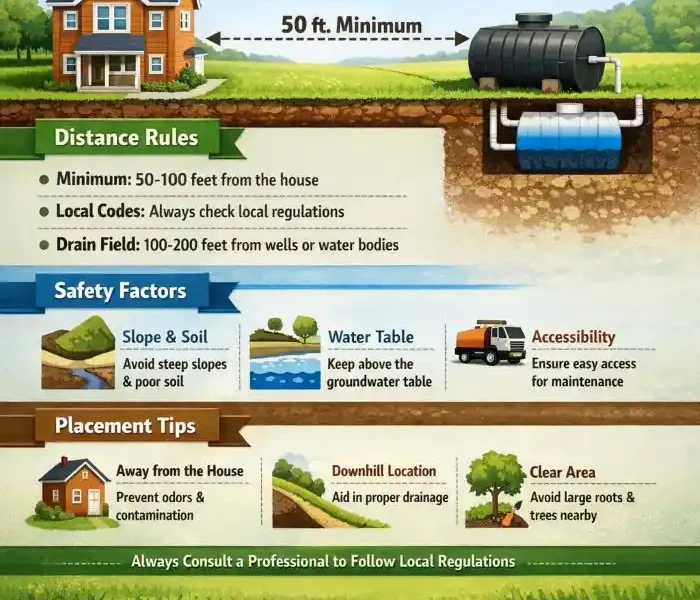
<p>Here is the direct answer: <strong>many septic tanks are placed roughly 7 to 25 feet from the house</strong>, but the exact distance depends on local rules and site conditions.</p>
<p>Some areas allow a shorter setback. Others require a longer one. In some cases, the tank must be positioned based on the route of the home’s plumbing, the slope of the land, and how the system will be pumped and serviced later.</p>
<p>A good septic tank location has to do several jobs at once:</p>
<ul>
<li>It must be <strong>close enough</strong> for wastewater to flow efficiently from the <a href="https://comeawayhome.co.uk/where-is-the-conjuring-house/">house</a>.</li>
<li>It must be <strong>far enough</strong> to avoid structural and maintenance problems.</li>
<li>It must meet <strong>local septic tank placement rules</strong>.</li>
<li>It must allow enough room for <strong>inspection, pumping, and repairs</strong>.</li>
</ul>
<p>That balance is the key. A septic tank is not placed just where it is convenient. It is placed where the system can work properly for years.</p>
<p>In practical terms, the tank should usually be near enough to reduce long plumbing runs, but not so close that it interferes with the foundation, driveways, patios, or future home projects. The best distance depends on the property, the code, and the design of the entire septic system.</p>
<h3 id="common-distance-ranges">Common Distance Ranges</h3>
<p>Different jurisdictions use different standards, but common examples often fall within a moderate range. Some regions rely on metric measurements, while others use feet. That is one reason septic rules can feel confusing at first.</p>
<p>A simple way to think about it is this: the septic tank is usually allowed to be <strong>reasonably close</strong> to the house, but not so close that it creates safety, access, or odor problems. At the same time, it may need to be positioned farther from wells, property boundaries, and water sources than from the home itself.</p>
<p>The exact distance from the house is only one part of the puzzle. Septic systems are often governed by <strong>septic system setback distances</strong> for several different features on the property.</p>
<h3 id="can-a-septic-tank-be-too-far-from-the-house-">Can a Septic Tank Be Too Far From the House?</h3>
<p>Yes, absolutely.</p>
<p>A septic tank can be <strong>too far</strong> from the house if the added distance creates problems with flow, cost, or maintenance. The longer the pipe run between the home and the tank, the more likely you are to face some of these issues:</p>
<ul>
<li>Higher installation cost</li>
<li>More digging and trenching</li>
<li>Greater chance of pipe blockage</li>
<li>Slower or less efficient wastewater flow</li>
<li>More risk of freezing in cold climates</li>
<li>More difficult repair work later</li>
</ul>
<p>A long run also makes gravity drainage harder to manage. Septic systems often work best when wastewater can move naturally from the house to the tank and then to the drain field with minimal strain.</p>
<p>So while a tank can be placed farther away when needed, there is a practical limit. Distance should support the system, not weaken it.</p>
<h2 id="local-codes-and-setback-rules">Local Codes and Setback Rules</h2>
<p>This is the part homeowners should never skip: <strong>local codes control the final answer</strong>.</p>
<p>Even if one area commonly allows a tank to be placed within a certain range, another area may require a different layout. Septic tank location requirements can vary by:</p>
<ul>
<li>State</li>
<li>County</li>
<li>City or municipality</li>
<li>Health department rules</li>
<li>Environmental protection standards</li>
<li>Soil and water conditions on the property</li>
</ul>
<p>That means you should never assume your neighbor’s setup will work for your home.</p>
<p>Many local rules set separate minimum distances for the tank, the drain field, the house foundation, wells, streams, property lines, and other structures. In other words, the septic tank code distance is usually only one part of a larger set of setback rules.</p>
<h3 id="typical-setback-requirements">Typical Setback Requirements</h3>
<p>The following table shows <strong>common examples</strong> of how septic setback rules may be organized. These are not universal numbers, but they show the kind of distances many codes consider.</p>
<table>
<thead>
<tr>
<th>Property Feature</th>
<th>Why Distance Matters</th>
<th>Common Rule Type</th>
</tr>
</thead>
<tbody>
<tr>
<td>House foundation</td>
<td>Prevents structural issues and allows safe access</td>
<td>Minimum setback from the home</td>
</tr>
<tr>
<td>Property line</td>
<td>Reduces disputes and protects neighboring land</td>
<td>Minimum separation from boundaries</td>
</tr>
<tr>
<td>Water well</td>
<td>Protects drinking water from contamination</td>
<td>Larger mandatory setback</td>
</tr>
<tr>
<td>Streams, ponds, lakes</td>
<td>Protects surface water quality</td>
<td>Stricter environmental setback</td>
</tr>
<tr>
<td>Utility lines</td>
<td>Prevents damage during excavation and repairs</td>
<td>Separation required by code</td>
</tr>
</tbody>
</table>
<p>The biggest lesson here is simple: <strong>the house is not the only thing that matters</strong>. A tank might be acceptable near the home, but still fail code if it is too close to a well or boundary line.</p>
<h3 id="why-codes-differ">Why Codes Differ</h3>
<p>Septic rules are not random. They are based on practical safety and environmental concerns.</p>
<h4 id="soil-type-and-permeability">Soil Type and Permeability</h4>
<p>Some soils drain very well. Others hold water. Sandy soil, clay soil, and rocky soil all behave differently. If the soil drains too fast, contaminants can move too easily. If it drains too slowly, wastewater can back up or stay trapped longer than it should.</p>
<h4 id="groundwater-level">Groundwater Level</h4>
<p>If groundwater is high, the system must be placed carefully so wastewater does not reach water tables too quickly. High groundwater can make septic design more sensitive and may limit where the tank and drain field can go.</p>
<h4 id="slope-and-drainage">Slope and Drainage</h4>
<p>The land shape matters too. A steep slope can create challenges with flow, installation, and erosion. A flat area may be easier to work with, but it still needs proper drainage.</p>
<h4 id="public-health-protection">Public Health Protection</h4>
<p>Septic systems handle wastewater, so they must be placed with public safety in mind. That is why setback rules often focus heavily on wells, streams, and drainage areas.</p>
<h4 id="climate-and-frost-conditions">Climate and Frost Conditions</h4>
<p>In colder regions, pipes and tank access may need extra protection. Distance and depth decisions often reflect freeze risk, soil movement, and winter maintenance needs.</p>
<h2 id="factors-that-affect-septic-tank-placement">Factors That Affect Septic Tank Placement</h2>
<p>Even when a code says the tank can be within a certain range, the installer still has to choose the best actual spot on the property. That decision depends on more than just distance from the house.</p>
<p>A smart septic layout balances <strong>code compliance, cost, access, and performance</strong>. Let’s look at the main factors one by one.</p>
<h3 id="soil-conditions">Soil Conditions</h3>
<p>Soil is one of the most important parts of septic planning.</p>
<p>If the soil drains well, the system may work more smoothly. If the soil holds too much water, the tank and drain field may need to be placed in a more suitable area. Rocky soil can make excavation harder. Clay soil can slow drainage. Loose or unstable soil can affect both the tank and the drain field.</p>
<p>Soil conditions influence:</p>
<ul>
<li>How deep the tank can go</li>
<li>Where the drain field should sit</li>
<li>Whether gravity flow is possible</li>
<li>How much excavation is needed</li>
<li>How easily the system can be serviced later</li>
</ul>
<p>This is why soil testing is not optional in good septic planning. It helps determine whether the system will perform properly over time.</p>
<h3 id="slope-and-elevation">Slope and Elevation</h3>
<p>A septic tank is often placed <strong>downhill from the house</strong> when gravity flow is used. That makes it easier for wastewater to move naturally through the piping without needing extra pumping equipment.</p>
<p>A gentle slope can be helpful. It supports smooth flow and can reduce mechanical complexity. But too much slope can create its own problems. If the land is very steep, installation may become harder, drainage may need special design, and erosion may become a concern.</p>
<p>In uneven terrain, the installer may need to adjust the tank’s depth or use a pump system. That decision can affect both the layout and the total cost.</p>
<h3 id="access-for-maintenance">Access for Maintenance</h3>
<p>This is one of the biggest practical concerns, and many homeowners underestimate it.</p>
<p>Your septic tank will eventually need pumping, inspection, and possible repairs. If the tank is buried in a hard-to-reach spot, every service visit becomes more difficult and more expensive.</p>
<p>That is why the tank should not be placed under a driveway, patio, permanent deck, or other structure unless there is a strong reason and the design allows for access. You want the lids, risers, and inspection points to be reachable without tearing apart the yard.</p>
<p>Good access matters because:</p>
<ul>
<li>Pumping equipment needs room</li>
<li>Inspectors need to open lids safely</li>
<li>Repairs may require digging around the tank</li>
<li>Future upgrades may need extra space</li>
</ul>
<p>A septic tank that is hidden or blocked may still function for a while, but it becomes a problem later.</p>
<h3 id="distance-from-water-sources">Distance From Water Sources</h3>
<p>Septic systems must be kept away from wells, streams, ponds, and other water-sensitive areas. That is because wastewater can contaminate water if the system is poorly placed or damaged.</p>
<p>This part of the design often involves stricter setback rules than the house setback itself. In many locations, the required distance from a water source is much larger than the distance from the home.</p>
<p>That is why a tank might be acceptable near the house but still illegal if it is too close to a well or a stream. Protecting drinking water and surface water is a top priority in septic regulations.</p>
<h2 id="risks-of-poor-septic-tank-placement">Risks of Poor Septic Tank Placement</h2>
<p>Choosing the wrong spot for a septic tank can lead to expensive and frustrating problems. Some of these issues show up right away. Others appear slowly over time.</p>
<p>The most common risks are tied to being either <strong>too close</strong> or <strong>too far</strong> from the house, or ignoring site conditions altogether.</p>
<h3 id="too-close-to-the-house">Too Close to the House</h3>
<p>If a septic tank is placed too close, several problems can happen.</p>
<h4 id="structural-risk-to-the-foundation">Structural Risk to the Foundation</h4>
<p>A tank installed too near the foundation may increase the chance of settlement or moisture problems around the house. Even if the tank is properly sealed, the area around it still needs careful planning.</p>
<h4 id="limited-service-access">Limited Service Access</h4>
<p>If the tank is too close to the home, workers may not have enough room to inspect or pump it easily. That can turn a routine service into a difficult job.</p>
<h4 id="odor-and-moisture-concerns">Odor and Moisture Concerns</h4>
<p>A properly working septic system should not smell strongly near the house. But if there is a leak, a venting issue, or poor placement, odors may become more noticeable near living spaces.</p>
<h3 id="too-far-from-the-house">Too Far From the House</h3>
<p>A tank that is too far away can also cause trouble.</p>
<h4 id="longer-pipe-runs">Longer Pipe Runs</h4>
<p>The farther wastewater has to travel, the more pipe is required. That means more digging, more materials, and more labor.</p>
<h4 id="reduced-efficiency">Reduced Efficiency</h4>
<p>A long distance can reduce the natural flow of the system. If the slope is not right, solids may settle in the wrong places or wastewater may not move as smoothly.</p>
<h4 id="greater-chance-of-clogs-or-freezing">Greater Chance of Clogs or Freezing</h4>
<p>Longer pipes may collect more buildup over time. In cold climates, long shallow runs may also be more exposed to freezing temperatures.</p>
<h4 id="higher-material-and-labor-costs">Higher Material and Labor Costs</h4>
<p>The farther the tank is from the house, the more expensive the installation usually becomes. More trenching and more pipe mean more money spent up front.</p>
<p>In short, the right location is a balance. Too close creates access and structural concerns. Too far creates cost and performance problems.</p>
<h2 id="septic-tank-vs-drain-field-distance">Septic Tank vs Drain Field Distance</h2>
<p>It is easy to mix up the tank and the drain field, but they are not the same thing.</p>
<p>The <strong>septic tank</strong> is where wastewater first goes after leaving the house. The <strong>drain field</strong> is where the partially treated liquid is dispersed into the soil.</p>
<p>That means the distance rules for the tank are not identical to the distance rules for the drain field. Each part may have its own setbacks and location requirements.</p>
<p>The tank and drain field work together as one system, but they are often placed in different parts of the yard. The tank may be closer to the house, while the drain field needs a more open area with the right soil and drainage conditions.</p>
<p>This separation matters because a system that looks fine from the house may still fail inspection if the drain field is too close to a boundary, a water source, or an unsuitable slope.</p>
<p>So when you ask how far a septic tank can be from the house, remember that the tank is only one piece. The full system has to fit the property as a whole.</p>
<h2 id="how-installers-decide-the-best-location">How Installers Decide the Best Location</h2>
<p>Professional installers do not guess. They evaluate the site carefully and work within the rules to find the best possible location.</p>
<p>The process usually starts with a property review. Then comes soil testing, permit checks, and a look at the home’s plumbing layout. After that, the installer chooses the safest and most practical location.</p>
<h3 id="site-evaluation">Site Evaluation</h3>
<p>This is where the real planning begins.</p>
<p>An installer will usually look at:</p>
<ul>
<li>The shape of the land</li>
<li>Soil type and drainage</li>
<li>Existing structures</li>
<li>Wells, wells, and water features</li>
<li>Utility lines</li>
<li>Trees, rocks, and obstacles</li>
<li>The location of the home’s sewer outlet</li>
</ul>
<p>A good site evaluation helps avoid expensive mistakes later.</p>
<h4 id="soil-percolation-testing">Soil Percolation Testing</h4>
<p>Many systems require some kind of soil testing to see how well the ground absorbs water. This tells the installer whether the drain field can function properly and where it should go.</p>
<h4 id="mapping-the-property">Mapping the Property</h4>
<p>The installer also maps the property to measure setbacks and identify any restricted areas. This step helps ensure the final layout meets local septic tank location requirements.</p>
<h4 id="checking-water-sources-and-utility-lines">Checking Water Sources and Utility Lines</h4>
<p>Water lines, power lines, gas lines, and wells must all be considered before digging starts. Hitting a utility line is dangerous and expensive, so this part is very important.</p>
<h3 id="permit-review">Permit Review</h3>
<p>Before excavation begins, the system usually needs approval from a local authority. That might be a health department, building office, or environmental agency.</p>
<p>Permits matter because they confirm that the design meets the septic tank installation guidelines for that area. They also help prevent unsafe or illegal installation.</p>
<p>A permit process may include:</p>
<ol>
<li>Site review</li>
<li>Soil testing</li>
<li>Design approval</li>
<li>Inspection during installation</li>
<li>Final sign-off after completion</li>
</ol>
<p>If the installer skips this process, the homeowner may face fines, delays, or costly changes later.</p>
<h2 id="signs-your-septic-tank-may-be-poorly-positioned">Signs Your Septic Tank May Be Poorly Positioned</h2>
<p>Sometimes a septic tank problem shows up not because the tank itself is broken, but because it was placed poorly from the start.</p>
<p>If you notice any of the following signs, the location may be part of the issue:</p>
<ul>
<li>Slow drains inside the house</li>
<li>Frequent backups</li>
<li>Bad smells around the yard or near the home</li>
<li>Standing water close to the tank area</li>
<li>Hard-to-reach lids or access points</li>
<li>Cracks, shifting, or movement near the tank</li>
<li>Moist or soggy ground around the installation area</li>
</ul>
<p>These signs do not always mean the tank location is wrong, but they are worth paying attention to. Poor placement can create stress on the system and make normal maintenance more difficult.</p>
<p>The earlier you catch a problem, the easier it is to fix.</p>
<h2 id="cost-impact-of-tank-distance">Cost Impact of Tank Distance</h2>
<p>Distance has a direct effect on price.</p>
<p>A tank that is closer to the house usually needs less pipe, less trenching, and less labor. A tank that is farther away may require more material and more work. If the land is rocky, steep, or difficult to dig, costs can rise even more.</p>
<p>Here is how distance can change the total cost:</p>
<ul>
<li><strong>More pipe</strong> means more material expense</li>
<li><strong>Longer trenches</strong> mean more labor</li>
<li><strong>Difficult terrain</strong> means more equipment and time</li>
<li><strong>Extra setback requirements</strong> may force a less convenient layout</li>
<li><strong>Future service access</strong> can also affect maintenance cost</li>
</ul>
<p>Sometimes the cheapest placement today is not the cheapest choice over time. A slightly better location may save money later by reducing repairs, pumping difficulty, or redesign work.</p>
<p>That is why smart septic planning looks beyond the initial installation bill.</p>
<h2 id="common-mistakes-homeowners-make">Common Mistakes Homeowners Make</h2>
<p>Many septic problems start with simple planning mistakes. These are some of the most common ones:</p>
<ul>
<li>Guessing the distance without checking local code</li>
<li>Assuming a neighbor’s setup will work for every property</li>
<li>Building a patio, deck, or driveway over the tank access</li>
<li>Forgetting to plan for pumping access</li>
<li>Ignoring the drain field location</li>
<li>Choosing a spot based only on convenience</li>
<li>Failing to leave room for future repairs</li>
</ul>
<p>The biggest mistake is thinking septic placement is only about where the tank “fits.” It is actually about where the whole system can work safely and legally.</p>
<p>A little planning up front can prevent major headaches later.</p>
<h2 id="practical-tips-for-homeowners">Practical Tips for Homeowners</h2>
<p>If you are in the planning stage, a few simple habits can make the whole process much smoother.</p>
<h3 id="helpful-steps-to-follow">Helpful Steps to Follow</h3>
<ol>
<li><strong>Check local septic rules early.</strong><br />
Do not wait until excavation is about to begin.</li>
<li><strong>Hire a licensed septic installer or engineer.</strong><br />
Professional planning helps prevent costly mistakes.</li>
<li><strong>Keep records of the approved layout.</strong><br />
Save maps, permits, and inspection documents.</li>
<li><strong>Plan for pumping access.</strong><br />
Make sure service workers can reach the tank easily.</li>
<li><strong>Leave space for future repairs or upgrades.</strong><br />
A tight layout can create problems later.</li>
</ol>
<p>These steps may sound simple, but they make a big difference. Septic systems last a long time when they are planned well from the beginning.</p>
<h2 id="frequently-asked-questions">Frequently Asked Questions</h2>
<h3 id="how-close-can-a-septic-tank-be-to-a-house-">How close can a septic tank be to a house?</h3>
<p>The answer depends on local regulations, but many areas require a minimum setback from the home. In many cases, septic tanks are placed in a moderate range rather than extremely close to the house.</p>
<h3 id="can-a-septic-tank-be-far-from-the-house-">Can a septic tank be far from the house?</h3>
<p>Yes, it can be farther away if the property design allows it. However, long distances can increase cost, reduce efficiency, and make maintenance more difficult.</p>
<h3 id="what-is-the-minimum-distance-from-property-lines-">What is the minimum distance from property lines?</h3>
<p>This varies by code and is usually regulated separately from the house setback. Some locations are stricter than others, so the property line rule must be checked locally.</p>
<h3 id="does-the-tank-need-to-be-downhill-from-the-house-">Does the tank need to be downhill from the house?</h3>
<p>Often, yes, especially when the system uses gravity flow. But the exact design depends on the slope of the land, the house plumbing, and whether pumps are used.</p>
<h3 id="can-a-septic-tank-be-100-feet-from-the-house-">Can a septic tank be 100 feet from the house?</h3>
<p>In some situations, it might be possible, but it is not common for every property. A distance like that would need careful design, local approval, and a layout that still supports proper flow and access.</p>
<h3 id="what-happens-if-a-septic-tank-is-too-far-from-the-house-">What happens if a septic tank is too far from the house?</h3>
<p>If the tank is too far away, you may face higher installation costs, longer pipe runs, more clogs, weaker gravity flow, and greater maintenance challenges.</p>
<h2 id="conclusion">Conclusion</h2>
<p>So, <strong>how far can a septic tank be from the house</strong>? In many places, the common range is roughly <strong>7 to 25 feet</strong>, but the real answer depends on local code, site conditions, soil, slope, and maintenance access.</p>
<p>The best septic tank location is not just the closest spot or the easiest spot. It is the spot that supports safe flow, legal setbacks, and long-term system performance.</p>
<p>If you are planning a system, the safest move is to work with a qualified septic professional and confirm the local rules before any digging starts. That way, you protect your home, your budget, and your peace of mind.</p>
<p>A well-placed septic tank may not be something you think about every day. But when it is done right, it quietly does its job for years with very little trouble.</p>
<p><a href="https://comeawayhome.co.uk/">House</a></p>
If you are planning a new home, replacing an old system, or simply trying to understand your property better, one question comes up fast: how far can a septic tank be from the house?
It sounds simple, but the answer is not one-size-fits-all. In many places, septic tanks are commonly placed somewhere around 7 to 25 feet from the house, but the exact distance depends on local code, soil conditions, slope, access for maintenance, and the overall design of the septic system.
That is why septic tank placement is not just a building detail. It is a major part of home safety, long-term performance, and future maintenance. A tank placed too close can create access problems and structural concerns. A tank placed too far can increase cost, make plumbing less efficient, and raise the chance of clogs or backups.
In this guide, we will break everything down in simple language. You will learn what a septic tank does, how distance rules usually work, why local codes matter so much, and how installers choose the best spot. You will also see the risks of poor placement, common mistakes homeowners make, and practical tips that can save you money and stress.
What Is a Septic Tank and How It Works

A septic tank is a large underground container that collects wastewater from a home. Every time you flush a toilet, run a sink, use a shower, or wash clothes, that water leaves the house and flows into the septic tank.
Inside the tank, the wastewater separates naturally. Solid waste sinks to the bottom. Oils and grease float to the top. The liquid in the middle then moves out of the tank and into the drain field, also called the leach field.
That drain field is just as important as the tank itself. It lets the liquid wastewater spread through the soil, where it is filtered naturally. In simple terms, the tank holds and separates waste, while the drain field finishes the treatment process.
Because the whole system depends on gravity, drainage, and access, the location of the tank matters a lot. If the tank is placed in the wrong spot, wastewater may not flow properly. Maintenance may also become harder. And once a septic system is installed, changing its location is expensive and disruptive.
That is why septic tank placement should be planned carefully from the very beginning.
How Far Can a Septic Tank Be From the House?
Here is the direct answer: many septic tanks are placed roughly 7 to 25 feet from the house, but the exact distance depends on local rules and site conditions.
Some areas allow a shorter setback. Others require a longer one. In some cases, the tank must be positioned based on the route of the home’s plumbing, the slope of the land, and how the system will be pumped and serviced later.
A good septic tank location has to do several jobs at once:
- It must be close enough for wastewater to flow efficiently from the house.
- It must be far enough to avoid structural and maintenance problems.
- It must meet local septic tank placement rules.
- It must allow enough room for inspection, pumping, and repairs.
That balance is the key. A septic tank is not placed just where it is convenient. It is placed where the system can work properly for years.
In practical terms, the tank should usually be near enough to reduce long plumbing runs, but not so close that it interferes with the foundation, driveways, patios, or future home projects. The best distance depends on the property, the code, and the design of the entire septic system.
Common Distance Ranges
Different jurisdictions use different standards, but common examples often fall within a moderate range. Some regions rely on metric measurements, while others use feet. That is one reason septic rules can feel confusing at first.
A simple way to think about it is this: the septic tank is usually allowed to be reasonably close to the house, but not so close that it creates safety, access, or odor problems. At the same time, it may need to be positioned farther from wells, property boundaries, and water sources than from the home itself.
The exact distance from the house is only one part of the puzzle. Septic systems are often governed by septic system setback distances for several different features on the property.
Can a Septic Tank Be Too Far From the House?
Yes, absolutely.
A septic tank can be too far from the house if the added distance creates problems with flow, cost, or maintenance. The longer the pipe run between the home and the tank, the more likely you are to face some of these issues:
- Higher installation cost
- More digging and trenching
- Greater chance of pipe blockage
- Slower or less efficient wastewater flow
- More risk of freezing in cold climates
- More difficult repair work later
A long run also makes gravity drainage harder to manage. Septic systems often work best when wastewater can move naturally from the house to the tank and then to the drain field with minimal strain.
So while a tank can be placed farther away when needed, there is a practical limit. Distance should support the system, not weaken it.
Local Codes and Setback Rules
This is the part homeowners should never skip: local codes control the final answer.
Even if one area commonly allows a tank to be placed within a certain range, another area may require a different layout. Septic tank location requirements can vary by:
- State
- County
- City or municipality
- Health department rules
- Environmental protection standards
- Soil and water conditions on the property
That means you should never assume your neighbor’s setup will work for your home.
Many local rules set separate minimum distances for the tank, the drain field, the house foundation, wells, streams, property lines, and other structures. In other words, the septic tank code distance is usually only one part of a larger set of setback rules.
Typical Setback Requirements
The following table shows common examples of how septic setback rules may be organized. These are not universal numbers, but they show the kind of distances many codes consider.
| Property Feature |
Why Distance Matters |
Common Rule Type |
| House foundation |
Prevents structural issues and allows safe access |
Minimum setback from the home |
| Property line |
Reduces disputes and protects neighboring land |
Minimum separation from boundaries |
| Water well |
Protects drinking water from contamination |
Larger mandatory setback |
| Streams, ponds, lakes |
Protects surface water quality |
Stricter environmental setback |
| Utility lines |
Prevents damage during excavation and repairs |
Separation required by code |
The biggest lesson here is simple: the house is not the only thing that matters. A tank might be acceptable near the home, but still fail code if it is too close to a well or boundary line.
Why Codes Differ
Septic rules are not random. They are based on practical safety and environmental concerns.
Soil Type and Permeability
Some soils drain very well. Others hold water. Sandy soil, clay soil, and rocky soil all behave differently. If the soil drains too fast, contaminants can move too easily. If it drains too slowly, wastewater can back up or stay trapped longer than it should.
Groundwater Level
If groundwater is high, the system must be placed carefully so wastewater does not reach water tables too quickly. High groundwater can make septic design more sensitive and may limit where the tank and drain field can go.
Slope and Drainage
The land shape matters too. A steep slope can create challenges with flow, installation, and erosion. A flat area may be easier to work with, but it still needs proper drainage.
Public Health Protection
Septic systems handle wastewater, so they must be placed with public safety in mind. That is why setback rules often focus heavily on wells, streams, and drainage areas.
Climate and Frost Conditions
In colder regions, pipes and tank access may need extra protection. Distance and depth decisions often reflect freeze risk, soil movement, and winter maintenance needs.
Factors That Affect Septic Tank Placement
Even when a code says the tank can be within a certain range, the installer still has to choose the best actual spot on the property. That decision depends on more than just distance from the house.
A smart septic layout balances code compliance, cost, access, and performance. Let’s look at the main factors one by one.
Soil Conditions
Soil is one of the most important parts of septic planning.
If the soil drains well, the system may work more smoothly. If the soil holds too much water, the tank and drain field may need to be placed in a more suitable area. Rocky soil can make excavation harder. Clay soil can slow drainage. Loose or unstable soil can affect both the tank and the drain field.
Soil conditions influence:
- How deep the tank can go
- Where the drain field should sit
- Whether gravity flow is possible
- How much excavation is needed
- How easily the system can be serviced later
This is why soil testing is not optional in good septic planning. It helps determine whether the system will perform properly over time.
Slope and Elevation
A septic tank is often placed downhill from the house when gravity flow is used. That makes it easier for wastewater to move naturally through the piping without needing extra pumping equipment.
A gentle slope can be helpful. It supports smooth flow and can reduce mechanical complexity. But too much slope can create its own problems. If the land is very steep, installation may become harder, drainage may need special design, and erosion may become a concern.
In uneven terrain, the installer may need to adjust the tank’s depth or use a pump system. That decision can affect both the layout and the total cost.
Access for Maintenance
This is one of the biggest practical concerns, and many homeowners underestimate it.
Your septic tank will eventually need pumping, inspection, and possible repairs. If the tank is buried in a hard-to-reach spot, every service visit becomes more difficult and more expensive.
That is why the tank should not be placed under a driveway, patio, permanent deck, or other structure unless there is a strong reason and the design allows for access. You want the lids, risers, and inspection points to be reachable without tearing apart the yard.
Good access matters because:
- Pumping equipment needs room
- Inspectors need to open lids safely
- Repairs may require digging around the tank
- Future upgrades may need extra space
A septic tank that is hidden or blocked may still function for a while, but it becomes a problem later.
Distance From Water Sources
Septic systems must be kept away from wells, streams, ponds, and other water-sensitive areas. That is because wastewater can contaminate water if the system is poorly placed or damaged.
This part of the design often involves stricter setback rules than the house setback itself. In many locations, the required distance from a water source is much larger than the distance from the home.
That is why a tank might be acceptable near the house but still illegal if it is too close to a well or a stream. Protecting drinking water and surface water is a top priority in septic regulations.
Risks of Poor Septic Tank Placement
Choosing the wrong spot for a septic tank can lead to expensive and frustrating problems. Some of these issues show up right away. Others appear slowly over time.
The most common risks are tied to being either too close or too far from the house, or ignoring site conditions altogether.
Too Close to the House
If a septic tank is placed too close, several problems can happen.
Structural Risk to the Foundation
A tank installed too near the foundation may increase the chance of settlement or moisture problems around the house. Even if the tank is properly sealed, the area around it still needs careful planning.
Limited Service Access
If the tank is too close to the home, workers may not have enough room to inspect or pump it easily. That can turn a routine service into a difficult job.
Odor and Moisture Concerns
A properly working septic system should not smell strongly near the house. But if there is a leak, a venting issue, or poor placement, odors may become more noticeable near living spaces.
Too Far From the House
A tank that is too far away can also cause trouble.
Longer Pipe Runs
The farther wastewater has to travel, the more pipe is required. That means more digging, more materials, and more labor.
Reduced Efficiency
A long distance can reduce the natural flow of the system. If the slope is not right, solids may settle in the wrong places or wastewater may not move as smoothly.
Greater Chance of Clogs or Freezing
Longer pipes may collect more buildup over time. In cold climates, long shallow runs may also be more exposed to freezing temperatures.
Higher Material and Labor Costs
The farther the tank is from the house, the more expensive the installation usually becomes. More trenching and more pipe mean more money spent up front.
In short, the right location is a balance. Too close creates access and structural concerns. Too far creates cost and performance problems.
Septic Tank vs Drain Field Distance
It is easy to mix up the tank and the drain field, but they are not the same thing.
The septic tank is where wastewater first goes after leaving the house. The drain field is where the partially treated liquid is dispersed into the soil.
That means the distance rules for the tank are not identical to the distance rules for the drain field. Each part may have its own setbacks and location requirements.
The tank and drain field work together as one system, but they are often placed in different parts of the yard. The tank may be closer to the house, while the drain field needs a more open area with the right soil and drainage conditions.
This separation matters because a system that looks fine from the house may still fail inspection if the drain field is too close to a boundary, a water source, or an unsuitable slope.
So when you ask how far a septic tank can be from the house, remember that the tank is only one piece. The full system has to fit the property as a whole.
How Installers Decide the Best Location
Professional installers do not guess. They evaluate the site carefully and work within the rules to find the best possible location.
The process usually starts with a property review. Then comes soil testing, permit checks, and a look at the home’s plumbing layout. After that, the installer chooses the safest and most practical location.
Site Evaluation
This is where the real planning begins.
An installer will usually look at:
- The shape of the land
- Soil type and drainage
- Existing structures
- Wells, wells, and water features
- Utility lines
- Trees, rocks, and obstacles
- The location of the home’s sewer outlet
A good site evaluation helps avoid expensive mistakes later.
Soil Percolation Testing
Many systems require some kind of soil testing to see how well the ground absorbs water. This tells the installer whether the drain field can function properly and where it should go.
Mapping the Property
The installer also maps the property to measure setbacks and identify any restricted areas. This step helps ensure the final layout meets local septic tank location requirements.
Checking Water Sources and Utility Lines
Water lines, power lines, gas lines, and wells must all be considered before digging starts. Hitting a utility line is dangerous and expensive, so this part is very important.
Permit Review
Before excavation begins, the system usually needs approval from a local authority. That might be a health department, building office, or environmental agency.
Permits matter because they confirm that the design meets the septic tank installation guidelines for that area. They also help prevent unsafe or illegal installation.
A permit process may include:
- Site review
- Soil testing
- Design approval
- Inspection during installation
- Final sign-off after completion
If the installer skips this process, the homeowner may face fines, delays, or costly changes later.
Signs Your Septic Tank May Be Poorly Positioned
Sometimes a septic tank problem shows up not because the tank itself is broken, but because it was placed poorly from the start.
If you notice any of the following signs, the location may be part of the issue:
- Slow drains inside the house
- Frequent backups
- Bad smells around the yard or near the home
- Standing water close to the tank area
- Hard-to-reach lids or access points
- Cracks, shifting, or movement near the tank
- Moist or soggy ground around the installation area
These signs do not always mean the tank location is wrong, but they are worth paying attention to. Poor placement can create stress on the system and make normal maintenance more difficult.
The earlier you catch a problem, the easier it is to fix.
Cost Impact of Tank Distance
Distance has a direct effect on price.
A tank that is closer to the house usually needs less pipe, less trenching, and less labor. A tank that is farther away may require more material and more work. If the land is rocky, steep, or difficult to dig, costs can rise even more.
Here is how distance can change the total cost:
- More pipe means more material expense
- Longer trenches mean more labor
- Difficult terrain means more equipment and time
- Extra setback requirements may force a less convenient layout
- Future service access can also affect maintenance cost
Sometimes the cheapest placement today is not the cheapest choice over time. A slightly better location may save money later by reducing repairs, pumping difficulty, or redesign work.
That is why smart septic planning looks beyond the initial installation bill.
Common Mistakes Homeowners Make
Many septic problems start with simple planning mistakes. These are some of the most common ones:
- Guessing the distance without checking local code
- Assuming a neighbor’s setup will work for every property
- Building a patio, deck, or driveway over the tank access
- Forgetting to plan for pumping access
- Ignoring the drain field location
- Choosing a spot based only on convenience
- Failing to leave room for future repairs
The biggest mistake is thinking septic placement is only about where the tank “fits.” It is actually about where the whole system can work safely and legally.
A little planning up front can prevent major headaches later.
Practical Tips for Homeowners
If you are in the planning stage, a few simple habits can make the whole process much smoother.
Helpful Steps to Follow
- Check local septic rules early.
Do not wait until excavation is about to begin.
- Hire a licensed septic installer or engineer.
Professional planning helps prevent costly mistakes.
- Keep records of the approved layout.
Save maps, permits, and inspection documents.
- Plan for pumping access.
Make sure service workers can reach the tank easily.
- Leave space for future repairs or upgrades.
A tight layout can create problems later.
These steps may sound simple, but they make a big difference. Septic systems last a long time when they are planned well from the beginning.
Frequently Asked Questions
How close can a septic tank be to a house?
The answer depends on local regulations, but many areas require a minimum setback from the home. In many cases, septic tanks are placed in a moderate range rather than extremely close to the house.
Can a septic tank be far from the house?
Yes, it can be farther away if the property design allows it. However, long distances can increase cost, reduce efficiency, and make maintenance more difficult.
What is the minimum distance from property lines?
This varies by code and is usually regulated separately from the house setback. Some locations are stricter than others, so the property line rule must be checked locally.
Does the tank need to be downhill from the house?
Often, yes, especially when the system uses gravity flow. But the exact design depends on the slope of the land, the house plumbing, and whether pumps are used.
Can a septic tank be 100 feet from the house?
In some situations, it might be possible, but it is not common for every property. A distance like that would need careful design, local approval, and a layout that still supports proper flow and access.
What happens if a septic tank is too far from the house?
If the tank is too far away, you may face higher installation costs, longer pipe runs, more clogs, weaker gravity flow, and greater maintenance challenges.
Conclusion
So, how far can a septic tank be from the house? In many places, the common range is roughly 7 to 25 feet, but the real answer depends on local code, site conditions, soil, slope, and maintenance access.
The best septic tank location is not just the closest spot or the easiest spot. It is the spot that supports safe flow, legal setbacks, and long-term system performance.
If you are planning a system, the safest move is to work with a qualified septic professional and confirm the local rules before any digging starts. That way, you protect your home, your budget, and your peace of mind.
A well-placed septic tank may not be something you think about every day. But when it is done right, it quietly does its job for years with very little trouble.
House