<h1 id="where-is-the-home-alone-house-the-exact-location-film-facts-and-visiting-tips">Where Is the Home Alone House? The Exact Location, Film Facts, and Visiting Tips</h1>
<p><img class="aligncenter wp-image-7120 size-full" src="https://comeawayhome.co.uk/wp-content/uploads/2026/05/48284350-9eb5-4cd4-9e43-537907a094c1-ezgif.com-jpg-to-webp-converter.webp" alt="where is the home alone house" width="700" height="700" /></p>
<p>Fans ask this question every holiday season: <a href="https://www.housebeautiful.com/design-inspiration/real-estate/a63081934/home-alone-house-details/"><strong>where is the Home Alone house</strong></a>?</p>
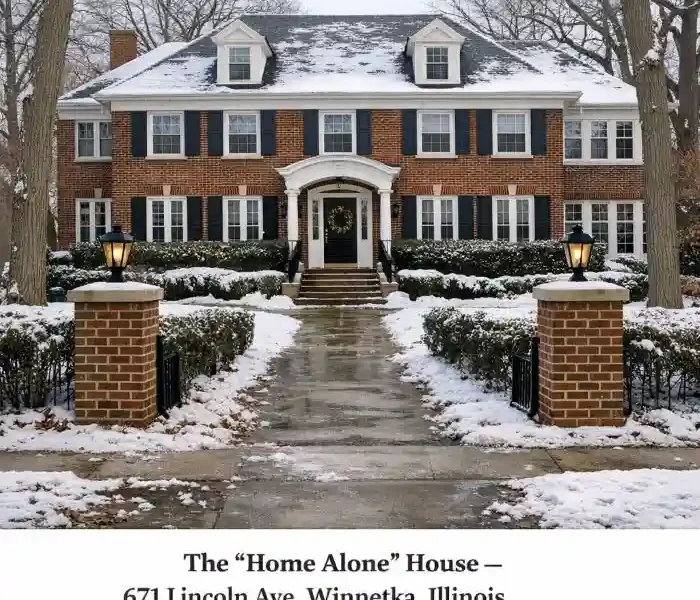
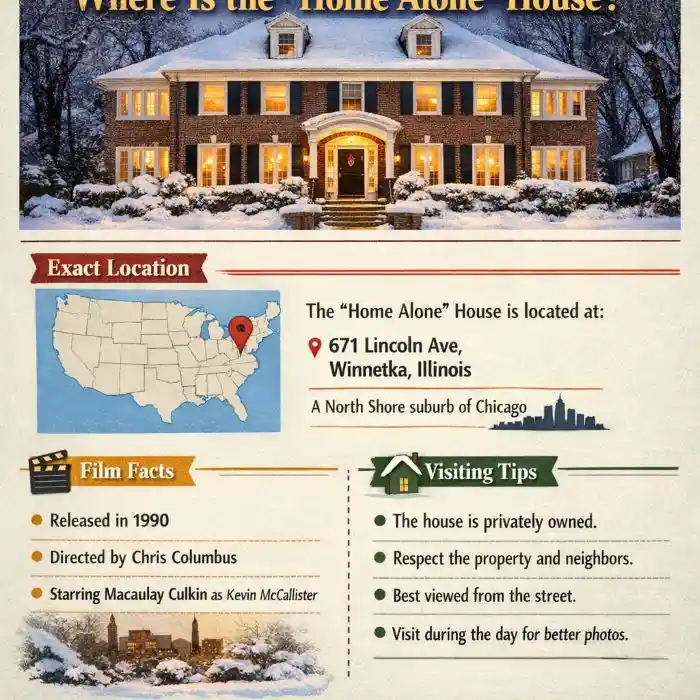
<p>The famous exterior from the 1990 film <strong><em>Home Alone</em></strong> is located at <strong>671 Lincoln Avenue in Winnetka, Illinois</strong>, a leafy North Shore suburb just north of Chicago. For many viewers, the house is more than just a film location. It is a holiday landmark, a piece of movie history, and one of the most recognizable homes in American pop culture.</p>
<p>If you have ever wondered whether the house is real, whether you can go inside, or what scenes were actually filmed there, you are in the right place. In this article, we will walk through the exact location, explain how the house was used in the movie, share its history and architecture, and give you respectful tips for visiting. We will also look at other filming spots from the movie and why the house still draws fans after all these years.</p>
<h4 id="quick-answer-for-readers-in-a-hurry">Quick answer for readers in a hurry</h4>
<p>The <strong>Home Alone house</strong> is the real exterior home at <strong>671 Lincoln Ave, Winnetka, Illinois</strong>. It is a <strong>private residence</strong>, so you can view it from the street, but you should <strong>not trespass or try to enter</strong>.</p>
<h2 id="exact-location-and-address">Exact Location and Address</h2>
<h3 id="address-and-neighborhood">Address and neighborhood</h3>
<p>The house that people picture when they think of Kevin McCallister’s home sits at <strong>671 Lincoln Avenue, Winnetka, Illinois</strong>. Winnetka is a peaceful, upscale suburb on Chicago’s North Shore, and it is known for its tree-lined streets, large homes, and quiet residential feel.</p>
<p>That setting is a big part of why the house stands out so much. It does not sit in a flashy, crowded city block. Instead, it is tucked into a neighborhood that feels calm and classic, which fits the story of a big family getting ready for a holiday trip. The movie uses that feeling well. Even before Kevin gets left behind, the home already tells you something important: this family lives in a place that feels warm, comfortable, and just a little bit magical.</p>
<p>If you are planning a visit, the address is easy to remember because it has become almost as famous as the movie itself. People do not usually come for a long tour. They come to stand on the sidewalk, take a photo, and enjoy the feeling of seeing a real-life movie landmark.</p>
<h3 id="how-it-appears-on-maps-and-street-view">How it appears on maps and street view</h3>
<p>The home is visible from the street, and many fans first “visit” it through map apps, street view, or search results before they ever make the trip in person. That is often the easiest way to see the front of the house without disturbing the people who actually live there.</p>
<p>From the road, the house looks very much like the one fans remember, even though your eye may notice small differences from the movie. That is normal. Film houses often change over time because owners remodel, paint, landscape, or update details for everyday living. Still, the overall shape, brick exterior, and familiar front entrance make it instantly recognizable.</p>
<p>Because the home is in a residential area, there may be other visitors nearby, especially around the holidays. Some people stop briefly for a picture, while others slowly drive by to catch a glimpse. If you go, remember that this is not a theme park. It is someone’s actual home and neighborhood.</p>
<h3 id="private-residence-status">Private residence status</h3>
<p>This is the part many first-time visitors need to hear clearly: <strong>the Home Alone house is private property</strong>.</p>
<p>That means no wandering into the driveway, no climbing steps, no knocking on the door, and no trying to peek into windows. Even if the place feels like a public attraction, it is still a lived-in home with privacy boundaries that should be respected.</p>
<p>There have been moments in the past when the <a href="https://comeawayhome.co.uk/how-far-can-a-septic-tank-be-from-the-house/">house</a> made headlines because of special publicity events or short-term stay promotions, but those are exceptions, not the rule. Most of the time, you should assume the interior is <strong>not open to the public</strong>. If you want to see it, do it the right way: from the public street or sidewalk, quietly and respectfully.</p>
<p>A simple rule helps here: <strong>if it would feel rude at your own home, it is rude here too</strong>.</p>
<h2 id="how-the-house-was-used-in-the-film">How the House Was Used in the Film</h2>
<h3 id="exterior-vs-interior-filming">Exterior vs. interior filming</h3>
<p>One of the most interesting things about the Home Alone house is that the movie did <strong>not</strong> use it in the same way for every scene. The exterior shots you know so well were filmed at the Winnetka home, but many interior scenes were created elsewhere.</p>
<p>That is a common trick in filmmaking. A real home may be perfect for outside shots, but it might not work for cameras, lighting, crew movement, or action scenes inside. So filmmakers often build a set that matches the real house closely enough for the audience to believe it is the same place.</p>
<p>In <strong><em>Home Alone</em></strong>, the inside of the McCallister home was largely recreated on a set rather than filmed room by room inside the real house. That allowed the crew to shape rooms for camera angles, action, and comic timing. It also made it easier to film chaotic scenes like Kevin’s movements, the family’s rush to leave, and the many moments of slapstick tension later in the movie.</p>
<p>This is one of the reasons the house feels so large and so cinematic. The audience sees one seamless home, but movie magic is doing a lot of the work behind the scenes.</p>
<h4 id="why-this-matters-to-fans">Why this matters to fans</h4>
<p>This detail surprises a lot of people because the movie feels so real. When you watch it as a child, or even as an adult, it is easy to assume every hallway and staircase belongs to the actual building. In reality, the movie blends the real exterior with recreated interior spaces.</p>
<p>That does not make the house any less special. If anything, it makes it more interesting. It is a good example of how films borrow from real life and then reshape it into something more dramatic and memorable.</p>
<h3 id="iconic-exterior-shots-and-memorable-scenes">Iconic exterior shots and memorable scenes</h3>
<p>The front of the house appears in some of the film’s most famous moments. It is where the family chaos begins, where the story introduces Kevin’s life at home, and where the world of the movie feels most grounded.</p>
<p>The front steps, driveway, and entryway become part of the emotional rhythm of the film. Viewers remember the excitement of the family getting ready to leave, the panic that follows, and the quiet before Kevin realizes he has been left behind. These are not just random shots of a house. They are the visual foundation of the whole story.</p>
<p>The exterior also helps establish the movie’s mood. The home looks big enough for a large family, warm enough for a holiday story, and just grand enough to feel like a dream house. That matters because the house is almost a character in the film. It represents family, comfort, and all the madness that comes with both.</p>
<h4 id="movie-vs-reality-a-simple-comparison">Movie vs. reality: a simple comparison</h4>
<table>
<thead>
<tr>
<th>Aspect</th>
<th>What fans see in the movie</th>
<th>What is true in real life</th>
</tr>
</thead>
<tbody>
<tr>
<td>Exterior</td>
<td>The recognizable front of the McCallister home</td>
<td>The real house is at 671 Lincoln Ave, Winnetka</td>
</tr>
<tr>
<td>Interior</td>
<td>Large, seamless family rooms and hallways</td>
<td>Many interior scenes were filmed on sets</td>
</tr>
<tr>
<td>Feeling</td>
<td>A huge holiday home full of movie energy</td>
<td>A private home in a quiet residential neighborhood</td>
</tr>
<tr>
<td>Access</td>
<td>Looks like a famous tourist stop</td>
<td>It is still a private residence</td>
</tr>
</tbody>
</table>
<h3 id="the-illusion-that-made-it-unforgettable">The illusion that made it unforgettable</h3>
<p>Part of the reason the house is so beloved is that the movie uses it with real confidence. It is not shown as a perfect mansion or a cold trophy property. Instead, it feels lived in. That makes the home believable and makes Kevin’s world feel familiar.</p>
<p>The house gives the movie a strong emotional center. When the action gets wild later, viewers always return mentally to that front door, that driveway, and that warm suburban setting. Without the house, the movie would lose a lot of its charm.</p>
<h2 id="history-and-architecture-of-the-house">History and Architecture of the House</h2>
<h3 id="build-year-and-style">Build year and style</h3>
<p>The Home Alone house was built in the <strong>early 20th century</strong>, with most reports placing its origin in the <strong>1920s</strong>. That puts it in the era of classic American suburban homes that were meant to feel elegant, sturdy, and timeless.</p>
<p>Architecturally, the house has a <strong>brick exterior</strong> and a traditional, formal look that fits <strong>Colonial Revival</strong> or <strong>Georgian-style</strong> design. These styles often feature symmetry, a balanced front facade, and a sense of order. That classic look is part of what makes the house so appealing on film. It looks rich without feeling flashy. It looks serious but still welcoming.</p>
<p>The home is also large, with multiple bedrooms and plenty of space. That size helped make it believable as the home of a big, busy family. A smaller house would have changed the whole feeling of the movie. The story needs a place where ten people can be scrambling around at once, and this home delivers that impression perfectly.</p>
<h4 id="why-the-style-works-so-well-on-camera">Why the style works so well on camera</h4>
<p>The house has a face that the camera loves. The brick gives it texture. The symmetry gives it calm. The scale gives it authority. In a movie full of comic energy, the home provides balance.</p>
<p>It also helps that the house feels like it belongs to a real family. It is not too polished and not too modern. It looks like a home that has history, which makes the movie feel warmer and more believable.</p>
<h3 id="renovations-and-modern-features">Renovations and modern features</h3>
<p>Like most homes that have been around for many decades, the house has changed over time. It has gone through renovations and updates to keep it comfortable for modern living. Those updates have included refreshed interiors, new amenities, and changes that make the home feel more usable while still protecting its classic look.</p>
<p>That balance matters. Owners of famous film homes often face a tricky question: how do you modernize a house without erasing what made it special in the first place? The Home Alone house is a strong example of a property that keeps its identity while still being adapted for real life.</p>
<p>Reports over the years have mentioned features such as entertainment spaces and updated family-friendly areas. In other words, the house is not frozen in 1990. It has grown up, just like the generations of fans who keep returning to it.</p>
<h3 id="notable-owners-and-sale-history">Notable owners and sale history</h3>
<p>Because the house is so famous, its ownership history has attracted attention far beyond the real estate world. Every time it changes hands, gets listed, or appears in the news, fans pay attention.</p>
<p>Recent years have brought major interest around the house as a property, not just as a film landmark. It has been listed for sale, discussed in the media, and tied to promotional events that made it even more famous. That kind of attention can push a normal house into the celebrity category almost overnight.</p>
<p>The interesting thing is that the fame does not just come from the movie itself. It also comes from the emotional memory people attach to it. For many people, this is the house they saw while watching a childhood holiday movie with family. That gives the property a cultural value that is hard to measure with a simple real estate listing.</p>
<h2 id="visiting-the-house-tips-and-rules">Visiting the House: Tips and Rules</h2>
<h3 id="best-times-to-visit">Best times to visit</h3>
<p>If you are hoping to see the house in person, timing matters.</p>
<p>The holiday season is the most popular time, and that is also when the street can be busiest. If you want a calmer visit, consider going during a quieter part of the year or earlier in the day. That often means fewer people, less traffic, and a more relaxed experience.</p>
<p>There is also something nice about visiting when the neighborhood is peaceful. You can take in the house without feeling rushed, and you are less likely to create any inconvenience for residents or neighbors.</p>
<p>Here are a few practical tips for timing your visit:</p>
<ul>
<li><strong>Go during daylight</strong> so you can see the house clearly and take better photos.</li>
<li><strong>Avoid peak holiday crowds</strong> if you want a quieter stop.</li>
<li><strong>Plan for a quick visit</strong> rather than a long stay.</li>
<li><strong>Be mindful of local traffic</strong> and do not block driveways or intersections.</li>
</ul>
<h3 id="respectful-visiting-etiquette">Respectful visiting etiquette</h3>
<p>This section matters most.</p>
<p>A famous house can tempt people to behave as if the whole block is part of a movie set. It is not. The home is in a neighborhood where people live, work, and relax. Your visit should not disturb them.</p>
<p>Follow these basic rules:</p>
<ul>
<li><strong>Stay on public sidewalks or streets.</strong></li>
<li><strong>Do not trespass onto the property.</strong></li>
<li><strong>Do not ring the doorbell or knock.</strong></li>
<li><strong>Do not block the driveway or neighbors’ access.</strong></li>
<li><strong>Keep voices low and avoid large crowds on the lawn area.</strong></li>
<li><strong>Do not leave trash behind.</strong></li>
<li><strong>Do not use drones or equipment that may invade privacy.</strong></li>
</ul>
<p>If you are taking pictures, be quick and considerate. You can get the shot you want without turning the place into a spectacle. In fact, a respectful approach usually leads to a much better visit. You get to enjoy the house, and the people who live there get to keep their normal day.</p>
<h3 id="photography-and-social-media-tips">Photography and social media tips</h3>
<p>The Home Alone house is one of those places that looks great from a simple street-level photo. You do not need a huge production setup. Often, the best shot is the most straightforward one.</p>
<p>Try to capture the house from a position that shows the front facade clearly without getting in anyone’s way. If you want a cleaner composition, step back a little and include the tree-lined street or the front walk. That helps the photo feel more like a memory than a snapshot.</p>
<p>For social media, it can help to share a caption that keeps the tone light and respectful. Instead of acting like you “found” a secret spot, frame it as a visit to a classic movie location. That small difference matters. It shows that you understand this is a real neighborhood, not a staged attraction.</p>
<p>If you are driving, use your preferred map app to check parking and directions before you go. The area is easiest when you know exactly where you are headed and where you can safely stop.</p>
<h3 id="alternatives-if-you-cannot-visit-in-person">Alternatives if you cannot visit in person</h3>
<p>Not everyone can make the trip, and that is perfectly fine.</p>
<p>If a visit is not practical, you can still enjoy the house in several ways. Street view tools let you look at the exterior from home. Fan articles and documentary-style coverage can give you more background. You can also rewatch the movie and pay attention to how the house is used as part of the story.</p>
<p>Another nice option is to pair your Home Alone interest with a wider look at Chicago film history. The city and its suburbs have appeared in many movies, and that can turn one nostalgic trip into a broader film-themed experience.</p>
<h2 id="other-filming-locations-used-in-home-alone">Other Filming Locations Used in Home Alone</h2>
<h3 id="interior-filming-locations-and-set-work">Interior filming locations and set work</h3>
<p>As mentioned earlier, the famous house is not the whole story. Many interior scenes were built on a set rather than filmed inside the Winnetka home.</p>
<p>This approach allowed the filmmakers to design rooms for movement and visual comedy. That matters a lot in <strong><em>Home Alone</em></strong> because the film depends on timing. Kevin’s quick thinking, the family’s rush, and the later trap-filled action all need flexible spaces where cameras can move easily.</p>
<p>The set also helped the production control details like lighting, prop placement, and angles. That is why the movie feels so polished. The home may look like one real place, but it is actually a smart blend of real and recreated spaces.</p>
<h4 id="why-sets-were-the-smart-choice">Why sets were the smart choice</h4>
<p>If the crew had tried to film every indoor scene in the actual house, the production would have been slower and more cramped. A soundstage gave them more freedom. It also let them build spaces that matched the audience’s memory of the house while still making the movie work technically.</p>
<p>In simple terms: <strong>the house gave the movie its soul, but the set gave it room to move</strong>.</p>
<h3 id="additional-chicago-area-locations">Additional Chicago-area locations</h3>
<p>The movie also uses other locations in the Chicago area, which is part of why local fans feel such a strong connection to it.</p>
<p>One of the most recognizable is <strong>O’Hare International Airport</strong>, which appears in the family’s travel chaos and immediately anchors the film in the Chicago world. The airport scenes are memorable because they set up the whole misunderstanding that leads to Kevin being left behind.</p>
<p>Beyond that, the movie is associated with the broader North Shore and greater Chicago environment, which helps it feel authentic. The story does not feel like it was made in a random studio with fake geography. It feels rooted in a real Midwestern place, with real winter weather, real suburbs, and real family life.</p>
<p>That regional honesty is part of why the movie has lasted so long. It is funny and dramatic, but it is also grounded in a setting that many people instantly recognize.</p>
<h2 id="recent-events-sales-and-pop-culture-moments">Recent Events, Sales, and Pop-Culture Moments</h2>
<h3 id="real-estate-attention-and-market-buzz">Real estate attention and market buzz</h3>
<p>The Home Alone house is not just a movie location. It is also a piece of highly watched real estate.</p>
<p>Over the years, the home has drawn attention whenever it hits the market or appears in the news. Because of its film history, its value is not just about size, location, or finishes. Its fame adds another layer. Buyers are not just looking at a house. They are looking at a property with a built-in audience.</p>
<p>That kind of attention can create a lot of buzz. Some people are interested because they love the movie. Others are fascinated by the idea of owning a famous landmark. And of course, some just want to know what a house like that is worth in today’s market.</p>
<p>The key point is simple: <strong>the house has become part of pop culture and real estate at the same time</strong>. That is rare, and it helps explain why people keep talking about it.</p>
<h3 id="airbnb-moments-and-social-media-attention">Airbnb moments and social media attention</h3>
<p>The house has also had moments that pushed it even deeper into the public eye. Special promotions and short-term stay offers have turned it into a viral story more than once.</p>
<p>That kind of publicity does two things. First, it reminds older fans that the house still exists and still looks familiar. Second, it introduces younger viewers to a movie location they may have only seen online. In the social media age, a famous house can become a trending topic all over again with just one announcement or one well-shared post.</p>
<p>Even when people cannot stay inside, the idea of being near the house is exciting enough to spark conversation. It is one of those rare places where nostalgia, travel, and celebrity culture overlap.</p>
<h2 id="why-fans-still-care">Why Fans Still Care</h2>
<p>The Home Alone house still matters because it carries memory.</p>
<p>For many people, <strong><em>Home Alone</em></strong> is part of the holiday season. It is the movie they watched with siblings, parents, cousins, or friends. It brings back the feeling of winter break, warm lights, funny scenes, and the familiar rhythm of a film that feels both silly and comforting.</p>
<p>The house also matters because it makes the movie feel real. Kevin’s story works because the home looks believable. It is big enough for adventure, ordinary enough to feel familiar, and beautiful enough to become iconic. That balance is hard to create, and the Winnetka house helped make it happen.</p>
<p>There is also a broader reason fans care: movie locations let people step into a story. Even if you only see the house from the sidewalk, you are still standing in a place that carried a famous film. For many visitors, that is enough. It turns a simple drive into a memory and a childhood favorite into something they can experience in person.</p>
<h2 id="frequently-asked-questions">Frequently Asked Questions</h2>
<h3 id="where-exactly-is-the-home-alone-house-located-">Where exactly is the Home Alone house located?</h3>
<p>The Home Alone house is at <strong>671 Lincoln Avenue, Winnetka, Illinois</strong>. It is in a northern Chicago suburb and is one of the most famous movie houses in the United States.</p>
<h3 id="can-i-go-inside-the-home-alone-house-">Can I go inside the Home Alone house?</h3>
<p>Usually, <strong>no</strong>. It is a <strong>private residence</strong>, so you should only view it from the street or sidewalk unless there is a rare special event that allows access.</p>
<h3 id="are-there-official-tours-of-the-home-alone-house-">Are there official tours of the Home Alone house?</h3>
<p>There are typically <strong>no regular official tours</strong> of the interior. Some local film-location experiences or Chicago-area tours may include the exterior or other movie spots, but the house itself is not generally open to visitors.</p>
<h3 id="what-scenes-were-filmed-inside-vs-outside-">What scenes were filmed inside vs. outside?</h3>
<p>The <strong>outside of the house</strong> was filmed at the Winnetka property. Many <strong>interior scenes</strong> were recreated on sets, which allowed the filmmakers to control camera angles and action more easily.</p>
<h3 id="is-the-home-alone-house-for-sale-">Is the Home Alone house for sale?</h3>
<p>The house has attracted major real estate attention in recent years and has appeared in the market and news cycles. If you are checking current status, look for the most recent real estate updates, since ownership and listing details can change.</p>
<h3 id="how-do-i-get-there-from-chicago-">How do I get there from Chicago?</h3>
<p>The house is in <strong>Winnetka</strong>, north of Chicago. If you are driving, use a map app for the best route and parking guidance. It is a straightforward trip from the city, but you should always check traffic and neighborhood parking before you go.</p>
<h3 id="can-i-take-photos-of-the-house-">Can I take photos of the house?</h3>
<p>Yes, you can usually take photos from <strong>public areas</strong>, but keep your visit brief and respectful. Do not enter the property, block the road, or disturb the residents.</p>
<h3 id="why-is-the-home-alone-house-so-famous-">Why is the Home Alone house so famous?</h3>
<p>It became famous because it is the memorable family home from <strong><em>Home Alone</em></strong>, a holiday movie that many people watch every year. The house is tied to childhood nostalgia, Christmas tradition, and one of the most beloved family comedies ever made.</p>
<h2 id="final-thoughts">Final Thoughts</h2>
<p>If you have been wondering <strong>where is the Home Alone house</strong>, the answer is simple: the exterior home is at <strong>671 Lincoln Avenue in Winnetka, Illinois</strong>. But the full story is richer than an address.</p>
<p>The house is a real home, a film landmark, and a piece of holiday memory all at once. It has stayed famous because it connects people to a movie they love and because it still feels familiar after all these years. Whether you see it in person, on a map, or on screen during a holiday rewatch, it remains one of the most iconic houses in movie history.</p>
<p>If you do visit, keep it respectful, enjoy the moment, and remember that the magic of the place comes from both the film and the real people who live there now.</p>
<p><a href="https://comeawayhome.co.uk/">House</a></p>
Where Is the Home Alone House? The Exact Location, Film Facts, and Visiting Tips
Fans ask this question every holiday season: where is the Home Alone house?
The famous exterior from the 1990 film Home Alone is located at 671 Lincoln Avenue in Winnetka, Illinois, a leafy North Shore suburb just north of Chicago. For many viewers, the house is more than just a film location. It is a holiday landmark, a piece of movie history, and one of the most recognizable homes in American pop culture.
If you have ever wondered whether the house is real, whether you can go inside, or what scenes were actually filmed there, you are in the right place. In this article, we will walk through the exact location, explain how the house was used in the movie, share its history and architecture, and give you respectful tips for visiting. We will also look at other filming spots from the movie and why the house still draws fans after all these years.
Quick answer for readers in a hurry
The Home Alone house is the real exterior home at 671 Lincoln Ave, Winnetka, Illinois. It is a private residence, so you can view it from the street, but you should not trespass or try to enter.
Exact Location and Address
Address and neighborhood
The house that people picture when they think of Kevin McCallister’s home sits at 671 Lincoln Avenue, Winnetka, Illinois. Winnetka is a peaceful, upscale suburb on Chicago’s North Shore, and it is known for its tree-lined streets, large homes, and quiet residential feel.
That setting is a big part of why the house stands out so much. It does not sit in a flashy, crowded city block. Instead, it is tucked into a neighborhood that feels calm and classic, which fits the story of a big family getting ready for a holiday trip. The movie uses that feeling well. Even before Kevin gets left behind, the home already tells you something important: this family lives in a place that feels warm, comfortable, and just a little bit magical.
If you are planning a visit, the address is easy to remember because it has become almost as famous as the movie itself. People do not usually come for a long tour. They come to stand on the sidewalk, take a photo, and enjoy the feeling of seeing a real-life movie landmark.
How it appears on maps and street view
The home is visible from the street, and many fans first “visit” it through map apps, street view, or search results before they ever make the trip in person. That is often the easiest way to see the front of the house without disturbing the people who actually live there.
From the road, the house looks very much like the one fans remember, even though your eye may notice small differences from the movie. That is normal. Film houses often change over time because owners remodel, paint, landscape, or update details for everyday living. Still, the overall shape, brick exterior, and familiar front entrance make it instantly recognizable.
Because the home is in a residential area, there may be other visitors nearby, especially around the holidays. Some people stop briefly for a picture, while others slowly drive by to catch a glimpse. If you go, remember that this is not a theme park. It is someone’s actual home and neighborhood.
Private residence status
This is the part many first-time visitors need to hear clearly: the Home Alone house is private property.
That means no wandering into the driveway, no climbing steps, no knocking on the door, and no trying to peek into windows. Even if the place feels like a public attraction, it is still a lived-in home with privacy boundaries that should be respected.
There have been moments in the past when the house made headlines because of special publicity events or short-term stay promotions, but those are exceptions, not the rule. Most of the time, you should assume the interior is not open to the public. If you want to see it, do it the right way: from the public street or sidewalk, quietly and respectfully.
A simple rule helps here: if it would feel rude at your own home, it is rude here too.
How the House Was Used in the Film
Exterior vs. interior filming
One of the most interesting things about the Home Alone house is that the movie did not use it in the same way for every scene. The exterior shots you know so well were filmed at the Winnetka home, but many interior scenes were created elsewhere.
That is a common trick in filmmaking. A real home may be perfect for outside shots, but it might not work for cameras, lighting, crew movement, or action scenes inside. So filmmakers often build a set that matches the real house closely enough for the audience to believe it is the same place.
In Home Alone, the inside of the McCallister home was largely recreated on a set rather than filmed room by room inside the real house. That allowed the crew to shape rooms for camera angles, action, and comic timing. It also made it easier to film chaotic scenes like Kevin’s movements, the family’s rush to leave, and the many moments of slapstick tension later in the movie.
This is one of the reasons the house feels so large and so cinematic. The audience sees one seamless home, but movie magic is doing a lot of the work behind the scenes.
Why this matters to fans
This detail surprises a lot of people because the movie feels so real. When you watch it as a child, or even as an adult, it is easy to assume every hallway and staircase belongs to the actual building. In reality, the movie blends the real exterior with recreated interior spaces.
That does not make the house any less special. If anything, it makes it more interesting. It is a good example of how films borrow from real life and then reshape it into something more dramatic and memorable.
Iconic exterior shots and memorable scenes
The front of the house appears in some of the film’s most famous moments. It is where the family chaos begins, where the story introduces Kevin’s life at home, and where the world of the movie feels most grounded.
The front steps, driveway, and entryway become part of the emotional rhythm of the film. Viewers remember the excitement of the family getting ready to leave, the panic that follows, and the quiet before Kevin realizes he has been left behind. These are not just random shots of a house. They are the visual foundation of the whole story.
The exterior also helps establish the movie’s mood. The home looks big enough for a large family, warm enough for a holiday story, and just grand enough to feel like a dream house. That matters because the house is almost a character in the film. It represents family, comfort, and all the madness that comes with both.
Movie vs. reality: a simple comparison
| Aspect |
What fans see in the movie |
What is true in real life |
| Exterior |
The recognizable front of the McCallister home |
The real house is at 671 Lincoln Ave, Winnetka |
| Interior |
Large, seamless family rooms and hallways |
Many interior scenes were filmed on sets |
| Feeling |
A huge holiday home full of movie energy |
A private home in a quiet residential neighborhood |
| Access |
Looks like a famous tourist stop |
It is still a private residence |
The illusion that made it unforgettable
Part of the reason the house is so beloved is that the movie uses it with real confidence. It is not shown as a perfect mansion or a cold trophy property. Instead, it feels lived in. That makes the home believable and makes Kevin’s world feel familiar.
The house gives the movie a strong emotional center. When the action gets wild later, viewers always return mentally to that front door, that driveway, and that warm suburban setting. Without the house, the movie would lose a lot of its charm.
History and Architecture of the House
Build year and style
The Home Alone house was built in the early 20th century, with most reports placing its origin in the 1920s. That puts it in the era of classic American suburban homes that were meant to feel elegant, sturdy, and timeless.
Architecturally, the house has a brick exterior and a traditional, formal look that fits Colonial Revival or Georgian-style design. These styles often feature symmetry, a balanced front facade, and a sense of order. That classic look is part of what makes the house so appealing on film. It looks rich without feeling flashy. It looks serious but still welcoming.
The home is also large, with multiple bedrooms and plenty of space. That size helped make it believable as the home of a big, busy family. A smaller house would have changed the whole feeling of the movie. The story needs a place where ten people can be scrambling around at once, and this home delivers that impression perfectly.
Why the style works so well on camera
The house has a face that the camera loves. The brick gives it texture. The symmetry gives it calm. The scale gives it authority. In a movie full of comic energy, the home provides balance.
It also helps that the house feels like it belongs to a real family. It is not too polished and not too modern. It looks like a home that has history, which makes the movie feel warmer and more believable.
Renovations and modern features
Like most homes that have been around for many decades, the house has changed over time. It has gone through renovations and updates to keep it comfortable for modern living. Those updates have included refreshed interiors, new amenities, and changes that make the home feel more usable while still protecting its classic look.
That balance matters. Owners of famous film homes often face a tricky question: how do you modernize a house without erasing what made it special in the first place? The Home Alone house is a strong example of a property that keeps its identity while still being adapted for real life.
Reports over the years have mentioned features such as entertainment spaces and updated family-friendly areas. In other words, the house is not frozen in 1990. It has grown up, just like the generations of fans who keep returning to it.
Notable owners and sale history
Because the house is so famous, its ownership history has attracted attention far beyond the real estate world. Every time it changes hands, gets listed, or appears in the news, fans pay attention.
Recent years have brought major interest around the house as a property, not just as a film landmark. It has been listed for sale, discussed in the media, and tied to promotional events that made it even more famous. That kind of attention can push a normal house into the celebrity category almost overnight.
The interesting thing is that the fame does not just come from the movie itself. It also comes from the emotional memory people attach to it. For many people, this is the house they saw while watching a childhood holiday movie with family. That gives the property a cultural value that is hard to measure with a simple real estate listing.
Visiting the House: Tips and Rules
Best times to visit
If you are hoping to see the house in person, timing matters.
The holiday season is the most popular time, and that is also when the street can be busiest. If you want a calmer visit, consider going during a quieter part of the year or earlier in the day. That often means fewer people, less traffic, and a more relaxed experience.
There is also something nice about visiting when the neighborhood is peaceful. You can take in the house without feeling rushed, and you are less likely to create any inconvenience for residents or neighbors.
Here are a few practical tips for timing your visit:
- Go during daylight so you can see the house clearly and take better photos.
- Avoid peak holiday crowds if you want a quieter stop.
- Plan for a quick visit rather than a long stay.
- Be mindful of local traffic and do not block driveways or intersections.
Respectful visiting etiquette
This section matters most.
A famous house can tempt people to behave as if the whole block is part of a movie set. It is not. The home is in a neighborhood where people live, work, and relax. Your visit should not disturb them.
Follow these basic rules:
- Stay on public sidewalks or streets.
- Do not trespass onto the property.
- Do not ring the doorbell or knock.
- Do not block the driveway or neighbors’ access.
- Keep voices low and avoid large crowds on the lawn area.
- Do not leave trash behind.
- Do not use drones or equipment that may invade privacy.
If you are taking pictures, be quick and considerate. You can get the shot you want without turning the place into a spectacle. In fact, a respectful approach usually leads to a much better visit. You get to enjoy the house, and the people who live there get to keep their normal day.
The Home Alone house is one of those places that looks great from a simple street-level photo. You do not need a huge production setup. Often, the best shot is the most straightforward one.
Try to capture the house from a position that shows the front facade clearly without getting in anyone’s way. If you want a cleaner composition, step back a little and include the tree-lined street or the front walk. That helps the photo feel more like a memory than a snapshot.
For social media, it can help to share a caption that keeps the tone light and respectful. Instead of acting like you “found” a secret spot, frame it as a visit to a classic movie location. That small difference matters. It shows that you understand this is a real neighborhood, not a staged attraction.
If you are driving, use your preferred map app to check parking and directions before you go. The area is easiest when you know exactly where you are headed and where you can safely stop.
Alternatives if you cannot visit in person
Not everyone can make the trip, and that is perfectly fine.
If a visit is not practical, you can still enjoy the house in several ways. Street view tools let you look at the exterior from home. Fan articles and documentary-style coverage can give you more background. You can also rewatch the movie and pay attention to how the house is used as part of the story.
Another nice option is to pair your Home Alone interest with a wider look at Chicago film history. The city and its suburbs have appeared in many movies, and that can turn one nostalgic trip into a broader film-themed experience.
Other Filming Locations Used in Home Alone
Interior filming locations and set work
As mentioned earlier, the famous house is not the whole story. Many interior scenes were built on a set rather than filmed inside the Winnetka home.
This approach allowed the filmmakers to design rooms for movement and visual comedy. That matters a lot in Home Alone because the film depends on timing. Kevin’s quick thinking, the family’s rush, and the later trap-filled action all need flexible spaces where cameras can move easily.
The set also helped the production control details like lighting, prop placement, and angles. That is why the movie feels so polished. The home may look like one real place, but it is actually a smart blend of real and recreated spaces.
Why sets were the smart choice
If the crew had tried to film every indoor scene in the actual house, the production would have been slower and more cramped. A soundstage gave them more freedom. It also let them build spaces that matched the audience’s memory of the house while still making the movie work technically.
In simple terms: the house gave the movie its soul, but the set gave it room to move.
Additional Chicago-area locations
The movie also uses other locations in the Chicago area, which is part of why local fans feel such a strong connection to it.
One of the most recognizable is O’Hare International Airport, which appears in the family’s travel chaos and immediately anchors the film in the Chicago world. The airport scenes are memorable because they set up the whole misunderstanding that leads to Kevin being left behind.
Beyond that, the movie is associated with the broader North Shore and greater Chicago environment, which helps it feel authentic. The story does not feel like it was made in a random studio with fake geography. It feels rooted in a real Midwestern place, with real winter weather, real suburbs, and real family life.
That regional honesty is part of why the movie has lasted so long. It is funny and dramatic, but it is also grounded in a setting that many people instantly recognize.
Recent Events, Sales, and Pop-Culture Moments
Real estate attention and market buzz
The Home Alone house is not just a movie location. It is also a piece of highly watched real estate.
Over the years, the home has drawn attention whenever it hits the market or appears in the news. Because of its film history, its value is not just about size, location, or finishes. Its fame adds another layer. Buyers are not just looking at a house. They are looking at a property with a built-in audience.
That kind of attention can create a lot of buzz. Some people are interested because they love the movie. Others are fascinated by the idea of owning a famous landmark. And of course, some just want to know what a house like that is worth in today’s market.
The key point is simple: the house has become part of pop culture and real estate at the same time. That is rare, and it helps explain why people keep talking about it.
The house has also had moments that pushed it even deeper into the public eye. Special promotions and short-term stay offers have turned it into a viral story more than once.
That kind of publicity does two things. First, it reminds older fans that the house still exists and still looks familiar. Second, it introduces younger viewers to a movie location they may have only seen online. In the social media age, a famous house can become a trending topic all over again with just one announcement or one well-shared post.
Even when people cannot stay inside, the idea of being near the house is exciting enough to spark conversation. It is one of those rare places where nostalgia, travel, and celebrity culture overlap.
Why Fans Still Care
The Home Alone house still matters because it carries memory.
For many people, Home Alone is part of the holiday season. It is the movie they watched with siblings, parents, cousins, or friends. It brings back the feeling of winter break, warm lights, funny scenes, and the familiar rhythm of a film that feels both silly and comforting.
The house also matters because it makes the movie feel real. Kevin’s story works because the home looks believable. It is big enough for adventure, ordinary enough to feel familiar, and beautiful enough to become iconic. That balance is hard to create, and the Winnetka house helped make it happen.
There is also a broader reason fans care: movie locations let people step into a story. Even if you only see the house from the sidewalk, you are still standing in a place that carried a famous film. For many visitors, that is enough. It turns a simple drive into a memory and a childhood favorite into something they can experience in person.
Frequently Asked Questions
Where exactly is the Home Alone house located?
The Home Alone house is at 671 Lincoln Avenue, Winnetka, Illinois. It is in a northern Chicago suburb and is one of the most famous movie houses in the United States.
Can I go inside the Home Alone house?
Usually, no. It is a private residence, so you should only view it from the street or sidewalk unless there is a rare special event that allows access.
Are there official tours of the Home Alone house?
There are typically no regular official tours of the interior. Some local film-location experiences or Chicago-area tours may include the exterior or other movie spots, but the house itself is not generally open to visitors.
What scenes were filmed inside vs. outside?
The outside of the house was filmed at the Winnetka property. Many interior scenes were recreated on sets, which allowed the filmmakers to control camera angles and action more easily.
Is the Home Alone house for sale?
The house has attracted major real estate attention in recent years and has appeared in the market and news cycles. If you are checking current status, look for the most recent real estate updates, since ownership and listing details can change.
How do I get there from Chicago?
The house is in Winnetka, north of Chicago. If you are driving, use a map app for the best route and parking guidance. It is a straightforward trip from the city, but you should always check traffic and neighborhood parking before you go.
Can I take photos of the house?
Yes, you can usually take photos from public areas, but keep your visit brief and respectful. Do not enter the property, block the road, or disturb the residents.
Why is the Home Alone house so famous?
It became famous because it is the memorable family home from Home Alone, a holiday movie that many people watch every year. The house is tied to childhood nostalgia, Christmas tradition, and one of the most beloved family comedies ever made.
Final Thoughts
If you have been wondering where is the Home Alone house, the answer is simple: the exterior home is at 671 Lincoln Avenue in Winnetka, Illinois. But the full story is richer than an address.
The house is a real home, a film landmark, and a piece of holiday memory all at once. It has stayed famous because it connects people to a movie they love and because it still feels familiar after all these years. Whether you see it in person, on a map, or on screen during a holiday rewatch, it remains one of the most iconic houses in movie history.
If you do visit, keep it respectful, enjoy the moment, and remember that the magic of the place comes from both the film and the real people who live there now.
House