<p>In winter, a two-story house can feel like two different homes. Upstairs may stay warm while the main floor feels chilly. Or the heat may run all day, yet your family still complains that one room never feels right.</p>
<p>That is why learning <a href="https://www.reddit.com/r/hvacadvice/comments/154srym/please_set_the_record_straight_thermostat/"><strong>how to set thermostat for 2 story house in winter</strong></a> matters. The right settings can make your home feel more even, lower your energy use, and reduce the constant back-and-forth of turning the heat up and down.</p>
<p>In this guide, you will learn what really causes temperature differences between floors, how to choose the best thermostat settings, and how to use airflow, sensors, and schedules to keep your home comfortable. We will also cover what to do if one floor stays too warm or too cold, and when it makes sense to call a professional.</p>
<p><strong>CTA:</strong> If you want, print or save this guide as a simple winter thermostat checklist you can follow during the heating season.</p>
<h2 id="why-two-story-homes-need-special-thermostat-settings">Why two-story homes need special thermostat settings</h2>
<p><img class="aligncenter wp-image-7127 size-full" src="https://comeawayhome.co.uk/wp-content/uploads/2026/05/32540f59-40ae-43cc-9fff-b7af94c49894-ezgif.com-jpg-to-webp-converter.webp" alt="how to set thermostat for 2 story house in winter" width="700" height="700" /></p>
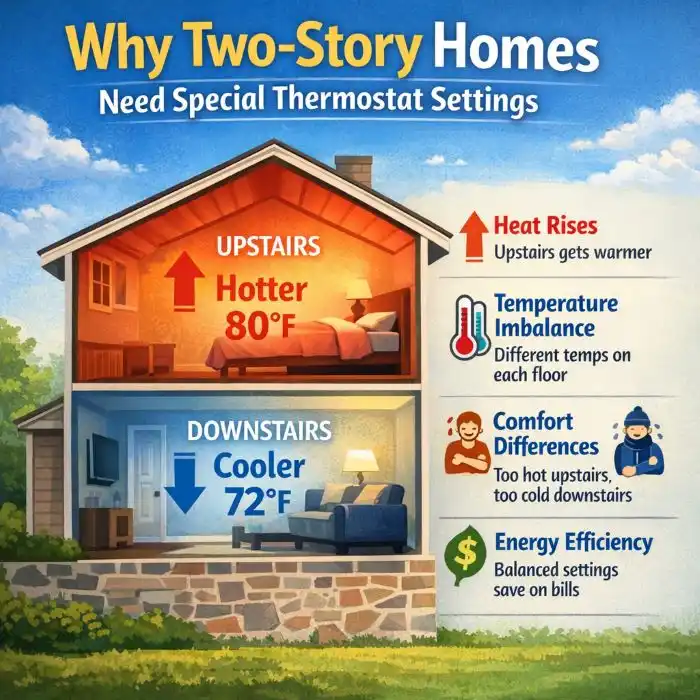
<p>A two-story house has a built-in challenge: <strong>heat does not stay evenly spread out</strong>. Even if your HVAC system is working properly, the upper and lower floors often feel different because warm air naturally moves upward.</p>
<h3 id="heat-rises-and-temperature-stratification">Heat rises and temperature stratification</h3>
<p>Warm air is lighter than cool air, so it rises toward the second floor. That basic physics rule creates what many homeowners call “hot upstairs, cold downstairs.”</p>
<p>This is why <strong>how to set thermostat for 2 story house in winter</strong> is not the same as setting the temperature in a one-level home. If your thermostat is downstairs, it may keep calling for heat because the lower level is not warm enough. Meanwhile, upstairs may already feel comfortable or even too warm.</p>
<p>That difference is called <strong>temperature stratification</strong>. In simple terms, it means the air in your home forms layers. The lower floor may lag behind the upper floor, especially if your home has weak airflow, older insulation, or a thermostat placed in a poor location.</p>
<h3 id="common-problems-homeowners-see">Common problems homeowners see</h3>
<p>If your home is not balanced well, you may notice:</p>
<ul>
<li><strong>Uneven comfort</strong> between upstairs and downstairs</li>
<li><strong>Higher heating bills</strong> because the system runs longer than needed</li>
<li><strong>Short cycling</strong>, where the furnace turns on and off too often</li>
<li><strong>Rooms that never feel right</strong>, even when the thermostat says the <a href="https://comeawayhome.co.uk/how-much-does-it-cost-to-paint-a-house/">house</a> is warm enough</li>
</ul>
<p>These problems are frustrating because they often look like a thermostat issue, but the real cause may be airflow, insulation, or system design.</p>
<h3 id="when-a-single-thermostat-is-enough-vs-when-zoning-is-needed">When a single thermostat is enough vs when zoning is needed</h3>
<p>Sometimes a single thermostat can work well enough if your home is fairly open and your HVAC system is balanced. But in many two-story homes, one thermostat can only “see” one part of the house.</p>
<p>Use this quick check:</p>
<ul>
<li>If both floors are usually within <strong>1–2°F</strong> of each other, a single thermostat may be fine.</li>
<li>If upstairs and downstairs are often <strong>3–5°F apart or more</strong>, you may need better airflow control or zoning.</li>
<li>If family members constantly fight over temperature, your home may benefit from <strong>separate zones</strong>, smart sensors, or a system upgrade.</li>
</ul>
<p>The goal is not perfection. The goal is <strong>steady comfort with less waste</strong>.</p>
<h2 id="assess-your-system-before-changing-settings">Assess your system before changing settings</h2>
<p>Before you adjust anything, take a moment to understand what kind of HVAC setup you have. The best thermostat settings depend on the system in your home, not just the number on the thermostat screen.</p>
<h3 id="identify-your-hvac-layout">Identify your HVAC layout</h3>
<p>Start by asking a few simple questions:</p>
<ol>
<li>Do you have <strong>one central heating system</strong> or <strong>more than one unit</strong>?</li>
<li>Is there <strong>one thermostat</strong> or <strong>two thermostats</strong>?</li>
<li>Does the upstairs and downstairs each have separate ductwork or separate equipment?</li>
</ol>
<p>If you only have one furnace and one thermostat, your options are different from a home with two thermostats or a zoned system.</p>
<p>A single-system home usually needs careful scheduling, airflow balancing, and sometimes smart sensors. A home with two thermostats may allow you to control each floor more directly. That can make a big difference in winter comfort.</p>
<h3 id="check-thermostat-type-and-capabilities">Check thermostat type and capabilities</h3>
<p>Not all thermostats work the same way. Your thermostat may be:</p>
<ul>
<li><strong>Manual</strong>: simple temperature control with little scheduling</li>
<li><strong>Programmable</strong>: lets you set different temperatures for different times of day</li>
<li><strong>Smart</strong>: learns patterns, supports app control, and may use sensors</li>
</ul>
<p>Smart and programmable thermostats are often better for multi-story homes because they let you create a schedule and make small adjustments without constant manual changes.</p>
<p>Some smart models also support:</p>
<ul>
<li><strong>Remote sensors</strong></li>
<li><strong>Room averaging</strong></li>
<li><strong>Geofencing</strong></li>
<li><strong>Energy reports</strong></li>
<li><strong>Separate settings for multiple zones</strong></li>
</ul>
<p>If your thermostat supports these features, you can fine-tune comfort on each floor instead of relying on one fixed number all day.</p>
<h3 id="inspect-vents-dampers-and-insulation">Inspect vents, dampers, and insulation</h3>
<p>A thermostat can only do so much if the house itself is not helping. Before you make big changes, check the basics:</p>
<ul>
<li>Are supply vents open?</li>
<li>Are return vents blocked by furniture or rugs?</li>
<li>Do you have manual dampers in the ductwork?</li>
<li>Is the attic insulated well?</li>
<li>Are windows and doors leaking cold air?</li>
</ul>
<p>Even small drafts can throw off temperature balance. A poorly insulated upstairs bedroom may feel cold no matter how high you set the heat. On the other hand, a sunny upstairs room may warm quickly and stay too hot.</p>
<p>Think of the thermostat as the <strong>controller</strong>, but the vents, ducts, and insulation as the <strong>support system</strong>. They all need to work together.</p>
<h2 id="recommended-thermostat-settings-and-schedules">Recommended thermostat settings and schedules</h2>
<p>When people ask about <strong>how to set thermostat for 2 story house in winter</strong>, they usually want a simple answer. The truth is that the best settings depend on your system, but there is a reliable starting point.</p>
<p>In general, aim for <strong>small temperature differences</strong> between floors, not large ones. Use schedules so the home warms up when people are awake and eases back when everyone is asleep or away.</p>
<h3 id="baseline-temperature-recommendations">Baseline temperature recommendations</h3>
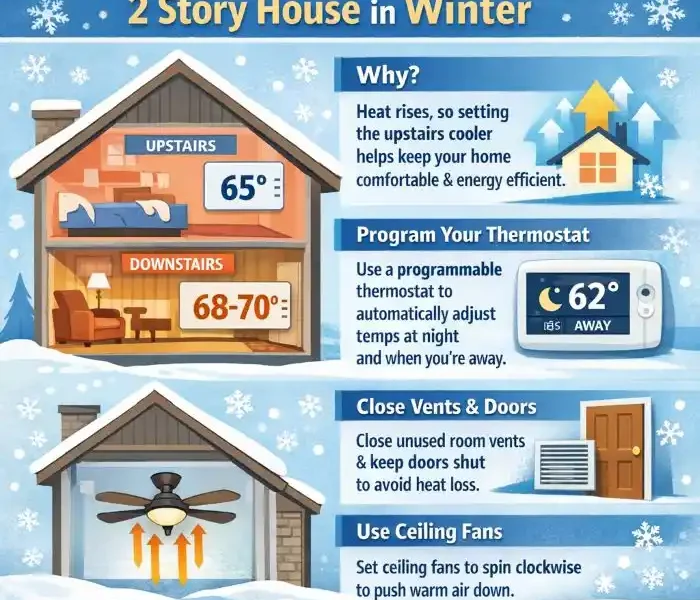
<p>A practical winter starting point for many homes is:</p>
<ul>
<li><strong>Daytime when people are home:</strong> <strong>68–70°F</strong> (<strong>20–21°C</strong>)</li>
<li><strong>Nighttime while sleeping:</strong> <strong>60–66°F</strong> (<strong>15.5–19°C</strong>), depending on comfort</li>
<li><strong>Away from home:</strong> <strong>62–65°F</strong> (<strong>16.5–18°C</strong>) if your climate and home conditions allow it</li>
</ul>
<p>For two-story homes, a small offset can help:</p>
<ul>
<li><strong>Downstairs:</strong> around <strong>68–70°F</strong></li>
<li><strong>Upstairs:</strong> around <strong>66–69°F</strong></li>
</ul>
<p>That small gap of <strong>1–2°F</strong> can make the house feel more even without overworking the system. Bigger differences often create more imbalance, not less.</p>
<p>Here is a simple example schedule many homeowners can start with:</p>
<table>
<thead>
<tr>
<th>Time of Day</th>
<th>Downstairs</th>
<th>Upstairs</th>
<th>Notes</th>
</tr>
</thead>
<tbody>
<tr>
<td>6:00 AM – 8:30 AM</td>
<td>69°F</td>
<td>67°F</td>
<td>Warm up before the family starts moving</td>
</tr>
<tr>
<td>8:30 AM – 4:30 PM</td>
<td>66°F</td>
<td>64–65°F</td>
<td>Lower while home is empty</td>
</tr>
<tr>
<td>4:30 PM – 10:30 PM</td>
<td>69–70°F</td>
<td>67–68°F</td>
<td>Comfortable evening setting</td>
</tr>
<tr>
<td>10:30 PM – 6:00 AM</td>
<td>64–66°F</td>
<td>62–65°F</td>
<td>Sleep setback, adjusted for comfort</td>
</tr>
</tbody>
</table>
<p>This is only a starting point. If your upstairs bedrooms feel stuffy, lower the upstairs setting a bit. If the main floor feels too cool at night, raise the downstairs setting slightly.</p>
<h3 id="settings-for-single-thermostat-homes">Settings for single-thermostat homes</h3>
<p>If your house has just <strong>one thermostat</strong>, that thermostat is usually the only thing telling the furnace when to turn on. That means placement matters a lot.</p>
<p>A thermostat should not be placed:</p>
<ul>
<li>Near windows</li>
<li>Above air vents</li>
<li>In direct sunlight</li>
<li>Next to the kitchen</li>
<li>In a hallway with weak airflow</li>
</ul>
<p>If it is in a bad spot, the thermostat may think the house is warmer or cooler than it really is.</p>
<p>For single-thermostat homes, use these simple rules:</p>
<ul>
<li>Keep the thermostat on <strong>Auto</strong> instead of changing it all day</li>
<li>Use a <strong>steady schedule</strong> rather than frequent manual adjustments</li>
<li>If your home allows it, use the <strong>fan Auto mode</strong> most of the time</li>
<li>Watch how long it takes the house to warm up in the morning and cool down at night</li>
</ul>
<p>You can also test different settings for several days and write down how the two floors feel. This is one of the easiest ways to learn what works in your house.</p>
<p>The main trade-off is this: one thermostat is simple, but it cannot see every room. So your job is to create a schedule that works for the whole house, not just one spot.</p>
<h3 id="settings-for-dual-thermostat-or-zoned-systems">Settings for dual-thermostat or zoned systems</h3>
<p>If your home has <strong>two thermostats</strong> or a <strong>zoned HVAC system</strong>, you have more control. That usually means more comfort too.</p>
<p>In winter, many homes do well when the upstairs zone is set <strong>1–2°F lower</strong> than the downstairs zone. That helps offset the fact that warm air collects upstairs.</p>
<p>A simple zoned schedule might look like this:</p>
<ul>
<li><strong>Morning:</strong> downstairs 69°F, upstairs 67°F</li>
<li><strong>Daytime away:</strong> downstairs 66°F, upstairs 64°F</li>
<li><strong>Evening:</strong> downstairs 70°F, upstairs 68°F</li>
<li><strong>Overnight:</strong> downstairs 65°F, upstairs 63°F</li>
</ul>
<p>This setup helps because the upper floor often gets extra warmth from rising air and from people, electronics, and plumbing lines that give off heat.</p>
<p>If you use smart sensors, place them where people actually spend time:</p>
<ul>
<li><strong>Bedrooms</strong> for nighttime comfort</li>
<li><strong>Living room</strong> for evening comfort</li>
<li><strong>Home office</strong> if you work from home during the day</li>
</ul>
<p>That way, the system responds to real use instead of a hallway that may not reflect comfort anywhere else.</p>
<p>A smart way to think about it is this:<br />
<strong>Do not fight the natural heat pattern. Work with it.</strong></p>
<h3 id="a-simple-rule-to-remember">A simple rule to remember</h3>
<p>If you want one easy takeaway, use this:</p>
<ul>
<li>Start with <strong>small differences</strong></li>
<li>Keep the overall home around <strong>68–70°F when occupied</strong></li>
<li>Lower the upstairs a little in winter if it tends to run warm</li>
<li>Use schedules instead of constant manual changes</li>
</ul>
<p>That approach is usually enough to improve comfort without wasting energy.</p>
<h2 id="airflow-vents-and-balancing">Airflow, vents, and balancing</h2>
<p>Thermostat settings matter, but airflow matters just as much. If warm air cannot move properly, your two-story house will always feel uneven.</p>
<h3 id="how-to-use-registers-and-dampers">How to use registers and dampers</h3>
<p>Supply registers are the vents that push warm air into rooms. Dampers are usually found in the ductwork and help control how much air goes to different parts of the home.</p>
<p>A few practical steps can help:</p>
<ul>
<li><strong>Keep downstairs vents fully open</strong></li>
<li><strong>Slightly close some upstairs vents</strong> if the second floor overheats</li>
<li>Adjust dampers carefully if your duct system has them</li>
<li>Make small changes, then wait and observe for a day or two</li>
</ul>
<p>Do not close too many vents at once. That can increase pressure in the duct system and may strain your HVAC equipment. The goal is <strong>balance</strong>, not blockage.</p>
<p>If you are not sure where dampers are, they are often located near the main trunk lines of the ductwork. If your home has manual dampers, small handle positions usually show whether they are open or partially closed.</p>
<p>[Image placeholder: Duct and damper illustration]<br />
<strong>Caption:</strong> Where to find dampers and how to adjust them.<br />
<strong>Alt text:</strong> Diagram showing ductwork, vents, and damper positions in a two-story house.</p>
<h3 id="role-of-the-hvac-fan-and-circulation">Role of the HVAC fan and circulation</h3>
<p>Your HVAC fan can help move heat more evenly through the home. In winter, many homeowners leave the fan on <strong>Auto</strong>, which means it runs only when the furnace is heating.</p>
<p>That is usually the most energy-efficient setting. But in some two-story homes, using the fan <strong>On</strong> for short periods can help circulate warm air and reduce temperature differences.</p>
<p>Here is the simple breakdown:</p>
<ul>
<li><strong>Fan Auto:</strong> lower energy use, quieter, normal default</li>
<li><strong>Fan On:</strong> better mixing of air, but uses more electricity</li>
</ul>
<p>A good middle ground is to use the fan on a schedule or for short circulation periods if your thermostat supports it.</p>
<p>If your upstairs stays warm and your downstairs stays cold, fan circulation can help mix the air more evenly. It will not solve every problem, but it can improve the feeling of balance.</p>
<h3 id="supplemental-solutions">Supplemental solutions</h3>
<p>Sometimes the issue is not just the thermostat. A few extra tools can help in winter:</p>
<ul>
<li><strong>Space heaters</strong> for one stubborn room, used carefully and safely</li>
<li><strong>Ceiling fans on reverse</strong> to push warm air downward</li>
<li><strong>Weather stripping</strong> around doors and windows</li>
<li><strong>Attic insulation upgrades</strong> to reduce heat loss</li>
<li><strong>Curtains and blinds</strong> to reduce drafts near windows</li>
</ul>
<p>Use space heaters only as a short-term fix. They can help in a bedroom or office, but they are not a replacement for proper HVAC balance.</p>
<p>Ceiling fans are especially useful in two-story homes. Set them to spin slowly in reverse during winter so they gently push warm air down without creating a strong draft.</p>
<h2 id="smart-thermostats-sensors-best-practices">Smart thermostats & sensors: best practices</h2>
<p>Smart thermostats can be a game-changer in a multi-story home. They give you more control, better scheduling, and a clearer picture of how your home actually uses heat.</p>
<h3 id="benefits-of-smart-thermostats">Benefits of smart thermostats</h3>
<p>Smart thermostats can:</p>
<ul>
<li>Learn your schedule</li>
<li>Adjust temperatures automatically</li>
<li>Let you control settings from your phone</li>
<li>Show energy reports</li>
<li>Work with sensors in different rooms</li>
</ul>
<p>This is useful in two-story homes because comfort changes throughout the day. The bedrooms matter at night. The living room matters in the evening. The kitchen and office may matter in the morning.</p>
<p>A smart thermostat makes it easier to match the schedule to your real life instead of forcing the whole home to stay at one temperature all day.</p>
<h3 id="using-remote-sensors-effectively">Using remote sensors effectively</h3>
<p>Remote sensors are small devices that report temperature to the thermostat. They can be very helpful in a home with two floors.</p>
<p>Best placement ideas:</p>
<ul>
<li>Put one sensor in a <strong>bedroom upstairs</strong></li>
<li>Put one sensor in the <strong>main living area</strong></li>
<li>Avoid placing sensors near windows, vents, or appliances</li>
</ul>
<p>Some smart thermostats let you choose whether to average all sensors or prioritize one room. That feature can help you decide whether to keep the living room comfortable during the day or bedrooms comfortable at night.</p>
<p>For example, you might want the system to prioritize the upstairs bedroom sensor after 10 PM, then switch back to the downstairs living area in the morning.</p>
<p>That kind of control is one of the best tools for anyone trying to figure out <strong>how to set thermostat for 2 story house in winter</strong> without guessing every day.</p>
<h3 id="geofencing-and-schedules">Geofencing and schedules</h3>
<p>Geofencing uses your phone’s location to adjust temperatures when you leave or come home. If you often forget to change the thermostat, this can reduce waste automatically.</p>
<p>Use geofencing carefully, though. In a two-story home, comfort can depend on time of day as much as location. A good schedule usually works best when combined with geofencing.</p>
<p>A smart setup can help you:</p>
<ul>
<li>Save energy when nobody is home</li>
<li>Warm the house before you return</li>
<li>Keep bedrooms cooler overnight</li>
<li>Reduce constant manual changes</li>
</ul>
<p><strong>Image placeholder: Example thermostat schedules screenshot</strong><br />
<strong>Caption:</strong> Sample 24-hour thermostat schedule for winter.<br />
<strong>Alt text:</strong> Smart thermostat schedule showing occupied, away, and sleep temperature settings for a two-story home.</p>
<h2 id="troubleshooting-common-issues">Troubleshooting common issues</h2>
<p>Even with a good thermostat setting, two-story homes can still run into problems. The key is to match the symptom to the likely cause.</p>
<h3 id="upstairs-always-too-warm">Upstairs always too warm</h3>
<p>If the upstairs feels too warm in winter, try these steps:</p>
<ul>
<li>Lower the upstairs thermostat by <strong>1–2°F</strong></li>
<li>Slightly close a few upstairs vents</li>
<li>Use ceiling fans in reverse</li>
<li>Check whether the attic is trapping heat</li>
<li>Make sure the thermostat is not near a heat source</li>
</ul>
<p>Sometimes the problem is simply that heat is collecting upstairs faster than the system can move it away. Small changes usually work better than big ones.</p>
<h3 id="downstairs-never-reaches-set-temp">Downstairs never reaches set temp</h3>
<p>If the downstairs never seems to hit the set temperature, check these items:</p>
<ul>
<li>Dirty air filter</li>
<li>Blocked return vents</li>
<li>Closed or partially closed downstairs supply vents</li>
<li>Leaky ducts</li>
<li>Thermostat placed too far from the main living area</li>
</ul>
<p>If the thermostat is in a hallway, it may think the house is warm enough even when the family room is not. In that case, zoning or remote sensors can help.</p>
<p>You may also need to look at insulation and air leaks. A cold draft from a door or window can make the lower floor feel like the furnace is not working, even when it is.</p>
<h3 id="short-cycling-or-frequent-system-on-off">Short cycling or frequent system on/off</h3>
<p>Short cycling means the furnace starts and stops too often. That usually points to one of these problems:</p>
<ul>
<li>A clogged air filter</li>
<li>Oversized heating equipment</li>
<li>Incorrect thermostat placement</li>
<li>Poor airflow</li>
<li>A system that needs service</li>
</ul>
<p>If you notice short cycling, do not just keep raising the thermostat. That can make the problem worse and waste energy.</p>
<p>Instead:</p>
<ul>
<li>Replace the filter</li>
<li>Check airflow around vents and returns</li>
<li>Make sure no furniture blocks the thermostat</li>
<li>Call a technician if the issue keeps coming back</li>
</ul>
<h3 id="quick-troubleshooting-list">Quick troubleshooting list</h3>
<p>If your two-story house still feels unbalanced, go through this short checklist:</p>
<ul>
<li>Check filters</li>
<li>Open blocked vents</li>
<li>Verify thermostat placement</li>
<li>Compare upstairs vs downstairs temperatures</li>
<li>Test a fan circulation setting</li>
<li>Review your schedule for too-large setbacks</li>
</ul>
<p>These small checks often solve more problems than people expect.</p>
<p><strong>CTA:</strong> If your home still has uneven temperatures after these adjustments, book a professional HVAC inspection. A trained technician can help you find the real cause instead of guessing.</p>
<h2 id="when-to-upgrade-or-call-a-pro">When to upgrade or call a pro</h2>
<p>Sometimes the best solution is not another thermostat tweak. It is a system upgrade or a professional balancing job.</p>
<h3 id="signs-you-need-zoning-or-hvac-upgrade">Signs you need zoning or HVAC upgrade</h3>
<p>You may need professional help if:</p>
<ul>
<li>Your home has a <strong>persistent 4°F+ difference</strong> between floors</li>
<li>One floor is always uncomfortable no matter what you do</li>
<li>Your furnace runs constantly but the house still feels uneven</li>
<li>Your HVAC system is older and needs frequent repairs</li>
<li>You have already tried schedules, fan settings, and vent adjustments</li>
</ul>
<p>If these problems keep happening, your home may need zoning, duct balancing, or updated equipment.</p>
<h3 id="what-a-professional-will-do">What a professional will do</h3>
<p>A qualified HVAC technician can:</p>
<ul>
<li>Inspect airflow and duct condition</li>
<li>Test system capacity</li>
<li>Adjust dampers</li>
<li>Add zone controls</li>
<li>Recommend sensor placement</li>
<li>Check whether your equipment is correctly sized</li>
</ul>
<p>That kind of work can make a major difference in comfort. It can also help your system last longer because it does not have to work as hard to compensate for uneven temperatures.</p>
<p>If you are a property manager or homeowner dealing with ongoing complaints, this may be the point where expert help saves time, money, and frustration.</p>
<h2 id="practical-example-a-two-story-home-in-real-life">Practical example: a two-story home in real life</h2>
<p>Let’s say you have a <strong>2,400-square-foot two-story home</strong> with one furnace, one main thermostat downstairs, and a second thermostat upstairs that controls a zone.</p>
<p>At first, the family sets both thermostats to <strong>72°F</strong> because that sounds comfortable. But the upstairs becomes too warm, the downstairs still feels cool in the morning, and the furnace runs too often.</p>
<p>Here is what changes the situation:</p>
<ol>
<li>The downstairs thermostat is set to <strong>69°F</strong> during occupied hours.</li>
<li>The upstairs thermostat is lowered to <strong>67°F</strong> during the day and <strong>65°F</strong> at night.</li>
<li>The fan is left on <strong>Auto</strong>, but circulation is used for short periods in the evening.</li>
<li>Upstairs bedroom sensors are added so the system reacts to the rooms that matter most.</li>
<li>The family lowers the temperature to <strong>66°F</strong> while away from home.</li>
</ol>
<p>After two weeks, the home feels more balanced. The upstairs no longer overheats as often, the downstairs is more comfortable in the morning, and the furnace does not run quite as long.</p>
<p>In a case like this, many homeowners may see an estimated <strong>8–12% reduction in heating costs</strong>, especially if the original schedule was too high and the system was overworking to correct uneven temperatures.</p>
<p>The real win is not just the bill. It is the comfort. When both floors feel close to the same temperature, winter stress drops fast.</p>
<h2 id="frequently-asked-questions">Frequently asked questions</h2>
<h3 id="what-temperature-should-i-set-my-thermostat-for-a-two-story-house-in-winter-">What temperature should I set my thermostat for a two-story house in winter?</h3>
<p>A good starting point is <strong>68–70°F during the day</strong> when people are home and <strong>60–66°F at night</strong> depending on comfort. In many two-story homes, the upstairs can be set <strong>1–2°F lower</strong> than the downstairs to help balance the natural rise of warm air.</p>
<h3 id="should-i-set-upstairs-thermostat-higher-or-lower-in-winter-">Should I set upstairs thermostat higher or lower in winter?</h3>
<p>In most two-story homes, the upstairs thermostat should be set <strong>slightly lower</strong> than the downstairs setting in winter. That helps prevent overheating upstairs while the main floor is still catching up.</p>
<h3 id="is-it-better-to-run-the-fan-on-or-auto-in-winter-">Is it better to run the fan “On” or “Auto” in winter?</h3>
<p><strong>Auto</strong> is usually the best default because it uses less energy. <strong>On</strong> can help mix air more evenly in a two-story house, but it may increase electricity use. If you need better circulation, try short fan runs instead of leaving it on all day.</p>
<h3 id="will-closing-vents-upstairs-damage-my-hvac-system-">Will closing vents upstairs damage my HVAC system?</h3>
<p><strong>Closing too many vents can cause problems</strong>, yes. It can increase pressure in the ducts and strain the system. If you close vents upstairs, do it only a little at a time and watch the results. Avoid shutting off large parts of the system.</p>
<h3 id="do-smart-thermostats-save-money-in-multi-story-homes-">Do smart thermostats save money in multi-story homes?</h3>
<p>Yes, they often do. Smart thermostats help by creating schedules, using remote sensors, and reducing unnecessary heating. In a multi-story home, that control can improve comfort and lower energy waste at the same time.</p>
<h3 id="when-should-i-install-zoning-or-multiple-thermostats-">When should I install zoning or multiple thermostats?</h3>
<p>If your floors stay far apart in temperature, your home feels uneven all winter, or you keep adjusting the thermostat with little improvement, zoning may be worth it. It is especially helpful in larger homes, older homes, or homes with complicated duct layouts.</p>
<h2 id="final-thoughts">Final thoughts</h2>
<p>Learning <strong>how to set thermostat for 2 story house in winter</strong> is really about balance. You want to use the thermostat, airflow, and schedule together so your home feels even without wasting heat.</p>
<p>Start with small changes. Keep the temperature gap between floors small. Use sensors if you have them. Watch airflow. And if your home still feels uneven after all that, it may be time for zoning or a professional check.</p>
<p>The best winter setup is not the highest temperature. It is the one that keeps your family comfortable, your system steady, and your bills under control.</p>
<p><strong>CTA:</strong> Subscribe for seasonal HVAC tips so you can get simple winter comfort advice before the next cold snap.</p>
<p><a href="https://comeawayhome.co.uk/">House</a></p>
In winter, a two-story house can feel like two different homes. Upstairs may stay warm while the main floor feels chilly. Or the heat may run all day, yet your family still complains that one room never feels right.
That is why learning how to set thermostat for 2 story house in winter matters. The right settings can make your home feel more even, lower your energy use, and reduce the constant back-and-forth of turning the heat up and down.
In this guide, you will learn what really causes temperature differences between floors, how to choose the best thermostat settings, and how to use airflow, sensors, and schedules to keep your home comfortable. We will also cover what to do if one floor stays too warm or too cold, and when it makes sense to call a professional.
CTA: If you want, print or save this guide as a simple winter thermostat checklist you can follow during the heating season.
Why two-story homes need special thermostat settings
A two-story house has a built-in challenge: heat does not stay evenly spread out. Even if your HVAC system is working properly, the upper and lower floors often feel different because warm air naturally moves upward.
Heat rises and temperature stratification
Warm air is lighter than cool air, so it rises toward the second floor. That basic physics rule creates what many homeowners call “hot upstairs, cold downstairs.”
This is why how to set thermostat for 2 story house in winter is not the same as setting the temperature in a one-level home. If your thermostat is downstairs, it may keep calling for heat because the lower level is not warm enough. Meanwhile, upstairs may already feel comfortable or even too warm.
That difference is called temperature stratification. In simple terms, it means the air in your home forms layers. The lower floor may lag behind the upper floor, especially if your home has weak airflow, older insulation, or a thermostat placed in a poor location.
Common problems homeowners see
If your home is not balanced well, you may notice:
- Uneven comfort between upstairs and downstairs
- Higher heating bills because the system runs longer than needed
- Short cycling, where the furnace turns on and off too often
- Rooms that never feel right, even when the thermostat says the house is warm enough
These problems are frustrating because they often look like a thermostat issue, but the real cause may be airflow, insulation, or system design.
When a single thermostat is enough vs when zoning is needed
Sometimes a single thermostat can work well enough if your home is fairly open and your HVAC system is balanced. But in many two-story homes, one thermostat can only “see” one part of the house.
Use this quick check:
- If both floors are usually within 1–2°F of each other, a single thermostat may be fine.
- If upstairs and downstairs are often 3–5°F apart or more, you may need better airflow control or zoning.
- If family members constantly fight over temperature, your home may benefit from separate zones, smart sensors, or a system upgrade.
The goal is not perfection. The goal is steady comfort with less waste.
Assess your system before changing settings
Before you adjust anything, take a moment to understand what kind of HVAC setup you have. The best thermostat settings depend on the system in your home, not just the number on the thermostat screen.
Identify your HVAC layout
Start by asking a few simple questions:
- Do you have one central heating system or more than one unit?
- Is there one thermostat or two thermostats?
- Does the upstairs and downstairs each have separate ductwork or separate equipment?
If you only have one furnace and one thermostat, your options are different from a home with two thermostats or a zoned system.
A single-system home usually needs careful scheduling, airflow balancing, and sometimes smart sensors. A home with two thermostats may allow you to control each floor more directly. That can make a big difference in winter comfort.
Check thermostat type and capabilities
Not all thermostats work the same way. Your thermostat may be:
- Manual: simple temperature control with little scheduling
- Programmable: lets you set different temperatures for different times of day
- Smart: learns patterns, supports app control, and may use sensors
Smart and programmable thermostats are often better for multi-story homes because they let you create a schedule and make small adjustments without constant manual changes.
Some smart models also support:
- Remote sensors
- Room averaging
- Geofencing
- Energy reports
- Separate settings for multiple zones
If your thermostat supports these features, you can fine-tune comfort on each floor instead of relying on one fixed number all day.
Inspect vents, dampers, and insulation
A thermostat can only do so much if the house itself is not helping. Before you make big changes, check the basics:
- Are supply vents open?
- Are return vents blocked by furniture or rugs?
- Do you have manual dampers in the ductwork?
- Is the attic insulated well?
- Are windows and doors leaking cold air?
Even small drafts can throw off temperature balance. A poorly insulated upstairs bedroom may feel cold no matter how high you set the heat. On the other hand, a sunny upstairs room may warm quickly and stay too hot.
Think of the thermostat as the controller, but the vents, ducts, and insulation as the support system. They all need to work together.
Recommended thermostat settings and schedules
When people ask about how to set thermostat for 2 story house in winter, they usually want a simple answer. The truth is that the best settings depend on your system, but there is a reliable starting point.
In general, aim for small temperature differences between floors, not large ones. Use schedules so the home warms up when people are awake and eases back when everyone is asleep or away.
Baseline temperature recommendations
A practical winter starting point for many homes is:
- Daytime when people are home: 68–70°F (20–21°C)
- Nighttime while sleeping: 60–66°F (15.5–19°C), depending on comfort
- Away from home: 62–65°F (16.5–18°C) if your climate and home conditions allow it
For two-story homes, a small offset can help:
- Downstairs: around 68–70°F
- Upstairs: around 66–69°F
That small gap of 1–2°F can make the house feel more even without overworking the system. Bigger differences often create more imbalance, not less.
Here is a simple example schedule many homeowners can start with:
| Time of Day |
Downstairs |
Upstairs |
Notes |
| 6:00 AM – 8:30 AM |
69°F |
67°F |
Warm up before the family starts moving |
| 8:30 AM – 4:30 PM |
66°F |
64–65°F |
Lower while home is empty |
| 4:30 PM – 10:30 PM |
69–70°F |
67–68°F |
Comfortable evening setting |
| 10:30 PM – 6:00 AM |
64–66°F |
62–65°F |
Sleep setback, adjusted for comfort |
This is only a starting point. If your upstairs bedrooms feel stuffy, lower the upstairs setting a bit. If the main floor feels too cool at night, raise the downstairs setting slightly.
Settings for single-thermostat homes
If your house has just one thermostat, that thermostat is usually the only thing telling the furnace when to turn on. That means placement matters a lot.
A thermostat should not be placed:
- Near windows
- Above air vents
- In direct sunlight
- Next to the kitchen
- In a hallway with weak airflow
If it is in a bad spot, the thermostat may think the house is warmer or cooler than it really is.
For single-thermostat homes, use these simple rules:
- Keep the thermostat on Auto instead of changing it all day
- Use a steady schedule rather than frequent manual adjustments
- If your home allows it, use the fan Auto mode most of the time
- Watch how long it takes the house to warm up in the morning and cool down at night
You can also test different settings for several days and write down how the two floors feel. This is one of the easiest ways to learn what works in your house.
The main trade-off is this: one thermostat is simple, but it cannot see every room. So your job is to create a schedule that works for the whole house, not just one spot.
Settings for dual-thermostat or zoned systems
If your home has two thermostats or a zoned HVAC system, you have more control. That usually means more comfort too.
In winter, many homes do well when the upstairs zone is set 1–2°F lower than the downstairs zone. That helps offset the fact that warm air collects upstairs.
A simple zoned schedule might look like this:
- Morning: downstairs 69°F, upstairs 67°F
- Daytime away: downstairs 66°F, upstairs 64°F
- Evening: downstairs 70°F, upstairs 68°F
- Overnight: downstairs 65°F, upstairs 63°F
This setup helps because the upper floor often gets extra warmth from rising air and from people, electronics, and plumbing lines that give off heat.
If you use smart sensors, place them where people actually spend time:
- Bedrooms for nighttime comfort
- Living room for evening comfort
- Home office if you work from home during the day
That way, the system responds to real use instead of a hallway that may not reflect comfort anywhere else.
A smart way to think about it is this:
Do not fight the natural heat pattern. Work with it.
A simple rule to remember
If you want one easy takeaway, use this:
- Start with small differences
- Keep the overall home around 68–70°F when occupied
- Lower the upstairs a little in winter if it tends to run warm
- Use schedules instead of constant manual changes
That approach is usually enough to improve comfort without wasting energy.
Airflow, vents, and balancing
Thermostat settings matter, but airflow matters just as much. If warm air cannot move properly, your two-story house will always feel uneven.
How to use registers and dampers
Supply registers are the vents that push warm air into rooms. Dampers are usually found in the ductwork and help control how much air goes to different parts of the home.
A few practical steps can help:
- Keep downstairs vents fully open
- Slightly close some upstairs vents if the second floor overheats
- Adjust dampers carefully if your duct system has them
- Make small changes, then wait and observe for a day or two
Do not close too many vents at once. That can increase pressure in the duct system and may strain your HVAC equipment. The goal is balance, not blockage.
If you are not sure where dampers are, they are often located near the main trunk lines of the ductwork. If your home has manual dampers, small handle positions usually show whether they are open or partially closed.
[Image placeholder: Duct and damper illustration]
Caption: Where to find dampers and how to adjust them.
Alt text: Diagram showing ductwork, vents, and damper positions in a two-story house.
Role of the HVAC fan and circulation
Your HVAC fan can help move heat more evenly through the home. In winter, many homeowners leave the fan on Auto, which means it runs only when the furnace is heating.
That is usually the most energy-efficient setting. But in some two-story homes, using the fan On for short periods can help circulate warm air and reduce temperature differences.
Here is the simple breakdown:
- Fan Auto: lower energy use, quieter, normal default
- Fan On: better mixing of air, but uses more electricity
A good middle ground is to use the fan on a schedule or for short circulation periods if your thermostat supports it.
If your upstairs stays warm and your downstairs stays cold, fan circulation can help mix the air more evenly. It will not solve every problem, but it can improve the feeling of balance.
Supplemental solutions
Sometimes the issue is not just the thermostat. A few extra tools can help in winter:
- Space heaters for one stubborn room, used carefully and safely
- Ceiling fans on reverse to push warm air downward
- Weather stripping around doors and windows
- Attic insulation upgrades to reduce heat loss
- Curtains and blinds to reduce drafts near windows
Use space heaters only as a short-term fix. They can help in a bedroom or office, but they are not a replacement for proper HVAC balance.
Ceiling fans are especially useful in two-story homes. Set them to spin slowly in reverse during winter so they gently push warm air down without creating a strong draft.
Smart thermostats & sensors: best practices
Smart thermostats can be a game-changer in a multi-story home. They give you more control, better scheduling, and a clearer picture of how your home actually uses heat.
Benefits of smart thermostats
Smart thermostats can:
- Learn your schedule
- Adjust temperatures automatically
- Let you control settings from your phone
- Show energy reports
- Work with sensors in different rooms
This is useful in two-story homes because comfort changes throughout the day. The bedrooms matter at night. The living room matters in the evening. The kitchen and office may matter in the morning.
A smart thermostat makes it easier to match the schedule to your real life instead of forcing the whole home to stay at one temperature all day.
Using remote sensors effectively
Remote sensors are small devices that report temperature to the thermostat. They can be very helpful in a home with two floors.
Best placement ideas:
- Put one sensor in a bedroom upstairs
- Put one sensor in the main living area
- Avoid placing sensors near windows, vents, or appliances
Some smart thermostats let you choose whether to average all sensors or prioritize one room. That feature can help you decide whether to keep the living room comfortable during the day or bedrooms comfortable at night.
For example, you might want the system to prioritize the upstairs bedroom sensor after 10 PM, then switch back to the downstairs living area in the morning.
That kind of control is one of the best tools for anyone trying to figure out how to set thermostat for 2 story house in winter without guessing every day.
Geofencing and schedules
Geofencing uses your phone’s location to adjust temperatures when you leave or come home. If you often forget to change the thermostat, this can reduce waste automatically.
Use geofencing carefully, though. In a two-story home, comfort can depend on time of day as much as location. A good schedule usually works best when combined with geofencing.
A smart setup can help you:
- Save energy when nobody is home
- Warm the house before you return
- Keep bedrooms cooler overnight
- Reduce constant manual changes
Image placeholder: Example thermostat schedules screenshot
Caption: Sample 24-hour thermostat schedule for winter.
Alt text: Smart thermostat schedule showing occupied, away, and sleep temperature settings for a two-story home.
Troubleshooting common issues
Even with a good thermostat setting, two-story homes can still run into problems. The key is to match the symptom to the likely cause.
Upstairs always too warm
If the upstairs feels too warm in winter, try these steps:
- Lower the upstairs thermostat by 1–2°F
- Slightly close a few upstairs vents
- Use ceiling fans in reverse
- Check whether the attic is trapping heat
- Make sure the thermostat is not near a heat source
Sometimes the problem is simply that heat is collecting upstairs faster than the system can move it away. Small changes usually work better than big ones.
Downstairs never reaches set temp
If the downstairs never seems to hit the set temperature, check these items:
- Dirty air filter
- Blocked return vents
- Closed or partially closed downstairs supply vents
- Leaky ducts
- Thermostat placed too far from the main living area
If the thermostat is in a hallway, it may think the house is warm enough even when the family room is not. In that case, zoning or remote sensors can help.
You may also need to look at insulation and air leaks. A cold draft from a door or window can make the lower floor feel like the furnace is not working, even when it is.
Short cycling or frequent system on/off
Short cycling means the furnace starts and stops too often. That usually points to one of these problems:
- A clogged air filter
- Oversized heating equipment
- Incorrect thermostat placement
- Poor airflow
- A system that needs service
If you notice short cycling, do not just keep raising the thermostat. That can make the problem worse and waste energy.
Instead:
- Replace the filter
- Check airflow around vents and returns
- Make sure no furniture blocks the thermostat
- Call a technician if the issue keeps coming back
Quick troubleshooting list
If your two-story house still feels unbalanced, go through this short checklist:
- Check filters
- Open blocked vents
- Verify thermostat placement
- Compare upstairs vs downstairs temperatures
- Test a fan circulation setting
- Review your schedule for too-large setbacks
These small checks often solve more problems than people expect.
CTA: If your home still has uneven temperatures after these adjustments, book a professional HVAC inspection. A trained technician can help you find the real cause instead of guessing.
When to upgrade or call a pro
Sometimes the best solution is not another thermostat tweak. It is a system upgrade or a professional balancing job.
Signs you need zoning or HVAC upgrade
You may need professional help if:
- Your home has a persistent 4°F+ difference between floors
- One floor is always uncomfortable no matter what you do
- Your furnace runs constantly but the house still feels uneven
- Your HVAC system is older and needs frequent repairs
- You have already tried schedules, fan settings, and vent adjustments
If these problems keep happening, your home may need zoning, duct balancing, or updated equipment.
What a professional will do
A qualified HVAC technician can:
- Inspect airflow and duct condition
- Test system capacity
- Adjust dampers
- Add zone controls
- Recommend sensor placement
- Check whether your equipment is correctly sized
That kind of work can make a major difference in comfort. It can also help your system last longer because it does not have to work as hard to compensate for uneven temperatures.
If you are a property manager or homeowner dealing with ongoing complaints, this may be the point where expert help saves time, money, and frustration.
Practical example: a two-story home in real life
Let’s say you have a 2,400-square-foot two-story home with one furnace, one main thermostat downstairs, and a second thermostat upstairs that controls a zone.
At first, the family sets both thermostats to 72°F because that sounds comfortable. But the upstairs becomes too warm, the downstairs still feels cool in the morning, and the furnace runs too often.
Here is what changes the situation:
- The downstairs thermostat is set to 69°F during occupied hours.
- The upstairs thermostat is lowered to 67°F during the day and 65°F at night.
- The fan is left on Auto, but circulation is used for short periods in the evening.
- Upstairs bedroom sensors are added so the system reacts to the rooms that matter most.
- The family lowers the temperature to 66°F while away from home.
After two weeks, the home feels more balanced. The upstairs no longer overheats as often, the downstairs is more comfortable in the morning, and the furnace does not run quite as long.
In a case like this, many homeowners may see an estimated 8–12% reduction in heating costs, especially if the original schedule was too high and the system was overworking to correct uneven temperatures.
The real win is not just the bill. It is the comfort. When both floors feel close to the same temperature, winter stress drops fast.
Frequently asked questions
What temperature should I set my thermostat for a two-story house in winter?
A good starting point is 68–70°F during the day when people are home and 60–66°F at night depending on comfort. In many two-story homes, the upstairs can be set 1–2°F lower than the downstairs to help balance the natural rise of warm air.
Should I set upstairs thermostat higher or lower in winter?
In most two-story homes, the upstairs thermostat should be set slightly lower than the downstairs setting in winter. That helps prevent overheating upstairs while the main floor is still catching up.
Is it better to run the fan “On” or “Auto” in winter?
Auto is usually the best default because it uses less energy. On can help mix air more evenly in a two-story house, but it may increase electricity use. If you need better circulation, try short fan runs instead of leaving it on all day.
Will closing vents upstairs damage my HVAC system?
Closing too many vents can cause problems, yes. It can increase pressure in the ducts and strain the system. If you close vents upstairs, do it only a little at a time and watch the results. Avoid shutting off large parts of the system.
Do smart thermostats save money in multi-story homes?
Yes, they often do. Smart thermostats help by creating schedules, using remote sensors, and reducing unnecessary heating. In a multi-story home, that control can improve comfort and lower energy waste at the same time.
When should I install zoning or multiple thermostats?
If your floors stay far apart in temperature, your home feels uneven all winter, or you keep adjusting the thermostat with little improvement, zoning may be worth it. It is especially helpful in larger homes, older homes, or homes with complicated duct layouts.
Final thoughts
Learning how to set thermostat for 2 story house in winter is really about balance. You want to use the thermostat, airflow, and schedule together so your home feels even without wasting heat.
Start with small changes. Keep the temperature gap between floors small. Use sensors if you have them. Watch airflow. And if your home still feels uneven after all that, it may be time for zoning or a professional check.
The best winter setup is not the highest temperature. It is the one that keeps your family comfortable, your system steady, and your bills under control.
CTA: Subscribe for seasonal HVAC tips so you can get simple winter comfort advice before the next cold snap.
House