Carbon monoxide is one of the most dangerous hazards a homeowner can face because you cannot see it, smell it, or taste it. That is exactly why so many people ask the same urgent question: how long for carbon monoxide to leave house after a leak or buildup?
The short answer is this: carbon monoxide can begin to clear within hours once the source stops and fresh air starts moving through the home, but the exact time depends on ventilation, house layout, and how much gas built up in the first place. In some situations, air changes may reduce the concentration fairly quickly. In other cases, it may take much longer, especially if the source is still running or the home has poor airflow.
That said, timing should never be your only concern. If you suspect carbon monoxide, the safest move is not to stand around guessing how fast it will disappear. You need to get people outside, ventilate the home if you can do so safely, and have the problem checked by a professional. A home may seem normal while still being unsafe.
In this guide, you will learn what carbon monoxide is, how long it may stay in a house, what affects how fast it clears, what you should do right away, and how to prevent the problem from happening again. If you have ever wondered how long does carbon monoxide stay in a house, this article will walk you through the answer in plain, simple language.
What Is Carbon Monoxide?
A Simple Definition
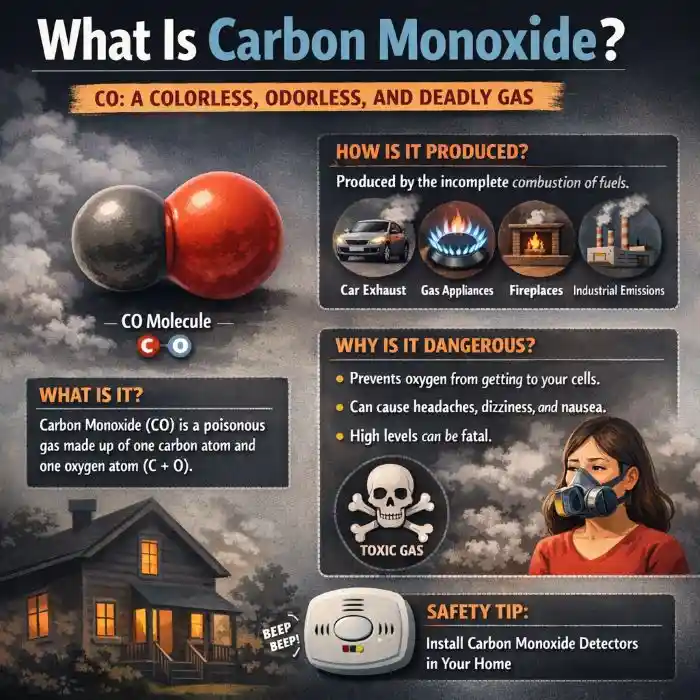
Carbon monoxide, often called CO, is a gas produced when fuels do not burn completely. That includes fuels many people use every day, such as natural gas, propane, oil, wood, charcoal, kerosene, and gasoline.
In simple terms, when something that burns fuel is not getting enough oxygen or is not working the right way, it can create carbon monoxide instead of burning cleanly. That makes it a common home safety issue around furnaces, water heaters, gas stoves, fireplaces, wood stoves, portable heaters, and generators.
Why It Is So Dangerous
The biggest problem with carbon monoxide is that it gives you almost no warning. You do not smell it the way you would smell smoke or a gas odor. You do not see it filling a room. You usually only know it is there if:
- A carbon monoxide alarm goes off
- A faulty appliance shows warning signs
- People in the house start feeling sick
That hidden nature is what makes carbon monoxide so serious. People may keep sitting in the room, sleeping, or going about normal routines while the gas builds up around them.
Where It Comes From in a Home
Carbon monoxide problems often start when a fuel-burning appliance is damaged, blocked, poorly vented, or used in the wrong place. For example, a blocked flue, a cracked heat exchanger, or a generator running too close to the house can all create danger.
Here are some common sources:
- Gas furnaces
- Water heaters
- Fireplaces
- Wood-burning stoves
- Gas ovens or gas ranges
- Portable fuel-burning heaters
- Cars left running in attached garages
- Generators used indoors or near windows and doors
- Charcoal grills used inside
If it burns fuel, it has the potential to produce carbon monoxide under the wrong conditions.
How Long Carbon Monoxide Takes to Leave a House
The Direct Answer
If you are asking how long for carbon monoxide to leave house, the honest answer is: it depends.
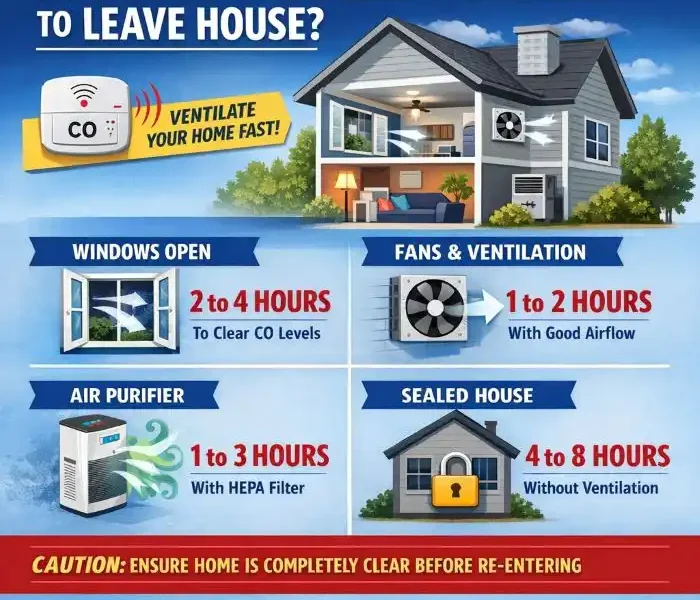
Once the source of the carbon monoxide is turned off and the house is opened up to fresh air, the gas may start clearing fairly quickly. In a well-ventilated house, levels can drop significantly within a few hours. But in a tightly sealed home, or in a house with a strong ongoing source, it can linger much longer.
So while many people want a set number, there is no one-size-fits-all timeline.
Why the Timing Varies So Much
Think of carbon monoxide in a house like steam in a bathroom. If you open the door, turn on the fan, and let air move through the room, the steam fades much faster. If you keep the door shut and the fan off, it hangs around longer.
Carbon monoxide behaves in a similar way in terms of indoor buildup and removal. The gas clears when fresh air replaces contaminated indoor air. That process speeds up or slows down based on the home and the situation.
General Time Estimates
The table below gives a practical estimate, not a guarantee. It is meant to help you understand the range, not to replace emergency action or professional testing.
| Situation | Likely Clearing Time | What It Means |
|---|---|---|
| Source still running | It may keep building | Ventilation alone will not solve the problem |
| Light buildup with strong cross-ventilation | A few hours | Levels may drop faster, but safety still needs to be confirmed |
| Moderate buildup in average home | Several hours to most of a day | Depends on airflow, room layout, and whether the source is fully shut off |
| Heavy buildup or poor ventilation | 24–48 hours or longer | Dangerous conditions may remain much longer |
| House closed up after a leak | Unpredictable | Gas can linger, especially in low-airflow spaces |
Why “Aired Out” Does Not Always Mean Safe
This is an important point. A house can feel fresh and still be unsafe. Since carbon monoxide has no smell, you cannot judge the air by what it seems like. Just because the room no longer feels stuffy or smoky does not mean the CO hazard is gone.
That is why homeowners should not rely only on time or on “airing it out” for a while. A carbon monoxide alarm, proper testing, and inspection of the source matter far more than guessing.
The Safest Way to Think About It
Instead of asking only, “How long does carbon monoxide stay in a house?” ask these three better questions:
- Has the source been stopped?
- Has the home been ventilated with outdoor air?
- Has a qualified professional confirmed it is safe?
Those questions matter because carbon monoxide is not just about how long it stays. It is about whether the danger has actually ended.
Why Homeowners Misjudge the Risk
Many people assume that if they open a few windows for 30 minutes, the problem must be over. That is a risky assumption. The gas may be lower than before, but lower does not always mean safe. Also, if the appliance turns back on, the gas may start building again.
So if you are dealing with a suspected carbon monoxide issue, avoid focusing on a single number like one hour, two hours, or overnight. The right answer depends on the conditions, and safety should come first every time.
Factors That Affect Dissipation Time
Ventilation Makes a Big Difference
The first major factor is airflow. The more fresh outdoor air you bring in, the faster carbon monoxide can leave the house.
Opening several windows and doors helps because it creates air exchange. If you only crack one small window, the process may be much slower. If you open windows on opposite sides of the house and create cross-ventilation, the air can move through much more effectively.
Still, ventilation helps most when the source has already been shut off. If the appliance is still producing carbon monoxide, fresh air alone may not keep up.
The Source Must Be Stopped
This may be the biggest factor of all. If the source continues to release carbon monoxide, the gas can keep building no matter how many windows you open.
For example, if a generator is running in an attached garage, or a malfunctioning furnace keeps cycling on, the home may continue to refill with contaminated air. That is why shutting off the source, when it can be done safely, is essential.
If you are not sure what the source is, do not waste time searching for it while everyone stays inside. Leave the house first.
House Size and Layout Matter
A home’s size, shape, and layout all affect carbon monoxide dissipate time.
A small apartment with several open windows may air out faster than a large two-story house with closed interior doors. A house with open floor space may move air more freely than one with many separate rooms, hallways, and dead-air corners.
Basements, utility rooms, attic spaces, and enclosed bedrooms can also hold contaminated air longer because airflow is weaker in those places.
Weather Conditions Affect Air Movement
Outdoor conditions matter too. Windy weather may help move air through open windows and doors. Calm, still weather may slow the process. Temperature differences between indoors and outdoors can also change how air flows through the house.
If the home has exhaust fans, range hoods, or other ventilation systems, those may help in some cases. But the effect varies depending on the layout and whether those systems are designed to move air outdoors.
The Level of Buildup Changes Everything
A house with a very small amount of carbon monoxide may clear much faster than a house with a severe buildup. The higher the concentration, the longer it can take to reduce it to a safer level.
This is another reason not to rely on guesswork. Two homes can have the same appliance issue but very different indoor conditions. One house might clear fairly quickly. Another may stay hazardous much longer.
Closed Interior Doors Can Slow the Process
Many people forget about interior airflow. Even if you open the front and back door, rooms with closed doors may not ventilate as well. Air tends to move through the easiest path. That means some spaces can clear faster than others.
If it is safe to do so, opening interior doors can help fresh air circulate through the whole house. But again, this should never replace evacuation when carbon monoxide is suspected.
Sealed Homes May Hold Contaminated Air Longer
Modern homes are often built to be energy efficient. That is good for heating and cooling costs, but it can also mean the house is tighter and less naturally ventilated. In a tightly sealed home, air does not leak out as easily, which can slow down the removal of indoor contaminants.
That does not mean newer homes are unsafe by nature. It simply means homeowners should take ventilation and CO alarms seriously.
What To Do Immediately If You Suspect Carbon Monoxide
First: Get People Out
If you think carbon monoxide may be present, do not wait to confirm it by how you feel. Move everyone outside right away, including pets.
This step matters because symptoms can sneak up on people. What starts as a mild headache or dizziness can become much more serious.
Then: Ventilate If You Can Do It Quickly and Safely
If it is safe and fast to do so on your way out, open doors and windows. Do not stay inside trying to create perfect airflow. Your goal is not to fix everything yourself in that moment. Your goal is to reduce exposure and get out.
Stop Using the Suspected Source
If you know what may be causing the problem and can turn it off safely, do so. This could be a furnace, water heater, space heater, fireplace, stove, or generator. But never delay leaving the house to troubleshoot a faulty appliance.
Call for Help
Once you are outside, call the proper service for your area. That may include:
- Emergency services if anyone feels ill
- Your gas provider if a gas appliance may be involved
- A licensed HVAC or appliance professional
- A qualified carbon monoxide safety specialist
If anyone has symptoms like confusion, fainting, severe headache, chest pain, or trouble breathing, treat it as a medical emergency.
Do Not Re-Enter Too Soon
One of the biggest mistakes homeowners make is going back inside too early. Even if the alarm stops, even if the air feels normal, and even if you only planned to grab something quickly, do not re-enter until the home has been checked and it is considered safe.
Quick Emergency Checklist
Here is a simple action list you can remember:
- Get everyone outside immediately
- Open doors and windows on the way out if safe
- Turn off the suspected source if it can be done quickly and safely
- Call for emergency or professional help
- Do not re-enter until the home is cleared
That is the safest response plan for anyone wondering how to get carbon monoxide out of house without taking unnecessary risks.
Signs Carbon Monoxide May Be Present
Physical Symptoms in People
Carbon monoxide often shows up first through symptoms. The problem is that the symptoms can look like many other everyday issues, such as tiredness, a cold, food poisoning, or the flu.
Common warning signs include:
- Headache
- Dizziness
- Nausea
- Fatigue
- Weakness
- Confusion
- Shortness of breath
- Vomiting
- Trouble concentrating
If several people in the house feel sick at the same time, especially if they start feeling better after leaving the house, that is a serious warning sign.
Warning Signs Around Appliances
Your body is not the only clue. Faulty appliances may also leave signs behind. Watch for:
- Yellow or orange flames instead of clean blue ones on gas appliances
- Soot marks near vents, burners, or appliances
- Pilot lights that frequently go out
- Excess condensation on windows near fuel-burning equipment
- Strange burner behavior or appliance shutdowns
These signs do not confirm carbon monoxide on their own, but they should never be ignored.
Why Nighttime Is Especially Dangerous
Carbon monoxide exposure during sleep is especially concerning because people may not notice symptoms in time. That is why working CO alarms near bedrooms are so important.
If an alarm sounds at night, do not assume it is a false alarm because everyone was asleep and “seemed fine.” Take it seriously and get out.
How to Get Carbon Monoxide Out of a House Faster
Shut Off the Source First
If you want to know how long to air out house after carbon monoxide, the first step is always the same: stop the source. Otherwise, you are trying to empty a bathtub while the tap is still running.
A faulty heater, stove, or furnace can keep feeding the problem. Until that stops, clearing the house becomes much harder.
Create Cross-Ventilation
The fastest natural way to move indoor air is to create a path for it. Open windows and doors on opposite sides of the home so fresh air can move through, not just into, the house.
This method works better than opening one window in one room because it gives contaminated air somewhere to go.
Open Interior Doors
If the situation is under control and professionals say it is appropriate, opening interior doors can help trapped air move out of enclosed rooms. Bedrooms, laundry rooms, basements, and hallways may otherwise ventilate more slowly.
Use Fans Carefully
Fans can help move air, but they are not a substitute for outside ventilation. A fan blowing contaminated air around a closed room does not remove the carbon monoxide. It only stirs the air.
If fans are used, they should support fresh-air exchange, not replace it. For example, a properly placed fan near an open window may help pull air through the home.
Avoid Restarting Appliances
Do not turn the suspected appliance back on just to “see if it’s okay now.” That can put everyone back at risk.
Even if the home seems clear, the original cause may still be there. A blocked vent, faulty burner, or damaged furnace does not fix itself just because the windows were opened.
Get a Professional Inspection
This is the step that turns a temporary response into a real safety plan. A qualified professional can inspect:
- The suspected appliance
- Flues and vents
- Exhaust systems
- Furnace operation
- Water heater function
- Airflow and ventilation pathways
This is the only reliable way to know whether the home is safe to use again.
Is It Safe To Stay Inside While It Clears?
The Short Answer
In most situations, no. If carbon monoxide is suspected, the safest action is to leave the house rather than stay inside waiting for the air to improve.
Why Waiting Inside Is Risky
People sometimes think, “I’ll just open the windows and stand near the door for a few minutes.” That is not a reliable safety strategy. Carbon monoxide can affect you before you realize what is happening, and symptoms can cloud your judgment.
Also, because you cannot smell or see the gas, you have no safe way to judge the risk by feel alone.
Low Levels Can Still Be Harmful Over Time
Even if the concentration is not immediately overwhelming, lower-level exposure over time can still be harmful. You may not collapse, but you may develop headaches, fatigue, nausea, and confusion. For children, older adults, pregnant women, and people with heart or breathing problems, the risk can be even more serious.
So if you are asking whether you should stay inside while it airs out, the safest answer is simple: don’t.
Carbon Monoxide vs. Airing Out the House
Airing Out Helps, But It Does Not Prove Safety
Opening windows and doors can reduce carbon monoxide in the air. That part is true. But reduced is not the same as gone, and gone is not the same as safe to re-enter without inspection.
This is where many people get confused. They think the act of ventilation itself solves the problem fully. In reality, ventilation is only one part of the response.
You Cannot “Smell When It’s Gone”
Unlike smoke, paint fumes, or cooking odors, carbon monoxide does not have a smell. So you cannot judge safety by whether the house smells normal again.
That means phrases like “the smell is gone” do not apply here. Carbon monoxide safety depends on detection, testing, and fixing the source.
How Long Carbon Monoxide Stays in the Body
Why Fresh Air Matters
Carbon monoxide does not just affect the air in your house. It also affects the body because it interferes with the blood’s ability to carry oxygen. That is why people can feel weak, dizzy, confused, or sick after exposure.
Once a person gets into fresh air, the body begins clearing the gas through breathing. But how long recovery takes depends on how much exposure happened, how long it lasted, and how quickly treatment begins.
When Medical Help Is Needed
Mild exposure may improve after leaving the area and getting fresh air, but serious exposure needs urgent medical attention. In more severe cases, hospital treatment and oxygen therapy may be required.
If anyone has strong symptoms, lost consciousness, seems confused, or is having trouble breathing, do not wait it out. Get medical help right away.
Prevention Tips for Homeowners
Install Carbon Monoxide Alarms
If there is one step every homeowner should take, it is this: install carbon monoxide alarms in the right places.
Place them near sleeping areas and on each level of the home. Follow the product instructions for placement, testing, and replacement. A working alarm can give you the warning your senses never will.
Test Alarms Regularly
An alarm only helps if it works. Test your units on a regular schedule and replace batteries when needed. Also pay attention to the device’s replacement date. Carbon monoxide alarms do not last forever.
Service Fuel-Burning Appliances Every Year
Furnaces, boilers, fireplaces, water heaters, and other fuel-burning appliances should be inspected and serviced regularly. Small issues can turn into dangerous problems when left alone.
Annual maintenance helps catch blocked vents, worn parts, poor burner performance, and other hidden risks before they become emergencies.
Never Use Outdoor Equipment Indoors
Generators, charcoal grills, camping stoves, and fuel-powered tools should never be used inside a home, basement, garage, or enclosed porch. Even if a garage door is open, that does not make it safe.
This is one of the most preventable carbon monoxide dangers, yet it causes many incidents every year.
Keep Vents and Chimneys Clear
Blocked chimneys and vents can cause combustion gases to back up into the house. Make sure flues, exhaust vents, and chimney systems stay clear and in good condition.
Bird nests, debris, damage, and poor installation can all create problems.
Pay Attention to Appliance Warning Signs
Do not ignore strange appliance behavior. A weak flame, soot marks, repeated shutdowns, odd condensation, or a stuffy utility room may be early clues that something is wrong.
The sooner you act, the lower the chance of a dangerous buildup.
Simple Prevention Habits
Here are a few practical habits worth keeping:
- Install and test CO alarms
- Book yearly appliance servicing
- Never run generators or grills indoors
- Keep vents, flues, and chimneys clear
- Investigate unusual flames, soot, or appliance issues quickly
These small habits go a long way toward preventing a serious emergency.
When To Call a Professional
Do Not Guess When Safety Is Involved
You should call a professional anytime carbon monoxide is suspected and the cause is not fully clear. This includes situations where:
- The CO alarm sounds
- Anyone in the house feels symptoms
- An appliance flame looks wrong
- You see soot or venting problems
- The issue keeps happening again
- You are unsure whether it is safe to go back inside
The Right Time to Get Expert Help
A professional inspection is especially important after any leak, alarm event, or appliance malfunction. Even if the house seems fine later, the original source may still be dangerous.
When it comes to carbon monoxide, uncertainty itself is a good reason to call.
FAQ About Carbon Monoxide in the Home
How long does it take for carbon monoxide to dissipate in a house?
It can begin clearing within hours once the source is stopped and the home is ventilated, but the full time varies widely. A lightly affected home with strong airflow may clear much faster than a tightly sealed home with heavy buildup. Because of that, there is no universal timeline.
Can opening windows remove carbon monoxide?
Yes, opening windows and doors can help reduce carbon monoxide by bringing in fresh air and pushing contaminated air out. But ventilation alone does not confirm the home is safe. You still need to deal with the source and have the situation checked if a leak is suspected.
How do I know if carbon monoxide is gone?
You cannot know by smell, sight, or “how the air feels.” The safest way is to rely on working carbon monoxide alarms and professional assessment of the home and the appliance involved.
What level of carbon monoxide is dangerous?
Any unexpected carbon monoxide in a living space should be taken seriously. Risk depends on both the level and how long people are exposed. Lower levels over time can still be harmful, and higher levels can become dangerous very quickly.
Should I sleep in the house after a CO leak?
Not unless the home has been properly checked and confirmed safe. Sleeping in a house that may still have a carbon monoxide issue is risky because symptoms may not wake you in time. If there is any doubt, stay elsewhere until the problem is resolved.
Final Thoughts
So, how long for carbon monoxide to leave house? In many cases, it may start clearing within hours after the source is stopped and fresh air is moving through the home. But the real answer depends on ventilation, the amount of buildup, the layout of the house, and whether the source has truly been fixed.
The key thing to remember is this: do not treat carbon monoxide like a normal household odor that simply fades away. If you suspect it, get outside, ventilate if you can do so safely, and have the home checked before going back in. Add working CO alarms, regular appliance servicing, and good safety habits, and you will greatly lower the risk of it happening again.