<p>If you are searching for <a href="https://www.reddit.com/r/lifehacks/comments/1d1gagu/how_to_get_rid_of_cigarette_smell_in_house/"><strong>how to get rid of smoke smell in a house</strong></a>, you are probably dealing with one of the most stubborn odors a home can hold.</p>
<p>Smoke does not just sit in the air for a few hours and disappear. It settles into walls, ceilings, carpets, furniture, curtains, vents, and even inside hidden areas like insulation and ductwork. That is why a room can still smell smoky long after the cigarette is out or the fire is gone.</p>
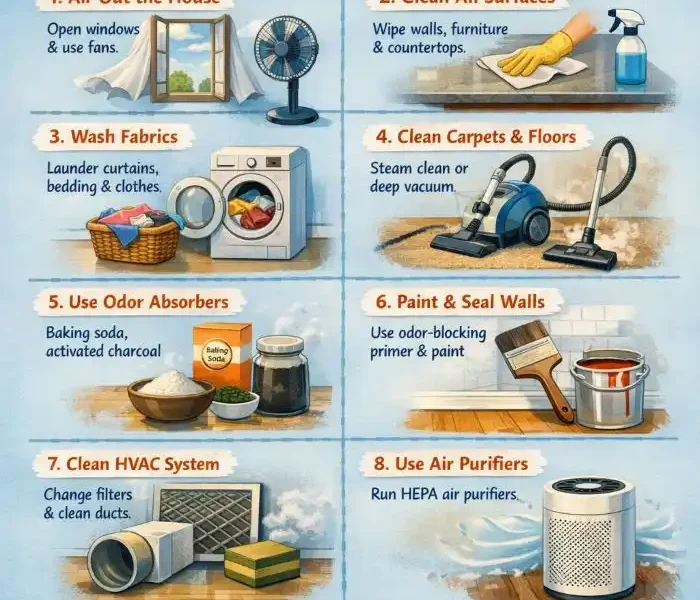
<p>The good news is that you can remove smoke odor. In many cases, you can do a lot on your own if you use the right order and the right methods. The key is to be <strong>systematic</strong>. You need to air out the house, remove the source, clean every surface that holds residue, treat fabrics, and make sure your HVAC system is not blowing the smell back into your rooms.</p>
<p>In this guide, I will walk you through the whole process in plain language. You will learn why smoke smell lingers, what to do right away, how to deep-clean each area, when natural remedies help, when commercial products make more sense, and when it is time to bring in a professional.</p>
<p>If you stay patient and follow the steps, you can make real progress.</p>
<h2 id="why-smoke-smell-lingers">Why Smoke Smell Lingers</h2>
<p><img class="aligncenter wp-image-7100 size-full" src="https://comeawayhome.co.uk/wp-content/uploads/2026/05/a052a20f-608d-40b8-81d4-c5ca3c949a58-ezgif.com-jpg-to-webp-converter.webp" alt="how to get rid of smoke smell in a house" width="700" height="700" /></p>
<h4 id="smoke-particles-stick-to-almost-everything">Smoke particles stick to almost everything</h4>
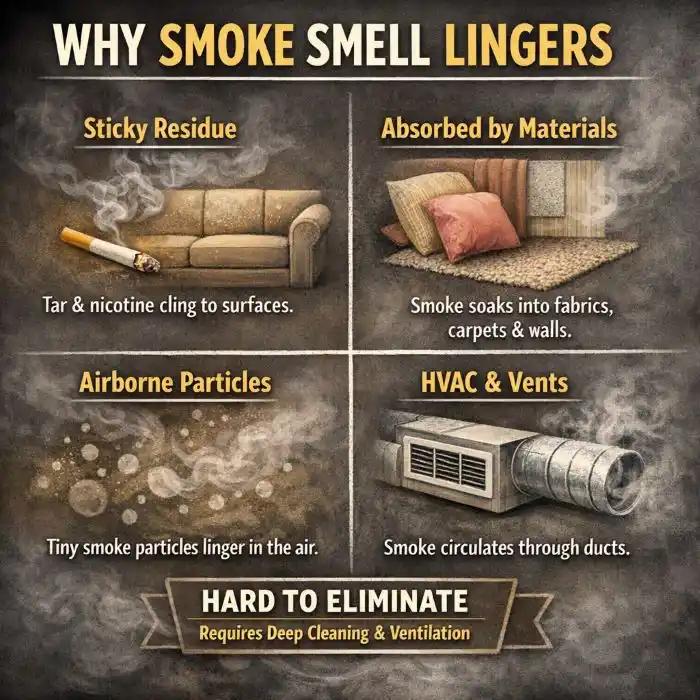
<p>Smoke is made up of tiny particles and oily residue. When smoke moves through a room, it does not simply float around and leave. It lands on surfaces and clings to them.</p>
<p>That residue often contains <strong>tar, soot, oils, and chemicals</strong>. Hard surfaces like glass and tile may be easier to clean, but porous materials hold on much longer. Carpets, upholstery, wood, drywall, clothing, and bedding soak in the smell like a sponge.</p>
<p>This is why air fresheners rarely solve the problem. They may cover the odor for a little while, but the real source is still sitting on the surfaces around you.</p>
<h4 id="different-types-of-smoke-behave-differently">Different types of smoke behave differently</h4>
<p>Not all smoke smells the same, and not all of them are equally easy to remove.</p>
<p>Cigarette smoke is especially sticky. It builds up over time and leaves a yellowish or brown film on walls, ceilings, blinds, and vents. It can spread through the whole <a href="https://comeawayhome.co.uk/how-to-eliminate-fish-odor-in-the-house/">house</a>, even if smoking only happened in one room.</p>
<p>Cooking smoke is usually lighter unless you had repeated grease-heavy cooking or a serious kitchen fire. It still gets into fabrics and cabinets, but it often responds better to basic cleaning.</p>
<p>Fire smoke is the toughest of all. It can sink deeply into drywall, insulation, subfloors, and HVAC systems. A house that has been through a fire may need more than deep cleaning. It may need sealing, restoration, or replacement of materials.</p>
<h4 id="you-need-to-find-the-source-before-you-treat-the-smell">You need to find the source before you treat the smell</h4>
<p>Many homeowners clean one area and then wonder why the odor keeps coming back. The reason is simple: the smell is often hiding in more than one place.</p>
<p>Before you start, walk through the house and identify where the odor is strongest. That usually tells you where the main buildup sits.</p>
<p><strong>Use this quick source-check list before you clean:</strong></p>
<ul>
<li><strong>Walls and ceilings</strong> in rooms where smoking or fire exposure happened</li>
<li><strong>Curtains, rugs, carpets, and upholstery</strong> that trap odor deeply</li>
<li><strong>HVAC filters, vents, and ducts</strong> that can spread smoke back into the air</li>
<li><strong>Closets, stored clothing, bedding, and soft toys</strong> that absorb residue quietly</li>
<li><strong>Cabinets, doors, trim, and blinds</strong> where sticky smoke film collects</li>
<li><strong>Attic insulation, wall cavities, or damaged materials</strong> if the smell followed a fire</li>
</ul>
<p>When you know where the smell is coming from, your cleaning work becomes much more effective.</p>
<h2 id="immediate-steps-after-smoking-or-a-recent-fire">Immediate Steps After Smoking or a Recent Fire</h2>
<h4 id="open-the-house-and-move-stale-air-out-fast">Open the house and move stale air out fast</h4>
<p>Your first job is to get as much smoky air out as possible.</p>
<p>Open windows and doors on opposite sides of the house to create <strong>cross-ventilation</strong>. This helps old air move out instead of just drifting around indoors. If you have fans, use them to push air outside rather than simply stirring it inside the room.</p>
<p>Exhaust fans in bathrooms and kitchens can help too. If weather allows, keep the home open for several hours. In mild conditions, you may want to do this for multiple days.</p>
<p>Ventilation will not remove deep smoke odor on its own, but it gives you a much better starting point.</p>
<h4 id="remove-the-source-right-away">Remove the source right away</h4>
<p>This part matters more than people think.</p>
<p>If cigarette butts, ashtrays, burned food, charred fabric, or fire-damaged items are still in the home, the smell will keep feeding itself. Get those items out as quickly as you safely can.</p>
<p>Throw away anything that is heavily burned, deeply contaminated, or impossible to clean well. Sometimes people waste time trying to save low-value items that keep spreading the odor through the house. It is often smarter to let those go and focus on the home itself.</p>
<p>If the smell came from indoor smoking, clean or remove all ashtrays, lighters, smoking trays, and nearby fabrics first. Those smaller items can keep a room smelling smoky even after you wipe the bigger surfaces.</p>
<h4 id="wipe-hard-surfaces-before-the-residue-settles-deeper">Wipe hard surfaces before the residue settles deeper</h4>
<p>Fresh smoke residue is easier to remove than old residue.</p>
<p>Use a simple cleaning mix such as warm water with a mild detergent, or a mix of water and white vinegar. Dampen a cloth or sponge and wipe tables, counters, doors, windowsills, trim, light switches, and any hard furniture surfaces.</p>
<p>Do not soak surfaces. A damp wipe works better than oversaturating walls or wood.</p>
<p>The goal here is not to complete the full deep clean yet. The goal is to start lifting off the film before it spreads further or dries harder.</p>
<h4 id="set-out-odor-absorbers-as-a-temporary-support">Set out odor absorbers as a temporary support</h4>
<p>Odor absorbers do not replace cleaning, but they can help lower the smell while you work.</p>
<p>Place bowls of <strong>white vinegar</strong>, <strong>baking soda</strong>, or <strong>activated charcoal</strong> in smoky rooms. These materials can absorb some odor from the air. Many people notice the biggest benefit in smaller rooms, closets, and near soft furnishings.</p>
<p>Leave them out for a day or two, then refresh them if needed.</p>
<p>Activated charcoal often lasts longer than baking soda. Vinegar works well, but some people dislike its smell at first. The vinegar smell fades as it dries.</p>
<h4 id="put-safety-first-if-the-house-had-a-fire">Put safety first if the house had a fire</h4>
<p>If the smoke smell came from an actual fire, be careful.</p>
<p>Before you start cleaning, make sure the home is safe to enter. Fire can damage wiring, weaken structures, and leave behind harmful residue. If firefighters or inspectors have not cleared the home, wait for professional guidance.</p>
<p>Wear gloves, and if the odor is strong or soot is visible, wear a proper mask. Avoid mixing random cleaners. Never mix <strong>bleach and ammonia</strong>, and do not use strong chemicals in poorly ventilated rooms.</p>
<p>A fresh smoke smell after a minor incident may be a cleaning problem. A heavy post-fire smell can also be a health and safety problem. Know the difference.</p>
<h2 id="deep-cleaning-rooms-and-surfaces">Deep-Cleaning Rooms and Surfaces</h2>
<h4 id="start-with-a-top-to-bottom-cleaning-plan">Start with a top-to-bottom cleaning plan</h4>
<p>When you clean smoke residue, the order matters.</p>
<p>Always work from the <strong>top down</strong>. Start with ceilings, then walls, then trim, then furniture, and finally floors. If you clean the floor first and then scrub the ceiling, you will just spread residue back onto areas you already finished.</p>
<p>Work one room at a time. That makes the project feel manageable and helps you track what is improving.</p>
<p>Smoke cleanup is not usually a one-pass job. You may need two or three rounds in the worst rooms.</p>
<h4 id="walls-and-ceilings-need-more-than-a-quick-wipe">Walls and ceilings need more than a quick wipe</h4>
<p>Walls and ceilings often carry the strongest hidden smoke film.</p>
<p>In smoker’s homes, nicotine and tar can build up over years. In fire-damaged rooms, soot can settle in uneven patches. Even when the surface looks clean, the smell may still be there.</p>
<p>Start with a dry dusting or vacuuming if there is loose residue. Then wash the surface using a sponge or microfiber cloth with a mild degreasing cleaner or a vinegar-water mix. Test a small area first, especially on painted surfaces.</p>
<p>Work gently and in sections. Rinse the cloth often so you do not smear dirty residue back across the wall.</p>
<p>If the walls are heavily stained, a stronger wall-washing cleaner may help. If the odor remains after repeated cleaning, the paint itself may be holding the smell. In that case, washing alone will not be enough.</p>
<p>You may need to use an <strong>odor-blocking primer</strong> and repaint. This is often the turning point in older homes where people smoked indoors for years. Paint does not remove odor by itself, but a proper sealing primer can trap what cleaning cannot fully lift.</p>
<p>Ceilings deserve special attention. Smoke rises, so ceilings often hold more odor than homeowners expect.</p>
<h4 id="floors-can-trap-smoke-much-longer-than-you-think">Floors can trap smoke much longer than you think</h4>
<p>Floors are another major holding zone for smoke residue.</p>
<p>Hard floors should be vacuumed first, especially along edges and corners. Then wash them with the right cleaner for the material. Wood, laminate, tile, and vinyl all need slightly different care, so avoid soaking them.</p>
<p>Carpets are harder. Smoke gets deep into the fibers and the padding underneath. Start with a <strong>HEPA vacuum</strong> if possible. A regular vacuum may pick up debris, but a HEPA unit is better at capturing finer particles.</p>
<p>After vacuuming, shampoo the carpet with a machine or hire a professional carpet cleaner. For light smoke odor, one good shampooing may help a lot. For stronger odor, you may need repeated cleaning.</p>
<p>If the smell still comes back after deep cleaning, the carpet pad underneath may be contaminated. At that point, replacement may be the only lasting fix.</p>
<h4 id="windows-trim-doors-and-cabinets-hold-a-sticky-film">Windows, trim, doors, and cabinets hold a sticky film</h4>
<p>People often focus on walls and floors and forget the details. That is a mistake.</p>
<p>Smoke leaves a sticky film on:</p>
<ul>
<li>window frames</li>
<li>blinds</li>
<li>baseboards</li>
<li>crown molding</li>
<li>cabinet doors</li>
<li>interior doors</li>
<li>shelves</li>
<li>light fixtures</li>
</ul>
<p>These surfaces may not look terrible at first glance, but they quietly keep releasing odor into the room.</p>
<p>Use a cloth and a mild degreasing cleaner to wipe them thoroughly. Pay attention to grooves, handles, hinges, and corners where residue collects.</p>
<p>Kitchen cabinets deserve extra care because cooking oils and smoke can combine into a stubborn layer. A simple wipe may not be enough. Sometimes you need a second pass with a cleaner made for grease and buildup.</p>
<h4 id="porous-household-items-need-special-handling">Porous household items need special handling</h4>
<p>Smoke does not stop at big visible surfaces. It also moves into all the smaller porous items in a room.</p>
<p>Books, papers, baskets, lampshades, cardboard boxes, pet beds, fabric bins, and stuffed toys can all hold odor. Some can be saved. Some cannot.</p>
<p>Books and paper are tricky. You can air them out in a dry, shaded space and place odor absorbers nearby. For light odor, that may be enough. For stronger odor, saving them becomes much harder.</p>
<p>Area rugs should be taken outside, shaken if safe to do so, aired out, and then professionally cleaned if the odor remains. Small washable rugs can go through a wash cycle if the care label allows it.</p>
<p>Stuffed toys and pet bedding should be washed thoroughly. If the smell remains after cleaning, replacement is usually the better option.</p>
<p>The main rule is simple: if an item is low-cost, heavily smoky, and difficult to wash well, replacing it may save you time and frustration.</p>
<h4 id="use-odor-absorbers-for-support-not-as-the-main-fix">Use odor absorbers for support, not as the main fix</h4>
<p>Baking soda, charcoal, and similar products work best <strong>after</strong> you clean, not instead of cleaning.</p>
<p>Once you have scrubbed the room, vacuumed, and washed the fabrics, place odor absorbers around the area for a few days. This can help capture lingering smell in the air while the house continues to dry and air out.</p>
<p>You can also sprinkle baking soda on some carpets before vacuuming if the carpet care instructions allow it. Let it sit for a few hours first. This can help with mild odor, though it will not fix a deeply contaminated carpet pad.</p>
<h4 id="here-is-a-room-by-room-guide-to-what-usually-works">Here is a room-by-room guide to what usually works</h4>
<table>
<thead>
<tr>
<th>Area of the House</th>
<th>Why Smoke Smell Stays There</th>
<th>Best First Step</th>
<th>When Replacement or Professional Help May Be Needed</th>
</tr>
</thead>
<tbody>
<tr>
<td>Walls and ceilings</td>
<td>Smoke film, tar, soot, paint absorption</td>
<td>Wash with mild degreaser or vinegar mix</td>
<td>If odor stays after cleaning and sealing primer is needed</td>
</tr>
<tr>
<td>Carpets and rugs</td>
<td>Fibers and padding trap particles</td>
<td>HEPA vacuum, then shampoo</td>
<td>If smell returns from padding or subfloor</td>
</tr>
<tr>
<td>Upholstery and curtains</td>
<td>Fabric absorbs odor deeply</td>
<td>Launder or steam clean</td>
<td>If odor remains after repeated treatment</td>
</tr>
<tr>
<td>HVAC system</td>
<td>Filters and ducts spread odor</td>
<td>Replace filters, clean vents</td>
<td>If ducts or blower system keep recirculating smell</td>
</tr>
<tr>
<td>Cabinets and trim</td>
<td>Sticky residue builds on surfaces</td>
<td>Thorough wipe-down</td>
<td>If buildup is heavy and widespread</td>
</tr>
<tr>
<td>Insulation and drywall</td>
<td>Smoke penetrates hidden spaces</td>
<td>Inspect affected areas</td>
<td>If post-fire odor remains in walls or attic</td>
</tr>
</tbody>
</table>
<p>This kind of full-house approach is what gets results. A smoke odor problem usually becomes stubborn only when one or two hidden areas get skipped.</p>
<h2 id="fabrics-upholstery-and-soft-furnishings">Fabrics, Upholstery, and Soft Furnishings</h2>
<h4 id="washable-fabrics-often-improve-with-repeated-laundering">Washable fabrics often improve with repeated laundering</h4>
<p>Fabrics are some of the biggest odor holders in any home.</p>
<p>Wash every washable item you can safely clean: curtains, cushion covers, blankets, bedding, clothing, removable slipcovers, and washable rugs. Use a strong detergent, and consider adding <strong>white vinegar</strong> or <strong>baking soda</strong> to the wash if the item care label allows it.</p>
<p>You may need to wash some items more than once. Smoke odor can fade gradually rather than disappear after one cycle.</p>
<p>Drying items outside in fresh air and sunlight can also help. Sun and airflow often reduce lingering odor better than indoor drying alone.</p>
<p>Do not rush these soft items. Many people clean the room but forget the fabrics, then wonder why the smell still hangs in the air.</p>
<h4 id="upholstery-needs-deeper-treatment">Upholstery needs deeper treatment</h4>
<p>Couches, armchairs, dining seats, and padded headboards can hold smoke for a very long time.</p>
<p>If the upholstery can be cleaned with a fabric-safe machine or steam cleaner, that may help. Always test a small hidden spot first. Some fabrics do not handle moisture well.</p>
<p>For older or delicate furniture, a professional upholstery cleaner is often the safest route. Smoke odor can sit deep inside the cushions, foam, and batting. Surface spraying may only cover the smell for a short time.</p>
<p>If a couch has been in a smoking room for years, there is a point where cleaning gives only limited results. That does not mean you failed. It just means the smoke reached deep into the material.</p>
<h4 id="drapes-mattresses-pillows-and-closets-are-often-overlooked">Drapes, mattresses, pillows, and closets are often overlooked</h4>
<p>Large fabric items quietly hold a lot of odor.</p>
<p>Drapes and curtains should come down and be washed or dry-cleaned depending on their material. Mattresses can be vacuumed, aired out, and lightly treated with baking soda before vacuuming again, but badly smoky mattresses may need to be replaced.</p>
<p>Pillows are similar. Some can be washed. Others hold odor deep in the filling and never fully recover.</p>
<p>Check closets too. Clothing stored in a smoky house absorbs odor even when nobody wore it during smoking. Wash what you can, and air out the rest.</p>
<p>Do not forget pet beds, throw pillows, fabric baskets, and seasonal blankets. These smaller items often keep the smell alive after the big cleaning jobs are done.</p>
<h4 id="mini-case-a-living-room-that-smelled-like-smoke-for-years">Mini-case: a living room that smelled like smoke for years</h4>
<p>To show you how this works in real life, imagine a living room where indoor smoking happened for several years. The room has a fabric sofa, heavy curtains, a rug, and a central air vent.</p>
<p><strong>A simple step-by-step timeline would look like this:</strong></p>
<ul>
<li><strong>Day 1:</strong> Open windows, run fans, remove ashtrays, and wipe all hard surfaces</li>
<li><strong>Day 2:</strong> Wash walls, ceiling edges, doors, trim, and blinds</li>
<li><strong>Day 3:</strong> Launder curtains, pillow covers, and throw blankets; vacuum sofa and rug with a HEPA vacuum</li>
<li><strong>Day 4:</strong> Steam clean upholstery and shampoo the rug; replace HVAC filter</li>
<li><strong>Day 5:</strong> Place activated charcoal in the room, keep air moving, and reassess the odor</li>
<li><strong>Day 6 and beyond:</strong> If smell remains, repaint with odor-sealing primer or replace the most contaminated soft furnishings</li>
</ul>
<p>That kind of methodical plan works far better than using one spray and hoping for the best.</p>
<h2 id="hvac-vents-and-insulation">HVAC, Vents, and Insulation</h2>
<h4 id="your-hvac-system-can-keep-bringing-the-smell-back">Your HVAC system can keep bringing the smell back</h4>
<p>You can clean a room very well and still notice smoke odor later. Often, the HVAC system is the reason.</p>
<p>Smoke gets pulled into return vents and can settle in filters, ducts, and internal parts of the system. Each time the air runs, it may blow some of that smell back through the house.</p>
<p>That means HVAC treatment is not optional in a serious smoke odor cleanup. It is part of the core job.</p>
<h4 id="change-filters-and-clean-vents-early-in-the-process">Change filters and clean vents early in the process</h4>
<p>Start by replacing all air filters. If possible, use a filter designed to capture finer particles and odors, such as one with <strong>activated carbon</strong>.</p>
<p>Then clean vent covers and returns. Dust and smoke residue often build up there, and it is an easy place to start.</p>
<p>If your system has a fresh-air setting or ventilation feature, use it as directed. Let the system help move cleaner air through the home after you have removed as much residue as possible.</p>
<p>During the cleanup stage, you may want to change filters more often than usual.</p>
<h4 id="ductwork-may-need-professional-cleaning">Ductwork may need professional cleaning</h4>
<p>If smoke exposure was heavy, especially after a fire or years of indoor smoking, the ducts may be carrying the smell.</p>
<p>A professional duct cleaning can help when there is visible buildup, strong odor from vents, or contamination throughout the system. DIY vent cleaning can help near the openings, but it does not reach deep inside the duct network.</p>
<p>If the smell gets stronger when the system turns on, that is a strong sign the HVAC system needs attention.</p>
<h4 id="insulation-and-wall-cavities-can-hold-hidden-odor">Insulation and wall cavities can hold hidden odor</h4>
<p>This is one of the most frustrating parts of smoke smell removal.</p>
<p>When smoke gets behind walls, into attic insulation, or into crawl spaces, the odor may continue even after every visible surface has been cleaned. This is more common after a fire than after ordinary indoor smoking, but it can happen in severe cases.</p>
<p>At that point, replacement may be necessary. Insulation is highly absorbent. Once it is saturated with smoke odor, cleaning is rarely enough.</p>
<h4 id="use-ozone-and-ionizers-with-caution">Use ozone and ionizers with caution</h4>
<p>Some people hear about ozone machines or ionizers and assume they are a quick fix.</p>
<p>These tools can help in some professional settings, but they are not casual household gadgets. Ozone, in particular, can be unsafe in occupied spaces and should be used with great care and proper guidance.</p>
<p>In simple terms, do not treat ozone as your first move. Start with ventilation, removal of the source, deep cleaning, and HVAC care. If stronger treatment is still needed, talk with a qualified professional.</p>
<h2 id="long-term-fixes-and-when-to-hire-professionals">Long-Term Fixes and When to Hire Professionals</h2>
<h4 id="know-the-signs-that-diy-methods-are-not-enough">Know the signs that DIY methods are not enough</h4>
<p>There is no shame in calling for help.</p>
<p>If you have cleaned the walls, floors, fabrics, and HVAC system and the smell still returns, that usually means one of three things is happening: the smoke reached hidden materials, the contamination is too deep, or something was missed.</p>
<p>Professional help makes sense when:</p>
<ul>
<li>the house had a <strong>major fire</strong></li>
<li>the odor is still strong after full cleaning</li>
<li>smoke has affected insulation, drywall, or subfloors</li>
<li>the smell gets stronger when heat or AC runs</li>
<li>you are preparing the home for sale and need lasting results</li>
</ul>
<p>In these cases, a professional may save you time, money, and repeated trial and error.</p>
<h4 id="what-professional-smoke-odor-removal-usually-includes">What professional smoke odor removal usually includes</h4>
<p>Restoration and odor-removal companies often use a mix of methods.</p>
<p>They may perform deep HEPA cleaning, duct cleaning, thermal fogging, odor sealing, or specialized deodorizing treatments. Some also inspect hidden spaces where smoke may have penetrated behind walls or above ceilings.</p>
<p>The benefit of a pro is not just stronger equipment. It is also their ability to identify where the smell is really coming from.</p>
<h4 id="typical-services-uses-and-rough-cost-ranges">Typical services, uses, and rough cost ranges</h4>
<table>
<thead>
<tr>
<th>Professional Service</th>
<th>What It Does</th>
<th>Best For</th>
<th>Typical Cost Range</th>
</tr>
</thead>
<tbody>
<tr>
<td>Deep smoke cleaning</td>
<td>Cleans residue from surfaces, trim, and contents</td>
<td>Moderate smoke buildup across several rooms</td>
<td><strong>$300–$1,500+</strong> depending on size</td>
</tr>
<tr>
<td>Carpet and upholstery treatment</td>
<td>Extracts odor from fabrics and soft furnishings</td>
<td>Smoky furniture, rugs, drapes</td>
<td><strong>$100–$800+</strong> depending on items</td>
</tr>
<tr>
<td>Air duct cleaning</td>
<td>Removes buildup inside ducts and vents</td>
<td>Odor that returns when HVAC runs</td>
<td><strong>$300–$1,000+</strong></td>
</tr>
<tr>
<td>Odor-sealing primer and repainting</td>
<td>Seals odor left in walls and ceilings</td>
<td>Long-term cigarette smoke or light post-fire odor</td>
<td><strong>$500–$3,000+</strong></td>
</tr>
<tr>
<td>Thermal fogging or advanced deodorizing</td>
<td>Reaches odor in cracks and hidden spaces</td>
<td>Stubborn odor after normal cleaning</td>
<td><strong>$200–$1,500+</strong></td>
</tr>
<tr>
<td>Insulation or material replacement</td>
<td>Removes deeply contaminated hidden materials</td>
<td>Severe fire smoke or lasting structural odor</td>
<td><strong>Varies widely, often $1,000+</strong></td>
</tr>
</tbody>
</table>
<p>Prices depend on the size of the home, how bad the damage is, and local labor rates. It is smart to get more than one quote and ask exactly what is included.</p>
<h4 id="professional-treatment-can-also-protect-health-and-home-value">Professional treatment can also protect health and home value</h4>
<p>A smoke-smelling home feels unpleasant, but it can also affect your comfort, your indoor air quality, and the value of the property.</p>
<p>If you plan to sell the house, thorough odor removal matters. Buyers notice smoke quickly, and many will assume the worst if the smell is still present. A documented professional cleanup can help show that the issue was handled properly.</p>
<h2 id="natural-remedies-vs-commercial-products">Natural Remedies vs. Commercial Products</h2>
<h4 id="natural-remedies-can-help-in-mild-to-moderate-cases">Natural remedies can help in mild to moderate cases</h4>
<p>Natural options are popular because they are affordable and easy to find.</p>
<p><strong>Baking soda</strong> helps absorb odor. <strong>White vinegar</strong> can cut through residue and reduce smell on hard surfaces. <strong>Activated charcoal</strong> is excellent for passive odor absorption. Some people also use <strong>coffee grounds</strong>, though they tend to mask odor more than truly remove it.</p>
<p>These remedies work best when the smoke odor is not deeply embedded, or when you use them as support after deep cleaning.</p>
<p>They are especially helpful in closets, small rooms, vehicles, cabinets, and areas where the smell is lingering but not severe.</p>
<h4 id="commercial-products-can-work-faster-and-go-deeper">Commercial products can work faster and go deeper</h4>
<p>Commercial odor neutralizers and smoke-removal cleaners are usually stronger and more targeted. Some are made to break down odor molecules instead of simply covering them up.</p>
<p>Enzyme-based products can help on certain soft surfaces. Specialized smoke cleaners may cut greasy residue better than homemade mixes. High-quality HEPA air purifiers can also reduce airborne particles while you work through the cleanup.</p>
<p>Still, stronger does not always mean better. You need to use the right product for the right surface, and you need to follow label directions carefully.</p>
<h4 id="a-quick-way-to-choose-between-them">A quick way to choose between them</h4>
<p><strong>Use this simple comparison to decide what fits your situation:</strong></p>
<ul>
<li><strong>Choose natural remedies</strong> if the smell is light, the budget is tight, and you mainly need support after cleaning</li>
<li><strong>Choose commercial products</strong> if the odor is stronger, the residue is sticky, or you need faster visible results</li>
<li><strong>Choose professional treatment</strong> if natural and store-bought solutions do not solve the problem after a full cleanup</li>
<li><strong>Choose pet- and child-safe products</strong> when treating shared living spaces</li>
<li><strong>Avoid risky shortcuts</strong> like using ozone in occupied areas or mixing strong chemicals together</li>
</ul>
<p>In most homes, the best approach is not natural versus commercial. It is <strong>natural plus commercial</strong>, used in the right order.</p>
<h2 id="preventive-measures-and-maintenance">Preventive Measures and Maintenance</h2>
<h4 id="the-easiest-smoke-smell-to-remove-is-the-one-that-never-builds-up">The easiest smoke smell to remove is the one that never builds up</h4>
<p>If anyone in the home smokes, the most effective long-term fix is to keep smoking <strong>outside</strong>.</p>
<p>That one rule can protect your walls, furniture, HVAC system, and fabrics from future buildup. Even occasional indoor smoking leaves residue behind over time.</p>
<h4 id="stay-consistent-with-maintenance-after-cleanup">Stay consistent with maintenance after cleanup</h4>
<p>Once the house smells better, keep it that way.</p>
<p>Change HVAC filters regularly, especially in the first few months after cleanup. Vacuum with a HEPA vacuum if possible. Wash soft furnishings often. Wipe hard surfaces before residue can build again.</p>
<p>A home that has already been treated for smoke odor will respond better to regular upkeep than to long periods of neglect.</p>
<h4 id="watch-your-indoor-air-quality">Watch your indoor air quality</h4>
<p>If the home had a serious smoke issue, it helps to stay aware of air quality.</p>
<p>Use working smoke detectors and carbon monoxide detectors where appropriate. If you want extra peace of mind, an indoor air quality monitor can help you keep an eye on fine particles and overall conditions.</p>
<p>The earlier you notice a problem, the easier it is to fix.</p>
<h2 id="conclusion">Conclusion</h2>
<p>Learning <strong>how to get rid of smoke smell in a house</strong> comes down to one clear plan: <strong>ventilate first, remove the source, deep-clean every surface, wash or treat fabrics, check the HVAC system, and bring in professionals when the odor goes beyond what cleaning can fix</strong>.</p>
<p>Smoke smell is stubborn, but it is not unbeatable. If you work through the house step by step and stay thorough, you can make your home smell clean, fresh, and comfortable again.</p>
<p><a href="https://comeawayhome.co.uk/">House</a></p>
If you are searching for how to get rid of smoke smell in a house, you are probably dealing with one of the most stubborn odors a home can hold.
Smoke does not just sit in the air for a few hours and disappear. It settles into walls, ceilings, carpets, furniture, curtains, vents, and even inside hidden areas like insulation and ductwork. That is why a room can still smell smoky long after the cigarette is out or the fire is gone.
The good news is that you can remove smoke odor. In many cases, you can do a lot on your own if you use the right order and the right methods. The key is to be systematic. You need to air out the house, remove the source, clean every surface that holds residue, treat fabrics, and make sure your HVAC system is not blowing the smell back into your rooms.
In this guide, I will walk you through the whole process in plain language. You will learn why smoke smell lingers, what to do right away, how to deep-clean each area, when natural remedies help, when commercial products make more sense, and when it is time to bring in a professional.
If you stay patient and follow the steps, you can make real progress.
Why Smoke Smell Lingers
Smoke particles stick to almost everything
Smoke is made up of tiny particles and oily residue. When smoke moves through a room, it does not simply float around and leave. It lands on surfaces and clings to them.
That residue often contains tar, soot, oils, and chemicals. Hard surfaces like glass and tile may be easier to clean, but porous materials hold on much longer. Carpets, upholstery, wood, drywall, clothing, and bedding soak in the smell like a sponge.
This is why air fresheners rarely solve the problem. They may cover the odor for a little while, but the real source is still sitting on the surfaces around you.
Different types of smoke behave differently
Not all smoke smells the same, and not all of them are equally easy to remove.
Cigarette smoke is especially sticky. It builds up over time and leaves a yellowish or brown film on walls, ceilings, blinds, and vents. It can spread through the whole house, even if smoking only happened in one room.
Cooking smoke is usually lighter unless you had repeated grease-heavy cooking or a serious kitchen fire. It still gets into fabrics and cabinets, but it often responds better to basic cleaning.
Fire smoke is the toughest of all. It can sink deeply into drywall, insulation, subfloors, and HVAC systems. A house that has been through a fire may need more than deep cleaning. It may need sealing, restoration, or replacement of materials.
You need to find the source before you treat the smell
Many homeowners clean one area and then wonder why the odor keeps coming back. The reason is simple: the smell is often hiding in more than one place.
Before you start, walk through the house and identify where the odor is strongest. That usually tells you where the main buildup sits.
Use this quick source-check list before you clean:
- Walls and ceilings in rooms where smoking or fire exposure happened
- Curtains, rugs, carpets, and upholstery that trap odor deeply
- HVAC filters, vents, and ducts that can spread smoke back into the air
- Closets, stored clothing, bedding, and soft toys that absorb residue quietly
- Cabinets, doors, trim, and blinds where sticky smoke film collects
- Attic insulation, wall cavities, or damaged materials if the smell followed a fire
When you know where the smell is coming from, your cleaning work becomes much more effective.
Open the house and move stale air out fast
Your first job is to get as much smoky air out as possible.
Open windows and doors on opposite sides of the house to create cross-ventilation. This helps old air move out instead of just drifting around indoors. If you have fans, use them to push air outside rather than simply stirring it inside the room.
Exhaust fans in bathrooms and kitchens can help too. If weather allows, keep the home open for several hours. In mild conditions, you may want to do this for multiple days.
Ventilation will not remove deep smoke odor on its own, but it gives you a much better starting point.
Remove the source right away
This part matters more than people think.
If cigarette butts, ashtrays, burned food, charred fabric, or fire-damaged items are still in the home, the smell will keep feeding itself. Get those items out as quickly as you safely can.
Throw away anything that is heavily burned, deeply contaminated, or impossible to clean well. Sometimes people waste time trying to save low-value items that keep spreading the odor through the house. It is often smarter to let those go and focus on the home itself.
If the smell came from indoor smoking, clean or remove all ashtrays, lighters, smoking trays, and nearby fabrics first. Those smaller items can keep a room smelling smoky even after you wipe the bigger surfaces.
Wipe hard surfaces before the residue settles deeper
Fresh smoke residue is easier to remove than old residue.
Use a simple cleaning mix such as warm water with a mild detergent, or a mix of water and white vinegar. Dampen a cloth or sponge and wipe tables, counters, doors, windowsills, trim, light switches, and any hard furniture surfaces.
Do not soak surfaces. A damp wipe works better than oversaturating walls or wood.
The goal here is not to complete the full deep clean yet. The goal is to start lifting off the film before it spreads further or dries harder.
Set out odor absorbers as a temporary support
Odor absorbers do not replace cleaning, but they can help lower the smell while you work.
Place bowls of white vinegar, baking soda, or activated charcoal in smoky rooms. These materials can absorb some odor from the air. Many people notice the biggest benefit in smaller rooms, closets, and near soft furnishings.
Leave them out for a day or two, then refresh them if needed.
Activated charcoal often lasts longer than baking soda. Vinegar works well, but some people dislike its smell at first. The vinegar smell fades as it dries.
Put safety first if the house had a fire
If the smoke smell came from an actual fire, be careful.
Before you start cleaning, make sure the home is safe to enter. Fire can damage wiring, weaken structures, and leave behind harmful residue. If firefighters or inspectors have not cleared the home, wait for professional guidance.
Wear gloves, and if the odor is strong or soot is visible, wear a proper mask. Avoid mixing random cleaners. Never mix bleach and ammonia, and do not use strong chemicals in poorly ventilated rooms.
A fresh smoke smell after a minor incident may be a cleaning problem. A heavy post-fire smell can also be a health and safety problem. Know the difference.
Deep-Cleaning Rooms and Surfaces
Start with a top-to-bottom cleaning plan
When you clean smoke residue, the order matters.
Always work from the top down. Start with ceilings, then walls, then trim, then furniture, and finally floors. If you clean the floor first and then scrub the ceiling, you will just spread residue back onto areas you already finished.
Work one room at a time. That makes the project feel manageable and helps you track what is improving.
Smoke cleanup is not usually a one-pass job. You may need two or three rounds in the worst rooms.
Walls and ceilings need more than a quick wipe
Walls and ceilings often carry the strongest hidden smoke film.
In smoker’s homes, nicotine and tar can build up over years. In fire-damaged rooms, soot can settle in uneven patches. Even when the surface looks clean, the smell may still be there.
Start with a dry dusting or vacuuming if there is loose residue. Then wash the surface using a sponge or microfiber cloth with a mild degreasing cleaner or a vinegar-water mix. Test a small area first, especially on painted surfaces.
Work gently and in sections. Rinse the cloth often so you do not smear dirty residue back across the wall.
If the walls are heavily stained, a stronger wall-washing cleaner may help. If the odor remains after repeated cleaning, the paint itself may be holding the smell. In that case, washing alone will not be enough.
You may need to use an odor-blocking primer and repaint. This is often the turning point in older homes where people smoked indoors for years. Paint does not remove odor by itself, but a proper sealing primer can trap what cleaning cannot fully lift.
Ceilings deserve special attention. Smoke rises, so ceilings often hold more odor than homeowners expect.
Floors can trap smoke much longer than you think
Floors are another major holding zone for smoke residue.
Hard floors should be vacuumed first, especially along edges and corners. Then wash them with the right cleaner for the material. Wood, laminate, tile, and vinyl all need slightly different care, so avoid soaking them.
Carpets are harder. Smoke gets deep into the fibers and the padding underneath. Start with a HEPA vacuum if possible. A regular vacuum may pick up debris, but a HEPA unit is better at capturing finer particles.
After vacuuming, shampoo the carpet with a machine or hire a professional carpet cleaner. For light smoke odor, one good shampooing may help a lot. For stronger odor, you may need repeated cleaning.
If the smell still comes back after deep cleaning, the carpet pad underneath may be contaminated. At that point, replacement may be the only lasting fix.
Windows, trim, doors, and cabinets hold a sticky film
People often focus on walls and floors and forget the details. That is a mistake.
Smoke leaves a sticky film on:
- window frames
- blinds
- baseboards
- crown molding
- cabinet doors
- interior doors
- shelves
- light fixtures
These surfaces may not look terrible at first glance, but they quietly keep releasing odor into the room.
Use a cloth and a mild degreasing cleaner to wipe them thoroughly. Pay attention to grooves, handles, hinges, and corners where residue collects.
Kitchen cabinets deserve extra care because cooking oils and smoke can combine into a stubborn layer. A simple wipe may not be enough. Sometimes you need a second pass with a cleaner made for grease and buildup.
Porous household items need special handling
Smoke does not stop at big visible surfaces. It also moves into all the smaller porous items in a room.
Books, papers, baskets, lampshades, cardboard boxes, pet beds, fabric bins, and stuffed toys can all hold odor. Some can be saved. Some cannot.
Books and paper are tricky. You can air them out in a dry, shaded space and place odor absorbers nearby. For light odor, that may be enough. For stronger odor, saving them becomes much harder.
Area rugs should be taken outside, shaken if safe to do so, aired out, and then professionally cleaned if the odor remains. Small washable rugs can go through a wash cycle if the care label allows it.
Stuffed toys and pet bedding should be washed thoroughly. If the smell remains after cleaning, replacement is usually the better option.
The main rule is simple: if an item is low-cost, heavily smoky, and difficult to wash well, replacing it may save you time and frustration.
Use odor absorbers for support, not as the main fix
Baking soda, charcoal, and similar products work best after you clean, not instead of cleaning.
Once you have scrubbed the room, vacuumed, and washed the fabrics, place odor absorbers around the area for a few days. This can help capture lingering smell in the air while the house continues to dry and air out.
You can also sprinkle baking soda on some carpets before vacuuming if the carpet care instructions allow it. Let it sit for a few hours first. This can help with mild odor, though it will not fix a deeply contaminated carpet pad.
Here is a room-by-room guide to what usually works
| Area of the House |
Why Smoke Smell Stays There |
Best First Step |
When Replacement or Professional Help May Be Needed |
| Walls and ceilings |
Smoke film, tar, soot, paint absorption |
Wash with mild degreaser or vinegar mix |
If odor stays after cleaning and sealing primer is needed |
| Carpets and rugs |
Fibers and padding trap particles |
HEPA vacuum, then shampoo |
If smell returns from padding or subfloor |
| Upholstery and curtains |
Fabric absorbs odor deeply |
Launder or steam clean |
If odor remains after repeated treatment |
| HVAC system |
Filters and ducts spread odor |
Replace filters, clean vents |
If ducts or blower system keep recirculating smell |
| Cabinets and trim |
Sticky residue builds on surfaces |
Thorough wipe-down |
If buildup is heavy and widespread |
| Insulation and drywall |
Smoke penetrates hidden spaces |
Inspect affected areas |
If post-fire odor remains in walls or attic |
This kind of full-house approach is what gets results. A smoke odor problem usually becomes stubborn only when one or two hidden areas get skipped.
Fabrics, Upholstery, and Soft Furnishings
Washable fabrics often improve with repeated laundering
Fabrics are some of the biggest odor holders in any home.
Wash every washable item you can safely clean: curtains, cushion covers, blankets, bedding, clothing, removable slipcovers, and washable rugs. Use a strong detergent, and consider adding white vinegar or baking soda to the wash if the item care label allows it.
You may need to wash some items more than once. Smoke odor can fade gradually rather than disappear after one cycle.
Drying items outside in fresh air and sunlight can also help. Sun and airflow often reduce lingering odor better than indoor drying alone.
Do not rush these soft items. Many people clean the room but forget the fabrics, then wonder why the smell still hangs in the air.
Upholstery needs deeper treatment
Couches, armchairs, dining seats, and padded headboards can hold smoke for a very long time.
If the upholstery can be cleaned with a fabric-safe machine or steam cleaner, that may help. Always test a small hidden spot first. Some fabrics do not handle moisture well.
For older or delicate furniture, a professional upholstery cleaner is often the safest route. Smoke odor can sit deep inside the cushions, foam, and batting. Surface spraying may only cover the smell for a short time.
If a couch has been in a smoking room for years, there is a point where cleaning gives only limited results. That does not mean you failed. It just means the smoke reached deep into the material.
Drapes, mattresses, pillows, and closets are often overlooked
Large fabric items quietly hold a lot of odor.
Drapes and curtains should come down and be washed or dry-cleaned depending on their material. Mattresses can be vacuumed, aired out, and lightly treated with baking soda before vacuuming again, but badly smoky mattresses may need to be replaced.
Pillows are similar. Some can be washed. Others hold odor deep in the filling and never fully recover.
Check closets too. Clothing stored in a smoky house absorbs odor even when nobody wore it during smoking. Wash what you can, and air out the rest.
Do not forget pet beds, throw pillows, fabric baskets, and seasonal blankets. These smaller items often keep the smell alive after the big cleaning jobs are done.
Mini-case: a living room that smelled like smoke for years
To show you how this works in real life, imagine a living room where indoor smoking happened for several years. The room has a fabric sofa, heavy curtains, a rug, and a central air vent.
A simple step-by-step timeline would look like this:
- Day 1: Open windows, run fans, remove ashtrays, and wipe all hard surfaces
- Day 2: Wash walls, ceiling edges, doors, trim, and blinds
- Day 3: Launder curtains, pillow covers, and throw blankets; vacuum sofa and rug with a HEPA vacuum
- Day 4: Steam clean upholstery and shampoo the rug; replace HVAC filter
- Day 5: Place activated charcoal in the room, keep air moving, and reassess the odor
- Day 6 and beyond: If smell remains, repaint with odor-sealing primer or replace the most contaminated soft furnishings
That kind of methodical plan works far better than using one spray and hoping for the best.
HVAC, Vents, and Insulation
Your HVAC system can keep bringing the smell back
You can clean a room very well and still notice smoke odor later. Often, the HVAC system is the reason.
Smoke gets pulled into return vents and can settle in filters, ducts, and internal parts of the system. Each time the air runs, it may blow some of that smell back through the house.
That means HVAC treatment is not optional in a serious smoke odor cleanup. It is part of the core job.
Change filters and clean vents early in the process
Start by replacing all air filters. If possible, use a filter designed to capture finer particles and odors, such as one with activated carbon.
Then clean vent covers and returns. Dust and smoke residue often build up there, and it is an easy place to start.
If your system has a fresh-air setting or ventilation feature, use it as directed. Let the system help move cleaner air through the home after you have removed as much residue as possible.
During the cleanup stage, you may want to change filters more often than usual.
Ductwork may need professional cleaning
If smoke exposure was heavy, especially after a fire or years of indoor smoking, the ducts may be carrying the smell.
A professional duct cleaning can help when there is visible buildup, strong odor from vents, or contamination throughout the system. DIY vent cleaning can help near the openings, but it does not reach deep inside the duct network.
If the smell gets stronger when the system turns on, that is a strong sign the HVAC system needs attention.
Insulation and wall cavities can hold hidden odor
This is one of the most frustrating parts of smoke smell removal.
When smoke gets behind walls, into attic insulation, or into crawl spaces, the odor may continue even after every visible surface has been cleaned. This is more common after a fire than after ordinary indoor smoking, but it can happen in severe cases.
At that point, replacement may be necessary. Insulation is highly absorbent. Once it is saturated with smoke odor, cleaning is rarely enough.
Use ozone and ionizers with caution
Some people hear about ozone machines or ionizers and assume they are a quick fix.
These tools can help in some professional settings, but they are not casual household gadgets. Ozone, in particular, can be unsafe in occupied spaces and should be used with great care and proper guidance.
In simple terms, do not treat ozone as your first move. Start with ventilation, removal of the source, deep cleaning, and HVAC care. If stronger treatment is still needed, talk with a qualified professional.
Long-Term Fixes and When to Hire Professionals
Know the signs that DIY methods are not enough
There is no shame in calling for help.
If you have cleaned the walls, floors, fabrics, and HVAC system and the smell still returns, that usually means one of three things is happening: the smoke reached hidden materials, the contamination is too deep, or something was missed.
Professional help makes sense when:
- the house had a major fire
- the odor is still strong after full cleaning
- smoke has affected insulation, drywall, or subfloors
- the smell gets stronger when heat or AC runs
- you are preparing the home for sale and need lasting results
In these cases, a professional may save you time, money, and repeated trial and error.
What professional smoke odor removal usually includes
Restoration and odor-removal companies often use a mix of methods.
They may perform deep HEPA cleaning, duct cleaning, thermal fogging, odor sealing, or specialized deodorizing treatments. Some also inspect hidden spaces where smoke may have penetrated behind walls or above ceilings.
The benefit of a pro is not just stronger equipment. It is also their ability to identify where the smell is really coming from.
Typical services, uses, and rough cost ranges
| Professional Service |
What It Does |
Best For |
Typical Cost Range |
| Deep smoke cleaning |
Cleans residue from surfaces, trim, and contents |
Moderate smoke buildup across several rooms |
$300–$1,500+ depending on size |
| Carpet and upholstery treatment |
Extracts odor from fabrics and soft furnishings |
Smoky furniture, rugs, drapes |
$100–$800+ depending on items |
| Air duct cleaning |
Removes buildup inside ducts and vents |
Odor that returns when HVAC runs |
$300–$1,000+ |
| Odor-sealing primer and repainting |
Seals odor left in walls and ceilings |
Long-term cigarette smoke or light post-fire odor |
$500–$3,000+ |
| Thermal fogging or advanced deodorizing |
Reaches odor in cracks and hidden spaces |
Stubborn odor after normal cleaning |
$200–$1,500+ |
| Insulation or material replacement |
Removes deeply contaminated hidden materials |
Severe fire smoke or lasting structural odor |
Varies widely, often $1,000+ |
Prices depend on the size of the home, how bad the damage is, and local labor rates. It is smart to get more than one quote and ask exactly what is included.
Professional treatment can also protect health and home value
A smoke-smelling home feels unpleasant, but it can also affect your comfort, your indoor air quality, and the value of the property.
If you plan to sell the house, thorough odor removal matters. Buyers notice smoke quickly, and many will assume the worst if the smell is still present. A documented professional cleanup can help show that the issue was handled properly.
Natural Remedies vs. Commercial Products
Natural remedies can help in mild to moderate cases
Natural options are popular because they are affordable and easy to find.
Baking soda helps absorb odor. White vinegar can cut through residue and reduce smell on hard surfaces. Activated charcoal is excellent for passive odor absorption. Some people also use coffee grounds, though they tend to mask odor more than truly remove it.
These remedies work best when the smoke odor is not deeply embedded, or when you use them as support after deep cleaning.
They are especially helpful in closets, small rooms, vehicles, cabinets, and areas where the smell is lingering but not severe.
Commercial products can work faster and go deeper
Commercial odor neutralizers and smoke-removal cleaners are usually stronger and more targeted. Some are made to break down odor molecules instead of simply covering them up.
Enzyme-based products can help on certain soft surfaces. Specialized smoke cleaners may cut greasy residue better than homemade mixes. High-quality HEPA air purifiers can also reduce airborne particles while you work through the cleanup.
Still, stronger does not always mean better. You need to use the right product for the right surface, and you need to follow label directions carefully.
A quick way to choose between them
Use this simple comparison to decide what fits your situation:
- Choose natural remedies if the smell is light, the budget is tight, and you mainly need support after cleaning
- Choose commercial products if the odor is stronger, the residue is sticky, or you need faster visible results
- Choose professional treatment if natural and store-bought solutions do not solve the problem after a full cleanup
- Choose pet- and child-safe products when treating shared living spaces
- Avoid risky shortcuts like using ozone in occupied areas or mixing strong chemicals together
In most homes, the best approach is not natural versus commercial. It is natural plus commercial, used in the right order.
Preventive Measures and Maintenance
The easiest smoke smell to remove is the one that never builds up
If anyone in the home smokes, the most effective long-term fix is to keep smoking outside.
That one rule can protect your walls, furniture, HVAC system, and fabrics from future buildup. Even occasional indoor smoking leaves residue behind over time.
Stay consistent with maintenance after cleanup
Once the house smells better, keep it that way.
Change HVAC filters regularly, especially in the first few months after cleanup. Vacuum with a HEPA vacuum if possible. Wash soft furnishings often. Wipe hard surfaces before residue can build again.
A home that has already been treated for smoke odor will respond better to regular upkeep than to long periods of neglect.
Watch your indoor air quality
If the home had a serious smoke issue, it helps to stay aware of air quality.
Use working smoke detectors and carbon monoxide detectors where appropriate. If you want extra peace of mind, an indoor air quality monitor can help you keep an eye on fine particles and overall conditions.
The earlier you notice a problem, the easier it is to fix.
Conclusion
Learning how to get rid of smoke smell in a house comes down to one clear plan: ventilate first, remove the source, deep-clean every surface, wash or treat fabrics, check the HVAC system, and bring in professionals when the odor goes beyond what cleaning can fix.
Smoke smell is stubborn, but it is not unbeatable. If you work through the house step by step and stay thorough, you can make your home smell clean, fresh, and comfortable again.
House