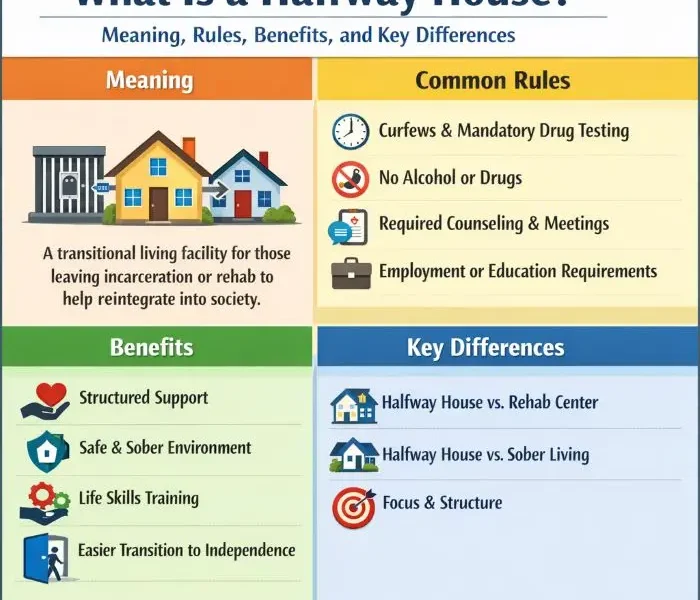
<p>Many people leaving rehab or coming out of jail or prison face the same hard question: <strong>what happens next?</strong> Going straight from a highly structured setting into full independence can feel overwhelming. That gap is where many people struggle most. They may need support, routine, accountability, and a safer place to rebuild their lives.</p>
<p>So, <a href="https://www.therecoveryvillage.com/treatment-program/aftercare/what-is-a-halfway-house/"><strong>what is a halfway house</strong></a>? In simple terms, a halfway house is a <strong>structured, temporary living environment</strong> that helps people transition from treatment or incarceration back into everyday life. It offers rules, support, and practical resources so residents can move forward with more stability.</p>
<p>In this guide, you will learn <strong>what a halfway house is</strong>, who lives there, what daily life looks like, how it compares with sober living and residential treatment, and how to choose the right option. If you are trying to make a decision for yourself or someone you care about, this article will help you understand the big picture in clear and simple language.</p>
<h2 id="what-is-a-halfway-house-definition-and-purpose">What Is a Halfway House? Definition and Purpose</h2>
<p><img class="aligncenter wp-image-7084 size-full" src="https://comeawayhome.co.uk/wp-content/uploads/2026/05/2a025e1b-3066-4562-872e-fcf6f7b0d560-ezgif.com-jpg-to-webp-converter.webp" alt="what is a halfway house" width="700" height="700" /></p>
<h3 id="what-is-a-halfway-house-">What Is a Halfway House?</h3>
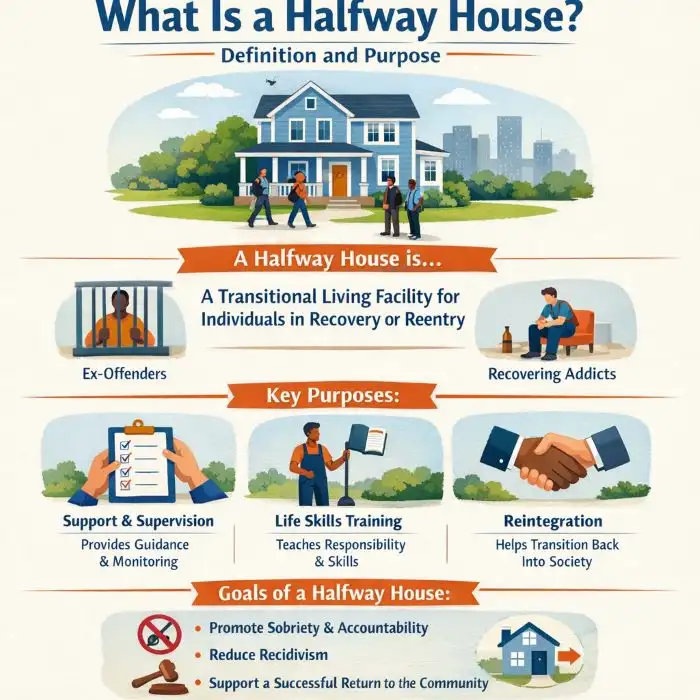
<p>If you are asking <strong>what is a halfway house</strong>, the easiest answer is this: it is a <strong>transitional housing program</strong> for people who are not yet ready for completely independent living but no longer need to stay in a hospital, rehab center, or correctional facility.</p>
<p>A halfway <a href="https://comeawayhome.co.uk/how-to-get-rid-of-gnats-in-house-fast/">house</a> is designed to sit in the middle of two worlds. On one side is a highly controlled environment, like inpatient treatment or prison. On the other side is normal community life, with work, family, bills, appointments, and personal responsibility. A halfway house helps bridge that distance.</p>
<p>For example, a person who has just finished inpatient addiction treatment may move into a halfway house so they can stay sober while adjusting to work, relationships, and daily routines. A person released from prison may live there while finding a job, meeting parole conditions, and learning how to manage life outside again.</p>
<p>That is why the term <strong>“halfway”</strong> matters. It describes a place that helps someone move from one stage of life to the next with support in between.</p>
<h3 id="primary-purpose-of-a-halfway-house">Primary Purpose of a Halfway House</h3>
<p>The purpose of a halfway house is not simply to provide a bed. Its real goal is to provide <strong>structure with support</strong>.</p>
<p>Most residents enter a halfway house during a vulnerable time. They may be dealing with early recovery, stress, legal obligations, mental health challenges, unemployment, or family conflict. Without a stable environment, the risk of relapse, reoffending, or emotional crisis can rise quickly.</p>
<p>A halfway house helps lower that risk by giving residents:</p>
<ul>
<li><strong>A stable place to live</strong></li>
<li><strong>Clear rules and expectations</strong></li>
<li><strong>Daily routine and accountability</strong></li>
<li><strong>Peer support from others in similar situations</strong></li>
<li><strong>Connections to treatment, work, and community resources</strong></li>
</ul>
<p>In many cases, halfway houses also focus on <strong>life skills</strong>. Residents may learn how to budget money, keep a schedule, apply for jobs, attend counseling, and rebuild trust with others. These steps may sound basic, but they are often the foundation of long-term recovery and successful reentry.</p>
<p>Another important purpose is <strong>relapse prevention</strong>. For someone leaving rehab, early sobriety can feel shaky. Triggers are everywhere. Stress can hit hard. A halfway house creates a buffer. It gives the person time to practice sober living while still having guidance and boundaries.</p>
<p>For someone leaving incarceration, the purpose may also include <strong>community reintegration</strong>. That can mean adjusting to freedom, finding work, reconnecting with family, following court orders, and avoiding old patterns that could lead to trouble again.</p>
<p>In short, a halfway house is meant to help people move forward <strong>safely, steadily, and with more confidence</strong>.</p>
<h2 id="who-lives-in-a-halfway-house-typical-residents">Who Lives in a Halfway House? Typical Residents</h2>
<p>Not everyone in a halfway house has the same background. These homes serve different populations, depending on the program, the funding source, and the rules of the facility.</p>
<p>Some residents are there by choice. Others are there because a court, parole board, or treatment provider recommended or required it. That is why it is helpful to understand that <strong>what is a halfway house</strong> can vary slightly depending on who it serves.</p>
<p>Typical residents often include:</p>
<ul>
<li><strong>People recently released from prison or jail</strong></li>
<li><strong>Individuals on parole or probation</strong></li>
<li><strong>People who have completed inpatient rehab</strong></li>
<li><strong>Adults in early recovery who need structured sober housing</strong></li>
<li><strong>People who need temporary support before returning to independent living</strong></li>
</ul>
<p>A person leaving incarceration may need housing because they do not yet have a safe place to go. They may also need help getting identification, finding work, meeting legal conditions, or rebuilding community ties.</p>
<p>A person leaving rehab may need a drug-free environment with rules and supervision. In that case, the halfway house can act as a form of recovery support, especially during the first few months after treatment.</p>
<p>It is also important to know that eligibility rules differ. Some halfway houses are tied closely to the criminal justice system. Others are connected to addiction recovery or community reentry services. Some accept residents voluntarily, while others only take referrals from courts, probation officers, social workers, or treatment programs.</p>
<p>So if you are looking at options, do not assume all halfway houses are the same. The residents, rules, and purpose can vary a lot from one program to another.</p>
<h2 id="what-to-expect-rules-daily-life-and-services">What to Expect: Rules, Daily Life, and Services</h2>
<p>When people first hear the term, they often ask not only <strong>what is a halfway house</strong>, but also <strong>what does life inside actually look like?</strong> That is an important question. The day-to-day experience matters just as much as the definition.</p>
<h3 id="common-rules-and-house-policies">Common Rules and House Policies</h3>
<p>Most halfway houses have rules that are stricter than regular housing but less restrictive than inpatient rehab or jail. These rules are meant to create safety, consistency, and accountability.</p>
<p>Common rules often include:</p>
<ul>
<li><strong>Curfews</strong></li>
<li><strong>Drug and alcohol testing</strong></li>
<li><strong>Mandatory house meetings</strong></li>
<li><strong>Required counseling, therapy, or recovery meetings</strong></li>
<li><strong>Chore assignments</strong></li>
<li><strong>Limits on visitors</strong></li>
<li><strong>Employment or job-search requirements</strong></li>
<li><strong>Respect for staff and other residents</strong></li>
<li><strong>No violence, threats, or illegal behavior</strong></li>
</ul>
<p>Curfews are common because they help residents keep a routine and reduce risky behavior. Drug testing is also common, especially in programs focused on recovery or court supervision. If a resident breaks a substance-use rule, the response may range from added support and warnings to discharge from the program, depending on the facility and the situation.</p>
<p>House meetings are another standard part of life. These meetings may cover schedules, expectations, conflicts, community updates, or progress checks. They also give residents a chance to practice communication and responsibility.</p>
<p>Visitor rules can be strict. Some halfway houses limit visiting hours. Some require approval for guests. Others may not allow visitors at all during the early stage of a resident’s stay. These rules can feel frustrating, but they are usually meant to keep the environment stable and focused.</p>
<p>Chores may seem small, but they matter. Cleaning shared spaces, helping with daily upkeep, and maintaining personal living areas teach consistency and respect for communal living. These habits often support larger goals, like employment and independent housing later on.</p>
<h3 id="typical-daily-schedule-and-community-life">Typical Daily Schedule and Community Life</h3>
<p>Daily life in a halfway house usually follows a basic routine. That structure is one of the main benefits.</p>
<p>A resident might wake up early, complete chores, attend a house meeting, go to work or job training, check in with staff, attend counseling or a recovery meeting, return by curfew, and prepare for the next day. Some homes also build in time for meals, group sessions, and personal goal tracking.</p>
<p>Living with others is a big part of the experience. Residents often share bedrooms, bathrooms, kitchens, or common areas. That means they must learn to cooperate, respect boundaries, and handle conflict in healthy ways.</p>
<p>This shared living environment can be challenging, but it can also be deeply helpful. Many residents say that one of the biggest benefits is realizing they are <strong>not alone</strong>. Other people in the house may understand the same struggles, fears, and hopes.</p>
<h3 id="support-services-and-referrals">Support Services and Referrals</h3>
<p>A halfway house is not always a full treatment center, but many programs offer or coordinate useful services.</p>
<p>Common supports may include:</p>
<ul>
<li><strong>Case management</strong></li>
<li><strong>Counseling referrals</strong></li>
<li><strong>Outpatient treatment referrals</strong></li>
<li><strong>Job search help</strong></li>
<li><strong>Resume and interview support</strong></li>
<li><strong>Life-skills training</strong></li>
<li><strong>Transportation planning</strong></li>
<li><strong>Education or GED support</strong></li>
<li><strong>Relapse prevention planning</strong></li>
</ul>
<p>Some halfway houses have staff on site who actively guide residents. Others work more like a housing base that connects residents to outside providers. In either case, support services often focus on helping people become more independent over time.</p>
<p>Job assistance is especially important. Many residents need income before they can move on to their own place. A program may help with applications, interview preparation, work clothing, or connecting with employers who are open to second-chance hiring.</p>
<p>Life-skills training also matters more than many people realize. Budgeting, meal planning, time management, communication, and problem-solving can all make the difference between steady progress and another setback.</p>
<p>If a halfway house serves people in addiction recovery, it may also help residents stay connected to therapy, outpatient treatment, medication management, or peer support groups. These supports can strengthen recovery and make the transition feel less isolating.</p>
<h2 id="halfway-house-vs-sober-living-vs-residential-treatment">Halfway House vs Sober Living vs Residential Treatment</h2>
<p>Many people mix these terms together. That is understandable because they all involve housing and support. Still, they are <strong>not the same thing</strong>. If you are trying to understand <strong>what is a halfway house</strong>, it helps to compare it with the options people often confuse it with.</p>
<h3 id="key-differences">Key Differences</h3>
<p>A halfway house generally provides <strong>structured transitional housing</strong> with rules, supervision, and some level of accountability. It may be connected to the justice system, a nonprofit program, or a recovery service.</p>
<p>A sober living home is often less formal. It is usually focused on maintaining sobriety in a drug- and alcohol-free environment, but it may offer less oversight than a halfway house. Some sober homes are privately run and rely more on peer accountability than staff supervision.</p>
<p>Residential treatment is more intensive. It is a clinical setting where people receive treatment for addiction, mental health concerns, or both. Staff are typically more involved, and therapy is a central part of the program.</p>
<p>Here is a simple comparison:</p>
<table>
<thead>
<tr>
<th>Feature</th>
<th>Halfway House</th>
<th>Sober Living Home</th>
<th>Residential Treatment</th>
</tr>
</thead>
<tbody>
<tr>
<td><strong>Funding</strong></td>
<td>Government, nonprofit, or private pay</td>
<td>Often private pay</td>
<td>Insurance, private pay, or public funding</td>
</tr>
<tr>
<td><strong>Legal Supervision</strong></td>
<td>May involve parole, probation, or court conditions</td>
<td>Usually voluntary, not court-managed</td>
<td>Usually clinical rather than legal</td>
</tr>
<tr>
<td><strong>Length of Stay</strong></td>
<td>Often short to moderate term</td>
<td>Often flexible, sometimes longer term</td>
<td>Usually short-term, based on treatment plan</td>
</tr>
<tr>
<td><strong>Structure</strong></td>
<td>Moderate to high</td>
<td>Moderate</td>
<td>High</td>
</tr>
<tr>
<td><strong>Clinical Care</strong></td>
<td>Limited or referral-based</td>
<td>Usually limited</td>
<td>Strong clinical oversight</td>
</tr>
</tbody>
</table>
<h3 id="which-option-fits-which-needs-">Which Option Fits Which Needs?</h3>
<p>The best choice depends on the person’s situation.</p>
<p>A halfway house may be the right fit for someone who needs <strong>more structure than regular housing</strong>, but does not need full-time clinical care. It can work well for people leaving incarceration, finishing inpatient rehab, or trying to stabilize after a difficult period.</p>
<p>A sober living home may be better for someone who already has a solid recovery foundation and mainly needs a <strong>safe, substance-free place</strong> with peers who support sobriety. It can be a good step after rehab or after time in a more structured recovery setting.</p>
<p>Residential treatment is usually the best option when someone has <strong>serious addiction symptoms, withdrawal concerns, major relapse risk, or co-occurring mental health needs</strong> that require close supervision and therapy.</p>
<p>If you are unsure, ask a simple question: <strong>Does the person need housing, support, or treatment?</strong><br />
Sometimes they need one. Sometimes they need all three. The answer can guide the right choice.</p>
<h2 id="benefits-and-limitations-of-halfway-houses">Benefits and Limitations of Halfway Houses</h2>
<p>To fully understand <strong>what is a halfway house</strong>, you need a balanced view. These programs can be very helpful, but they are not perfect.</p>
<h3 id="benefits-of-halfway-houses">Benefits of Halfway Houses</h3>
<p>Halfway houses can offer important advantages, especially during times of transition.</p>
<p>Key benefits include:</p>
<ul>
<li><strong>Strong accountability</strong></li>
<li><strong>A stable place to live</strong></li>
<li><strong>Lower exposure to risky environments</strong></li>
<li><strong>Peer encouragement and shared experience</strong></li>
<li><strong>Help finding work and building life skills</strong></li>
<li><strong>Support for relapse prevention</strong></li>
<li><strong>A smoother return to community life</strong></li>
</ul>
<p>Accountability is often the biggest benefit. Rules, curfews, check-ins, and house expectations give residents structure when they need it most. That structure can reduce chaos and help people build new habits.</p>
<p>Community is another major advantage. Recovery and reentry can feel lonely. Living with others who understand the journey can make the process more bearable and more hopeful.</p>
<p>Halfway houses can also act as a stepping stone. Instead of expecting someone to manage everything alone right away, they allow for gradual progress. A resident can work on sobriety, employment, communication, and stability one step at a time.</p>
<h3 id="limitations-to-keep-in-mind">Limitations to Keep in Mind</h3>
<p>At the same time, halfway houses have limits.</p>
<p>Some programs only allow a <strong>short stay</strong>, which may not feel like enough time for someone with complex needs. Others may have limited access to mental health care or addiction treatment on site. In those cases, residents still need outside services.</p>
<p>Quality can also vary. Some halfway houses are well-run, supportive, and organized. Others may feel overcrowded, understaffed, or unclear in their rules and expectations.</p>
<p>There can also be stigma. Some people hear the term “halfway house” and make unfair assumptions about the people who live there. That stigma can affect confidence, relationships, and even housing or job opportunities later.</p>
<p>So while halfway houses can be powerful tools, they work best when they are part of a bigger support plan.</p>
<h2 id="how-to-find-and-choose-the-right-halfway-house">How to Find and Choose the Right Halfway House</h2>
<p>Finding the right program takes more than searching a name online. If you want a good fit, you need to look closely at the quality of the house, the kind of support it offers, and whether it matches the resident’s actual needs.</p>
<p>If you are asking <strong>what is a halfway house</strong> in practical terms, this section matters most, because it turns information into action.</p>
<h3 id="steps-to-evaluate-quality">Steps to Evaluate Quality</h3>
<p>Start by learning who runs the home. Is it connected to a nonprofit, treatment organization, reentry service, or licensed provider? A clear affiliation often tells you more about how the program operates.</p>
<p>Look at staff experience. Are there trained case managers, recovery staff, or supervisors? Are rules explained clearly? Is there a written resident handbook? Good programs are usually transparent. They do not hide their expectations.</p>
<p>You should also ask about the environment. Is the house clean? Is it organized? Do residents seem safe and respected? Even simple observations can tell you a lot.</p>
<p>Pay attention to whether the program helps residents move forward. A good halfway house should not just provide housing. It should also support progress through aftercare planning, employment help, treatment referrals, or reentry guidance.</p>
<h3 id="questions-to-ask-before-choosing">Questions to Ask Before Choosing</h3>
<p>When you contact a halfway house, ask direct questions. You are not being difficult. You are being careful.</p>
<p>Helpful questions include:</p>
<ol>
<li><strong>Who is eligible to live here?</strong></li>
<li><strong>Is the program voluntary or court-referred only?</strong></li>
<li><strong>What are the rules about curfew, visitors, and testing?</strong></li>
<li><strong>How long can someone stay?</strong></li>
<li><strong>What services are included?</strong></li>
<li><strong>How much does it cost?</strong></li>
<li><strong>Are meals, transportation, or job support provided?</strong></li>
<li><strong>What happens if a resident breaks a rule?</strong></li>
<li><strong>Is there a discharge plan or aftercare plan?</strong></li>
<li><strong>How do you support safety in the house?</strong></li>
</ol>
<p>You can also ask local treatment centers, community health departments, reentry programs, social workers, probation offices, or behavioral health agencies for referrals. These groups often know which programs have better reputations and which ones may not be a good fit.</p>
<p>The goal is not to find a “perfect” program. It is to find one that is <strong>safe, clear, supportive, and realistic</strong> for the person’s next stage of life.</p>
<h2 id="legal-funding-and-safety-considerations">Legal, Funding, and Safety Considerations</h2>
<p>Another part of understanding <strong>what is a halfway house</strong> is knowing how these homes are funded, supervised, and managed.</p>
<p>Some halfway houses are funded through <strong>government programs</strong>, especially those tied to reentry or corrections. Others are run by nonprofits. Some require <strong>private payment</strong>, and some combine several funding sources.</p>
<p>If a resident is on parole or probation, there may be legal oversight involved. That can include required check-ins, drug testing, attendance expectations, or restrictions on travel and contact. In those cases, the halfway house may work closely with officers or court systems.</p>
<p>Safety is also a major concern. Good programs usually have clear screening procedures, behavior policies, and staff oversight. They may review criminal background issues, substance-use history, mental health needs, and house compatibility before accepting a resident.</p>
<p>Confidentiality is another issue to ask about. A halfway house is not always the same as a medical treatment setting, so privacy rules can differ. Residents and families should understand what information may be shared, especially if legal supervision is involved.</p>
<p>Before choosing a home, make sure you know:</p>
<ul>
<li><strong>Who pays</strong></li>
<li><strong>Who supervises</strong></li>
<li><strong>What rules are enforced</strong></li>
<li><strong>How resident safety is handled</strong></li>
</ul>
<p>Those details can have a major impact on the overall experience.</p>
<h2 id="evidence-and-success-stories-from-transitional-housing">Evidence and Success Stories from Transitional Housing</h2>
<p>People often want to know whether halfway houses actually help. While outcomes vary by program and person, structured transitional housing has often been linked to <strong>better stability during recovery and reentry</strong>.</p>
<p>When people leave treatment or incarceration without support, they may face housing instability, unemployment, social pressure, and emotional stress all at once. Transitional housing can reduce that shock by providing routine and accountability during a critical period.</p>
<p>Programs that include sober support, employment help, case management, and community connection often show stronger outcomes than housing alone. That does not mean every halfway house guarantees success. It means that <strong>supportive structure increases the chances of progress</strong>.</p>
<p>Think of a resident named Marcus, for example. After completing inpatient treatment, he did not feel ready to go back to the same neighborhood and routines that had fed his addiction. He moved into a halfway house, followed the house rules, attended outpatient counseling, got help with his resume, and found part-time work. Over time, he rebuilt trust with his family and saved enough money to move into an apartment with a stable routine. His progress did not happen overnight, but the halfway house gave him a safer path forward.</p>
<p>Stories like that are common because recovery and reintegration often improve when people are given <strong>time, structure, and support</strong> rather than being pushed too quickly into full independence.</p>
<h2 id="costs-payment-options-and-length-of-stay">Costs, Payment Options, and Length of Stay</h2>
<p>A common question behind <strong>what is a halfway house</strong> is how much it costs and how long someone can stay.</p>
<p>The answer depends on the type of program. Some halfway houses are publicly funded or supported by nonprofit organizations, which may lower the cost for residents. Others require private payment, either weekly or monthly.</p>
<p>Costs can vary widely based on location, services, and supervision level. Some homes are basic and affordable. Others charge more because they offer added support, staffing, or recovery programming.</p>
<p>Length of stay also varies. Some residents stay for just a few weeks. Others stay for several months. In some cases, the stay depends on legal requirements, treatment progress, employment status, or housing readiness.</p>
<p>Before enrolling, ask about:</p>
<ul>
<li><strong>Monthly or weekly fees</strong></li>
<li><strong>Deposit requirements</strong></li>
<li><strong>What services are included</strong></li>
<li><strong>Whether financial aid or sliding-scale support exists</strong></li>
<li><strong>The expected or maximum length of stay</strong></li>
</ul>
<p>The more clearly you understand the financial and time commitment, the easier it is to plan for a successful transition.</p>
<h2 id="conclusion-is-a-halfway-house-right-for-you-">Conclusion: Is a Halfway House Right for You?</h2>
<p>By now, you should have a clear answer to <strong>what is a halfway house</strong> and why it matters. A halfway house is a structured transitional living option that helps people move from rehab, incarceration, or another highly supervised setting into more independent life.</p>
<p>For many residents, it offers the right mix of <strong>accountability, safety, peer support, and practical help</strong>. It can reduce the risk of relapse, provide a more stable reentry process, and create space for healthy habits to take root. At the same time, it is not the right fit for everyone, especially those who need intensive clinical care or more specialized mental health support.</p>
<p>If you are considering this option, take the next step carefully. Think about the person’s current needs, level of independence, legal situation, recovery status, and support system. Then compare programs, ask strong questions, and choose a house that offers clear rules, safe conditions, and real support.</p>
<p>The right transition environment can make a major difference. And for many people, a halfway house becomes the bridge that helps them move from survival to stability.</p>
<h2 id="frequently-asked-questions">Frequently Asked Questions</h2>
<h3 id="what-is-a-halfway-house-in-simple-terms-">What is a halfway house in simple terms?</h3>
<p>A halfway house is a <strong>temporary, structured place to live</strong> for people who need support while moving back into everyday life after rehab, incarceration, or another major transition.</p>
<h3 id="how-long-can-you-stay-in-a-halfway-house-">How long can you stay in a halfway house?</h3>
<p>It depends on the program. Some stays are only a few weeks, while others last several months. The length often depends on the resident’s needs, progress, legal status, and housing plan.</p>
<h3 id="is-a-halfway-house-the-same-as-a-sober-living-home-">Is a halfway house the same as a sober living home?</h3>
<p>No. Both offer supportive housing, but halfway houses usually have <strong>more structure and supervision</strong>. Some are also connected to courts, parole, or reentry services.</p>
<h3 id="can-family-visit-someone-in-a-halfway-house-">Can family visit someone in a halfway house?</h3>
<p>Sometimes, yes. But most programs have visitor rules, approved hours, and restrictions. Some may limit visits during the early part of a resident’s stay.</p>
<h3 id="are-halfway-houses-only-for-people-leaving-prison-">Are halfway houses only for people leaving prison?</h3>
<p>No. Some serve people leaving prison or jail, but others support people who are leaving rehab or need structured sober housing during early recovery.</p>
<h3 id="do-halfway-houses-offer-treatment-">Do halfway houses offer treatment?</h3>
<p>Usually not full residential treatment. Many offer referrals to counseling, outpatient therapy, recovery meetings, and case management instead of intensive on-site care.</p>
<h3 id="are-residents-tested-for-drugs-or-alcohol-">Are residents tested for drugs or alcohol?</h3>
<p>In many halfway houses, yes. Drug and alcohol testing is common, especially in recovery-focused or court-involved programs.</p>
<h3 id="do-residents-have-to-work-while-living-there-">Do residents have to work while living there?</h3>
<p>Many programs encourage or require residents to work, attend school, or actively look for a job, unless a medical or legal issue prevents that.</p>
<h3 id="how-do-you-choose-a-good-halfway-house-">How do you choose a good halfway house?</h3>
<p>Look for a program with <strong>clear rules, safe living conditions, trained staff, realistic expectations, and support for aftercare or reentry planning</strong>.</p>
<h3 id="what-happens-after-leaving-a-halfway-house-">What happens after leaving a halfway house?</h3>
<p>Most residents move into independent housing, sober living, family housing, or another step-down setting. The goal is to leave with more stability, better habits, and a stronger support system.</p>
<p><a href="https://comeawayhome.co.uk/">House</a></p>
Many people leaving rehab or coming out of jail or prison face the same hard question: what happens next? Going straight from a highly structured setting into full independence can feel overwhelming. That gap is where many people struggle most. They may need support, routine, accountability, and a safer place to rebuild their lives.
So, what is a halfway house? In simple terms, a halfway house is a structured, temporary living environment that helps people transition from treatment or incarceration back into everyday life. It offers rules, support, and practical resources so residents can move forward with more stability.
In this guide, you will learn what a halfway house is, who lives there, what daily life looks like, how it compares with sober living and residential treatment, and how to choose the right option. If you are trying to make a decision for yourself or someone you care about, this article will help you understand the big picture in clear and simple language.
What Is a Halfway House? Definition and Purpose
What Is a Halfway House?
If you are asking what is a halfway house, the easiest answer is this: it is a transitional housing program for people who are not yet ready for completely independent living but no longer need to stay in a hospital, rehab center, or correctional facility.
A halfway house is designed to sit in the middle of two worlds. On one side is a highly controlled environment, like inpatient treatment or prison. On the other side is normal community life, with work, family, bills, appointments, and personal responsibility. A halfway house helps bridge that distance.
For example, a person who has just finished inpatient addiction treatment may move into a halfway house so they can stay sober while adjusting to work, relationships, and daily routines. A person released from prison may live there while finding a job, meeting parole conditions, and learning how to manage life outside again.
That is why the term “halfway” matters. It describes a place that helps someone move from one stage of life to the next with support in between.
Primary Purpose of a Halfway House
The purpose of a halfway house is not simply to provide a bed. Its real goal is to provide structure with support.
Most residents enter a halfway house during a vulnerable time. They may be dealing with early recovery, stress, legal obligations, mental health challenges, unemployment, or family conflict. Without a stable environment, the risk of relapse, reoffending, or emotional crisis can rise quickly.
A halfway house helps lower that risk by giving residents:
- A stable place to live
- Clear rules and expectations
- Daily routine and accountability
- Peer support from others in similar situations
- Connections to treatment, work, and community resources
In many cases, halfway houses also focus on life skills. Residents may learn how to budget money, keep a schedule, apply for jobs, attend counseling, and rebuild trust with others. These steps may sound basic, but they are often the foundation of long-term recovery and successful reentry.
Another important purpose is relapse prevention. For someone leaving rehab, early sobriety can feel shaky. Triggers are everywhere. Stress can hit hard. A halfway house creates a buffer. It gives the person time to practice sober living while still having guidance and boundaries.
For someone leaving incarceration, the purpose may also include community reintegration. That can mean adjusting to freedom, finding work, reconnecting with family, following court orders, and avoiding old patterns that could lead to trouble again.
In short, a halfway house is meant to help people move forward safely, steadily, and with more confidence.
Who Lives in a Halfway House? Typical Residents
Not everyone in a halfway house has the same background. These homes serve different populations, depending on the program, the funding source, and the rules of the facility.
Some residents are there by choice. Others are there because a court, parole board, or treatment provider recommended or required it. That is why it is helpful to understand that what is a halfway house can vary slightly depending on who it serves.
Typical residents often include:
- People recently released from prison or jail
- Individuals on parole or probation
- People who have completed inpatient rehab
- Adults in early recovery who need structured sober housing
- People who need temporary support before returning to independent living
A person leaving incarceration may need housing because they do not yet have a safe place to go. They may also need help getting identification, finding work, meeting legal conditions, or rebuilding community ties.
A person leaving rehab may need a drug-free environment with rules and supervision. In that case, the halfway house can act as a form of recovery support, especially during the first few months after treatment.
It is also important to know that eligibility rules differ. Some halfway houses are tied closely to the criminal justice system. Others are connected to addiction recovery or community reentry services. Some accept residents voluntarily, while others only take referrals from courts, probation officers, social workers, or treatment programs.
So if you are looking at options, do not assume all halfway houses are the same. The residents, rules, and purpose can vary a lot from one program to another.
What to Expect: Rules, Daily Life, and Services
When people first hear the term, they often ask not only what is a halfway house, but also what does life inside actually look like? That is an important question. The day-to-day experience matters just as much as the definition.
Common Rules and House Policies
Most halfway houses have rules that are stricter than regular housing but less restrictive than inpatient rehab or jail. These rules are meant to create safety, consistency, and accountability.
Common rules often include:
- Curfews
- Drug and alcohol testing
- Mandatory house meetings
- Required counseling, therapy, or recovery meetings
- Chore assignments
- Limits on visitors
- Employment or job-search requirements
- Respect for staff and other residents
- No violence, threats, or illegal behavior
Curfews are common because they help residents keep a routine and reduce risky behavior. Drug testing is also common, especially in programs focused on recovery or court supervision. If a resident breaks a substance-use rule, the response may range from added support and warnings to discharge from the program, depending on the facility and the situation.
House meetings are another standard part of life. These meetings may cover schedules, expectations, conflicts, community updates, or progress checks. They also give residents a chance to practice communication and responsibility.
Visitor rules can be strict. Some halfway houses limit visiting hours. Some require approval for guests. Others may not allow visitors at all during the early stage of a resident’s stay. These rules can feel frustrating, but they are usually meant to keep the environment stable and focused.
Chores may seem small, but they matter. Cleaning shared spaces, helping with daily upkeep, and maintaining personal living areas teach consistency and respect for communal living. These habits often support larger goals, like employment and independent housing later on.
Typical Daily Schedule and Community Life
Daily life in a halfway house usually follows a basic routine. That structure is one of the main benefits.
A resident might wake up early, complete chores, attend a house meeting, go to work or job training, check in with staff, attend counseling or a recovery meeting, return by curfew, and prepare for the next day. Some homes also build in time for meals, group sessions, and personal goal tracking.
Living with others is a big part of the experience. Residents often share bedrooms, bathrooms, kitchens, or common areas. That means they must learn to cooperate, respect boundaries, and handle conflict in healthy ways.
This shared living environment can be challenging, but it can also be deeply helpful. Many residents say that one of the biggest benefits is realizing they are not alone. Other people in the house may understand the same struggles, fears, and hopes.
Support Services and Referrals
A halfway house is not always a full treatment center, but many programs offer or coordinate useful services.
Common supports may include:
- Case management
- Counseling referrals
- Outpatient treatment referrals
- Job search help
- Resume and interview support
- Life-skills training
- Transportation planning
- Education or GED support
- Relapse prevention planning
Some halfway houses have staff on site who actively guide residents. Others work more like a housing base that connects residents to outside providers. In either case, support services often focus on helping people become more independent over time.
Job assistance is especially important. Many residents need income before they can move on to their own place. A program may help with applications, interview preparation, work clothing, or connecting with employers who are open to second-chance hiring.
Life-skills training also matters more than many people realize. Budgeting, meal planning, time management, communication, and problem-solving can all make the difference between steady progress and another setback.
If a halfway house serves people in addiction recovery, it may also help residents stay connected to therapy, outpatient treatment, medication management, or peer support groups. These supports can strengthen recovery and make the transition feel less isolating.
Halfway House vs Sober Living vs Residential Treatment
Many people mix these terms together. That is understandable because they all involve housing and support. Still, they are not the same thing. If you are trying to understand what is a halfway house, it helps to compare it with the options people often confuse it with.
Key Differences
A halfway house generally provides structured transitional housing with rules, supervision, and some level of accountability. It may be connected to the justice system, a nonprofit program, or a recovery service.
A sober living home is often less formal. It is usually focused on maintaining sobriety in a drug- and alcohol-free environment, but it may offer less oversight than a halfway house. Some sober homes are privately run and rely more on peer accountability than staff supervision.
Residential treatment is more intensive. It is a clinical setting where people receive treatment for addiction, mental health concerns, or both. Staff are typically more involved, and therapy is a central part of the program.
Here is a simple comparison:
| Feature |
Halfway House |
Sober Living Home |
Residential Treatment |
| Funding |
Government, nonprofit, or private pay |
Often private pay |
Insurance, private pay, or public funding |
| Legal Supervision |
May involve parole, probation, or court conditions |
Usually voluntary, not court-managed |
Usually clinical rather than legal |
| Length of Stay |
Often short to moderate term |
Often flexible, sometimes longer term |
Usually short-term, based on treatment plan |
| Structure |
Moderate to high |
Moderate |
High |
| Clinical Care |
Limited or referral-based |
Usually limited |
Strong clinical oversight |
Which Option Fits Which Needs?
The best choice depends on the person’s situation.
A halfway house may be the right fit for someone who needs more structure than regular housing, but does not need full-time clinical care. It can work well for people leaving incarceration, finishing inpatient rehab, or trying to stabilize after a difficult period.
A sober living home may be better for someone who already has a solid recovery foundation and mainly needs a safe, substance-free place with peers who support sobriety. It can be a good step after rehab or after time in a more structured recovery setting.
Residential treatment is usually the best option when someone has serious addiction symptoms, withdrawal concerns, major relapse risk, or co-occurring mental health needs that require close supervision and therapy.
If you are unsure, ask a simple question: Does the person need housing, support, or treatment?
Sometimes they need one. Sometimes they need all three. The answer can guide the right choice.
Benefits and Limitations of Halfway Houses
To fully understand what is a halfway house, you need a balanced view. These programs can be very helpful, but they are not perfect.
Benefits of Halfway Houses
Halfway houses can offer important advantages, especially during times of transition.
Key benefits include:
- Strong accountability
- A stable place to live
- Lower exposure to risky environments
- Peer encouragement and shared experience
- Help finding work and building life skills
- Support for relapse prevention
- A smoother return to community life
Accountability is often the biggest benefit. Rules, curfews, check-ins, and house expectations give residents structure when they need it most. That structure can reduce chaos and help people build new habits.
Community is another major advantage. Recovery and reentry can feel lonely. Living with others who understand the journey can make the process more bearable and more hopeful.
Halfway houses can also act as a stepping stone. Instead of expecting someone to manage everything alone right away, they allow for gradual progress. A resident can work on sobriety, employment, communication, and stability one step at a time.
Limitations to Keep in Mind
At the same time, halfway houses have limits.
Some programs only allow a short stay, which may not feel like enough time for someone with complex needs. Others may have limited access to mental health care or addiction treatment on site. In those cases, residents still need outside services.
Quality can also vary. Some halfway houses are well-run, supportive, and organized. Others may feel overcrowded, understaffed, or unclear in their rules and expectations.
There can also be stigma. Some people hear the term “halfway house” and make unfair assumptions about the people who live there. That stigma can affect confidence, relationships, and even housing or job opportunities later.
So while halfway houses can be powerful tools, they work best when they are part of a bigger support plan.
How to Find and Choose the Right Halfway House
Finding the right program takes more than searching a name online. If you want a good fit, you need to look closely at the quality of the house, the kind of support it offers, and whether it matches the resident’s actual needs.
If you are asking what is a halfway house in practical terms, this section matters most, because it turns information into action.
Steps to Evaluate Quality
Start by learning who runs the home. Is it connected to a nonprofit, treatment organization, reentry service, or licensed provider? A clear affiliation often tells you more about how the program operates.
Look at staff experience. Are there trained case managers, recovery staff, or supervisors? Are rules explained clearly? Is there a written resident handbook? Good programs are usually transparent. They do not hide their expectations.
You should also ask about the environment. Is the house clean? Is it organized? Do residents seem safe and respected? Even simple observations can tell you a lot.
Pay attention to whether the program helps residents move forward. A good halfway house should not just provide housing. It should also support progress through aftercare planning, employment help, treatment referrals, or reentry guidance.
Questions to Ask Before Choosing
When you contact a halfway house, ask direct questions. You are not being difficult. You are being careful.
Helpful questions include:
- Who is eligible to live here?
- Is the program voluntary or court-referred only?
- What are the rules about curfew, visitors, and testing?
- How long can someone stay?
- What services are included?
- How much does it cost?
- Are meals, transportation, or job support provided?
- What happens if a resident breaks a rule?
- Is there a discharge plan or aftercare plan?
- How do you support safety in the house?
You can also ask local treatment centers, community health departments, reentry programs, social workers, probation offices, or behavioral health agencies for referrals. These groups often know which programs have better reputations and which ones may not be a good fit.
The goal is not to find a “perfect” program. It is to find one that is safe, clear, supportive, and realistic for the person’s next stage of life.
Legal, Funding, and Safety Considerations
Another part of understanding what is a halfway house is knowing how these homes are funded, supervised, and managed.
Some halfway houses are funded through government programs, especially those tied to reentry or corrections. Others are run by nonprofits. Some require private payment, and some combine several funding sources.
If a resident is on parole or probation, there may be legal oversight involved. That can include required check-ins, drug testing, attendance expectations, or restrictions on travel and contact. In those cases, the halfway house may work closely with officers or court systems.
Safety is also a major concern. Good programs usually have clear screening procedures, behavior policies, and staff oversight. They may review criminal background issues, substance-use history, mental health needs, and house compatibility before accepting a resident.
Confidentiality is another issue to ask about. A halfway house is not always the same as a medical treatment setting, so privacy rules can differ. Residents and families should understand what information may be shared, especially if legal supervision is involved.
Before choosing a home, make sure you know:
- Who pays
- Who supervises
- What rules are enforced
- How resident safety is handled
Those details can have a major impact on the overall experience.
Evidence and Success Stories from Transitional Housing
People often want to know whether halfway houses actually help. While outcomes vary by program and person, structured transitional housing has often been linked to better stability during recovery and reentry.
When people leave treatment or incarceration without support, they may face housing instability, unemployment, social pressure, and emotional stress all at once. Transitional housing can reduce that shock by providing routine and accountability during a critical period.
Programs that include sober support, employment help, case management, and community connection often show stronger outcomes than housing alone. That does not mean every halfway house guarantees success. It means that supportive structure increases the chances of progress.
Think of a resident named Marcus, for example. After completing inpatient treatment, he did not feel ready to go back to the same neighborhood and routines that had fed his addiction. He moved into a halfway house, followed the house rules, attended outpatient counseling, got help with his resume, and found part-time work. Over time, he rebuilt trust with his family and saved enough money to move into an apartment with a stable routine. His progress did not happen overnight, but the halfway house gave him a safer path forward.
Stories like that are common because recovery and reintegration often improve when people are given time, structure, and support rather than being pushed too quickly into full independence.
Costs, Payment Options, and Length of Stay
A common question behind what is a halfway house is how much it costs and how long someone can stay.
The answer depends on the type of program. Some halfway houses are publicly funded or supported by nonprofit organizations, which may lower the cost for residents. Others require private payment, either weekly or monthly.
Costs can vary widely based on location, services, and supervision level. Some homes are basic and affordable. Others charge more because they offer added support, staffing, or recovery programming.
Length of stay also varies. Some residents stay for just a few weeks. Others stay for several months. In some cases, the stay depends on legal requirements, treatment progress, employment status, or housing readiness.
Before enrolling, ask about:
- Monthly or weekly fees
- Deposit requirements
- What services are included
- Whether financial aid or sliding-scale support exists
- The expected or maximum length of stay
The more clearly you understand the financial and time commitment, the easier it is to plan for a successful transition.
Conclusion: Is a Halfway House Right for You?
By now, you should have a clear answer to what is a halfway house and why it matters. A halfway house is a structured transitional living option that helps people move from rehab, incarceration, or another highly supervised setting into more independent life.
For many residents, it offers the right mix of accountability, safety, peer support, and practical help. It can reduce the risk of relapse, provide a more stable reentry process, and create space for healthy habits to take root. At the same time, it is not the right fit for everyone, especially those who need intensive clinical care or more specialized mental health support.
If you are considering this option, take the next step carefully. Think about the person’s current needs, level of independence, legal situation, recovery status, and support system. Then compare programs, ask strong questions, and choose a house that offers clear rules, safe conditions, and real support.
The right transition environment can make a major difference. And for many people, a halfway house becomes the bridge that helps them move from survival to stability.
Frequently Asked Questions
What is a halfway house in simple terms?
A halfway house is a temporary, structured place to live for people who need support while moving back into everyday life after rehab, incarceration, or another major transition.
How long can you stay in a halfway house?
It depends on the program. Some stays are only a few weeks, while others last several months. The length often depends on the resident’s needs, progress, legal status, and housing plan.
Is a halfway house the same as a sober living home?
No. Both offer supportive housing, but halfway houses usually have more structure and supervision. Some are also connected to courts, parole, or reentry services.
Can family visit someone in a halfway house?
Sometimes, yes. But most programs have visitor rules, approved hours, and restrictions. Some may limit visits during the early part of a resident’s stay.
Are halfway houses only for people leaving prison?
No. Some serve people leaving prison or jail, but others support people who are leaving rehab or need structured sober housing during early recovery.
Do halfway houses offer treatment?
Usually not full residential treatment. Many offer referrals to counseling, outpatient therapy, recovery meetings, and case management instead of intensive on-site care.
Are residents tested for drugs or alcohol?
In many halfway houses, yes. Drug and alcohol testing is common, especially in recovery-focused or court-involved programs.
Do residents have to work while living there?
Many programs encourage or require residents to work, attend school, or actively look for a job, unless a medical or legal issue prevents that.
How do you choose a good halfway house?
Look for a program with clear rules, safe living conditions, trained staff, realistic expectations, and support for aftercare or reentry planning.
What happens after leaving a halfway house?
Most residents move into independent housing, sober living, family housing, or another step-down setting. The goal is to leave with more stability, better habits, and a stronger support system.
House