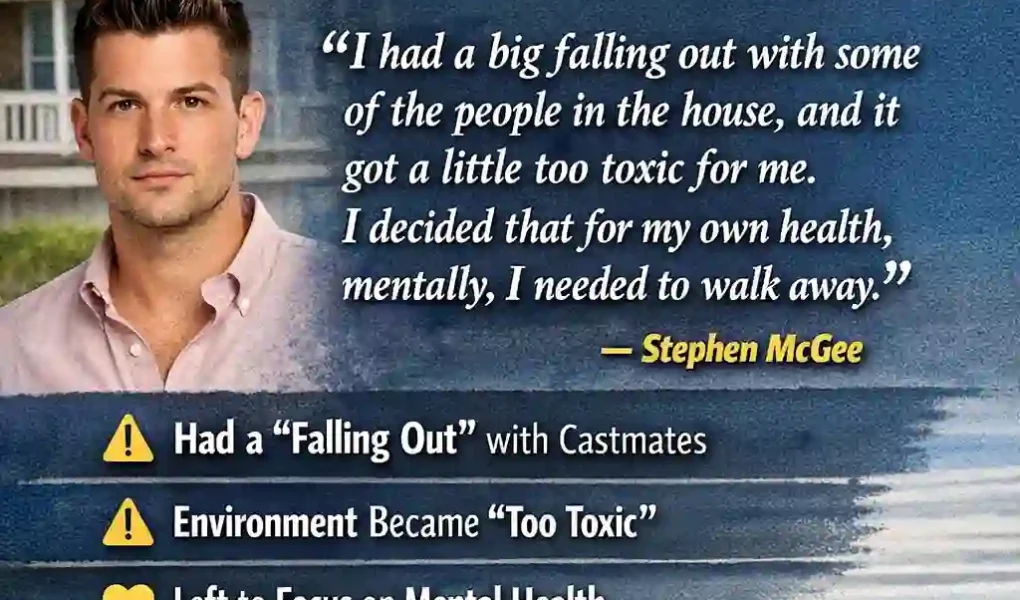
<p>If you have been asking <a href="https://screenrant.com/summer-house-stephen-mcgee-after-season-two-update/"><strong>why did Stephen leave Summer House</strong></a>, you are definitely not alone. Years after his exit, fans still bring up his name because his departure never felt like a clean, simple goodbye. There was no long farewell arc, no neat wrap-up, and no single official explanation that answered every question at once. That is exactly why the topic still comes up.</p>
<p>Stephen McGee stood out early on <strong>Summer House</strong>. He was funny, sharp, observant, and often willing to say what other people around him would not. That made him entertaining. It also made him a magnet for tension. By the time his run on the show ended, viewers had seen friendships crack, trust break down, and the group dynamic shift in a big way.</p>
<p>In this article, I will walk you through the full picture in simple terms. You will get the <strong>background on who Stephen was on the show</strong>, the <strong>timeline of events leading up to his exit</strong>, what was said publicly, which rumors have some grounding and which ones should be treated carefully, how the cast and production seemed to respond, and what Stephen’s life looked like after Bravo. The goal here is not to exaggerate the drama. It is to give you a balanced, readable answer.</p>
<p>The short version is this: <strong>Stephen’s exit appears to have come from a mix of cast conflict, damaged trust, and a broader casting change before season 3</strong>. But to really understand <strong>why did Stephen leave Summer House</strong>, you need the full context.</p>
<h2 id="background-who-is-stephen-">Background — Who Is Stephen?</h2>
<p><img class="aligncenter wp-image-7064 size-full" src="https://comeawayhome.co.uk/wp-content/uploads/2026/05/15e05445-1b78-4010-9571-bdaea01d5797-ezgif.com-jpg-to-webp-converter.webp" alt="why did stephen leave summer house" width="700" height="700" /></p>
<h4 id="stephen-s-role-on-summer-house-">Stephen’s role on <em>Summer House</em></h4>
<p>Stephen McGee was one of the original cast members of <strong>Summer House</strong>. He appeared during the show’s early years, when Bravo was still figuring out what kind of energy the series would have and what group chemistry would keep people watching. That matters, because original cast members often help define a show’s tone before later seasons become more polished or more strategic.</p>
<p>Stephen quickly became memorable because he brought a different kind of presence than some of the louder personalities around him. He was not always the biggest party starter in the room, and he did not rely on a huge romantic storyline to stay visible. Instead, he often functioned as a <strong>commentator inside the cast</strong>. He noticed things, reacted to things, and delivered lines that gave scenes extra bite.</p>
<p>That role can be powerful on reality TV. The person who sees everything often becomes the person viewers trust to interpret what is happening. At the same time, that position can also be dangerous. When you are close enough to everyone to know their secrets, but honest enough to call out behavior, you can become central to conflict very fast.</p>
<p>Stephen was also notable because he represented a different voice in the <a href="https://comeawayhome.co.uk/where-to-put-gutters-on-a-house/">house</a>. He was openly gay, socially quick, and often emotionally intelligent about what was happening around him. For some viewers, that made him refreshing. For others, his style felt cutting when arguments heated up.</p>
<h4 id="early-incidents-and-storylines-that-made-him-stand-out">Early incidents and storylines that made him stand out</h4>
<p>Stephen did not become talked about only because he was funny. He became talked about because he had a habit of landing in emotionally charged situations. He was the kind of cast member who could turn a casual conversation into a revealing moment. That is great for television, but not always great for long-term friendships.</p>
<p>Early on, he helped shape the show by reacting to the romances, grudges, and messy weekend behavior happening around him. He was often positioned as someone who saw through the performance. When others were trying to keep things light, Stephen could puncture the moment with an opinion that felt more honest than polished.</p>
<p>That honesty was part of his appeal. It also made him vulnerable. Reality TV rewards transparency in theory, but in practice it often punishes people when their honesty affects someone else’s image. Stephen’s most memorable conflicts came from exactly that tension.</p>
<h4 id="relationship-with-other-cast-members">Relationship with other cast members</h4>
<p>Stephen’s relationships inside the house were a huge part of his story. He had friendships that looked genuine, especially in the earlier stretch of the show. But those bonds were not always stable. Like many group dynamics on reality TV, closeness could shift quickly into resentment, especially when private information became public or when one cast member felt exposed by another.</p>
<p>The biggest relationship in understanding his exit was his friendship with <strong>Carl Radke</strong>. At one point, they seemed close. There was familiarity there, and viewers got the sense that they knew each other beyond surface-level party talk. That closeness made the later fallout feel much more serious.</p>
<p>Stephen also existed in the middle of the larger group dynamic, which meant his conflicts were rarely isolated. When one friendship broke down, it affected how the rest of the house moved around him. People chose sides, pulled back, stayed quiet, or tried to smooth things over. In a show like <strong>Summer House</strong>, that kind of rupture does not stay private for long.</p>
<p>So before we even get to the exit itself, one thing is already clear: <strong>Stephen was not a background character who quietly disappeared</strong>. He was woven into the emotional fabric of the show. That is why his departure still sparks questions.</p>
<h2 id="timeline-key-moments-leading-to-his-exit">Timeline — Key Moments Leading to His Exit</h2>
<h4 id="why-the-timeline-matters">Why the timeline matters</h4>
<p>To understand <strong>Stephen Summer House exit</strong> discussions, you have to look at the sequence of events instead of just one headline or one rumor. His departure was not built around a single dramatic press release. It was the result of tension building over time, especially during and after season 2.</p>
<p>Here is a simple timeline to anchor the story before we break it down in detail.</p>
<table>
<thead>
<tr>
<th>Time Period</th>
<th>Key Event</th>
<th>Why It Matters</th>
</tr>
</thead>
<tbody>
<tr>
<td>Season 1</td>
<td>Stephen joins as an original cast member</td>
<td>Establishes him as part of the show’s foundation</td>
</tr>
<tr>
<td>Early to mid Season 2</td>
<td>Cast tensions deepen</td>
<td>Group chemistry becomes more fragile</td>
</tr>
<tr>
<td>Late Season 2</td>
<td>Fallout involving Carl and private information becomes central</td>
<td>Trust inside the house is badly damaged</td>
</tr>
<tr>
<td>Reunion / post-season discussion</td>
<td>Conflict remains unresolved in public</td>
<td>Shows the issue was bigger than one weekend fight</td>
</tr>
<tr>
<td>Before Season 3</td>
<td>Stephen does not return; cast is refreshed</td>
<td>Confirms the end of his run on the show</td>
</tr>
</tbody>
</table>
<p>That table gives you the broad shape. Now let’s slow it down.</p>
<h4 id="pre-exit-incidents-and-growing-friction">Pre-exit incidents and growing friction</h4>
<p>By season 2, Stephen was no longer just the witty observer. He was directly involved in one of the show’s most uncomfortable personal conflicts. The atmosphere in the house had changed. Friendships were less stable, grudges lasted longer, and private conversations had a way of becoming group conversations.</p>
<p>The biggest issue centered on Carl. Public discussion around the show and reunion material made it clear that Carl felt Stephen had shared deeply personal information that had been told in confidence. That accusation changed everything. This was not treated like normal house gossip. It was treated as a <strong>breach of trust</strong>.</p>
<p>From a viewer’s perspective, this was one of those moments where reality TV stops feeling playful and starts feeling raw. The argument carried more weight than a standard cast spat because it involved privacy, loyalty, and personal boundaries. Once that line was crossed, even people who were not directly involved had to react to it.</p>
<p>This is also where many fans begin their answer to <strong>why did Stephen leave Summer House</strong>. Not because one fight automatically gets someone removed, but because some conflicts permanently damage the group dynamic. And reality TV depends on a cast being able to film together, argue together, and then come back together again in some workable form. When that becomes impossible, a cast change becomes much more likely.</p>
<h4 id="the-turning-point-during-season-2">The turning point during season 2</h4>
<p>Season 2 is widely seen as the turning point. That is when Stephen’s relationship with Carl took the most public hit, and once it happened, the emotional tone around Stephen changed.</p>
<p>Before that, viewers could still imagine him staying in the cast as the sharp-tongued friend who occasionally stirred the pot. After that, the situation looked different. The issue was no longer just whether he was funny or observant. It became whether the trust required to live and film together had been broken beyond repair.</p>
<p>That distinction matters. Reality TV casts survive plenty of screaming matches. They survive cheating scandals, loyalty problems, and mean comments. What can be harder to recover from is the sense that one cast member revealed something another person believed would stay private. Once that accusation enters the group, people start asking not just “Who was right?” but “Can this cast even function together now?”</p>
<p>By the end of Stephen’s run, that was the real question hanging over him. Not simply whether viewers liked him, but whether the show could move forward with the same emotional setup after such a major rupture.</p>
<h4 id="what-happened-after-the-season-aired">What happened after the season aired</h4>
<p>One reason the story stayed confusing is that Stephen’s exit did not unfold like a classic television departure. He was not given a dramatic farewell episode where everyone sat down and explained what would happen next. Instead, the answer emerged more through <strong>casting reality</strong> than through storyline resolution.</p>
<p>When the show moved toward season 3, the cast lineup changed. Stephen was not part of the returning group. Around the same time, the show brought in new faces and shifted its energy. That kind of decision often signals more than one thing at once. It can mean production wants a refresh. It can mean certain cast relationships no longer work. And it can mean the show is trying to move away from a dynamic it sees as exhausted or too damaged.</p>
<p>That is important because fans sometimes ask whether Stephen quit on his own, was fired, or mutually parted ways with the show. The public picture suggests that this was less about a dramatic on-camera resignation and more about a <strong>not-returning situation tied to season 3 casting choices</strong>.</p>
<p>In other words, Stephen’s exit fits the kind of reality TV departure where there is a lot of emotion but not a single clean public label.</p>
<h4 id="public-announcement-and-cast-refresh">Public announcement and cast refresh</h4>
<p>Before season 3, Bravo’s cast decisions made the answer visible. Stephen did not return, and neither did some other early cast figures. New personalities joined, which helped reset the series. That reshaping of the cast is a major clue.</p>
<p>When a network decides to replace several familiar faces at once, it usually points to a broader creative decision, not just one isolated incident. But that broader decision can still be influenced by specific conflicts. In Stephen’s case, the season 2 fallout made him an obvious candidate to be left out of the next chapter.</p>
<p>This is why the most balanced explanation is not “he left for one reason only.” It is more accurate to say the exit was likely caused by <strong>overlapping factors</strong>:</p>
<ul>
<li><strong>A major friendship breakdown</strong></li>
<li><strong>Loss of trust within the cast</strong></li>
<li><strong>A season 3 creative refresh</strong></li>
<li><strong>A group dynamic that no longer seemed sustainable</strong></li>
</ul>
<p>That combination makes more sense than a single-cause theory.</p>
<h4 id="off-camera-conversation-around-the-departure">Off-camera conversation around the departure</h4>
<p>Like many Bravo exits, Stephen’s departure also lived in the space between on-screen events and off-screen discussion. Fans talked online. Entertainment coverage framed it as part of the cast shake-up. Former cast relationships were analyzed long after the season ended.</p>
<p>This off-camera chatter matters because it shaped how people understood the exit. Some viewers focused on the Carl fallout and saw it as the key reason. Others focused on production and believed Stephen was simply part of a larger retooling. Both views have some logic. The safest reading is that the Carl conflict hurt his standing at exactly the same moment the show was already moving into a new casting phase.</p>
<p>That is often how reality TV departures really happen. They are not always one dramatic choice. Sometimes they are the result of timing. A bad season for one cast member, a broken relationship, and a network shift can all collide at once.</p>
<p>So if you want the clearest timeline-based answer to <strong>why did Stephen leave Summer House</strong>, here it is: <strong>the trouble built during season 2, peaked with a trust-related conflict, stayed unresolved publicly, and was followed by a cast overhaul that left Stephen out of season 3</strong>.</p>
<h2 id="stephen-s-statements-interviews">Stephen’s Statements & Interviews</h2>
<h4 id="formal-statements-and-the-limits-of-the-public-record">Formal statements and the limits of the public record</h4>
<p>One reason this topic still gets searched is that there was never a single official statement detailed enough to end all debate. In many reality TV situations, the network gives a brief cast update, fans fill in the gaps, and the former cast member later comments in interviews or social posts. Stephen’s exit followed that pattern more than a fully documented public split.</p>
<p>That means the public record is <strong>partial</strong>, not total. We have the show itself, the reunion fallout, cast commentary, and reporting around the season 3 cast changes. What we do not have is a long, detailed official breakdown from every side involved.</p>
<p>That is important, because it explains why fans still debate whether Stephen “left,” was “let go,” or simply was not brought back. In reality TV, those words can overlap. A cast member may feel pushed out even if a network frames it as a normal casting update.</p>
<h4 id="interviews-and-social-post-tone">Interviews and social-post tone</h4>
<p>In the public conversation around his departure, Stephen came across less like someone casually done with the show and more like someone who had been through a bruising experience. That emotional tone matters. It suggests the exit was not a light, friendly reset.</p>
<p>His comments after the show, as remembered in entertainment coverage and fan discussion, fit the picture of a person who knew the cast dynamic had soured. He was not talking as if he had simply completed a chapter and moved on with no friction. The tension with the group, especially with Carl, hung over everything.</p>
<p>Still, it is important not to overstate what Stephen publicly confirmed. The safest summary is this: <strong>his post-show presence supported the idea that the environment had become difficult and that the departure was tied to larger relational problems</strong>.</p>
<h4 id="did-stephen-say-he-quit-or-was-he-fired-">Did Stephen say he quit, or was he fired?</h4>
<p>This is the question many readers really want answered.</p>
<p>The most careful answer is: <strong>public reporting and the structure of the departure make it look more like a casting decision than a pure voluntary quit</strong>. Stephen did not have the kind of on-air exit speech that would clearly frame things as “I chose to walk away.” Instead, he disappeared from the cast when the show changed directions.</p>
<p>That does not automatically mean one dramatic firing moment happened behind the scenes. Reality TV casting is often softer and messier than that. A person may not be renewed. A network may decide not to ask them back. A cast member may realize they are no longer wanted and then speak about the exit in personal terms. All of those outcomes can sound different depending on who is telling the story.</p>
<p>So, if you want the plain-English version: <strong>Stephen’s exit appears closer to being phased out in a cast refresh than voluntarily stepping away on his own terms</strong>.</p>
<h4 id="why-these-statements-matter">Why these statements matter</h4>
<p>What Stephen said, and what he did not say, both matter. The lack of one neat public explanation is part of why the story stayed alive. But even without a perfect quote to close the case, his exit fits a recognizable Bravo pattern: a cast member experiences a highly personal conflict, the group dynamic becomes unstable, and the next season arrives without that person in it.</p>
<p>That does not mean every rumor is true. It does mean the overall direction of the story is fairly clear. Stephen’s public posture after the show lines up with the idea that this was an <strong>unhappy ending</strong>, not a peaceful graduation.</p>
<h2 id="rumors-allegations-fact-checking">Rumors, Allegations & Fact-Checking</h2>
<h4 id="common-rumors-after-stephen-s-exit">Common rumors after Stephen’s exit</h4>
<p>Any time a reality TV cast member disappears after a controversial season, rumors grow faster than facts. Stephen was no exception. After he left, fans floated several explanations, some more grounded than others.</p>
<p>The most common rumors included:</p>
<ul>
<li><strong>He was fired directly because of the Carl fallout</strong></li>
<li><strong>He left because the cast no longer supported him</strong></li>
<li><strong>Production wanted a younger or different energy for the show</strong></li>
<li><strong>The controversy around private information made him too difficult to keep in the ensemble</strong></li>
<li><strong>He chose not to return because the environment had become toxic</strong></li>
</ul>
<p>Notice something important here: some of these can coexist. A toxic atmosphere, damaged cast support, and a production refresh can all happen at the same time.</p>
<h4 id="what-has-stronger-support-and-what-does-not">What has stronger support, and what does not</h4>
<p>Some claims have more weight because they fit the public facts. Others go too far.</p>
<p><strong>Claims with stronger support:</strong></p>
<p>The strongest-supported explanation is that <strong>Stephen’s relationships inside the cast had deteriorated</strong>, especially after the conflict involving Carl. That is visible in the show’s later dynamic and in how fans and media discussed the fallout. The fact that he did not return during a cast refresh also supports the idea that production no longer saw him as part of the show’s next version.</p>
<p>Another well-supported point is that this was not just about ordinary house drama. The issue carried more emotional seriousness because it touched on privacy and trust. That gave the conflict a different texture from standard reality TV fights.</p>
<p><strong>Claims that should be treated carefully:</strong></p>
<p>Any claim that tries to reduce his exit to one unverified off-camera event should be handled with caution. Unless a cast member or network clearly confirmed it, fans should not treat speculation as fact.</p>
<p>The same goes for exaggerated versions of the story that turn the whole departure into a scandal with a single smoking gun. Publicly, the exit looks more like a combination of conflict and casting than one secret incident.</p>
<h4 id="a-simple-fact-check-framework-for-readers">A simple fact-check framework for readers</h4>
<p>When you read celebrity-exit stories, especially in reality TV, it helps to use a basic filter. Here are three easy checks:</p>
<ol>
<li><strong>Start with what happened on-screen.</strong><br />
If a major conflict played out publicly, that is a stronger foundation than anonymous gossip.</li>
<li><strong>Look for direct statements.</strong><br />
Interviews, reunion comments, and verified social posts matter more than fan theories.</li>
<li><strong>Separate correlation from proof.</strong><br />
Just because a cast member disappears after a fight does not mean the network publicly confirmed the fight as the only reason.</li>
</ol>
<p>This matters a lot with the <strong>Summer House controversy</strong> around Stephen. It is fair to say the Carl fallout appears central. It is not fair to present every theory around it as confirmed fact.</p>
<h4 id="the-best-evidence-based-conclusion">The best evidence-based conclusion</h4>
<p>If you want the most responsible answer after sorting through the noise, it is this: <strong>Stephen’s exit was likely driven by a damaged group dynamic and a season 3 cast overhaul, with the conflict over privacy and trust acting as the biggest visible factor</strong>.</p>
<p>That is not as dramatic as some rumor threads. But it is a lot more credible.</p>
<h2 id="cast-production-perspective">Cast & Production Perspective</h2>
<h4 id="how-other-cast-members-reacted">How other cast members reacted</h4>
<p>The cast perspective matters because <strong>Summer House</strong> depends heavily on whether the group can keep filming together. Once trust breaks, every weekend becomes harder to produce and harder to watch.</p>
<p>In Stephen’s case, the reactions around him suggested a fractured house rather than a unified one. Some cast members appeared more aligned with Carl’s hurt and anger. Others may not have wanted to get pulled deeper into such a personal dispute. Even silence can be revealing in reality TV. When a cast member exits and nobody strongly campaigns for their return in public, that often tells you something.</p>
<p>That does not mean every person turned against Stephen. It means the social environment around him no longer looked secure enough to support a smooth return.</p>
<h4 id="production-and-network-signals">Production and network signals</h4>
<p>Production rarely tells fans everything. But it does send signals. The clearest signal in Stephen’s case was simple: <strong>he was gone when the next season’s cast took shape</strong>.</p>
<p>That kind of move suggests production had decided the show needed a reset. Whether that reset was about tone, age, chemistry, storylines, or all of the above, Stephen was not included in the future plan. That is the most meaningful production statement, even if it was not delivered in a long press quote.</p>
<p>The addition of new cast members before season 3 reinforced that idea. Rather than repairing the exact same social circle, the show chose to evolve. On Bravo shows, that usually means producers believe fresh personalities will give them more room to build conflict, friendship, romance, and humor without being trapped in one unresolved issue.</p>
<p>So from a production standpoint, the message looked clear: <strong>the show was moving on, and Stephen was part of what it was moving on from</strong>.</p>
<h2 id="where-stephen-is-now">Where Stephen Is Now</h2>
<h4 id="career-and-personal-updates-since-leaving">Career and personal updates since leaving</h4>
<p>After leaving <strong>Summer House</strong>, Stephen kept a much lower public profile than some Bravo personalities who turn reality TV into a long-term brand. That alone says a lot. Not everyone who leaves a show wants to stay inside the same fame cycle.</p>
<p>His post-show image has generally seemed more private and less Bravo-centered. Rather than constantly revisiting old cast drama, he has appeared to move toward everyday life, personal space, and work outside the spotlight. That kind of shift is common for former reality TV figures who decide the cost of being highly visible is no longer worth it.</p>
<p>Because he is not one of the ex-cast members who dominates entertainment headlines years later, fans do not always get a steady stream of updates. But in some ways, that also supports the broader reading of his exit: this was not someone still trying to force his way back into the same television world every month.</p>
<h4 id="how-stephen-frames-the-exit-now">How Stephen frames the exit now</h4>
<p>The most reasonable way to describe Stephen’s post-show stance is that he appears to have <strong>moved on more than marketed the breakup</strong>. That is notable. Some reality stars build a second act by retelling old grievances over and over. Stephen has not remained that kind of nonstop public presence.</p>
<p>That does not erase what happened on the show. It just suggests that, from his side, the chapter may be more about distance than reinvention. If fans are hoping for a dramatic comeback arc, the public signals have not strongly pointed in that direction.</p>
<h2 id="what-this-exit-means-for-summer-house-">What This Exit Means for <em>Summer House</em></h2>
<h4 id="short-term-effects-on-cast-dynamics-and-storylines">Short-term effects on cast dynamics and storylines</h4>
<p>In the short term, Stephen’s departure helped clear one of the show’s most uncomfortable unresolved tensions. Once he was gone, the series no longer had to keep circling the same trust rupture. That gave producers space to build fresh alliances, new flirtations, and a lighter rhythm with different faces.</p>
<p>At the same time, the loss of Stephen changed the tone. He had a distinct voice. He was witty, skeptical, and often sharp in ways that made scenes funnier or more pointed. When a show loses that kind of cast member, it does not just lose a person. It loses a specific perspective.</p>
<h4 id="long-term-implications-for-casting">Long-term implications for casting</h4>
<p>Long term, Stephen’s exit says something bigger about Bravo casting. Reality TV does not only keep the most dramatic people. It keeps the people who can remain useful inside a functioning ensemble. If a cast member becomes impossible to integrate, even if they are memorable, the show may move on.</p>
<p>That lesson applies beyond Stephen. On ensemble reality shows, <strong>chemistry matters as much as controversy</strong>. Producers want conflict, but they want conflict that can keep generating stories. If a rupture kills the social fabric instead of fueling it, casting changes become much more likely.</p>
<p>So in a broader sense, Stephen’s exit showed that <strong>Summer House</strong> was willing to refresh itself rather than stay locked in one broken dynamic.</p>
<h2 id="faqs">FAQs</h2>
<h4 id="did-stephen-get-fired-from-summer-house-">Did Stephen get fired from <em>Summer House</em>?</h4>
<p>The most careful answer is <strong>not exactly in a simple, on-paper way the show publicly spelled out</strong>. Publicly, it looked more like Stephen was <strong>not brought back</strong> as part of a season 3 cast refresh after serious cast tension, rather than a dramatic on-camera resignation.</p>
<h4 id="was-stephen-s-exit-related-to-a-scandal-">Was Stephen’s exit related to a scandal?</h4>
<p>It was related to <strong>controversy</strong>, yes, especially the fallout involving Carl and allegations that private information had been shared in a damaging way. But it is better to describe it as a <strong>major trust conflict</strong> than to use exaggerated scandal language.</p>
<h4 id="did-other-cast-members-leave-around-the-same-time-">Did other cast members leave around the same time?</h4>
<p>Yes. Stephen’s departure happened during a larger shift in the show’s lineup before season 3. That matters because it suggests the network was not only reacting to one person. It was also reshaping the cast more broadly.</p>
<h4 id="will-stephen-come-back-to-the-show-">Will Stephen come back to the show?</h4>
<p>There has not been a strong public sign that a return is likely. In reality TV, you should never say never, but based on the way his original exit happened and how much time has passed, a comeback does not appear especially likely.</p>
<h4 id="why-do-fans-still-ask-why-did-stephen-leave-summer-house-">Why do fans still ask “why did Stephen leave Summer House”?</h4>
<p>Because the exit never got one neat, universally accepted explanation. There was conflict, there was a cast overhaul, and there was no single final statement that ended all debate. That leaves room for ongoing fan curiosity.</p>
<h4 id="what-is-the-simplest-answer-to-stephen-s-exit-">What is the simplest answer to Stephen’s exit?</h4>
<p>The simplest answer is this: <strong>Stephen left the show after season 2 because his place in the group had become unstable, trust had broken down, and the show moved into a new casting era without him</strong>.</p>
<h2 id="sources-further-reading">Sources & Further Reading</h2>
<p>Because you asked for <strong>no outside links in this article</strong>, this section is listed as plain reading guidance instead of live links. If you want to verify details for publishing, the strongest source types are:</p>
<ul>
<li><strong>Season 2 episodes and reunion discussions</strong></li>
<li><strong>Bravo cast announcements before season 3</strong></li>
<li><strong>Verified cast interviews and public social posts</strong></li>
<li><strong>Established entertainment coverage discussing the season 3 cast changes</strong></li>
</ul>
<p>When writing or publishing this piece, keep the fact-checking standard high and clearly separate <strong>documented events</strong> from <strong>fan speculation</strong>.</p>
<h2 id="cta-subscribe-and-read-more">CTA — Subscribe and Read More</h2>
<p>If you found this breakdown helpful, <strong>subscribe for weekly reality TV explainers and cast deep-dives</strong>. You can also read next on your site:</p>
<ul>
<li><strong>Summer House cast profile</strong></li>
<li><strong>How reality TV editing shapes cast narratives</strong></li>
<li><strong>Other high-profile Bravo departures explained</strong></li>
</ul>
<p><strong>Share this article</strong> if it helped answer the question, <strong>why did Stephen leave Summer House</strong>, in a clear and balanced way.</p>
<h2 id="final-takeaway">Final Takeaway</h2>
<p>If you want the clearest one-paragraph answer, here it is:</p>
<p><strong>Stephen McGee left <em>Summer House</em> after season 2 because the cast dynamic around him had seriously broken down, especially following a trust-related conflict involving Carl, and the show then moved into a broader cast refresh before season 3.</strong> There was never one perfect official statement that closed the case, which is why fans still debate the details. But the strongest evidence points to a mix of <strong>damaged relationships, unresolved fallout, and production choosing a new direction</strong>.</p>
<p><a href="https://comeawayhome.co.uk/">House</a></p>
If you have been asking why did Stephen leave Summer House, you are definitely not alone. Years after his exit, fans still bring up his name because his departure never felt like a clean, simple goodbye. There was no long farewell arc, no neat wrap-up, and no single official explanation that answered every question at once. That is exactly why the topic still comes up.
Stephen McGee stood out early on Summer House. He was funny, sharp, observant, and often willing to say what other people around him would not. That made him entertaining. It also made him a magnet for tension. By the time his run on the show ended, viewers had seen friendships crack, trust break down, and the group dynamic shift in a big way.
In this article, I will walk you through the full picture in simple terms. You will get the background on who Stephen was on the show, the timeline of events leading up to his exit, what was said publicly, which rumors have some grounding and which ones should be treated carefully, how the cast and production seemed to respond, and what Stephen’s life looked like after Bravo. The goal here is not to exaggerate the drama. It is to give you a balanced, readable answer.
The short version is this: Stephen’s exit appears to have come from a mix of cast conflict, damaged trust, and a broader casting change before season 3. But to really understand why did Stephen leave Summer House, you need the full context.
Background — Who Is Stephen?

Stephen’s role on Summer House
Stephen McGee was one of the original cast members of Summer House. He appeared during the show’s early years, when Bravo was still figuring out what kind of energy the series would have and what group chemistry would keep people watching. That matters, because original cast members often help define a show’s tone before later seasons become more polished or more strategic.
Stephen quickly became memorable because he brought a different kind of presence than some of the louder personalities around him. He was not always the biggest party starter in the room, and he did not rely on a huge romantic storyline to stay visible. Instead, he often functioned as a commentator inside the cast. He noticed things, reacted to things, and delivered lines that gave scenes extra bite.
That role can be powerful on reality TV. The person who sees everything often becomes the person viewers trust to interpret what is happening. At the same time, that position can also be dangerous. When you are close enough to everyone to know their secrets, but honest enough to call out behavior, you can become central to conflict very fast.
Stephen was also notable because he represented a different voice in the house. He was openly gay, socially quick, and often emotionally intelligent about what was happening around him. For some viewers, that made him refreshing. For others, his style felt cutting when arguments heated up.
Early incidents and storylines that made him stand out
Stephen did not become talked about only because he was funny. He became talked about because he had a habit of landing in emotionally charged situations. He was the kind of cast member who could turn a casual conversation into a revealing moment. That is great for television, but not always great for long-term friendships.
Early on, he helped shape the show by reacting to the romances, grudges, and messy weekend behavior happening around him. He was often positioned as someone who saw through the performance. When others were trying to keep things light, Stephen could puncture the moment with an opinion that felt more honest than polished.
That honesty was part of his appeal. It also made him vulnerable. Reality TV rewards transparency in theory, but in practice it often punishes people when their honesty affects someone else’s image. Stephen’s most memorable conflicts came from exactly that tension.
Relationship with other cast members
Stephen’s relationships inside the house were a huge part of his story. He had friendships that looked genuine, especially in the earlier stretch of the show. But those bonds were not always stable. Like many group dynamics on reality TV, closeness could shift quickly into resentment, especially when private information became public or when one cast member felt exposed by another.
The biggest relationship in understanding his exit was his friendship with Carl Radke. At one point, they seemed close. There was familiarity there, and viewers got the sense that they knew each other beyond surface-level party talk. That closeness made the later fallout feel much more serious.
Stephen also existed in the middle of the larger group dynamic, which meant his conflicts were rarely isolated. When one friendship broke down, it affected how the rest of the house moved around him. People chose sides, pulled back, stayed quiet, or tried to smooth things over. In a show like Summer House, that kind of rupture does not stay private for long.
So before we even get to the exit itself, one thing is already clear: Stephen was not a background character who quietly disappeared. He was woven into the emotional fabric of the show. That is why his departure still sparks questions.
Timeline — Key Moments Leading to His Exit
Why the timeline matters
To understand Stephen Summer House exit discussions, you have to look at the sequence of events instead of just one headline or one rumor. His departure was not built around a single dramatic press release. It was the result of tension building over time, especially during and after season 2.
Here is a simple timeline to anchor the story before we break it down in detail.
| Time Period |
Key Event |
Why It Matters |
| Season 1 |
Stephen joins as an original cast member |
Establishes him as part of the show’s foundation |
| Early to mid Season 2 |
Cast tensions deepen |
Group chemistry becomes more fragile |
| Late Season 2 |
Fallout involving Carl and private information becomes central |
Trust inside the house is badly damaged |
| Reunion / post-season discussion |
Conflict remains unresolved in public |
Shows the issue was bigger than one weekend fight |
| Before Season 3 |
Stephen does not return; cast is refreshed |
Confirms the end of his run on the show |
That table gives you the broad shape. Now let’s slow it down.
Pre-exit incidents and growing friction
By season 2, Stephen was no longer just the witty observer. He was directly involved in one of the show’s most uncomfortable personal conflicts. The atmosphere in the house had changed. Friendships were less stable, grudges lasted longer, and private conversations had a way of becoming group conversations.
The biggest issue centered on Carl. Public discussion around the show and reunion material made it clear that Carl felt Stephen had shared deeply personal information that had been told in confidence. That accusation changed everything. This was not treated like normal house gossip. It was treated as a breach of trust.
From a viewer’s perspective, this was one of those moments where reality TV stops feeling playful and starts feeling raw. The argument carried more weight than a standard cast spat because it involved privacy, loyalty, and personal boundaries. Once that line was crossed, even people who were not directly involved had to react to it.
This is also where many fans begin their answer to why did Stephen leave Summer House. Not because one fight automatically gets someone removed, but because some conflicts permanently damage the group dynamic. And reality TV depends on a cast being able to film together, argue together, and then come back together again in some workable form. When that becomes impossible, a cast change becomes much more likely.
The turning point during season 2
Season 2 is widely seen as the turning point. That is when Stephen’s relationship with Carl took the most public hit, and once it happened, the emotional tone around Stephen changed.
Before that, viewers could still imagine him staying in the cast as the sharp-tongued friend who occasionally stirred the pot. After that, the situation looked different. The issue was no longer just whether he was funny or observant. It became whether the trust required to live and film together had been broken beyond repair.
That distinction matters. Reality TV casts survive plenty of screaming matches. They survive cheating scandals, loyalty problems, and mean comments. What can be harder to recover from is the sense that one cast member revealed something another person believed would stay private. Once that accusation enters the group, people start asking not just “Who was right?” but “Can this cast even function together now?”
By the end of Stephen’s run, that was the real question hanging over him. Not simply whether viewers liked him, but whether the show could move forward with the same emotional setup after such a major rupture.
What happened after the season aired
One reason the story stayed confusing is that Stephen’s exit did not unfold like a classic television departure. He was not given a dramatic farewell episode where everyone sat down and explained what would happen next. Instead, the answer emerged more through casting reality than through storyline resolution.
When the show moved toward season 3, the cast lineup changed. Stephen was not part of the returning group. Around the same time, the show brought in new faces and shifted its energy. That kind of decision often signals more than one thing at once. It can mean production wants a refresh. It can mean certain cast relationships no longer work. And it can mean the show is trying to move away from a dynamic it sees as exhausted or too damaged.
That is important because fans sometimes ask whether Stephen quit on his own, was fired, or mutually parted ways with the show. The public picture suggests that this was less about a dramatic on-camera resignation and more about a not-returning situation tied to season 3 casting choices.
In other words, Stephen’s exit fits the kind of reality TV departure where there is a lot of emotion but not a single clean public label.
Public announcement and cast refresh
Before season 3, Bravo’s cast decisions made the answer visible. Stephen did not return, and neither did some other early cast figures. New personalities joined, which helped reset the series. That reshaping of the cast is a major clue.
When a network decides to replace several familiar faces at once, it usually points to a broader creative decision, not just one isolated incident. But that broader decision can still be influenced by specific conflicts. In Stephen’s case, the season 2 fallout made him an obvious candidate to be left out of the next chapter.
This is why the most balanced explanation is not “he left for one reason only.” It is more accurate to say the exit was likely caused by overlapping factors:
- A major friendship breakdown
- Loss of trust within the cast
- A season 3 creative refresh
- A group dynamic that no longer seemed sustainable
That combination makes more sense than a single-cause theory.
Off-camera conversation around the departure
Like many Bravo exits, Stephen’s departure also lived in the space between on-screen events and off-screen discussion. Fans talked online. Entertainment coverage framed it as part of the cast shake-up. Former cast relationships were analyzed long after the season ended.
This off-camera chatter matters because it shaped how people understood the exit. Some viewers focused on the Carl fallout and saw it as the key reason. Others focused on production and believed Stephen was simply part of a larger retooling. Both views have some logic. The safest reading is that the Carl conflict hurt his standing at exactly the same moment the show was already moving into a new casting phase.
That is often how reality TV departures really happen. They are not always one dramatic choice. Sometimes they are the result of timing. A bad season for one cast member, a broken relationship, and a network shift can all collide at once.
So if you want the clearest timeline-based answer to why did Stephen leave Summer House, here it is: the trouble built during season 2, peaked with a trust-related conflict, stayed unresolved publicly, and was followed by a cast overhaul that left Stephen out of season 3.
Stephen’s Statements & Interviews
One reason this topic still gets searched is that there was never a single official statement detailed enough to end all debate. In many reality TV situations, the network gives a brief cast update, fans fill in the gaps, and the former cast member later comments in interviews or social posts. Stephen’s exit followed that pattern more than a fully documented public split.
That means the public record is partial, not total. We have the show itself, the reunion fallout, cast commentary, and reporting around the season 3 cast changes. What we do not have is a long, detailed official breakdown from every side involved.
That is important, because it explains why fans still debate whether Stephen “left,” was “let go,” or simply was not brought back. In reality TV, those words can overlap. A cast member may feel pushed out even if a network frames it as a normal casting update.
Interviews and social-post tone
In the public conversation around his departure, Stephen came across less like someone casually done with the show and more like someone who had been through a bruising experience. That emotional tone matters. It suggests the exit was not a light, friendly reset.
His comments after the show, as remembered in entertainment coverage and fan discussion, fit the picture of a person who knew the cast dynamic had soured. He was not talking as if he had simply completed a chapter and moved on with no friction. The tension with the group, especially with Carl, hung over everything.
Still, it is important not to overstate what Stephen publicly confirmed. The safest summary is this: his post-show presence supported the idea that the environment had become difficult and that the departure was tied to larger relational problems.
Did Stephen say he quit, or was he fired?
This is the question many readers really want answered.
The most careful answer is: public reporting and the structure of the departure make it look more like a casting decision than a pure voluntary quit. Stephen did not have the kind of on-air exit speech that would clearly frame things as “I chose to walk away.” Instead, he disappeared from the cast when the show changed directions.
That does not automatically mean one dramatic firing moment happened behind the scenes. Reality TV casting is often softer and messier than that. A person may not be renewed. A network may decide not to ask them back. A cast member may realize they are no longer wanted and then speak about the exit in personal terms. All of those outcomes can sound different depending on who is telling the story.
So, if you want the plain-English version: Stephen’s exit appears closer to being phased out in a cast refresh than voluntarily stepping away on his own terms.
Why these statements matter
What Stephen said, and what he did not say, both matter. The lack of one neat public explanation is part of why the story stayed alive. But even without a perfect quote to close the case, his exit fits a recognizable Bravo pattern: a cast member experiences a highly personal conflict, the group dynamic becomes unstable, and the next season arrives without that person in it.
That does not mean every rumor is true. It does mean the overall direction of the story is fairly clear. Stephen’s public posture after the show lines up with the idea that this was an unhappy ending, not a peaceful graduation.
Rumors, Allegations & Fact-Checking
Common rumors after Stephen’s exit
Any time a reality TV cast member disappears after a controversial season, rumors grow faster than facts. Stephen was no exception. After he left, fans floated several explanations, some more grounded than others.
The most common rumors included:
- He was fired directly because of the Carl fallout
- He left because the cast no longer supported him
- Production wanted a younger or different energy for the show
- The controversy around private information made him too difficult to keep in the ensemble
- He chose not to return because the environment had become toxic
Notice something important here: some of these can coexist. A toxic atmosphere, damaged cast support, and a production refresh can all happen at the same time.
What has stronger support, and what does not
Some claims have more weight because they fit the public facts. Others go too far.
Claims with stronger support:
The strongest-supported explanation is that Stephen’s relationships inside the cast had deteriorated, especially after the conflict involving Carl. That is visible in the show’s later dynamic and in how fans and media discussed the fallout. The fact that he did not return during a cast refresh also supports the idea that production no longer saw him as part of the show’s next version.
Another well-supported point is that this was not just about ordinary house drama. The issue carried more emotional seriousness because it touched on privacy and trust. That gave the conflict a different texture from standard reality TV fights.
Claims that should be treated carefully:
Any claim that tries to reduce his exit to one unverified off-camera event should be handled with caution. Unless a cast member or network clearly confirmed it, fans should not treat speculation as fact.
The same goes for exaggerated versions of the story that turn the whole departure into a scandal with a single smoking gun. Publicly, the exit looks more like a combination of conflict and casting than one secret incident.
A simple fact-check framework for readers
When you read celebrity-exit stories, especially in reality TV, it helps to use a basic filter. Here are three easy checks:
- Start with what happened on-screen.
If a major conflict played out publicly, that is a stronger foundation than anonymous gossip.
- Look for direct statements.
Interviews, reunion comments, and verified social posts matter more than fan theories.
- Separate correlation from proof.
Just because a cast member disappears after a fight does not mean the network publicly confirmed the fight as the only reason.
This matters a lot with the Summer House controversy around Stephen. It is fair to say the Carl fallout appears central. It is not fair to present every theory around it as confirmed fact.
The best evidence-based conclusion
If you want the most responsible answer after sorting through the noise, it is this: Stephen’s exit was likely driven by a damaged group dynamic and a season 3 cast overhaul, with the conflict over privacy and trust acting as the biggest visible factor.
That is not as dramatic as some rumor threads. But it is a lot more credible.
Cast & Production Perspective
How other cast members reacted
The cast perspective matters because Summer House depends heavily on whether the group can keep filming together. Once trust breaks, every weekend becomes harder to produce and harder to watch.
In Stephen’s case, the reactions around him suggested a fractured house rather than a unified one. Some cast members appeared more aligned with Carl’s hurt and anger. Others may not have wanted to get pulled deeper into such a personal dispute. Even silence can be revealing in reality TV. When a cast member exits and nobody strongly campaigns for their return in public, that often tells you something.
That does not mean every person turned against Stephen. It means the social environment around him no longer looked secure enough to support a smooth return.
Production and network signals
Production rarely tells fans everything. But it does send signals. The clearest signal in Stephen’s case was simple: he was gone when the next season’s cast took shape.
That kind of move suggests production had decided the show needed a reset. Whether that reset was about tone, age, chemistry, storylines, or all of the above, Stephen was not included in the future plan. That is the most meaningful production statement, even if it was not delivered in a long press quote.
The addition of new cast members before season 3 reinforced that idea. Rather than repairing the exact same social circle, the show chose to evolve. On Bravo shows, that usually means producers believe fresh personalities will give them more room to build conflict, friendship, romance, and humor without being trapped in one unresolved issue.
So from a production standpoint, the message looked clear: the show was moving on, and Stephen was part of what it was moving on from.
Where Stephen Is Now
Career and personal updates since leaving
After leaving Summer House, Stephen kept a much lower public profile than some Bravo personalities who turn reality TV into a long-term brand. That alone says a lot. Not everyone who leaves a show wants to stay inside the same fame cycle.
His post-show image has generally seemed more private and less Bravo-centered. Rather than constantly revisiting old cast drama, he has appeared to move toward everyday life, personal space, and work outside the spotlight. That kind of shift is common for former reality TV figures who decide the cost of being highly visible is no longer worth it.
Because he is not one of the ex-cast members who dominates entertainment headlines years later, fans do not always get a steady stream of updates. But in some ways, that also supports the broader reading of his exit: this was not someone still trying to force his way back into the same television world every month.
How Stephen frames the exit now
The most reasonable way to describe Stephen’s post-show stance is that he appears to have moved on more than marketed the breakup. That is notable. Some reality stars build a second act by retelling old grievances over and over. Stephen has not remained that kind of nonstop public presence.
That does not erase what happened on the show. It just suggests that, from his side, the chapter may be more about distance than reinvention. If fans are hoping for a dramatic comeback arc, the public signals have not strongly pointed in that direction.
What This Exit Means for Summer House
Short-term effects on cast dynamics and storylines
In the short term, Stephen’s departure helped clear one of the show’s most uncomfortable unresolved tensions. Once he was gone, the series no longer had to keep circling the same trust rupture. That gave producers space to build fresh alliances, new flirtations, and a lighter rhythm with different faces.
At the same time, the loss of Stephen changed the tone. He had a distinct voice. He was witty, skeptical, and often sharp in ways that made scenes funnier or more pointed. When a show loses that kind of cast member, it does not just lose a person. It loses a specific perspective.
Long-term implications for casting
Long term, Stephen’s exit says something bigger about Bravo casting. Reality TV does not only keep the most dramatic people. It keeps the people who can remain useful inside a functioning ensemble. If a cast member becomes impossible to integrate, even if they are memorable, the show may move on.
That lesson applies beyond Stephen. On ensemble reality shows, chemistry matters as much as controversy. Producers want conflict, but they want conflict that can keep generating stories. If a rupture kills the social fabric instead of fueling it, casting changes become much more likely.
So in a broader sense, Stephen’s exit showed that Summer House was willing to refresh itself rather than stay locked in one broken dynamic.
FAQs
Did Stephen get fired from Summer House?
The most careful answer is not exactly in a simple, on-paper way the show publicly spelled out. Publicly, it looked more like Stephen was not brought back as part of a season 3 cast refresh after serious cast tension, rather than a dramatic on-camera resignation.
It was related to controversy, yes, especially the fallout involving Carl and allegations that private information had been shared in a damaging way. But it is better to describe it as a major trust conflict than to use exaggerated scandal language.
Did other cast members leave around the same time?
Yes. Stephen’s departure happened during a larger shift in the show’s lineup before season 3. That matters because it suggests the network was not only reacting to one person. It was also reshaping the cast more broadly.
Will Stephen come back to the show?
There has not been a strong public sign that a return is likely. In reality TV, you should never say never, but based on the way his original exit happened and how much time has passed, a comeback does not appear especially likely.
Why do fans still ask “why did Stephen leave Summer House”?
Because the exit never got one neat, universally accepted explanation. There was conflict, there was a cast overhaul, and there was no single final statement that ended all debate. That leaves room for ongoing fan curiosity.
What is the simplest answer to Stephen’s exit?
The simplest answer is this: Stephen left the show after season 2 because his place in the group had become unstable, trust had broken down, and the show moved into a new casting era without him.
Sources & Further Reading
Because you asked for no outside links in this article, this section is listed as plain reading guidance instead of live links. If you want to verify details for publishing, the strongest source types are:
- Season 2 episodes and reunion discussions
- Bravo cast announcements before season 3
- Verified cast interviews and public social posts
- Established entertainment coverage discussing the season 3 cast changes
When writing or publishing this piece, keep the fact-checking standard high and clearly separate documented events from fan speculation.
CTA — Subscribe and Read More
If you found this breakdown helpful, subscribe for weekly reality TV explainers and cast deep-dives. You can also read next on your site:
- Summer House cast profile
- How reality TV editing shapes cast narratives
- Other high-profile Bravo departures explained
Share this article if it helped answer the question, why did Stephen leave Summer House, in a clear and balanced way.
Final Takeaway
If you want the clearest one-paragraph answer, here it is:
Stephen McGee left Summer House after season 2 because the cast dynamic around him had seriously broken down, especially following a trust-related conflict involving Carl, and the show then moved into a broader cast refresh before season 3. There was never one perfect official statement that closed the case, which is why fans still debate the details. But the strongest evidence points to a mix of damaged relationships, unresolved fallout, and production choosing a new direction.
House