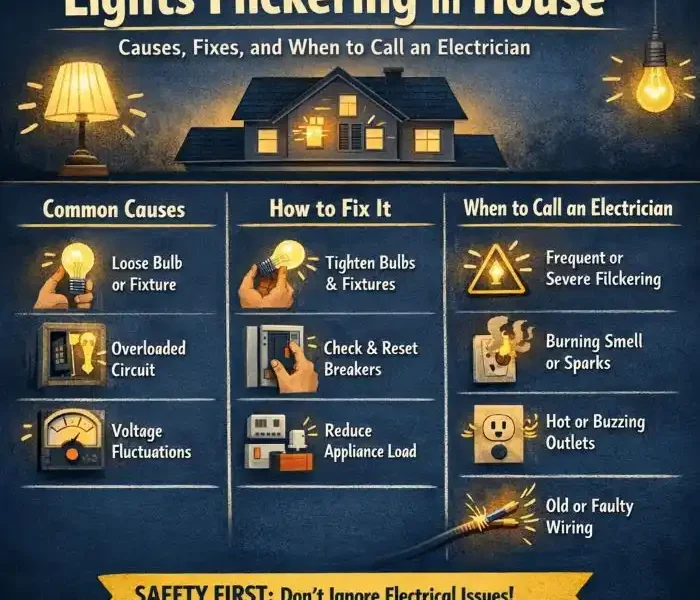
If you have noticed lights flickering in house, you are not alone. This is a common problem in many homes, and it can happen for several different reasons. Sometimes the cause is minor, like a loose bulb. Other times, the flickering points to a more serious electrical issue that needs quick attention.
That is why it is important not to ignore the problem, especially if it keeps happening. A light that flickers once in a while may not seem like a big deal. But if lights blink often, dim when appliances turn on, or flicker in several rooms, your home may be trying to warn you about something deeper.
The good news is that some causes are easy to check. You may be able to solve the issue by tightening a bulb, changing a dimmer-friendly LED, or reducing the load on one circuit. But there are also situations where you should stop troubleshooting and call a licensed electrician right away.
In this guide, you will learn what flickering lights usually mean, the most common causes, safe fixes you can try, warning signs to watch for, and when professional help is the smartest choice. By the end, you will have a much clearer idea of what is normal, what is not, and what steps to take next.
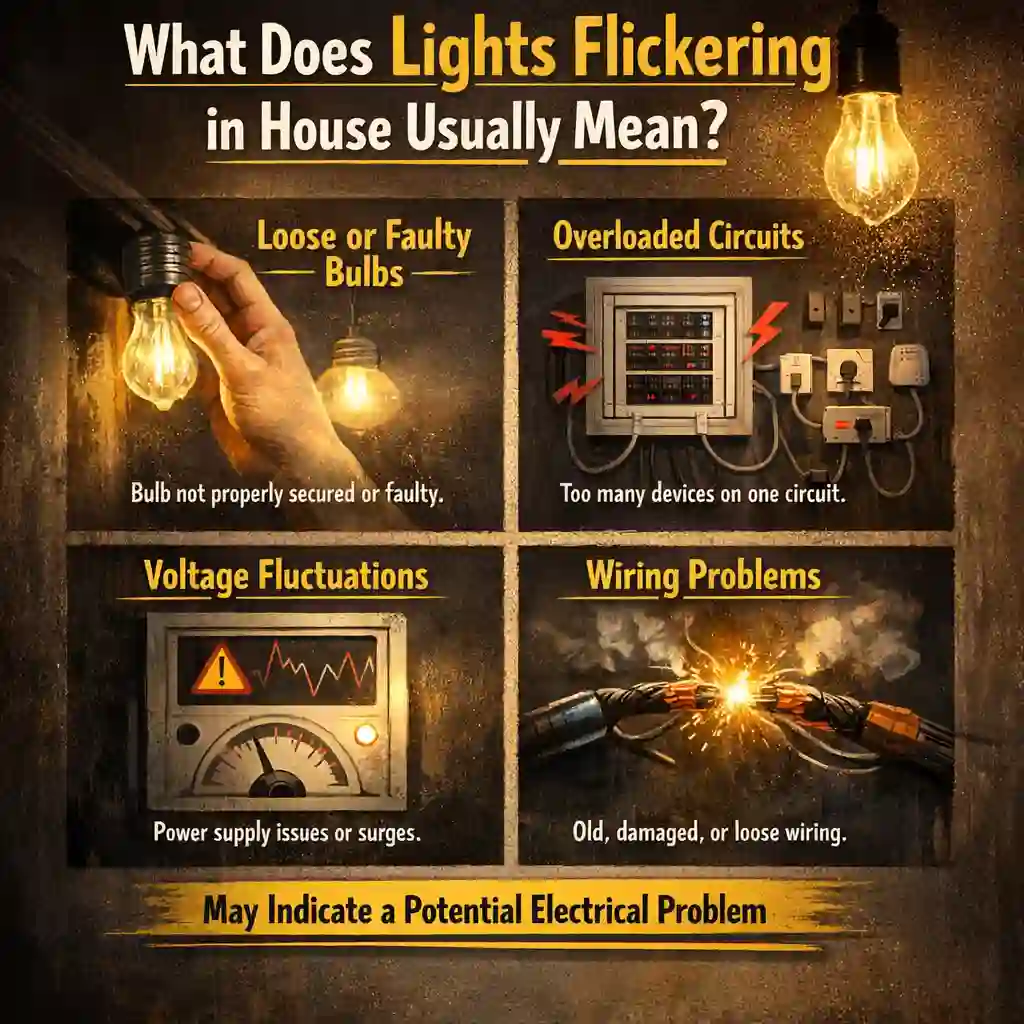
What Does Lights Flickering in House Usually Mean?
Occasional flickering vs. constant flickering
Not all flickering means the same thing. If a light flickers once after you screw in a new bulb, the issue may be simple and harmless. But if it happens again and again, you should pay closer attention.
Occasional flickering often comes from a loose bulb, a bulb that is reaching the end of its life, or a minor dimmer compatibility issue. These are usually easier to fix.
Constant flickering, on the other hand, can point to electrical problems such as poor wiring, overloaded circuits, voltage changes, or issues inside the electrical panel. The more often it happens, the more important it becomes to investigate.
Where the flickering happens matters
You should also think about where the flickering is happening. That pattern can tell you a lot.
If only one light flickers, the problem is often limited to the bulb, the fixture, or the wall switch.
If one room flickers, you may be dealing with a local wiring issue or a circuit that is carrying too much power demand.
If the whole house flickers, that is more serious. The problem could involve the electrical panel, the main service connection, or even the power coming into your home from the utility company.
The timing matters too
It also helps to ask yourself when the flickering happens. Do the lights flicker only at night? Do they blink when the air conditioner starts? Do they dim when the microwave runs? These details are not random. They can help identify the source.
In short, flickering lights can range from a simple annoyance to a real safety issue. The key is to notice the pattern and respond before a small issue becomes a larger one.
Common Reasons for Lights Flickering in House
Loose or faulty light bulbs
Start with the easiest possibility first. A bulb that is not screwed in tightly can lose proper contact inside the socket. When that happens, the power flow becomes uneven, and the light may flicker, blink, or dim.
Bulbs can also fail over time. Even if the bulb still turns on, the internal parts may be worn out. This is common with older incandescent bulbs, but it can happen with LEDs too.
The fix may be very simple. Turn off the switch, let the bulb cool, and make sure it is seated properly. If the flickering continues, replace the bulb with a new one.
This is usually the first thing to check because it is fast, safe, and often solves the problem right away.
Incompatible dimmer switches
Many homeowners switch to LED bulbs to save energy, but not every LED bulb works well with every dimmer switch. Older dimmers were often designed for incandescent bulbs, not modern LEDs.
When the bulb and dimmer do not match, the light may flicker, buzz, or fail to dim smoothly. You may notice the problem most when the light is set low.
This does not always mean the bulb or switch is broken. It may simply mean they are not compatible. The best solution is to use dimmer-compatible LED bulbs and, if needed, upgrade to a dimmer switch designed for LEDs.
If flickering only happens on dimmed lights, this cause should move near the top of your list.
Loose light switches or fixtures
A wall switch or light fixture can also cause flickering if the electrical connection inside becomes loose. Every time the connection shifts, the flow of electricity becomes unstable for a moment.
You may notice that the light flickers when you touch the switch, when someone walks heavily across the floor, or when the fixture moves slightly. That is a clue that the issue may be local to the switch or fixture.
Older homes are especially likely to have this problem because parts wear down over time. Poor installation or recent repairs can also leave a connection less secure than it should be.
This kind of issue should be taken seriously. Even if the flickering seems minor, a loose connection can create heat and lead to bigger electrical trouble.
Voltage fluctuations
Your home electrical system should deliver steady voltage. But in real life, the voltage can rise or fall a little when large appliances turn on. This is called a voltage fluctuation.
You might see the lights dim for a second when the air conditioner, refrigerator, washing machine, or microwave starts running. A small change can be normal, especially in older homes. But noticeable or repeated changes should not be ignored.
If the flickering is strong, frequent, or happening with several different appliances, it may point to a larger issue with the circuit, panel, or service line.
You do not need to become an electrical expert to spot this. Just pay attention to the pattern. If lights regularly flicker when heavy appliances start, that is useful information for troubleshooting.
Overloaded circuits
Every circuit in your home has a limit. When too many devices draw power from the same circuit, the load can become too high. That can lead to flickering lights, dimming, warm outlets, or breaker trips.
This issue is common in homes where several appliances, chargers, entertainment devices, and lighting fixtures all share the same line. Kitchens, laundry areas, home offices, and older bedrooms are common trouble spots.
An overloaded circuit does not always trip the breaker right away. Sometimes the first warning sign is flickering lights when everything is running at once.
If this is the cause, the solution may be to reduce what is plugged into that circuit or have an electrician redistribute the load more safely.
Faulty wiring
This is one of the most important causes to understand because it can be dangerous. Faulty wiring includes wires that are old, damaged, loose, worn, or installed incorrectly.
When wires do not carry electricity properly, lights may flicker in one room or across the whole house. You may also notice buzzing sounds, warm switches, or a burning smell.
Older homes are more likely to have wiring issues, but newer homes are not immune. Poor workmanship, pest damage, water exposure, or hidden wear can all affect wiring over time.
This is not something you should treat as a guessing game. Faulty wiring can increase the risk of electrical fire. If you suspect it, bring in a licensed electrician.
Problems with the electrical panel
The electrical panel is the control center of your home’s electrical system. If there is a loose breaker, failing connection, worn bus bar, or aging panel component, lights may flicker in several areas or throughout the house.
Panel issues are more likely if your home is older, your breakers trip often, or your power behaves inconsistently. You may notice lights dimming and brightening for no obvious reason.
Unlike changing a bulb, panel work is not a beginner task. Even opening the panel should be done with care. If whole-house flickering is happening, a panel inspection may be necessary.
Utility service issues
Sometimes the problem does not start inside your house at all. The issue may come from the utility side, such as a loose service connection, transformer trouble, or power fluctuations from the local grid.
A good clue is when your neighbors notice the same thing. If multiple homes experience flickering at the same time, the utility company may need to inspect the outside service.
Storms, tree contact, equipment wear, and service line problems can all affect incoming power. If your home wiring seems fine but the flickering continues across the property, this outside source becomes more likely.
Different Types of Flickering and What They Suggest
The type of flickering often tells you where to look first. Here is a simple guide you can use.
| Flickering Pattern | Likely Cause | How Serious It May Be |
|---|---|---|
| One light flickers | Loose bulb, bad bulb, fixture issue | Usually low to moderate |
| One room flickers | Circuit issue, local wiring problem, overloaded line | Moderate |
| Lights flicker when appliances start | Voltage drop, heavy power draw, overloaded circuit | Moderate |
| Whole house flickers | Panel issue, service connection problem, utility issue | High |
| Flickering with buzzing or heat | Loose wiring, switch failure, dangerous connection | High |
| Flickering after storm or outage | Surge damage, utility fault, panel damage | Moderate to high |
One light flickers
If only one light is acting up, the issue is often limited and easier to solve. Check the bulb first. Then think about the fixture and switch.
This type of flickering is often less serious than a whole-home issue, but you should still pay attention if it keeps happening after the bulb is replaced.
One room flickers
When several lights in one room flicker, the problem usually goes beyond a single bulb. It may involve a shared circuit, a loose connection, or wiring tied to that area.
This becomes more important if outlets in the same room also act strangely.
Lights flicker when appliances turn on
This is a classic sign of a power load issue. Large appliances need a surge of power when they start. That sudden demand can cause nearby lights to dim or flicker briefly.
A small change can be normal. A strong or regular change should be checked.
Whole house lights flicker
If lights all over the house flicker, take it seriously. This points toward bigger system problems, such as the panel, service line, or utility feed.
You should not ignore whole-house flickering, especially if it is becoming more frequent.
How to Troubleshoot Lights Flickering in House
Before you panic, you can do a few simple checks. These steps can help you narrow down the cause safely.
Check the bulb
Start with the most obvious place. Turn off the light and let the bulb cool. Then tighten it gently. If it already feels secure, replace it with a new bulb.
A surprising number of flickering issues stop right here.
Test another bulb
Use a bulb that you know works well. Make sure it matches the fixture and, if needed, the dimmer switch.
If the new bulb works normally, the old bulb was likely the problem.
Inspect the switch
Pay attention to how the switch feels. Does it seem loose? Does it crackle, buzz, or feel warm? Does the light flicker when you touch the switch?
These are signs that the switch may be failing. Do not take the switch apart unless you are trained to do so.
Check for appliance-related flickering
Watch what is happening around the time the lights flicker. Does it happen when the air conditioner starts? When the refrigerator runs? When someone uses the microwave or vacuum?
If yes, you may be dealing with a circuit load problem or voltage drop.
Look at the breaker panel
Check whether any breakers have tripped. Also notice if there are obvious warning signs such as heat, corrosion, burn marks, or unusual smells.
If you see any of those signs, stop there and call an electrician. Do not try to repair panel issues on your own.
Use this quick troubleshooting checklist
- Tighten or replace the bulb
- Try a compatible LED bulb if a dimmer is involved
- Notice whether the flickering happens in one light, one room, or the whole house
- Watch for flickering when appliances start
- Check for tripped breakers
- Stop immediately if you notice heat, burning smells, sparking, or buzzing
Safe DIY Fixes You Can Try
Some fixes are safe for homeowners. Others are not. It helps to know the difference.
Tighten or replace loose bulbs
This is the easiest and safest first step. If the bulb is loose, tighten it. If it looks dark, damaged, or worn, replace it.
Choose the correct bulb type and wattage for the fixture.
Replace incompatible bulbs
If you are using LED bulbs on a dimmer switch, make sure they are designed for dimming. If not, they may flicker even when nothing else is wrong.
A quick bulb change can solve a frustrating problem.
Reduce the load on one circuit
If flickering happens when several devices run at the same time, unplug some items and spread them across other outlets or circuits if possible.
This is especially useful in older homes, where fewer circuits may be carrying more devices than they were originally designed for.
Reset a tripped breaker if safe
If a breaker has tripped, you may reset it once if there are no signs of damage, heat, or odor. But if it trips again, do not keep resetting it. Repeated tripping is a warning sign, not a nuisance to ignore.
Use the right dimmer setup
If the problem comes from a dimmer, use bulbs designed for dimming and consider replacing the switch with a compatible LED dimmer.
This often improves both flickering and buzzing.
What not to do
It is just as important to know what not to do. Avoid risky repairs that expose you to electric shock or make a hidden problem worse.
Here are the jobs you should leave to a pro:
- Do not open switches, fixtures, or outlets if you are not qualified
- Do not touch exposed wires
- Do not attempt panel repairs
- Do not ignore repeated flickering with heat, smell, or sound
- Do not keep resetting a breaker that trips often
DIY is fine for bulbs and simple observation. But once the issue involves wiring, the panel, or signs of damage, professional help is the safer path.
When Flickering Lights Become a Safety Concern
Not every flickering light is dangerous, but some warning signs should make you act quickly.
Burning smell
A burning or scorched smell near a fixture, outlet, switch, or panel is a serious warning. It can mean overheating insulation, damaged wiring, or a failing electrical part.
If you notice this, turn off power to the affected area if you can do so safely, and call an electrician right away.
Warm switches or outlets
Electrical devices should not feel hot during normal use. Warmth often means resistance, and resistance creates heat. That heat may be caused by a loose connection or failing component.
If a switch or outlet feels warm and lights are also flickering, stop using it until it is inspected.
Sparking or buzzing
Sparking is never something to ignore. Buzzing is also important because electricity should not make those kinds of sounds under normal conditions.
These signs often mean the connection is unstable, and unstable electrical connections can become dangerous fast.
Frequent breaker trips
Breakers are designed to protect your home. If one keeps tripping, it is doing its job by telling you something is wrong.
That problem may be a simple overload, but it could also be faulty wiring, a failing breaker, or a device drawing too much power. If trips happen often, get it checked.
Flickering after storms or power outages
Storms and outages can damage electrical equipment. Surges may affect bulbs, switches, breakers, and sensitive home systems.
If lights start flickering after severe weather or a blackout, do not assume it will just go away. An inspection may be the safest next step.
Why You Should Call a Licensed Electrician
A licensed electrician does more than fix the visible symptom. They can test for problems behind the walls, inside the panel, and at the service connection.
That matters because electrical issues often hide where you cannot see them. A light might flicker because of a deeper connection problem that gets worse over time. If left alone, that same issue may eventually damage devices, trip breakers, or create a fire hazard.
An electrician can:
- Check voltage stability
- Inspect switches, fixtures, and outlets
- Test circuits for overload or poor connections
- Evaluate the electrical panel
- Look for aging or unsafe wiring
- Identify utility-side issues when needed
Most importantly, a licensed electrician knows how to do this safely. Electricity is not forgiving. Temporary fixes may hide the problem for a while, but they do not remove the risk.
If your home has repeated flickering, whole-house flickering, or any warning signs like heat or smell, professional help is the right move.
How to Prevent Lights Flickering in House
The best way to deal with electrical problems is to catch them early. A few smart habits can help prevent future trouble.
Use the right bulbs
Always match the bulb to the fixture. If you use dimmers, choose bulbs clearly marked as dimmable and compatible with your switch type.
This small detail prevents many common flickering issues.
Avoid overloading circuits
Try not to run too many high-demand devices on the same circuit. Space heaters, microwaves, air conditioners, and other large appliances need plenty of power.
Spreading the load helps your system run more smoothly.
Schedule electrical inspections
If your home is older, or if you have added new appliances, an electrical inspection is a smart idea. It can reveal aging wiring, weak connections, or panel issues before they become serious.
Think of it as preventive maintenance for your home’s power system.
Upgrade old components
Old switches, outdated fixtures, and aging electrical panels can all contribute to flickering. Replacing worn parts improves safety and reliability.
If your home still has very old electrical equipment, it may be time to consider an upgrade.
Monitor recurring warning signs
Do not brush off patterns. If lights flicker in the same room, at the same time of day, or when certain appliances run, take note.
That kind of information helps spot problems early and makes it easier for an electrician to diagnose the issue.
Frequently Asked Questions
Why do my lights flicker only at night?
There are a few possible reasons. At night, many homes use more power for lighting, heating, cooling, cooking, or entertainment. That extra demand can reveal voltage changes or overloaded circuits.
You may also notice outside utility demand changing in the evening. If the flickering happens often and not just once in a while, it is worth checking further.
Is one flickering bulb dangerous?
Usually, one flickering bulb is not a major danger. In many cases, the bulb is loose, old, or defective.
Still, you should not ignore it forever. If replacing the bulb does not fix the problem, the issue may be with the fixture or switch. That deserves attention before it gets worse.
Why do LED lights flicker more often?
LEDs are efficient, but they can be sensitive to compatibility issues. They may flicker because of the wrong dimmer switch, low-quality internal drivers, loose connections, or unstable voltage.
That is why choosing good-quality, compatible LED bulbs matters so much.
Can flickering lights cause a fire?
A flickering light itself does not automatically cause a fire. But the electrical problem behind it can increase fire risk, especially if the cause is loose wiring, overheating, or a failing switch or panel connection.
If flickering comes with buzzing, warmth, burning smells, or breaker trips, take it very seriously.
Should I worry if lights flicker when the AC turns on?
A slight dimming for a brief moment can happen when a large appliance starts. But if the flicker is strong, frequent, or worsening, the circuit may be overloaded or the voltage may not be stable.
This is one of those signs you should keep watching rather than dismissing.
Can the utility company be responsible for flickering lights?
Yes, sometimes the issue comes from outside your home. Service line problems, transformer issues, or neighborhood power disturbances can all cause lights to flicker.
If your neighbors notice the same thing, the utility company may need to inspect the supply side.
Conclusion: What to Do About Lights Flickering in House
When it comes to lights flickering in house, the cause can be as simple as a loose bulb or as serious as faulty wiring, a bad breaker, or a service connection problem. That is why it is so important to pay attention to the pattern.
If one light flickers once in a while, start with the easy checks. Tighten the bulb, replace it, and make sure the dimmer and bulb match. If flickering happens in one room, when appliances start, or across the whole house, look more closely. And if you notice heat, sparks, buzzing, burning smells, or repeated breaker trips, treat the issue as urgent.
The safest approach is to fix small problems early and never ignore warning signs. Electrical issues often get worse over time, not better. A quick inspection today can prevent a much larger repair tomorrow.
If the flickering continues and you are not sure why, the smartest next step is to contact a licensed electrician and schedule an inspection. Your home should feel safe, stable, and reliable, and your lighting should too.