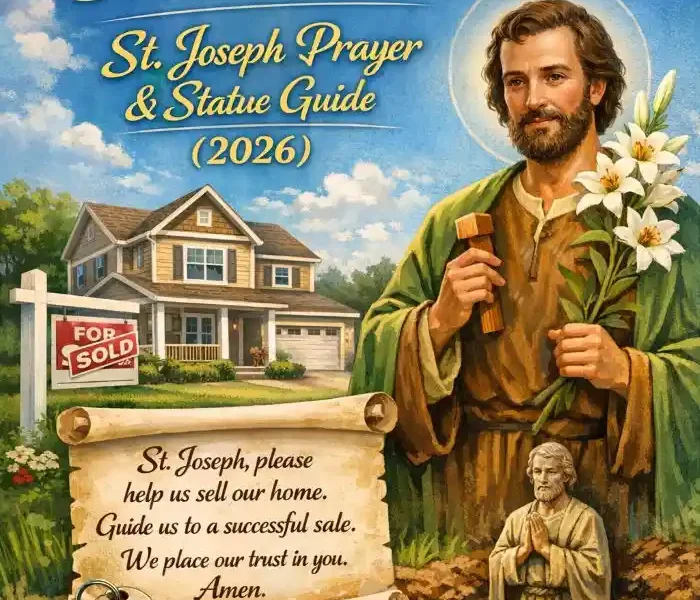
<p>If your home has been sitting on the market for weeks or even months, you already know how stressful it can feel.</p>
<p>You lower the price. You clean every room. You fix the small things buyers always notice. You make the photos look great. And still, the phone stays quiet. The offers do not come. Or worse, buyers show interest and then disappear.</p>
<p>That is usually the moment when many homeowners start asking a very specific question: <strong><a href="https://catholiccourier.com/articles/can-st-joseph-sell-a-house-skip-burying-statue-priests-say/">what saint helps sell a house</a>?</strong></p>
<p>For generations, the answer has almost always been <strong>St. Joseph</strong>.</p>
<p>In Catholic tradition, St. Joseph is closely connected with homes, families, work, and protection. Because he was a carpenter and the earthly guardian of the Holy Family, many people turn to him when they need help with housing matters. That includes buying a home, finding a home, and of course, selling one. Over time, this belief led to one of the most talked-about real estate traditions: the custom of praying to St. Joseph and, in some cases, burying a small St. Joseph statue in the yard.</p>
<p>Now, let’s be clear. This is not magic. It is not a shortcut that replaces proper pricing, strong marketing, or smart home presentation. But for many homeowners, it offers something powerful during a stressful season: <strong>hope, focus, peace, and a sense of spiritual support</strong>.</p>
<p>In this guide, you will learn who St. Joseph is, why he is known as the saint for home selling, where the tradition came from, how the St. Joseph statue burial custom works, which prayers people use, and how to combine faith with real-world real estate strategy.</p>
<p>And if you are trying to move your property soon, this article will help you approach the process with both <strong>prayer and a plan</strong>.</p>
<h2 id="who-is-the-saint-that-helps-sell-a-house-">Who Is the Saint That Helps Sell a House?</h2>
<h3 id="st-joseph-and-the-tradition-of-home-selling">St. Joseph and the tradition of home selling</h3>
<p>If you are asking <strong>what saint helps sell a house</strong>, the name you will hear most often is <strong>St. Joseph</strong>.</p>
<p>He is widely known as the saint people pray to when they need help with home-related matters. That includes selling a <a href="https://comeawayhome.co.uk/how-long-can-you-delay-closing-on-a-house/">house</a>, buying a home, moving to a new city, finding a safe place for the family, or simply asking for peace in the home.</p>
<p>This connection did not appear out of nowhere. It comes from who St. Joseph is and how Christians have understood his role for centuries.</p>
<p>In the Bible, St. Joseph is the husband of Mary and the earthly father of Jesus. He is often described as a <strong>carpenter</strong>, which already links him with building, shelter, repair, and practical work. But his deeper connection to housing comes from his role as a <strong>protector</strong>.</p>
<p>He cared for his family. He provided for them. He guided them through uncertainty. He helped keep them safe, even during difficult moments like the journey to Egypt. In a very real sense, he is seen as someone who understands what it means to secure a home and protect the people inside it.</p>
<p>That is why homeowners often feel a natural connection to him.</p>
<h3 id="why-st-joseph-is-linked-to-real-estate">Why St. Joseph is linked to real estate</h3>
<p>When people speak about <strong>St. Joseph sell house</strong> traditions, they are usually talking about two ideas at the same time.</p>
<p>First, they believe St. Joseph intercedes for practical needs. A house sale is not only a financial event. It is emotional. It affects your family, your next move, your timing, and sometimes your peace of mind. People pray to St. Joseph because they see him as someone who understands these very human concerns.</p>
<p>Second, he has become associated with homes and real estate through long-standing devotional customs. Over time, many families, priests, and even real estate professionals began recommending prayers to St. Joseph when a sale seemed delayed or difficult.</p>
<p>That is why you may also hear him called a <strong>patron saint of homes</strong>, <strong>families</strong>, <strong>workers</strong>, and in popular tradition, even a kind of <strong>patron saint of real estate needs</strong>.</p>
<h3 id="is-st-joseph-officially-the-only-saint-for-this-purpose-">Is St. Joseph officially the only saint for this purpose?</h3>
<p>In practice, <strong>St. Joseph is the main saint people turn to for selling a house</strong>.</p>
<p>You may hear other saints mentioned in broader situations. For example, some people pray to St. Jude in impossible cases or St. Anthony when something is lost. But when the issue is specifically <strong>selling a home</strong>, St. Joseph is by far the most recognized figure in popular Catholic tradition.</p>
<p>That matters because devotion works best when it feels meaningful, focused, and sincere.</p>
<p>So if you have been wondering which saint is most closely tied to this need, you do not need to overcomplicate it. The simple answer is this:</p>
<p><strong>If you are asking what saint helps sell a house, the traditional answer is St. Joseph.</strong></p>
<h2 id="history-of-the-st-joseph-home-selling-tradition">History of the St. Joseph Home-Selling Tradition</h2>
<p><img class="aligncenter wp-image-6917 size-full" src="https://comeawayhome.co.uk/wp-content/uploads/2026/05/1792d92f-33aa-4d47-90f0-f80ae3f92399-ezgif.com-jpg-to-webp-converter.webp" alt="what saint helps sell a house" width="700" height="700" /></p>
<h3 id="where-the-tradition-began">Where the tradition began</h3>
<p>Like many religious customs, the St. Joseph home-selling tradition sits somewhere between <strong>history, devotion, and folklore</strong>.</p>
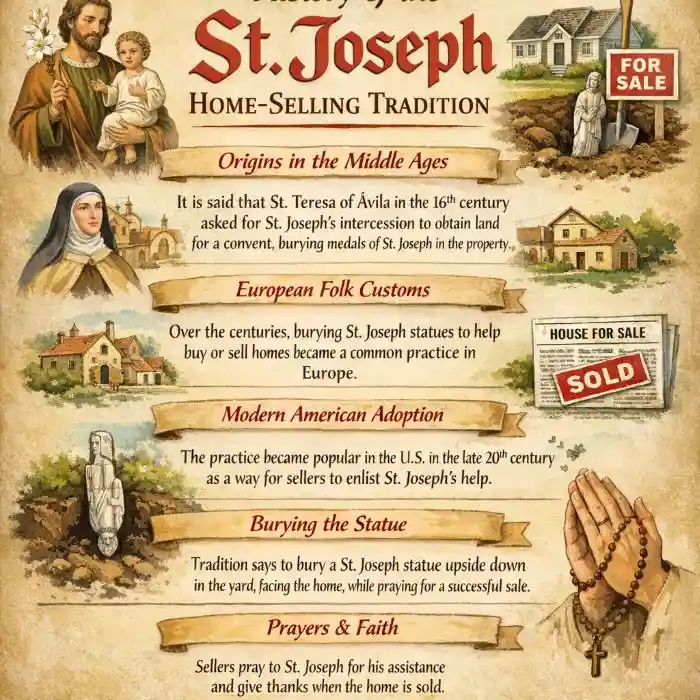
<p>The story most often told traces the custom back several centuries. It is commonly linked to <strong>St. Teresa of Ávila</strong>, who is said to have buried medals of St. Joseph while seeking land for convents. Over time, people began to connect this act with asking for help in property matters.</p>
<p>Whether every detail of the story can be proven in a modern historical sense is not really the main point for most believers. What matters is that the tradition took root because people trusted St. Joseph’s intercession and saw him as a helper in housing concerns.</p>
<p>That trust then spread from convent life into everyday family life.</p>
<h3 id="how-the-custom-grew-over-time">How the custom grew over time</h3>
<p>As Catholic communities grew in different parts of the world, home-based devotions also grew with them.</p>
<p>Immigrant families brought their prayers, customs, and small devotional practices into new places. In the United States and elsewhere, the St. Joseph house-selling custom became more visible during the 19th and 20th centuries. Priests, families, and later even some real estate agents began sharing the practice with homeowners who felt stuck.</p>
<p>It likely became popular for a simple reason: it was easy to do, deeply symbolic, and emotionally comforting.</p>
<p>A small statue could fit in the palm of your hand. A prayer took only a few minutes. Yet the action itself helped people feel that they were doing something meaningful while waiting for a buyer.</p>
<p>And when a sale finally happened, the story was remembered and passed on.</p>
<p>That is how traditions survive. One family shares it with another. One neighbor tells another neighbor. One agent mentions it to a client. Slowly, a private custom becomes a familiar one.</p>
<h3 id="folklore-faith-and-misunderstanding">Folklore, faith, and misunderstanding</h3>
<p>This is where it helps to be balanced.</p>
<p>The St. Joseph custom is best understood as a <strong>private devotional practice</strong>, not a guaranteed formula. It is not a replacement for faith, and it is definitely not a magic trick. Most people who approach it seriously do so with humility. They pray, ask for help, and then continue doing the practical work needed to sell the property.</p>
<p>That balance matters.</p>
<p>Some people treat the tradition lightly, almost like a superstition. Others reject it because they think it sounds too unusual. The wiser approach is somewhere in the middle. If you are a person of faith, you can see it as a simple act of trust. If you are not Catholic, you can still understand why the practice has stayed alive for so long: it gives people comfort during a major life transition.</p>
<p>And honestly, selling a house is exactly the kind of process where people crave peace and reassurance.</p>
<h3 id="why-the-tradition-still-matters-in-2026">Why the tradition still matters in 2026</h3>
<p>Even in a world of AI pricing tools, video walkthroughs, digital closings, and highly competitive listings, the St. Joseph tradition has not disappeared.</p>
<p>Why?</p>
<p>Because modern tools help you market a house, but they do not calm your heart.</p>
<p>A family selling a home in 2026 still faces the same old worries: Will we sell on time?<br />
Will the offer be fair?<br />
Will the next chapter work out?<br />
Will this move help our family?</p>
<p>That emotional side of selling has never changed.</p>
<p>So while today’s homeowner may use professional photos, smart staging, and online ads, they may also say a prayer to St. Joseph at the same time. To many people, that combination feels natural.</p>
<h3 id="timeline-of-the-tradition">Timeline of the tradition</h3>
<table>
<thead>
<tr>
<th>Era</th>
<th>Key Event</th>
</tr>
</thead>
<tbody>
<tr>
<td>1500s</td>
<td>The tradition is often linked to stories about St. Teresa of Ávila using St. Joseph devotion in property matters</td>
</tr>
<tr>
<td>1800s</td>
<td>Catholic families and religious communities help spread the custom more widely</td>
</tr>
<tr>
<td>1900s</td>
<td>The practice becomes a recognizable home-selling tradition in many local communities</td>
</tr>
<tr>
<td>2026</td>
<td>Homeowners still use St. Joseph prayers and statues alongside modern real estate strategies</td>
</tr>
</tbody>
</table>
<p><strong>Infographic placeholder:</strong> Timeline graphic showing the growth of the St. Joseph home-selling tradition from the 1500s to today.</p>
<h2 id="how-to-bury-a-st-joseph-statue-for-home-sales">How to Bury a St. Joseph Statue for Home Sales</h2>
<h3 id="what-the-statue-tradition-means">What the statue tradition means</h3>
<p>The practice of using a statue is one of the most well-known parts of St. Joseph devotion for sellers.</p>
<p>If you have heard someone say, “Just <strong>bury St. Joseph statue</strong> in the yard,” they are referring to a popular custom where a small statue of St. Joseph is placed in the ground while praying for help selling a home.</p>
<p>Again, the important thing is the spirit behind it.</p>
<p>The statue is not supposed to be treated like a lucky charm. For many people, it serves as a visible and physical reminder of prayer, trust, and intention. It helps turn a private hope into a meaningful action.</p>
<h3 id="what-you-need-before-you-begin">What you need before you begin</h3>
<p>You do not need much.</p>
<p>Most people use a small statue that is easy to place in the yard. These statues are often only a few inches tall. Some homeowners buy special home-selling kits, while others simply use a basic St. Joseph figure.</p>
<p>Before you begin, gather these items:</p>
<ul>
<li>A <strong>small St. Joseph statue</strong></li>
<li>A small tool for digging</li>
<li>A weather-safe bag or cloth if you want extra protection for the statue</li>
<li>A note or prayer card with your intention</li>
<li>A marker so you remember where the statue is buried</li>
</ul>
<p>That last part is more important than it sounds. Many people get so focused on selling the home that they forget where they placed the statue.</p>
<h3 id="step-by-step-guide-to-burying-the-statue">Step-by-step guide to burying the statue</h3>
<p>Here is the most common way people do it:</p>
<ol>
<li><strong>Choose a spot near the front of the property.</strong><br />
Many people place the statue near the “for sale” sign or close to the walkway leading to the entrance.</li>
<li><strong>Dig a small hole.</strong><br />
A depth of about 6 to 12 inches is common. It does not need to be dramatic. Just make sure the statue is secure.</li>
<li><strong>Place the statue upside down.</strong><br />
This is part of the popular tradition. Different families explain the symbolism differently, but the most common belief is that St. Joseph will not “rest” until the house is sold.</li>
<li><strong>Face the statue toward the house or toward the street, depending on the custom you follow.</strong><br />
Practices vary from family to family. Some want the statue facing outward to “draw” a buyer. Others place it facing the home as a sign of blessing and protection.</li>
<li><strong>Say a prayer right away.</strong><br />
This is the heart of the practice. Ask sincerely for the right buyer, fair terms, and a smooth process.</li>
<li><strong>Keep praying while the home is listed.</strong><br />
Many people say a daily prayer or begin a nine-day novena.</li>
<li><strong>Retrieve the statue after the sale.</strong><br />
Once the house is sold, dig up the statue, clean it, and place it in a place of honor in your new home.</li>
</ol>
<h3 id="why-people-place-the-statue-upside-down">Why people place the statue upside down</h3>
<p>This is the part most people ask about first.</p>
<p>Why upside down?</p>
<p>The answer is simple: <strong>tradition</strong>.</p>
<p>There are many explanations, but none of them should be treated too rigidly. Some say it symbolizes urgency. Others say it is a playful way of saying, “St. Joseph, please help us quickly.” Some people prefer not to bury the statue upside down at all and instead place it respectfully in a flower bed or inside the home next to a prayer card.</p>
<p>If you are uncomfortable with the upside-down custom, you are not doing anything wrong by skipping that part. The prayer matters more than the position.</p>
<h3 id="common-mistakes-to-avoid">Common mistakes to avoid</h3>
<p>People often become so focused on the ritual that they forget the purpose.</p>
<p>Try to avoid these mistakes:</p>
<ul>
<li><strong>Treating the practice like magic</strong></li>
<li><strong>Using the statue without prayer</strong></li>
<li><strong>Forgetting to retrieve the statue after the sale</strong></li>
<li><strong>Ignoring practical home-selling steps</strong></li>
<li><strong>Getting anxious if the house does not sell immediately</strong></li>
</ul>
<p>Faith works best with patience.</p>
<p>The point is not to force a quick result. The point is to ask for help, remain hopeful, and keep doing your part.</p>
<h3 id="a-simple-approach-if-you-do-not-want-to-bury-anything">A simple approach if you do not want to bury anything</h3>
<p>Not everyone feels comfortable burying a statue. That is completely fine.</p>
<p>You can still practice devotion to St. Joseph by:</p>
<ul>
<li>Placing a small statue inside the house</li>
<li>Keeping a St. Joseph prayer card near the front door</li>
<li>Saying a daily prayer before showings</li>
<li>Lighting a candle during your novena time</li>
<li>Asking for wisdom, peace, and the right buyer</li>
</ul>
<p>So if you want the spiritual meaning without the yard ritual, you still have meaningful options.</p>
<p><strong>Image placeholder:</strong> Small St. Joseph statue being placed near a front garden bed.<br />
<strong>Image placeholder:</strong> Simple diagram showing common statue placement near a for-sale sign.</p>
<h2 id="powerful-st-joseph-prayers-for-selling-your-house">Powerful St. Joseph Prayers for Selling Your House</h2>
<h3 id="why-prayer-matters-during-a-home-sale">Why prayer matters during a home sale</h3>
<p>A home sale can test your patience in ways you never expected.</p>
<p>Prayer gives you a place to put your fear, frustration, and uncertainty. It helps you move from panic to peace. It also reminds you that you are not carrying the whole burden alone.</p>
<p>That is why the <strong>St. Joseph prayer house sale</strong> tradition remains so popular. People want more than a transaction. They want clarity, timing, fairness, and peace of mind.</p>
<h3 id="a-short-prayer-for-selling-your-house">A short prayer for selling your house</h3>
<p>Use this simple prayer if you want something direct and easy to repeat:</p>
<blockquote><p><strong>O St. Joseph, guardian of homes and families, I ask for your help in selling this house. Please bring the right buyer, guide the process, and help everything move smoothly and honestly. May this home be a blessing to the next family, and may our next step be filled with peace. Amen.</strong></p></blockquote>
<p>This prayer works well in the morning, before a showing, or whenever anxiety starts to rise.</p>
<h3 id="a-longer-prayer-for-the-right-buyer">A longer prayer for the right buyer</h3>
<blockquote><p><strong>St. Joseph, faithful protector and provider, I place this home sale in your care. Please help us find a buyer who will value this home and make a fair offer. Remove delays, confusion, and unnecessary obstacles. Lead us to the right outcome at the right time. Give us patience, wisdom, and trust while we wait. Amen.</strong></p></blockquote>
<p>This version is helpful if the home has been listed for a while or if deals keep falling through.</p>
<h3 id="a-quick-prayer-before-showings">A quick prayer before showings</h3>
<blockquote><p><strong>St. Joseph, bless this home today. Let every room feel warm, peaceful, and welcoming. Guide the people who walk through this door. If this is the right place for them, open the way. Amen.</strong></p></blockquote>
<p>Short prayers like this help many homeowners stay calm before viewings or open houses.</p>
<h3 id="a-prayer-for-peace-while-waiting">A prayer for peace while waiting</h3>
<blockquote><p><strong>St. Joseph, calm my heart and steady my thoughts. Help me trust the process, make wise decisions, and stay hopeful even when results feel slow. Let this home sale happen in the best possible way. Amen.</strong></p></blockquote>
<p>Sometimes the biggest need is not speed. It is peace.</p>
<h3 id="how-to-pray-a-st-joseph-novena">How to pray a St. Joseph novena</h3>
<p>A novena is a prayer said over <strong>nine consecutive days</strong> for a special intention.</p>
<p>If you want a more structured spiritual practice, a novena is a great option. You can keep it simple:</p>
<ul>
<li>Start by naming your intention clearly</li>
<li>Pray at the same time each day if possible</li>
<li>Add one short St. Joseph prayer daily</li>
<li>Ask for the right buyer, fair price, and smooth closing</li>
<li>End by giving thanks, even before the final result arrives</li>
</ul>
<p>The beauty of a novena is consistency. It gives you a rhythm. And during stressful seasons, rhythm can be deeply grounding.</p>
<h3 id="should-you-use-the-prayer-with-the-statue-">Should you use the prayer with the statue?</h3>
<p>Many people do both.</p>
<p>They bury the statue or place it in the home, then continue praying each day. That combination works well because it joins <strong>symbol and intention</strong>. The symbol reminds you to pray. The prayer keeps your focus where it belongs.</p>
<p><strong>Printable prayer card placeholder:</strong> “St. Joseph Prayer for Selling a House” graphic for blog download.</p>
<h2 id="real-life-success-stories-and-testimonials">Real-Life Success Stories and Testimonials</h2>
<h3 id="why-stories-matter">Why stories matter</h3>
<p>When people ask about the <strong>saint for home selling</strong>, they are often not just looking for theory. They want reassurance.</p>
<p>They want to know, “Has this helped anyone else?”</p>
<p>The answer, at least in the world of personal experience, is yes. Many homeowners share stories of praying to St. Joseph, using the statue tradition, and then seeing movement in a sale that had felt stuck.</p>
<p>Of course, every market is different. Every property is different. And no story should be treated as a guarantee. But these testimonies matter because they show how people combine faith, patience, and practical effort during a major life event.</p>
<h3 id="story-one-the-stalled-listing-that-finally-moved">Story one: the stalled listing that finally moved</h3>
<p>A common example goes like this: a family lists their home, gets little interest, and starts to lose confidence. After hearing about St. Joseph from a friend, they place a small statue in the yard and begin a daily prayer.</p>
<p>Within the next few weeks, they receive more serious showings. Then one buyer returns for a second visit and makes a reasonable offer.</p>
<p>Was it only the prayer? Was it timing? Better listing exposure? A small market shift?</p>
<p>Most believers would say it was a mix of factors, with prayer helping open the way.</p>
<p>And that is exactly how many people experience it. Not as magic, but as grace working through ordinary events.</p>
<h3 id="story-two-peace-before-the-sale">Story two: peace before the sale</h3>
<p>Not every story is about a lightning-fast offer.</p>
<p>Sometimes the real result is emotional. A homeowner may still wait several weeks for the sale, but instead of living in daily panic, they become calmer, more patient, and more able to make wise choices.</p>
<p>That kind of testimonial matters too.</p>
<p>If you have ever sold a house, you know that stress can lead to bad decisions. Prayer can help you slow down, think clearly, and avoid acting from fear.</p>
<p>In that sense, St. Joseph devotion does not just help with the sale. It can help with <strong>how you go through the sale</strong>.</p>
<h3 id="story-three-faith-plus-strategy-works-better">Story three: faith plus strategy works better</h3>
<p>We often see the best outcomes when devotion is paired with smart action.</p>
<p>Imagine a homeowner who prays daily to St. Joseph but also does the practical basics well. They improve the photos, repaint a tired room, fix the entryway, stage the living space, and adjust the price based on current market feedback.</p>
<p>Then, instead of waiting passively, they stay engaged.</p>
<p>That combination often creates the strongest story afterward. The seller feels that faith gave them peace and perseverance, while strategy created better conditions for the right buyer to say yes.</p>
<h3 id="a-business-blog-perspective">A business-blog perspective</h3>
<p>If you work in real estate or property marketing, this topic matters because it speaks to the whole person.</p>
<p>Clients do not only need technical support. They also need emotional confidence.</p>
<p>Some sellers want market analysis. Some want staging advice. Some quietly want prayer and reassurance too.</p>
<p>There is nothing strange about that. Selling a home is one of life’s biggest transitions.</p>
<p>So if you serve homeowners, this tradition gives you a respectful and human way to understand what many clients may already believe: that a successful sale often requires both <strong>practical guidance and personal peace</strong>.</p>
<h2 id="modern-tips-combine-faith-with-real-estate-strategy">Modern Tips: Combine Faith with Real Estate Strategy</h2>
<h3 id="prayer-is-not-a-replacement-for-preparation">Prayer is not a replacement for preparation</h3>
<p>This may be the most important part of the entire article.</p>
<p>If you want to know <strong>what saint helps sell a house</strong>, the answer is St. Joseph. But if you want to actually improve your chances of selling well, you also need the basics of real estate done right.</p>
<p>Faith and strategy can work together beautifully.</p>
<p>Prayer can give you peace. Strategy can improve your results.</p>
<h3 id="what-to-do-alongside-your-st-joseph-devotion">What to do alongside your St. Joseph devotion</h3>
<p>Here are practical steps you should not skip:</p>
<ul>
<li><strong>Price the home correctly from the start</strong></li>
<li><strong>Use clean, bright, professional photos</strong></li>
<li><strong>Declutter each room so buyers can picture themselves living there</strong></li>
<li><strong>Fix obvious maintenance issues</strong></li>
<li><strong>Make the front entrance look welcoming</strong></li>
<li><strong>Use virtual tours and video walkthroughs when possible</strong></li>
<li><strong>Review buyer feedback honestly</strong></li>
<li><strong>Work with an agent or advisor who understands your local market</strong></li>
</ul>
<p>These steps matter in every city.</p>
<h3 id="2026-home-selling-realities">2026 home-selling realities</h3>
<p>Today’s buyers move fast, but they also compare everything online.</p>
<p>That means your listing has to look good on a phone screen before anyone ever steps through the front door. In 2026, sellers are using digital marketing, short-form property videos, AI-based pricing tools, neighborhood research, and targeted ad campaigns more than ever.</p>
<p>That does not cancel faith. It simply means that faith should walk beside preparation.</p>
<h3 id="if-you-are-selling-in-lahore-or-another-fast-moving-market">If you are selling in Lahore or another fast-moving market</h3>
<p>Local market conditions always matter.</p>
<p>If you are selling in Lahore, for example, buyer expectations, neighborhood demand, legal paperwork, and pricing behavior may differ from other cities. You may also find that family-based decisions play a big role in the sale process. In that environment, a home seller often needs both <strong>spiritual calm and local market expertise</strong>.</p>
<p>So pray if prayer matters to you. But also study the market, understand the paperwork, and present the property in a way that fits local expectations.</p>
<p><strong>Internal link suggestion:</strong> Home Staging Guide<br />
<strong>Internal link suggestion:</strong> Property Pricing Guide<br />
<strong>Internal link suggestion:</strong> Seller Checklist for First-Time Homeowners</p>
<h2 id="faqs">FAQs</h2>
<h3 id="what-saint-helps-sell-a-house-">What saint helps sell a house?</h3>
<p><strong>St. Joseph</strong> is the saint most commonly associated with selling a house. He is connected with homes, family life, protection, and practical needs, which is why many people pray to him during a property sale.</p>
<h3 id="does-burying-the-statue-really-work-">Does burying the statue really work?</h3>
<p>For many people, it is a meaningful act of devotion. It should be seen as a prayerful tradition, not a guaranteed formula. Some homeowners feel it helps bring peace, hope, and even positive momentum. Others simply value the symbolism.</p>
<h3 id="where-can-i-buy-a-st-joseph-statue-">Where can I buy a St. Joseph statue?</h3>
<p>You can usually find a small statue in religious gift shops, church stores, or general online marketplaces. Many people choose a small figure made specifically for house-selling devotion.</p>
<h3 id="can-renters-use-this-tradition-">Can renters use this tradition?</h3>
<p>Yes. A renter may still pray to St. Joseph for help finding a new place, ending a lease smoothly, or moving into a better home. The devotion is not limited to homeowners.</p>
<h3 id="what-if-i-am-not-catholic-">What if I am not Catholic?</h3>
<p>You do not have to be Catholic to appreciate the meaning behind the tradition. If prayer is part of your life, you can still ask for peace, guidance, and the right outcome. If not, you may still find the story helpful as a reminder to stay hopeful and intentional during the sale process.</p>
<h2 id="conclusion">Conclusion</h2>
<p>So, <strong>what saint helps sell a house?</strong> The traditional answer is <strong>St. Joseph</strong>.</p>
<p>For many homeowners, he represents protection, provision, steady work, and care for the home. That is why people continue to turn to him when a sale feels delayed, stressful, or uncertain. Whether you use a simple prayer, follow the custom to <strong>bury St. Joseph statue</strong> in the yard, or just keep a small figure in your home, the goal is the same: to ask for peace, the right buyer, and a smooth path forward.</p>
<p>And if you want the best outcome, remember this: <strong>faith works best when it walks alongside smart real estate strategy</strong>.</p>
<p>If you are preparing to sell, our team can help you combine both with confidence, clarity, and a plan that works.</p>
<p><a href="https://comeawayhome.co.uk/">House</a></p>
If your home has been sitting on the market for weeks or even months, you already know how stressful it can feel.
You lower the price. You clean every room. You fix the small things buyers always notice. You make the photos look great. And still, the phone stays quiet. The offers do not come. Or worse, buyers show interest and then disappear.
That is usually the moment when many homeowners start asking a very specific question: what saint helps sell a house?
For generations, the answer has almost always been St. Joseph.
In Catholic tradition, St. Joseph is closely connected with homes, families, work, and protection. Because he was a carpenter and the earthly guardian of the Holy Family, many people turn to him when they need help with housing matters. That includes buying a home, finding a home, and of course, selling one. Over time, this belief led to one of the most talked-about real estate traditions: the custom of praying to St. Joseph and, in some cases, burying a small St. Joseph statue in the yard.
Now, let’s be clear. This is not magic. It is not a shortcut that replaces proper pricing, strong marketing, or smart home presentation. But for many homeowners, it offers something powerful during a stressful season: hope, focus, peace, and a sense of spiritual support.
In this guide, you will learn who St. Joseph is, why he is known as the saint for home selling, where the tradition came from, how the St. Joseph statue burial custom works, which prayers people use, and how to combine faith with real-world real estate strategy.
And if you are trying to move your property soon, this article will help you approach the process with both prayer and a plan.
Who Is the Saint That Helps Sell a House?
St. Joseph and the tradition of home selling
If you are asking what saint helps sell a house, the name you will hear most often is St. Joseph.
He is widely known as the saint people pray to when they need help with home-related matters. That includes selling a house, buying a home, moving to a new city, finding a safe place for the family, or simply asking for peace in the home.
This connection did not appear out of nowhere. It comes from who St. Joseph is and how Christians have understood his role for centuries.
In the Bible, St. Joseph is the husband of Mary and the earthly father of Jesus. He is often described as a carpenter, which already links him with building, shelter, repair, and practical work. But his deeper connection to housing comes from his role as a protector.
He cared for his family. He provided for them. He guided them through uncertainty. He helped keep them safe, even during difficult moments like the journey to Egypt. In a very real sense, he is seen as someone who understands what it means to secure a home and protect the people inside it.
That is why homeowners often feel a natural connection to him.
Why St. Joseph is linked to real estate
When people speak about St. Joseph sell house traditions, they are usually talking about two ideas at the same time.
First, they believe St. Joseph intercedes for practical needs. A house sale is not only a financial event. It is emotional. It affects your family, your next move, your timing, and sometimes your peace of mind. People pray to St. Joseph because they see him as someone who understands these very human concerns.
Second, he has become associated with homes and real estate through long-standing devotional customs. Over time, many families, priests, and even real estate professionals began recommending prayers to St. Joseph when a sale seemed delayed or difficult.
That is why you may also hear him called a patron saint of homes, families, workers, and in popular tradition, even a kind of patron saint of real estate needs.
Is St. Joseph officially the only saint for this purpose?
In practice, St. Joseph is the main saint people turn to for selling a house.
You may hear other saints mentioned in broader situations. For example, some people pray to St. Jude in impossible cases or St. Anthony when something is lost. But when the issue is specifically selling a home, St. Joseph is by far the most recognized figure in popular Catholic tradition.
That matters because devotion works best when it feels meaningful, focused, and sincere.
So if you have been wondering which saint is most closely tied to this need, you do not need to overcomplicate it. The simple answer is this:
If you are asking what saint helps sell a house, the traditional answer is St. Joseph.
History of the St. Joseph Home-Selling Tradition
Where the tradition began
Like many religious customs, the St. Joseph home-selling tradition sits somewhere between history, devotion, and folklore.
The story most often told traces the custom back several centuries. It is commonly linked to St. Teresa of Ávila, who is said to have buried medals of St. Joseph while seeking land for convents. Over time, people began to connect this act with asking for help in property matters.
Whether every detail of the story can be proven in a modern historical sense is not really the main point for most believers. What matters is that the tradition took root because people trusted St. Joseph’s intercession and saw him as a helper in housing concerns.
That trust then spread from convent life into everyday family life.
How the custom grew over time
As Catholic communities grew in different parts of the world, home-based devotions also grew with them.
Immigrant families brought their prayers, customs, and small devotional practices into new places. In the United States and elsewhere, the St. Joseph house-selling custom became more visible during the 19th and 20th centuries. Priests, families, and later even some real estate agents began sharing the practice with homeowners who felt stuck.
It likely became popular for a simple reason: it was easy to do, deeply symbolic, and emotionally comforting.
A small statue could fit in the palm of your hand. A prayer took only a few minutes. Yet the action itself helped people feel that they were doing something meaningful while waiting for a buyer.
And when a sale finally happened, the story was remembered and passed on.
That is how traditions survive. One family shares it with another. One neighbor tells another neighbor. One agent mentions it to a client. Slowly, a private custom becomes a familiar one.
Folklore, faith, and misunderstanding
This is where it helps to be balanced.
The St. Joseph custom is best understood as a private devotional practice, not a guaranteed formula. It is not a replacement for faith, and it is definitely not a magic trick. Most people who approach it seriously do so with humility. They pray, ask for help, and then continue doing the practical work needed to sell the property.
That balance matters.
Some people treat the tradition lightly, almost like a superstition. Others reject it because they think it sounds too unusual. The wiser approach is somewhere in the middle. If you are a person of faith, you can see it as a simple act of trust. If you are not Catholic, you can still understand why the practice has stayed alive for so long: it gives people comfort during a major life transition.
And honestly, selling a house is exactly the kind of process where people crave peace and reassurance.
Why the tradition still matters in 2026
Even in a world of AI pricing tools, video walkthroughs, digital closings, and highly competitive listings, the St. Joseph tradition has not disappeared.
Why?
Because modern tools help you market a house, but they do not calm your heart.
A family selling a home in 2026 still faces the same old worries: Will we sell on time?
Will the offer be fair?
Will the next chapter work out?
Will this move help our family?
That emotional side of selling has never changed.
So while today’s homeowner may use professional photos, smart staging, and online ads, they may also say a prayer to St. Joseph at the same time. To many people, that combination feels natural.
Timeline of the tradition
| Era |
Key Event |
| 1500s |
The tradition is often linked to stories about St. Teresa of Ávila using St. Joseph devotion in property matters |
| 1800s |
Catholic families and religious communities help spread the custom more widely |
| 1900s |
The practice becomes a recognizable home-selling tradition in many local communities |
| 2026 |
Homeowners still use St. Joseph prayers and statues alongside modern real estate strategies |
Infographic placeholder: Timeline graphic showing the growth of the St. Joseph home-selling tradition from the 1500s to today.
How to Bury a St. Joseph Statue for Home Sales
What the statue tradition means
The practice of using a statue is one of the most well-known parts of St. Joseph devotion for sellers.
If you have heard someone say, “Just bury St. Joseph statue in the yard,” they are referring to a popular custom where a small statue of St. Joseph is placed in the ground while praying for help selling a home.
Again, the important thing is the spirit behind it.
The statue is not supposed to be treated like a lucky charm. For many people, it serves as a visible and physical reminder of prayer, trust, and intention. It helps turn a private hope into a meaningful action.
What you need before you begin
You do not need much.
Most people use a small statue that is easy to place in the yard. These statues are often only a few inches tall. Some homeowners buy special home-selling kits, while others simply use a basic St. Joseph figure.
Before you begin, gather these items:
- A small St. Joseph statue
- A small tool for digging
- A weather-safe bag or cloth if you want extra protection for the statue
- A note or prayer card with your intention
- A marker so you remember where the statue is buried
That last part is more important than it sounds. Many people get so focused on selling the home that they forget where they placed the statue.
Step-by-step guide to burying the statue
Here is the most common way people do it:
- Choose a spot near the front of the property.
Many people place the statue near the “for sale” sign or close to the walkway leading to the entrance.
- Dig a small hole.
A depth of about 6 to 12 inches is common. It does not need to be dramatic. Just make sure the statue is secure.
- Place the statue upside down.
This is part of the popular tradition. Different families explain the symbolism differently, but the most common belief is that St. Joseph will not “rest” until the house is sold.
- Face the statue toward the house or toward the street, depending on the custom you follow.
Practices vary from family to family. Some want the statue facing outward to “draw” a buyer. Others place it facing the home as a sign of blessing and protection.
- Say a prayer right away.
This is the heart of the practice. Ask sincerely for the right buyer, fair terms, and a smooth process.
- Keep praying while the home is listed.
Many people say a daily prayer or begin a nine-day novena.
- Retrieve the statue after the sale.
Once the house is sold, dig up the statue, clean it, and place it in a place of honor in your new home.
Why people place the statue upside down
This is the part most people ask about first.
Why upside down?
The answer is simple: tradition.
There are many explanations, but none of them should be treated too rigidly. Some say it symbolizes urgency. Others say it is a playful way of saying, “St. Joseph, please help us quickly.” Some people prefer not to bury the statue upside down at all and instead place it respectfully in a flower bed or inside the home next to a prayer card.
If you are uncomfortable with the upside-down custom, you are not doing anything wrong by skipping that part. The prayer matters more than the position.
Common mistakes to avoid
People often become so focused on the ritual that they forget the purpose.
Try to avoid these mistakes:
- Treating the practice like magic
- Using the statue without prayer
- Forgetting to retrieve the statue after the sale
- Ignoring practical home-selling steps
- Getting anxious if the house does not sell immediately
Faith works best with patience.
The point is not to force a quick result. The point is to ask for help, remain hopeful, and keep doing your part.
A simple approach if you do not want to bury anything
Not everyone feels comfortable burying a statue. That is completely fine.
You can still practice devotion to St. Joseph by:
- Placing a small statue inside the house
- Keeping a St. Joseph prayer card near the front door
- Saying a daily prayer before showings
- Lighting a candle during your novena time
- Asking for wisdom, peace, and the right buyer
So if you want the spiritual meaning without the yard ritual, you still have meaningful options.
Image placeholder: Small St. Joseph statue being placed near a front garden bed.
Image placeholder: Simple diagram showing common statue placement near a for-sale sign.
Powerful St. Joseph Prayers for Selling Your House
Why prayer matters during a home sale
A home sale can test your patience in ways you never expected.
Prayer gives you a place to put your fear, frustration, and uncertainty. It helps you move from panic to peace. It also reminds you that you are not carrying the whole burden alone.
That is why the St. Joseph prayer house sale tradition remains so popular. People want more than a transaction. They want clarity, timing, fairness, and peace of mind.
A short prayer for selling your house
Use this simple prayer if you want something direct and easy to repeat:
O St. Joseph, guardian of homes and families, I ask for your help in selling this house. Please bring the right buyer, guide the process, and help everything move smoothly and honestly. May this home be a blessing to the next family, and may our next step be filled with peace. Amen.
This prayer works well in the morning, before a showing, or whenever anxiety starts to rise.
A longer prayer for the right buyer
St. Joseph, faithful protector and provider, I place this home sale in your care. Please help us find a buyer who will value this home and make a fair offer. Remove delays, confusion, and unnecessary obstacles. Lead us to the right outcome at the right time. Give us patience, wisdom, and trust while we wait. Amen.
This version is helpful if the home has been listed for a while or if deals keep falling through.
A quick prayer before showings
St. Joseph, bless this home today. Let every room feel warm, peaceful, and welcoming. Guide the people who walk through this door. If this is the right place for them, open the way. Amen.
Short prayers like this help many homeowners stay calm before viewings or open houses.
A prayer for peace while waiting
St. Joseph, calm my heart and steady my thoughts. Help me trust the process, make wise decisions, and stay hopeful even when results feel slow. Let this home sale happen in the best possible way. Amen.
Sometimes the biggest need is not speed. It is peace.
How to pray a St. Joseph novena
A novena is a prayer said over nine consecutive days for a special intention.
If you want a more structured spiritual practice, a novena is a great option. You can keep it simple:
- Start by naming your intention clearly
- Pray at the same time each day if possible
- Add one short St. Joseph prayer daily
- Ask for the right buyer, fair price, and smooth closing
- End by giving thanks, even before the final result arrives
The beauty of a novena is consistency. It gives you a rhythm. And during stressful seasons, rhythm can be deeply grounding.
Should you use the prayer with the statue?
Many people do both.
They bury the statue or place it in the home, then continue praying each day. That combination works well because it joins symbol and intention. The symbol reminds you to pray. The prayer keeps your focus where it belongs.
Printable prayer card placeholder: “St. Joseph Prayer for Selling a House” graphic for blog download.
Real-Life Success Stories and Testimonials
Why stories matter
When people ask about the saint for home selling, they are often not just looking for theory. They want reassurance.
They want to know, “Has this helped anyone else?”
The answer, at least in the world of personal experience, is yes. Many homeowners share stories of praying to St. Joseph, using the statue tradition, and then seeing movement in a sale that had felt stuck.
Of course, every market is different. Every property is different. And no story should be treated as a guarantee. But these testimonies matter because they show how people combine faith, patience, and practical effort during a major life event.
Story one: the stalled listing that finally moved
A common example goes like this: a family lists their home, gets little interest, and starts to lose confidence. After hearing about St. Joseph from a friend, they place a small statue in the yard and begin a daily prayer.
Within the next few weeks, they receive more serious showings. Then one buyer returns for a second visit and makes a reasonable offer.
Was it only the prayer? Was it timing? Better listing exposure? A small market shift?
Most believers would say it was a mix of factors, with prayer helping open the way.
And that is exactly how many people experience it. Not as magic, but as grace working through ordinary events.
Story two: peace before the sale
Not every story is about a lightning-fast offer.
Sometimes the real result is emotional. A homeowner may still wait several weeks for the sale, but instead of living in daily panic, they become calmer, more patient, and more able to make wise choices.
That kind of testimonial matters too.
If you have ever sold a house, you know that stress can lead to bad decisions. Prayer can help you slow down, think clearly, and avoid acting from fear.
In that sense, St. Joseph devotion does not just help with the sale. It can help with how you go through the sale.
Story three: faith plus strategy works better
We often see the best outcomes when devotion is paired with smart action.
Imagine a homeowner who prays daily to St. Joseph but also does the practical basics well. They improve the photos, repaint a tired room, fix the entryway, stage the living space, and adjust the price based on current market feedback.
Then, instead of waiting passively, they stay engaged.
That combination often creates the strongest story afterward. The seller feels that faith gave them peace and perseverance, while strategy created better conditions for the right buyer to say yes.
A business-blog perspective
If you work in real estate or property marketing, this topic matters because it speaks to the whole person.
Clients do not only need technical support. They also need emotional confidence.
Some sellers want market analysis. Some want staging advice. Some quietly want prayer and reassurance too.
There is nothing strange about that. Selling a home is one of life’s biggest transitions.
So if you serve homeowners, this tradition gives you a respectful and human way to understand what many clients may already believe: that a successful sale often requires both practical guidance and personal peace.
Modern Tips: Combine Faith with Real Estate Strategy
Prayer is not a replacement for preparation
This may be the most important part of the entire article.
If you want to know what saint helps sell a house, the answer is St. Joseph. But if you want to actually improve your chances of selling well, you also need the basics of real estate done right.
Faith and strategy can work together beautifully.
Prayer can give you peace. Strategy can improve your results.
What to do alongside your St. Joseph devotion
Here are practical steps you should not skip:
- Price the home correctly from the start
- Use clean, bright, professional photos
- Declutter each room so buyers can picture themselves living there
- Fix obvious maintenance issues
- Make the front entrance look welcoming
- Use virtual tours and video walkthroughs when possible
- Review buyer feedback honestly
- Work with an agent or advisor who understands your local market
These steps matter in every city.
2026 home-selling realities
Today’s buyers move fast, but they also compare everything online.
That means your listing has to look good on a phone screen before anyone ever steps through the front door. In 2026, sellers are using digital marketing, short-form property videos, AI-based pricing tools, neighborhood research, and targeted ad campaigns more than ever.
That does not cancel faith. It simply means that faith should walk beside preparation.
If you are selling in Lahore or another fast-moving market
Local market conditions always matter.
If you are selling in Lahore, for example, buyer expectations, neighborhood demand, legal paperwork, and pricing behavior may differ from other cities. You may also find that family-based decisions play a big role in the sale process. In that environment, a home seller often needs both spiritual calm and local market expertise.
So pray if prayer matters to you. But also study the market, understand the paperwork, and present the property in a way that fits local expectations.
Internal link suggestion: Home Staging Guide
Internal link suggestion: Property Pricing Guide
Internal link suggestion: Seller Checklist for First-Time Homeowners
FAQs
What saint helps sell a house?
St. Joseph is the saint most commonly associated with selling a house. He is connected with homes, family life, protection, and practical needs, which is why many people pray to him during a property sale.
Does burying the statue really work?
For many people, it is a meaningful act of devotion. It should be seen as a prayerful tradition, not a guaranteed formula. Some homeowners feel it helps bring peace, hope, and even positive momentum. Others simply value the symbolism.
Where can I buy a St. Joseph statue?
You can usually find a small statue in religious gift shops, church stores, or general online marketplaces. Many people choose a small figure made specifically for house-selling devotion.
Can renters use this tradition?
Yes. A renter may still pray to St. Joseph for help finding a new place, ending a lease smoothly, or moving into a better home. The devotion is not limited to homeowners.
What if I am not Catholic?
You do not have to be Catholic to appreciate the meaning behind the tradition. If prayer is part of your life, you can still ask for peace, guidance, and the right outcome. If not, you may still find the story helpful as a reminder to stay hopeful and intentional during the sale process.
Conclusion
So, what saint helps sell a house? The traditional answer is St. Joseph.
For many homeowners, he represents protection, provision, steady work, and care for the home. That is why people continue to turn to him when a sale feels delayed, stressful, or uncertain. Whether you use a simple prayer, follow the custom to bury St. Joseph statue in the yard, or just keep a small figure in your home, the goal is the same: to ask for peace, the right buyer, and a smooth path forward.
And if you want the best outcome, remember this: faith works best when it walks alongside smart real estate strategy.
If you are preparing to sell, our team can help you combine both with confidence, clarity, and a plan that works.
House