<p>Knowing <a href="https://legacyrestorationllc.com/blog/where-should-you-install-gutters-a-comprehensive-guide/"><strong>where to put gutters on a house</strong></a> is one of the most important parts of protecting your home from water damage. If gutters are placed in the wrong spots, rainwater can pour too close to the foundation, wash away soil, stain siding, and even find its way into the basement. What looks like a small installation detail can quickly turn into a costly repair.</p>
<p>The good news is that gutter placement follows a few clear rules. Once you understand how roof runoff works, it becomes much easier to decide where gutters belong, where downspouts should go, and how to make sure water leaves your property safely.</p>
<p><strong>In short, place gutters along every eave and roof valley where water runs off. Position downspouts at low points and near corners so they can carry water away quickly and efficiently.</strong> That is the simple answer to <strong>where to put gutters on a house</strong>, but there are important details that depend on roof style, rainfall, grading, snow, and the layout of your home.</p>
<p>In this guide, you will learn the basic rules of gutter placement, how to place gutters for different roof types, how far apart to space downspouts, and the most common mistakes homeowners make. By the end, you will have a clear plan for installing or correcting your gutter system with confidence.</p>
<h2 id="quick-answer-where-to-put-gutters-on-a-house">Where to Put Gutters on a House</h2>
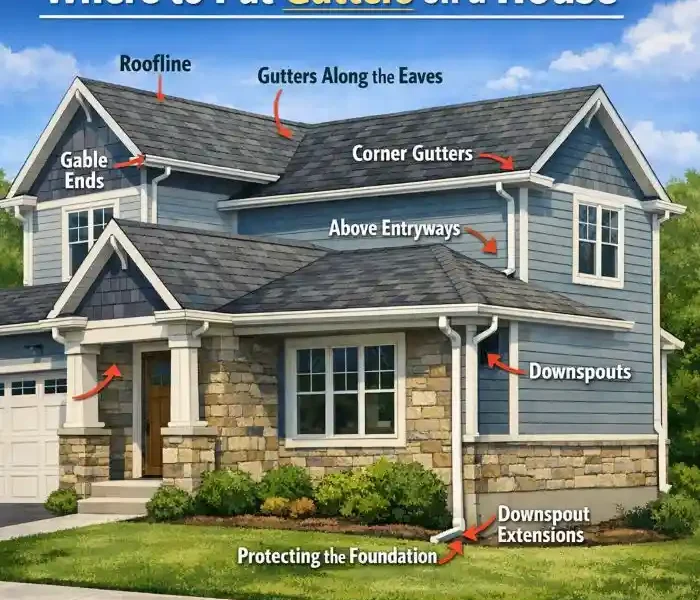
<p>If you want the short version, here it is: <strong>gutters should be installed along the lower edges of the roof, called the eaves, wherever rainwater naturally runs off.</strong> In most homes, that means mounting gutters to the <strong>fascia board</strong> just under the roof edge or drip edge. If your roof has valleys, dormers, porch roofs, or multiple levels, those areas often need extra attention because they send a lot of water into concentrated spots.</p>
<p>Downspouts should be placed at <strong>corners, low points, and at intervals of roughly 20 to 40 feet</strong>, depending on gutter size, roof area, and how much rain your area gets. Gutters should also have a gentle slope so water flows toward the downspouts instead of sitting in the channel.</p>
<p>So, if you are wondering <strong>where to put gutters on a house</strong>, the core rule is simple: <strong>put them under every active roof runoff edge and give the water a clear exit path away from the foundation.</strong></p>
<h2 id="why-correct-gutter-placement-matters">Why Correct Gutter Placement Matters</h2>
<p><img class="aligncenter wp-image-7060 size-full" src="https://comeawayhome.co.uk/wp-content/uploads/2026/05/1327e8ac-232f-49bb-9851-6b32b4210c70-ezgif.com-jpg-to-webp-converter.webp" alt="where to put gutters on a house" width="700" height="700" /></p>
<p>A gutter system does one main job: it <strong>collects rainwater from the roof and moves it away from the house</strong>. That sounds simple, but the placement of each gutter section and each downspout decides whether the system actually works.</p>
<p>When gutters are installed in the right places, they help protect several parts of your home at once. They reduce splashing against siding, stop water from pooling near the base of the <a href="https://comeawayhome.co.uk/when-to-lower-the-price-of-your-house/">house</a>, and help preserve landscaping, flower beds, walkways, and driveways. Good gutter placement also helps control roof drainage so water does not pour off the roof in random areas.</p>
<p>When gutters are placed poorly, the problems can build up fast. Water may overflow near doors or windows. Soil around the home can erode. Mulch and plants can wash away. Wood trim can stay wet for too long and begin to rot. Over time, constant water near the foundation can lead to cracks, moisture intrusion, or basement leaks.</p>
<p>Here are some of the biggest risks of poor gutter placement:</p>
<ul>
<li><strong>Foundation settling or cracking</strong></li>
<li><strong>Basement dampness or flooding</strong></li>
<li><strong>Soil erosion around the perimeter</strong></li>
<li><strong>Wood rot on fascia, soffits, and trim</strong></li>
<li><strong>Mold and mildew growth</strong></li>
<li><strong>Staining on siding and masonry</strong></li>
</ul>
<p>Many contractors and building professionals agree on one basic truth: <strong>water management is one of the first lines of defense for the entire house.</strong> Even a strong roof and solid siding can struggle if water is not directed away properly.</p>
<p>Think of gutters as traffic control for rain. If you guide the flow correctly, your home stays safer, cleaner, and drier. If you ignore the flow, water will find its own route, and that route is often expensive.</p>
<h2 id="basic-gutter-placement-rules">Basic Gutter Placement Rules</h2>
<p>Before you get into roof shapes and advanced drainage details, it helps to understand what “placement” really means. In simple terms, <strong>gutter placement is about where the gutter sits along the roofline and how the downspouts are arranged to carry water away.</strong> If either part is off, the whole system becomes less effective.</p>
<h3 id="place-gutters-under-the-roof-edge-at-the-fascia">Place Gutters Under the Roof Edge at the Fascia</h3>
<p>The most common and effective place to install gutters is along the <strong>fascia board</strong>, directly beneath the lower edge of the roof. This is where runoff leaves the shingles and drops into the gutter channel.</p>
<p>In many homes, the back edge of the gutter sits <strong>under the drip edge</strong> or just behind the line where water falls from the shingles. That placement matters because it helps capture water cleanly instead of letting it slide behind the gutter. If water runs behind the gutter, it can soak the fascia board and eventually cause rot.</p>
<p>Before installing any gutter, check the fascia itself. If the wood is soft, cracked, or already damaged by moisture, it should be repaired first. Gutters need a strong surface for fastening. Mounting a new gutter on weak or rotted wood only hides the problem for a short time.</p>
<p>It is also smart to check whether <strong>flashing</strong> is needed. On some roofs, a small piece of metal flashing helps direct water from the shingles into the gutter, especially if the roof edge is short, uneven, or missing a proper drip edge.</p>
<p>When planning the run, measure the full roof edge carefully. Make sure the gutter continues across all active runoff sections and does not leave open gaps, especially near <strong>roof valleys</strong>. Valleys send a large amount of water into a small area, so even a short missing section can cause major overflow.</p>
<p>A good rule to remember is this: <strong>the gutter should sit where falling roof water naturally lands, not where it only looks neat from the ground.</strong> Appearance matters, but water capture comes first.</p>
<h3 id="slope-and-pitch-maintain-proper-fall">Slope and Pitch: Maintain Proper Fall</h3>
<p>Even the best-placed gutter will not work well if it is perfectly level. Gutters need a slight slope so water moves toward the downspout instead of collecting in the channel.</p>
<p>A common rule of thumb is <strong>about 1/4 inch of slope for every 10 feet of gutter run</strong>. This is usually enough to keep water moving without making the angle look obvious from the ground.</p>
<p>Why does this matter so much? Because standing water creates several problems. It adds weight to the gutter, attracts debris, increases rust in metal systems, and can lead to overflow during heavy rain. In colder climates, standing water can also freeze and put more stress on hangers and joints.</p>
<p>To check slope during installation, mark the high point and low point of the run before attaching the gutter. A chalk line or level can help you create a straight guide. If you already have gutters installed, you can test the slope by running water from a hose and watching whether it flows easily to the outlet.</p>
<p>If water sits still or moves sluggishly, the slope likely needs adjustment. In many cases, resetting a few hangers is enough to fix the problem.</p>
<h3 id="position-gutters-at-roof-valleys-and-overhangs">Position Gutters at Roof Valleys and Overhangs</h3>
<p>Roof valleys deserve special attention because they carry <strong>more water than standard roof edges</strong>. Whenever two roof planes meet, water from both sides rushes into the same channel and then spills off at the eave. That concentrated flow can overwhelm a small or poorly placed gutter.</p>
<p>If your home has valleys, install gutters continuously across the lower edge where that water exits. In high-flow spots, it often makes sense to use <strong>wider gutters, extra hangers, or reinforced sections</strong>. These areas are not where you want to cut corners.</p>
<p>Overhangs, porch roofs, and dormers also need careful planning. A small porch roof may only need a short gutter run, but it still needs to catch runoff if water falls near an entryway or walkway. Dormers can send water onto lower roof sections, increasing the amount of runoff that reaches the main gutter below.</p>
<p>In some homes, separate short runs work fine. In others, it is better to connect smaller sections into the main system using leaders or tied-in downspouts. The best choice depends on how the water travels from one roof level to another.</p>
<p>The key is simple: <strong>follow the flow of water, not just the outline of the roof.</strong></p>
<h3 id="account-for-intersections-and-offsets">Account for Intersections and Offsets</h3>
<p>Homes with multiple roof levels, bump-outs, corners, and offsets often need more than a straight gutter line. At these intersections, water can change direction quickly, and gutter placement has to adapt.</p>
<p>This is where <strong>miters, corner pieces, internal corners, and custom fittings</strong> come into play. On more complex houses, you may also see <strong>box gutters</strong> or built-in drainage channels that handle water within a concealed structure.</p>
<p>If your roofline turns, steps down, or splits into different sections, plan each transition carefully. Poorly aligned corners and awkward offsets are common sources of leaks, overflow, and clogs.</p>
<h2 id="where-to-place-gutters-by-roof-type">Where to Place Gutters by Roof Type</h2>
<p>Different roof shapes change how rainwater behaves. That is why the answer to <strong>where to put gutters on a house</strong> depends in part on the type of roof you have. Some roofs shed water in simple, predictable lines. Others create heavy runoff in several directions at once.</p>
<p>To make this easier, here is a quick reference table.</p>
<table>
<thead>
<tr>
<th><strong>Roof Type</strong></th>
<th><strong>Where Gutters Go</strong></th>
<th><strong>Best Downspout Locations</strong></th>
<th><strong>Special Notes</strong></th>
</tr>
</thead>
<tbody>
<tr>
<td><strong>Gable Roof</strong></td>
<td>Along the two main eaves</td>
<td>At the ends or corners</td>
<td>Simple layout, but watch exposed sides in wind-driven rain</td>
</tr>
<tr>
<td><strong>Hip Roof</strong></td>
<td>Around all eaves</td>
<td>Near corners and mid-runs if needed</td>
<td>Usually needs continuous guttering</td>
</tr>
<tr>
<td><strong>Shed / Lean-to Roof</strong></td>
<td>Along the single lower edge</td>
<td>One or both ends depending on run length</td>
<td>Water concentrates on one side</td>
</tr>
<tr>
<td><strong>Multi-Level Roof</strong></td>
<td>At every active eave and valley</td>
<td>At low points, junctions, and corners</td>
<td>Often needs extra downspouts</td>
</tr>
<tr>
<td><strong>Dormer / Valley Roof Areas</strong></td>
<td>Along lower discharge edges and under valley exits</td>
<td>Close to high-flow areas</td>
<td>Reinforced or wider gutters help</td>
</tr>
</tbody>
</table>
<h3 id="gable-roofs">Gable Roofs</h3>
<p>Gable roofs are among the easiest roofs to plan for. They usually have two sloped sides that meet at a ridge, with water running down toward the two lower eaves.</p>
<p>In most cases, gutters go <strong>along both eaves</strong>, and downspouts are placed at the ends or near the corners. This layout works well because runoff is split evenly across the two main sides of the house.</p>
<p>Even with a simple gable roof, there are still a few things to watch. If one side of the house gets more wind-driven rain, or if one side has a longer run, you may need larger gutters or an extra downspout. If the roof overhang is wide, make sure the gutter is positioned correctly to catch the water as it drops from the shingles.</p>
<p>For many homeowners, a gable roof is the easiest starting point for understanding <strong>where to put gutters on a house</strong> because the runoff pattern is so clear.</p>
<h3 id="hip-roofs">Hip Roofs</h3>
<p>Hip roofs slope downward on all sides, which means water drains around the full perimeter. Because of that, hip roofs often need <strong>continuous guttering around all eaves</strong>.</p>
<p>This design usually calls for downspouts at multiple corners, and longer sides may need an extra downspout somewhere along the run. Since water does not just leave the house on two sides, the drainage load is spread more widely, but it still must be collected all the way around.</p>
<p>Hip roofs often look balanced from the street, and gutter placement should support that symmetry. At the same time, the practical goal is still water control. If one side is longer or handles more roof area, adjust the downspout count to match.</p>
<h3 id="shed-and-lean-to-roofs">Shed and Lean-to Roofs</h3>
<p>A shed roof or lean-to roof sends nearly all the water toward <strong>one lower edge</strong>. That makes gutter placement straightforward: put the gutter along that lower eave.</p>
<p>If the run is short, one downspout may be enough. If the roof edge is long, use two downspouts or a larger outlet setup to prevent overflow. These roofs can create a strong sheet of runoff because the drainage is so concentrated in one direction.</p>
<p>That is especially important for patio covers, additions, workshops, and side structures. Even though they may look smaller, they can still dump a lot of water quickly.</p>
<h3 id="complex-multi-level-roofs-valleys-and-dormers">Complex Multi-Level Roofs, Valleys, and Dormers</h3>
<p>This is where gutter planning becomes more detailed. Multi-level roofs often include valleys, step-down sections, dormers, intersecting rooflines, and short runs that feed into larger runs below.</p>
<p>In these homes, gutters should be placed at <strong>each active eave</strong> and especially at the points where roof valleys discharge. If an upper roof empties onto a lower roof, the lower gutter often needs more capacity because it is catching water from both levels.</p>
<p>Dormers may also require short gutter sections along their lower edges, especially if they direct water over windows, entrances, or high-traffic areas. In some cases, leaders can connect dormer drainage into the main gutter system below.</p>
<p>For complicated roof designs, extra downspouts can make a big difference. They reduce strain on long runs and help handle sudden heavy flow during storms. In very demanding layouts, custom drainage features such as box gutters or scuppers may be worth considering.</p>
<h4 id="need-help-planning-gutter-placement-">Need Help Planning Gutter Placement?</h4>
<p><strong>If your roof has multiple levels, valleys, or tricky drainage paths, a professional layout can save you from overflow and foundation trouble later.</strong><br />
<strong>Get a Free Gutter Plan</strong> or request a site inspection before installation.</p>
<h2 id="downspout-placement-and-spacing">Downspout Placement and Spacing</h2>
<p>Gutters collect water, but <strong>downspouts are what actually get it off the roofline and away from the house</strong>. If gutters are the channels, downspouts are the exits. Without enough exits in the right places, even a well-installed gutter system can overflow.</p>
<h3 id="how-many-downspouts-do-you-need-">How Many Downspouts Do You Need?</h3>
<p>A common rule of thumb is <strong>one downspout for every 20 to 40 feet of gutter run</strong>, but that range depends on several things:</p>
<ul>
<li><strong>Roof area feeding into the gutter</strong></li>
<li><strong>Gutter size</strong></li>
<li><strong>Downspout size</strong></li>
<li><strong>Rainfall intensity in your location</strong></li>
<li><strong>How many valleys or heavy-flow points feed that run</strong></li>
</ul>
<p>A small single-story home in a moderate climate may work well with fewer downspouts. A large home with steep roofs and frequent heavy rain may need more than the minimum.</p>
<p>If you notice water overshooting the gutter, overflowing at corners, or backing up during storms, it often means the system needs more downspout capacity. Sometimes the fix is adding another downspout. Other times, the better answer is using a larger gutter size or a bigger downspout diameter.</p>
<p>As a practical approach, do not rely only on the overall length of the gutter. Also think about <strong>how much roof is draining into that section</strong>. A short run below a large valley can carry more water than a long run on a simple roof edge.</p>
<h3 id="best-locations-for-downspouts">Best Locations for Downspouts</h3>
<p>The best place for a downspout is where it can collect water efficiently and discharge it safely. In most homes, that means placing downspouts at:</p>
<ul>
<li><strong>Corners of the house</strong></li>
<li><strong>Low points in the gutter slope</strong></li>
<li><strong>Spots directly below heavy roof runoff</strong></li>
<li><strong>Ends of long gutter runs</strong></li>
<li><strong>Near valleys when flow is intense</strong></li>
</ul>
<p>Corners are popular because they are visually unobtrusive and easy to route down the wall. But the best location is not always the most hidden one. If the natural low point is closer to the center of a run, forcing everything to drain to one corner may reduce performance.</p>
<p>It is also important to think about where the water goes after it leaves the downspout. Avoid placing outlets where discharge will flow toward the neighbor’s property, onto walkways, or into areas that stay wet.</p>
<p>As a general rule, <strong>downspouts should discharge at least 3 to 6 feet away from the foundation</strong>, using extensions, splash blocks, or underground drains if needed. Simply dropping water at the base of the wall defeats the whole purpose of the system.</p>
<h3 id="dispersal-options-for-downspouts">Dispersal Options for Downspouts</h3>
<p>Once water reaches the bottom of the downspout, it still needs a controlled path away from the home. You have several options, and the right one depends on your yard and drainage conditions.</p>
<p>A <strong>splash block</strong> is simple and affordable. It helps spread water out and direct it away from the foundation. This works best when the yard already slopes away from the house.</p>
<p>A <strong>downspout extension</strong> carries water farther from the wall. This is useful when the grade is flat or when beds and walkways sit close to the home.</p>
<p>A <strong>buried drain line</strong> is a cleaner-looking option that moves water underground to a safer discharge point. It works well when surface runoff would be messy or inconvenient.</p>
<p>Some homeowners also use <strong>rain barrels</strong> or route water into a <strong>rain garden</strong>. These options can work well if they are sized properly and placed in areas where overflow will not return toward the foundation.</p>
<p>No matter which method you choose, the goal stays the same: <strong>move water away, not just down.</strong></p>
<h2 id="special-considerations">Special Considerations</h2>
<p>Not every house can use the same gutter layout. Your yard, weather, and design preferences all affect <strong>where to put gutters on a house</strong> and how the whole system should be set up.</p>
<h3 id="landscaping-and-grading-interactions">Landscaping and Grading Interactions</h3>
<p>Your gutter system and your yard need to work together. If the ground slopes toward the home, even a well-placed downspout can still create pooling near the foundation. Likewise, if water is released into a flower bed with loose soil, mulch can wash out and erosion can start quickly.</p>
<p>When choosing downspout locations, look at the grading around the house. Water should be directed toward areas where it can continue moving away naturally. If the yard is flat, you may need extensions or drains to get water far enough away.</p>
<p>Landscape beds also matter. Repeated discharge in one spot can damage plants, dig trenches in mulch, or create muddy patches. If you want your landscaping to stay healthy, plan the gutter outlets with that in mind from the start.</p>
<h3 id="snow-and-ice-zones">Snow and Ice Zones</h3>
<p>In colder regions, gutters face extra stress. Snow sliding from the roof and ice buildup inside the gutter can pull sections loose or block normal drainage.</p>
<p>In these climates, strong hangers are essential. Gutters should be fastened securely, and downspouts should be routed as straight as possible so melting ice and water can move down without too much restriction. Some homes also benefit from <strong>heat cables</strong> in problem areas to reduce ice dam formation.</p>
<p>Placement matters here too. If the gutter sits where snow loads drop heavily, it may need reinforcement or a design adjustment. In snow country, durability is just as important as water capture.</p>
<h3 id="heavy-rainfall-or-hurricane-zones">Heavy Rainfall or Hurricane Zones</h3>
<p>Homes in regions with intense storms need more drainage capacity. If your area gets frequent cloudbursts, tropical storms, or hurricane-driven rain, standard sizing may not be enough.</p>
<p>That often means <strong>oversized gutters, larger downspouts, and more outlets</strong> than a typical installation. Reinforced hangers are also a smart choice because heavy water adds weight fast.</p>
<p>In these climates, gutter placement should focus on fast removal. Long runs with too few downspouts are much more likely to overflow during major storms. It is usually better to add capacity early than to deal with washouts and leaks later.</p>
<h3 id="aesthetics-and-concealed-gutters">Aesthetics and Concealed Gutters</h3>
<p>Most homeowners want gutters to work well and look tidy. Fortunately, you usually do not have to choose one over the other.</p>
<p>Standard K-style gutters are common because they blend in well on many homes. But if appearance is a top priority, you might consider <strong>fascia-integrated gutters, box gutters, or other concealed designs</strong>. These can create a cleaner look, especially on historic or modern homes.</p>
<p>Still, hidden systems should never sacrifice function. They must have enough capacity, proper slope, and easy access for cleaning. A gutter you barely see can still cause major damage if it is too small or too hard to maintain.</p>
<h2 id="common-mistakes-and-quick-fixes">Common Mistakes and Quick Fixes</h2>
<p>A lot of gutter problems come from a few common placement mistakes. The good news is that many of them can be corrected without replacing the entire system.</p>
<ul>
<li><strong>Too few downspouts</strong><br />
If water overflows during heavy rain, add another downspout or increase downspout size to improve flow.</li>
<li><strong>Gutters with little or no slope</strong><br />
If water stands in the gutter, reset the hangers and create the proper fall toward the outlet.</li>
<li><strong>Downspouts dumping at the foundation</strong><br />
Add extensions, splash blocks, or buried drains so water discharges farther away from the house.</li>
<li><strong>Ignoring roof valleys</strong><br />
Install continuous guttering under valley discharge points and use wider or reinforced sections where needed.</li>
<li><strong>Blocked outlets at corners</strong><br />
Keep outlet openings clear, install leaf protection if needed, and follow a regular cleaning schedule.</li>
<li><strong>Gutters mounted too high or too low</strong><br />
Reposition them so roof runoff falls directly into the channel instead of overshooting or running behind it.</li>
<li><strong>Poor planning on multi-level roofs</strong><br />
Add separate runs or extra downspouts where upper roofs dump onto lower sections.</li>
</ul>
<p>A quick homeowner check is simple: watch the system during a steady rain. See where water overflows, where it runs behind the gutter, and where it lands after leaving the downspout. Those three observations reveal most placement problems.</p>
<h2 id="diy-vs-professional-installation-checklist">DIY vs Professional Installation Checklist</h2>
<p>Some gutter jobs are manageable for a careful homeowner. Others are better left to a professional, especially when rooflines are complex or drainage problems already exist.</p>
<h3 id="diy-checklist">DIY Checklist</h3>
<p>If you plan to handle the work yourself, make sure you can do all of the following:</p>
<ul>
<li><strong>Measure each roof run accurately</strong></li>
<li><strong>Choose the right gutter size</strong></li>
<li><strong>Mark high and low points for slope</strong></li>
<li><strong>Plan downspout locations before hanging gutters</strong></li>
<li><strong>Account for valleys and heavy-flow spots</strong></li>
<li><strong>Check fascia condition and repair weak areas</strong></li>
<li><strong>Use proper brackets, fasteners, and sealants</strong></li>
<li><strong>Work safely with ladders and protective gear</strong></li>
</ul>
<h3 id="when-to-hire-a-professional">When to Hire a Professional</h3>
<p>You should strongly consider professional help if your home has any of these conditions:</p>
<ul>
<li><strong>Multi-level or steep rooflines</strong></li>
<li><strong>Structural fascia damage</strong></li>
<li><strong>Historic or architecturally sensitive details</strong></li>
<li><strong>Major grading or drainage issues</strong></li>
<li><strong>Heavy snow or storm exposure</strong></li>
<li><strong>Past problems with basement leaks or erosion</strong></li>
</ul>
<p>A professional installer can also help size the system correctly, which is often just as important as deciding <strong>where to put gutters on a house</strong>.</p>
<h2 id="simple-gutter-placement-checklist">Simple Gutter Placement Checklist</h2>
<p>Use this quick checklist if you want a practical planning tool before installation:</p>
<ol>
<li><strong>Identify every roof edge where water runs off</strong></li>
<li><strong>Mark all valleys and concentrated flow points</strong></li>
<li><strong>Install gutters along each active eave</strong></li>
<li><strong>Mount gutters on strong fascia beneath the roof edge</strong></li>
<li><strong>Create a slight slope toward each outlet</strong></li>
<li><strong>Place downspouts every 20 to 40 feet as needed</strong></li>
<li><strong>Add extra downspouts for large roof areas or heavy rainfall</strong></li>
<li><strong>Direct discharge at least 3 to 6 feet away from the foundation</strong></li>
<li><strong>Adjust for landscaping, grading, snow, and storm conditions</strong></li>
<li><strong>Test the system with water after installation</strong></li>
</ol>
<h2 id="frequently-asked-questions">Frequently Asked Questions</h2>
<h3 id="1-where-should-gutters-be-installed-on-a-house-">1. Where should gutters be installed on a house?</h3>
<p>Install gutters <strong>under the roof edge at the fascia</strong> along every eave and valley where roof runoff leaves the house.</p>
<h3 id="2-how-far-apart-should-downspouts-be-">2. How far apart should downspouts be?</h3>
<p>Most homes need downspouts every <strong>20 to 40 feet</strong>, though large roofs and heavy-rain regions usually need closer spacing.</p>
<h3 id="3-do-gutters-need-to-be-at-the-fascia-or-behind-the-drip-edge-">3. Do gutters need to be at the fascia or behind the drip edge?</h3>
<p>Yes, gutters are typically mounted on the <strong>fascia under or just behind the drip edge</strong> so roof runoff falls directly inside.</p>
<h3 id="4-where-do-gutters-go-on-a-multi-level-roof-">4. Where do gutters go on a multi-level roof?</h3>
<p>Place gutters at <strong>each lower roof edge and valley discharge point</strong>, with extra downspouts where upper roofs feed lower sections.</p>
<h3 id="5-how-far-should-downspouts-discharge-from-the-foundation-">5. How far should downspouts discharge from the foundation?</h3>
<p>Aim for <strong>at least 3 to 6 feet away</strong> using extensions, splash blocks, or buried drainage lines.</p>
<h3 id="6-should-gutters-be-continuous-around-hip-roofs-">6. Should gutters be continuous around hip roofs?</h3>
<p>Yes, <strong>continuous gutters around all eaves</strong> usually work best on hip roofs because water drains on every side.</p>
<h3 id="7-where-do-gutters-go-for-a-porch-or-dormer-">7. Where do gutters go for a porch or dormer?</h3>
<p>Install them along the <strong>lower edge of the porch or dormer roof</strong>, then connect them into the main drainage plan if possible.</p>
<h3 id="8-can-i-place-gutters-so-they-are-less-visible-">8. Can I place gutters so they are less visible?</h3>
<p>Yes, you can use <strong>concealed, fascia-style, or box gutters</strong>, but they still need proper sizing and easy maintenance access.</p>
<h3 id="9-how-do-i-handle-valleys-with-heavy-water-flow-">9. How do I handle valleys with heavy water flow?</h3>
<p>Use <strong>wider gutters, extra hangers, and nearby downspouts</strong> to manage the concentrated runoff from valleys.</p>
<h3 id="10-when-should-i-call-a-professional-">10. When should I call a professional?</h3>
<p>Call a pro for <strong>complex roofs, repeated overflow, fascia damage, drainage issues, or homes in heavy snow or storm zones</strong>.</p>
<h2 id="final-thoughts">Final Thoughts</h2>
<p>If you have been asking <strong>where to put gutters on a house</strong>, the best answer is this: <strong>put gutters anywhere the roof sends water off an edge, and place downspouts where that water can leave the system quickly and safely.</strong> Most homes need gutters along all eaves, reinforced attention at valleys, and downspouts at corners or low points with enough spacing to prevent overflow.</p>
<p>Good gutter placement is not just about attaching metal to the roofline. It is about understanding how water moves across your roof, around your home, and through your yard. When you get that path right, you protect your foundation, siding, landscaping, and long-term repair budget.</p>
<p>If you are planning a new installation or fixing an existing setup, start with a full roof runoff review and a simple placement sketch. From there, you can decide whether this is a realistic DIY project or one that deserves professional help.</p>
<p><strong>Need a next step?</strong> Consider booking a gutter inspection or creating a printable gutter placement checklist for your home. A clear plan now can prevent expensive water damage later.</p>
<p><a href="https://comeawayhome.co.uk/">House</a></p>
Knowing where to put gutters on a house is one of the most important parts of protecting your home from water damage. If gutters are placed in the wrong spots, rainwater can pour too close to the foundation, wash away soil, stain siding, and even find its way into the basement. What looks like a small installation detail can quickly turn into a costly repair.
The good news is that gutter placement follows a few clear rules. Once you understand how roof runoff works, it becomes much easier to decide where gutters belong, where downspouts should go, and how to make sure water leaves your property safely.
In short, place gutters along every eave and roof valley where water runs off. Position downspouts at low points and near corners so they can carry water away quickly and efficiently. That is the simple answer to where to put gutters on a house, but there are important details that depend on roof style, rainfall, grading, snow, and the layout of your home.
In this guide, you will learn the basic rules of gutter placement, how to place gutters for different roof types, how far apart to space downspouts, and the most common mistakes homeowners make. By the end, you will have a clear plan for installing or correcting your gutter system with confidence.
Where to Put Gutters on a House
If you want the short version, here it is: gutters should be installed along the lower edges of the roof, called the eaves, wherever rainwater naturally runs off. In most homes, that means mounting gutters to the fascia board just under the roof edge or drip edge. If your roof has valleys, dormers, porch roofs, or multiple levels, those areas often need extra attention because they send a lot of water into concentrated spots.
Downspouts should be placed at corners, low points, and at intervals of roughly 20 to 40 feet, depending on gutter size, roof area, and how much rain your area gets. Gutters should also have a gentle slope so water flows toward the downspouts instead of sitting in the channel.
So, if you are wondering where to put gutters on a house, the core rule is simple: put them under every active roof runoff edge and give the water a clear exit path away from the foundation.
Why Correct Gutter Placement Matters

A gutter system does one main job: it collects rainwater from the roof and moves it away from the house. That sounds simple, but the placement of each gutter section and each downspout decides whether the system actually works.
When gutters are installed in the right places, they help protect several parts of your home at once. They reduce splashing against siding, stop water from pooling near the base of the house, and help preserve landscaping, flower beds, walkways, and driveways. Good gutter placement also helps control roof drainage so water does not pour off the roof in random areas.
When gutters are placed poorly, the problems can build up fast. Water may overflow near doors or windows. Soil around the home can erode. Mulch and plants can wash away. Wood trim can stay wet for too long and begin to rot. Over time, constant water near the foundation can lead to cracks, moisture intrusion, or basement leaks.
Here are some of the biggest risks of poor gutter placement:
- Foundation settling or cracking
- Basement dampness or flooding
- Soil erosion around the perimeter
- Wood rot on fascia, soffits, and trim
- Mold and mildew growth
- Staining on siding and masonry
Many contractors and building professionals agree on one basic truth: water management is one of the first lines of defense for the entire house. Even a strong roof and solid siding can struggle if water is not directed away properly.
Think of gutters as traffic control for rain. If you guide the flow correctly, your home stays safer, cleaner, and drier. If you ignore the flow, water will find its own route, and that route is often expensive.
Basic Gutter Placement Rules
Before you get into roof shapes and advanced drainage details, it helps to understand what “placement” really means. In simple terms, gutter placement is about where the gutter sits along the roofline and how the downspouts are arranged to carry water away. If either part is off, the whole system becomes less effective.
Place Gutters Under the Roof Edge at the Fascia
The most common and effective place to install gutters is along the fascia board, directly beneath the lower edge of the roof. This is where runoff leaves the shingles and drops into the gutter channel.
In many homes, the back edge of the gutter sits under the drip edge or just behind the line where water falls from the shingles. That placement matters because it helps capture water cleanly instead of letting it slide behind the gutter. If water runs behind the gutter, it can soak the fascia board and eventually cause rot.
Before installing any gutter, check the fascia itself. If the wood is soft, cracked, or already damaged by moisture, it should be repaired first. Gutters need a strong surface for fastening. Mounting a new gutter on weak or rotted wood only hides the problem for a short time.
It is also smart to check whether flashing is needed. On some roofs, a small piece of metal flashing helps direct water from the shingles into the gutter, especially if the roof edge is short, uneven, or missing a proper drip edge.
When planning the run, measure the full roof edge carefully. Make sure the gutter continues across all active runoff sections and does not leave open gaps, especially near roof valleys. Valleys send a large amount of water into a small area, so even a short missing section can cause major overflow.
A good rule to remember is this: the gutter should sit where falling roof water naturally lands, not where it only looks neat from the ground. Appearance matters, but water capture comes first.
Slope and Pitch: Maintain Proper Fall
Even the best-placed gutter will not work well if it is perfectly level. Gutters need a slight slope so water moves toward the downspout instead of collecting in the channel.
A common rule of thumb is about 1/4 inch of slope for every 10 feet of gutter run. This is usually enough to keep water moving without making the angle look obvious from the ground.
Why does this matter so much? Because standing water creates several problems. It adds weight to the gutter, attracts debris, increases rust in metal systems, and can lead to overflow during heavy rain. In colder climates, standing water can also freeze and put more stress on hangers and joints.
To check slope during installation, mark the high point and low point of the run before attaching the gutter. A chalk line or level can help you create a straight guide. If you already have gutters installed, you can test the slope by running water from a hose and watching whether it flows easily to the outlet.
If water sits still or moves sluggishly, the slope likely needs adjustment. In many cases, resetting a few hangers is enough to fix the problem.
Position Gutters at Roof Valleys and Overhangs
Roof valleys deserve special attention because they carry more water than standard roof edges. Whenever two roof planes meet, water from both sides rushes into the same channel and then spills off at the eave. That concentrated flow can overwhelm a small or poorly placed gutter.
If your home has valleys, install gutters continuously across the lower edge where that water exits. In high-flow spots, it often makes sense to use wider gutters, extra hangers, or reinforced sections. These areas are not where you want to cut corners.
Overhangs, porch roofs, and dormers also need careful planning. A small porch roof may only need a short gutter run, but it still needs to catch runoff if water falls near an entryway or walkway. Dormers can send water onto lower roof sections, increasing the amount of runoff that reaches the main gutter below.
In some homes, separate short runs work fine. In others, it is better to connect smaller sections into the main system using leaders or tied-in downspouts. The best choice depends on how the water travels from one roof level to another.
The key is simple: follow the flow of water, not just the outline of the roof.
Account for Intersections and Offsets
Homes with multiple roof levels, bump-outs, corners, and offsets often need more than a straight gutter line. At these intersections, water can change direction quickly, and gutter placement has to adapt.
This is where miters, corner pieces, internal corners, and custom fittings come into play. On more complex houses, you may also see box gutters or built-in drainage channels that handle water within a concealed structure.
If your roofline turns, steps down, or splits into different sections, plan each transition carefully. Poorly aligned corners and awkward offsets are common sources of leaks, overflow, and clogs.
Where to Place Gutters by Roof Type
Different roof shapes change how rainwater behaves. That is why the answer to where to put gutters on a house depends in part on the type of roof you have. Some roofs shed water in simple, predictable lines. Others create heavy runoff in several directions at once.
To make this easier, here is a quick reference table.
| Roof Type |
Where Gutters Go |
Best Downspout Locations |
Special Notes |
| Gable Roof |
Along the two main eaves |
At the ends or corners |
Simple layout, but watch exposed sides in wind-driven rain |
| Hip Roof |
Around all eaves |
Near corners and mid-runs if needed |
Usually needs continuous guttering |
| Shed / Lean-to Roof |
Along the single lower edge |
One or both ends depending on run length |
Water concentrates on one side |
| Multi-Level Roof |
At every active eave and valley |
At low points, junctions, and corners |
Often needs extra downspouts |
| Dormer / Valley Roof Areas |
Along lower discharge edges and under valley exits |
Close to high-flow areas |
Reinforced or wider gutters help |
Gable Roofs
Gable roofs are among the easiest roofs to plan for. They usually have two sloped sides that meet at a ridge, with water running down toward the two lower eaves.
In most cases, gutters go along both eaves, and downspouts are placed at the ends or near the corners. This layout works well because runoff is split evenly across the two main sides of the house.
Even with a simple gable roof, there are still a few things to watch. If one side of the house gets more wind-driven rain, or if one side has a longer run, you may need larger gutters or an extra downspout. If the roof overhang is wide, make sure the gutter is positioned correctly to catch the water as it drops from the shingles.
For many homeowners, a gable roof is the easiest starting point for understanding where to put gutters on a house because the runoff pattern is so clear.
Hip Roofs
Hip roofs slope downward on all sides, which means water drains around the full perimeter. Because of that, hip roofs often need continuous guttering around all eaves.
This design usually calls for downspouts at multiple corners, and longer sides may need an extra downspout somewhere along the run. Since water does not just leave the house on two sides, the drainage load is spread more widely, but it still must be collected all the way around.
Hip roofs often look balanced from the street, and gutter placement should support that symmetry. At the same time, the practical goal is still water control. If one side is longer or handles more roof area, adjust the downspout count to match.
Shed and Lean-to Roofs
A shed roof or lean-to roof sends nearly all the water toward one lower edge. That makes gutter placement straightforward: put the gutter along that lower eave.
If the run is short, one downspout may be enough. If the roof edge is long, use two downspouts or a larger outlet setup to prevent overflow. These roofs can create a strong sheet of runoff because the drainage is so concentrated in one direction.
That is especially important for patio covers, additions, workshops, and side structures. Even though they may look smaller, they can still dump a lot of water quickly.
Complex Multi-Level Roofs, Valleys, and Dormers
This is where gutter planning becomes more detailed. Multi-level roofs often include valleys, step-down sections, dormers, intersecting rooflines, and short runs that feed into larger runs below.
In these homes, gutters should be placed at each active eave and especially at the points where roof valleys discharge. If an upper roof empties onto a lower roof, the lower gutter often needs more capacity because it is catching water from both levels.
Dormers may also require short gutter sections along their lower edges, especially if they direct water over windows, entrances, or high-traffic areas. In some cases, leaders can connect dormer drainage into the main gutter system below.
For complicated roof designs, extra downspouts can make a big difference. They reduce strain on long runs and help handle sudden heavy flow during storms. In very demanding layouts, custom drainage features such as box gutters or scuppers may be worth considering.
Need Help Planning Gutter Placement?
If your roof has multiple levels, valleys, or tricky drainage paths, a professional layout can save you from overflow and foundation trouble later.
Get a Free Gutter Plan or request a site inspection before installation.
Downspout Placement and Spacing
Gutters collect water, but downspouts are what actually get it off the roofline and away from the house. If gutters are the channels, downspouts are the exits. Without enough exits in the right places, even a well-installed gutter system can overflow.
How Many Downspouts Do You Need?
A common rule of thumb is one downspout for every 20 to 40 feet of gutter run, but that range depends on several things:
- Roof area feeding into the gutter
- Gutter size
- Downspout size
- Rainfall intensity in your location
- How many valleys or heavy-flow points feed that run
A small single-story home in a moderate climate may work well with fewer downspouts. A large home with steep roofs and frequent heavy rain may need more than the minimum.
If you notice water overshooting the gutter, overflowing at corners, or backing up during storms, it often means the system needs more downspout capacity. Sometimes the fix is adding another downspout. Other times, the better answer is using a larger gutter size or a bigger downspout diameter.
As a practical approach, do not rely only on the overall length of the gutter. Also think about how much roof is draining into that section. A short run below a large valley can carry more water than a long run on a simple roof edge.
Best Locations for Downspouts
The best place for a downspout is where it can collect water efficiently and discharge it safely. In most homes, that means placing downspouts at:
- Corners of the house
- Low points in the gutter slope
- Spots directly below heavy roof runoff
- Ends of long gutter runs
- Near valleys when flow is intense
Corners are popular because they are visually unobtrusive and easy to route down the wall. But the best location is not always the most hidden one. If the natural low point is closer to the center of a run, forcing everything to drain to one corner may reduce performance.
It is also important to think about where the water goes after it leaves the downspout. Avoid placing outlets where discharge will flow toward the neighbor’s property, onto walkways, or into areas that stay wet.
As a general rule, downspouts should discharge at least 3 to 6 feet away from the foundation, using extensions, splash blocks, or underground drains if needed. Simply dropping water at the base of the wall defeats the whole purpose of the system.
Dispersal Options for Downspouts
Once water reaches the bottom of the downspout, it still needs a controlled path away from the home. You have several options, and the right one depends on your yard and drainage conditions.
A splash block is simple and affordable. It helps spread water out and direct it away from the foundation. This works best when the yard already slopes away from the house.
A downspout extension carries water farther from the wall. This is useful when the grade is flat or when beds and walkways sit close to the home.
A buried drain line is a cleaner-looking option that moves water underground to a safer discharge point. It works well when surface runoff would be messy or inconvenient.
Some homeowners also use rain barrels or route water into a rain garden. These options can work well if they are sized properly and placed in areas where overflow will not return toward the foundation.
No matter which method you choose, the goal stays the same: move water away, not just down.
Special Considerations
Not every house can use the same gutter layout. Your yard, weather, and design preferences all affect where to put gutters on a house and how the whole system should be set up.
Landscaping and Grading Interactions
Your gutter system and your yard need to work together. If the ground slopes toward the home, even a well-placed downspout can still create pooling near the foundation. Likewise, if water is released into a flower bed with loose soil, mulch can wash out and erosion can start quickly.
When choosing downspout locations, look at the grading around the house. Water should be directed toward areas where it can continue moving away naturally. If the yard is flat, you may need extensions or drains to get water far enough away.
Landscape beds also matter. Repeated discharge in one spot can damage plants, dig trenches in mulch, or create muddy patches. If you want your landscaping to stay healthy, plan the gutter outlets with that in mind from the start.
Snow and Ice Zones
In colder regions, gutters face extra stress. Snow sliding from the roof and ice buildup inside the gutter can pull sections loose or block normal drainage.
In these climates, strong hangers are essential. Gutters should be fastened securely, and downspouts should be routed as straight as possible so melting ice and water can move down without too much restriction. Some homes also benefit from heat cables in problem areas to reduce ice dam formation.
Placement matters here too. If the gutter sits where snow loads drop heavily, it may need reinforcement or a design adjustment. In snow country, durability is just as important as water capture.
Heavy Rainfall or Hurricane Zones
Homes in regions with intense storms need more drainage capacity. If your area gets frequent cloudbursts, tropical storms, or hurricane-driven rain, standard sizing may not be enough.
That often means oversized gutters, larger downspouts, and more outlets than a typical installation. Reinforced hangers are also a smart choice because heavy water adds weight fast.
In these climates, gutter placement should focus on fast removal. Long runs with too few downspouts are much more likely to overflow during major storms. It is usually better to add capacity early than to deal with washouts and leaks later.
Aesthetics and Concealed Gutters
Most homeowners want gutters to work well and look tidy. Fortunately, you usually do not have to choose one over the other.
Standard K-style gutters are common because they blend in well on many homes. But if appearance is a top priority, you might consider fascia-integrated gutters, box gutters, or other concealed designs. These can create a cleaner look, especially on historic or modern homes.
Still, hidden systems should never sacrifice function. They must have enough capacity, proper slope, and easy access for cleaning. A gutter you barely see can still cause major damage if it is too small or too hard to maintain.
Common Mistakes and Quick Fixes
A lot of gutter problems come from a few common placement mistakes. The good news is that many of them can be corrected without replacing the entire system.
- Too few downspouts
If water overflows during heavy rain, add another downspout or increase downspout size to improve flow.
- Gutters with little or no slope
If water stands in the gutter, reset the hangers and create the proper fall toward the outlet.
- Downspouts dumping at the foundation
Add extensions, splash blocks, or buried drains so water discharges farther away from the house.
- Ignoring roof valleys
Install continuous guttering under valley discharge points and use wider or reinforced sections where needed.
- Blocked outlets at corners
Keep outlet openings clear, install leaf protection if needed, and follow a regular cleaning schedule.
- Gutters mounted too high or too low
Reposition them so roof runoff falls directly into the channel instead of overshooting or running behind it.
- Poor planning on multi-level roofs
Add separate runs or extra downspouts where upper roofs dump onto lower sections.
A quick homeowner check is simple: watch the system during a steady rain. See where water overflows, where it runs behind the gutter, and where it lands after leaving the downspout. Those three observations reveal most placement problems.
DIY vs Professional Installation Checklist
Some gutter jobs are manageable for a careful homeowner. Others are better left to a professional, especially when rooflines are complex or drainage problems already exist.
DIY Checklist
If you plan to handle the work yourself, make sure you can do all of the following:
- Measure each roof run accurately
- Choose the right gutter size
- Mark high and low points for slope
- Plan downspout locations before hanging gutters
- Account for valleys and heavy-flow spots
- Check fascia condition and repair weak areas
- Use proper brackets, fasteners, and sealants
- Work safely with ladders and protective gear
When to Hire a Professional
You should strongly consider professional help if your home has any of these conditions:
- Multi-level or steep rooflines
- Structural fascia damage
- Historic or architecturally sensitive details
- Major grading or drainage issues
- Heavy snow or storm exposure
- Past problems with basement leaks or erosion
A professional installer can also help size the system correctly, which is often just as important as deciding where to put gutters on a house.
Simple Gutter Placement Checklist
Use this quick checklist if you want a practical planning tool before installation:
- Identify every roof edge where water runs off
- Mark all valleys and concentrated flow points
- Install gutters along each active eave
- Mount gutters on strong fascia beneath the roof edge
- Create a slight slope toward each outlet
- Place downspouts every 20 to 40 feet as needed
- Add extra downspouts for large roof areas or heavy rainfall
- Direct discharge at least 3 to 6 feet away from the foundation
- Adjust for landscaping, grading, snow, and storm conditions
- Test the system with water after installation
Frequently Asked Questions
1. Where should gutters be installed on a house?
Install gutters under the roof edge at the fascia along every eave and valley where roof runoff leaves the house.
2. How far apart should downspouts be?
Most homes need downspouts every 20 to 40 feet, though large roofs and heavy-rain regions usually need closer spacing.
3. Do gutters need to be at the fascia or behind the drip edge?
Yes, gutters are typically mounted on the fascia under or just behind the drip edge so roof runoff falls directly inside.
4. Where do gutters go on a multi-level roof?
Place gutters at each lower roof edge and valley discharge point, with extra downspouts where upper roofs feed lower sections.
5. How far should downspouts discharge from the foundation?
Aim for at least 3 to 6 feet away using extensions, splash blocks, or buried drainage lines.
6. Should gutters be continuous around hip roofs?
Yes, continuous gutters around all eaves usually work best on hip roofs because water drains on every side.
7. Where do gutters go for a porch or dormer?
Install them along the lower edge of the porch or dormer roof, then connect them into the main drainage plan if possible.
8. Can I place gutters so they are less visible?
Yes, you can use concealed, fascia-style, or box gutters, but they still need proper sizing and easy maintenance access.
9. How do I handle valleys with heavy water flow?
Use wider gutters, extra hangers, and nearby downspouts to manage the concentrated runoff from valleys.
10. When should I call a professional?
Call a pro for complex roofs, repeated overflow, fascia damage, drainage issues, or homes in heavy snow or storm zones.
Final Thoughts
If you have been asking where to put gutters on a house, the best answer is this: put gutters anywhere the roof sends water off an edge, and place downspouts where that water can leave the system quickly and safely. Most homes need gutters along all eaves, reinforced attention at valleys, and downspouts at corners or low points with enough spacing to prevent overflow.
Good gutter placement is not just about attaching metal to the roofline. It is about understanding how water moves across your roof, around your home, and through your yard. When you get that path right, you protect your foundation, siding, landscaping, and long-term repair budget.
If you are planning a new installation or fixing an existing setup, start with a full roof runoff review and a simple placement sketch. From there, you can decide whether this is a realistic DIY project or one that deserves professional help.
Need a next step? Consider booking a gutter inspection or creating a printable gutter placement checklist for your home. A clear plan now can prevent expensive water damage later.
House