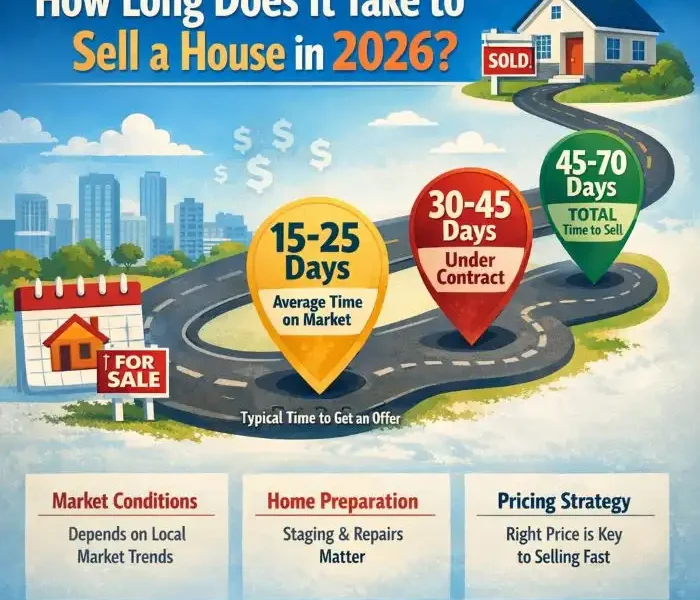
<p>If you are asking <a href="https://www.zillow.com/learn/average-time-to-sell-a-house/"><strong>how long does it take to sell a house</strong></a>, you are not alone. It is one of the first questions most sellers ask, and for good reason. Whether you are moving for work, upsizing, downsizing, or trying to free up cash, your timeline matters.</p>
<p>The short answer is this: <strong>the average time to sell a house</strong> often falls between <strong>33 and 60 days to get an offer</strong>, depending on where you live and what the market looks like. But that is only part of the story. Once you accept an offer, the sale can still take <strong>another 30 to 60 days</strong> to close. So, from the day you decide to list to the day you hand over the keys, the full <strong>house selling timeline</strong> can range from around <strong>two months to four months</strong>, and sometimes longer.</p>
<p>That said, no two home sales are exactly the same.</p>
<p>A well-priced, move-in-ready home in a busy area can sell very quickly. On the other hand, an overpriced property in a slower market may sit for weeks or even months. Things like season, interest rates, buyer demand, condition, and your marketing strategy all play a role.</p>
<p>In this guide, you will get a clear breakdown of the full timeline, the main <strong>factors affecting home sale time</strong>, and practical ways to speed up the process.</p>
<p><strong>If you want a faster, smoother sale, a free home valuation is a smart first step.</strong></p>
<h2 id="how-long-does-it-take-to-sell-a-house-on-average-">How Long Does It Take to Sell a House on Average?</h2>
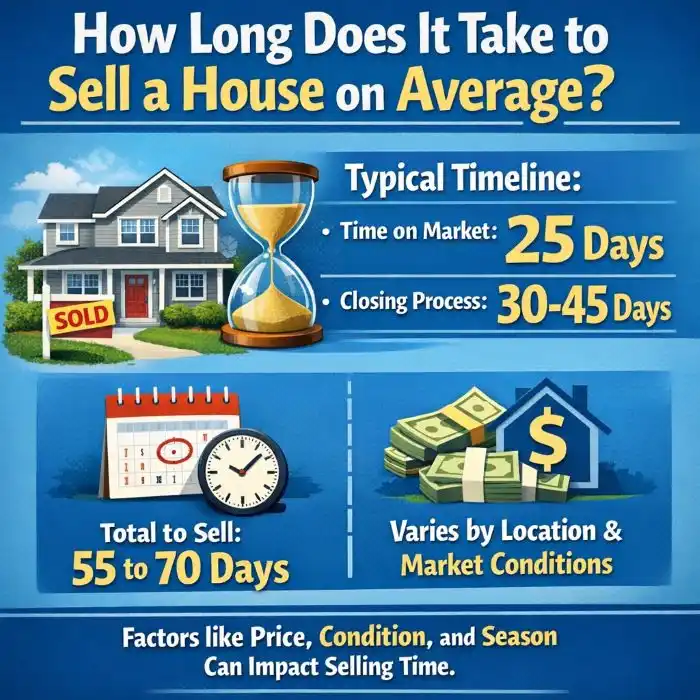
<p><img class="aligncenter wp-image-6929 size-full" src="https://comeawayhome.co.uk/wp-content/uploads/2026/05/a8d58fe7-45f1-4053-8575-ba61211456bfz-ezgif.com-jpg-to-webp-converter.webp" alt="how long does it take to sell a house" width="700" height="700" /></p>
<p>When people talk about selling speed, they often mean one of two things:</p>
<ol>
<li><strong>Time from listing to finding a buyer</strong></li>
<li><strong>Time from listing to final completion</strong></li>
</ol>
<p>That difference matters more than many sellers realize.</p>
<p>In many UK markets, the average time to secure a buyer is around <strong>33 days</strong>. In the US, it is often closer to <strong>45 to 60 days</strong>, depending on the local area and current housing demand. But once a buyer makes an offer, the legal and financial steps still need to happen. That includes inspections, mortgage approval, paperwork, and final closing.</p>
<p>So, if your home goes under offer in a month, that does not mean the money lands in your account the next day.</p>
<p>Here is a simple snapshot of common 2026 averages:</p>
<table>
<thead>
<tr>
<th>Region</th>
<th>Avg Days to Under Offer</th>
</tr>
</thead>
<tbody>
<tr>
<td><strong>UK Overall</strong></td>
<td><strong>33 days</strong></td>
</tr>
<tr>
<td><strong>London</strong></td>
<td><strong>41 days</strong></td>
</tr>
<tr>
<td><strong>North East</strong></td>
<td><strong>28 days</strong></td>
</tr>
<tr>
<td><strong>US National</strong></td>
<td><strong>45–60 days</strong></td>
</tr>
</tbody>
</table>
<p>These numbers are useful, but they are still averages. Your home could sell faster or slower based on its price, location, and presentation.</p>
<p>A good way to think about it is like this:</p>
<ul>
<li><strong>Fast market + smart pricing + strong presentation = shorter timeline</strong></li>
<li><strong>Weak market + overpricing + poor marketing = longer timeline</strong></li>
</ul>
<p>Another key point: the phrase <strong>days on market</strong> usually refers to how long the property is listed before an offer is accepted. It does <strong>not always include the full closing period</strong>. In many cases, you should add <strong>30 to 60 more days</strong> after accepting an offer.</p>
<p>So if you are planning a move, do not just ask how quickly homes are getting offers. Ask how long the <strong>entire process</strong> takes from start to finish.</p>
<h2 id="key-factors-that-determine-how-long-it-takes-to-sell-a-house">Key Factors That Determine How Long It Takes to Sell a House</h2>
<p>The truth is simple: <strong>there is no one-size-fits-all answer</strong>. Several moving parts affect the time to sell a home. Some are under your control. Others depend on the broader market.</p>
<h3 id="location-impact">Location Impact</h3>
<p>Location is one of the biggest factors affecting home sale time.</p>
<p>Homes in strong-demand areas usually sell much faster. That includes popular suburbs, family-friendly neighborhoods, commuter zones, and places with good schools or strong job markets. In hot areas, some homes attract serious interest in <strong>20 days or less</strong>.</p>
<p>By contrast, properties in remote or rural areas often take much longer to sell. In some cases, homes may stay on the market for <strong>90 days or more</strong>, especially if buyer demand is low or the property appeals to a smaller audience.</p>
<p>Even within the same city, timelines can vary. A well-kept three-bedroom home near transport links may sell quickly, while a similar home on a busy road or in a less desirable pocket may take much longer.</p>
<p>If you want a realistic estimate, look at <strong>recent local sales</strong>, not national headlines.</p>
<h3 id="seasonality">Seasonality</h3>
<p>The time of year can strongly shape your <a href="https://comeawayhome.co.uk/how-to-use-a-generator-to-power-a-house/">house</a> selling timeline.</p>
<p>In many markets, <strong>spring and early summer</strong> are the busiest seasons. Buyers are more active, homes look better in natural light, gardens are more appealing, and families often want to move before a new school year begins. Because of that, homes listed in peak months can sell <strong>20% to 40% faster</strong>.</p>
<p>Autumn can still be good, especially for motivated buyers. Winter, however, often slows things down. There are fewer active buyers, holiday schedules get in the way, and weather can make moving feel less attractive.</p>
<p>That does not mean you cannot sell in winter. You absolutely can. It just means you may need stronger pricing and better presentation to stand out.</p>
<h3 id="economic-conditions">Economic Conditions</h3>
<p>Wider economic conditions also matter.</p>
<p>When mortgage rates rise, buyers often become more cautious. Their borrowing power drops, monthly payments increase, and some decide to wait. That can slow down the market and add <strong>five to ten extra days</strong> or more to the average selling timeline.</p>
<p>On the other hand, when rates are stable and consumer confidence is stronger, buyers tend to act faster.</p>
<p>Inflation, employment, lending rules, and local affordability all influence the pace of the market. Even if your home is attractive, a tougher economic climate can reduce the number of qualified buyers.</p>
<h3 id="property-condition-and-appeal">Property Condition and Appeal</h3>
<p>A clean, updated, move-in-ready home will almost always sell faster than one that needs visible work.</p>
<p>Buyers notice everything. Peeling paint, worn carpets, old fixtures, damp smells, cracked tiles, and poor lighting can make them hesitate. Many buyers want convenience. They may be willing to pay for a better-presented home if it means less stress after moving in.</p>
<p>Curb appeal also matters. If the outside of the property looks neglected, some buyers may already feel unsure before they even step through the door.</p>
<p>Small updates can make a big difference. You do not always need a full renovation. Often, basic repairs and presentation improvements are enough to shorten the time on market.</p>
<h3 id="competition-in-your-area">Competition in Your Area</h3>
<p>You are not just selling your home. You are competing against every similar home listed near you.</p>
<p>If there are many comparable homes available, buyers have options. That makes them slower to commit and more selective. If supply is low and demand is high, sellers often have the advantage.</p>
<p>This is why pricing, marketing, and presentation all need to work together. If five similar homes are available, yours has to give buyers a clear reason to choose it.</p>
<h2 id="pricing-right-to-minimize-time-on-market">Pricing Right to Minimize Time on Market</h2>
<p>If you want to cut down the time it takes to sell a house, start with pricing.</p>
<p>This is where many sellers make their biggest mistake.</p>
<p>It is natural to want the highest possible price. After all, your home is personal, and you may have invested years of care and money into it. But buyers do not price homes based on your memories. They compare your property with similar homes nearby. That means the market sets the range, not emotion.</p>
<p>An overpriced home often sits on the market <strong>twice as long</strong> as a correctly priced one.</p>
<p>Why does that happen?</p>
<p>Because buyers search by budget first. If your home is listed too high, the right buyers may never even see it in search results. Others will see it, compare it with better-value properties, and move on. Then your listing gets stale. Once that happens, buyers start wondering what is wrong with it.</p>
<p>Price reductions later can help, but they do not always erase the damage. A home that has lingered too long can lose momentum.</p>
<p>A better strategy is to price close to <strong>true market value</strong> from day one. That gives you the best chance of attracting more interest, more viewings, and possibly stronger offers. In many cases, homes priced well from the start sell <strong>much faster</strong> than those that begin too high.</p>
<p>Here is a simple example.</p>
<p>Imagine your house should reasonably sell for <strong>£300,000</strong>. If you list it at <strong>£310,000</strong>, it may not sound like a huge jump. But that small gap can still reduce interest and add <strong>around three extra weeks</strong> to the timeline. In a changing market, those extra days can cost more than the higher asking price was worth.</p>
<p>Good pricing relies on:</p>
<ul>
<li>recent comparable sales</li>
<li>current competition</li>
<li>local buyer demand</li>
<li>property condition</li>
<li>timing and season</li>
</ul>
<p>You should also think about buyer psychology. A strong price can create urgency. A weak price can create doubt.</p>
<p>If speed matters to you, price to attract action, not just attention.</p>
<p><strong>A smart pricing strategy is one of the fastest ways to shorten your house selling timeline.</strong></p>
<p><strong>CTA:</strong> Use our <strong>free home pricing tool</strong> to estimate your property’s current market value before you list.</p>
<h2 id="prep-your-house-fast-cut-weeks-off-the-timeline">Prep Your House Fast—Cut Weeks Off the Timeline</h2>
<p>The preparation stage is where sellers either create momentum or lose it.</p>
<p>You do not need a magazine-perfect home to sell well. But you do need a property that feels clean, cared for, and easy for buyers to imagine living in. Good preparation can take <strong>days or a couple of weeks</strong>, but it often saves much more time later.</p>
<h3 id="staging-and-repairs">Staging and Repairs</h3>
<p>Staging is not about making your home look fake. It is about helping buyers see space, comfort, and possibility.</p>
<p>A staged home usually feels brighter, bigger, and more welcoming. Even light staging can help a lot. That might include neutral bedding, tidy surfaces, balanced furniture layout, soft lighting, and simple decor.</p>
<p>Homes that are staged often sell faster because buyers connect with them more quickly. They can picture themselves living there.</p>
<p>Repairs matter just as much.</p>
<p>Loose handles, dripping taps, chipped paint, broken lights, scuffed walls, and squeaky doors may seem minor, but together they send the wrong message. Buyers often assume small visible issues point to bigger hidden problems.</p>
<p>If you fix the obvious things before listing, you remove reasons for hesitation.</p>
<h3 id="professional-photos">Professional Photos</h3>
<p>Your online listing creates the first impression.</p>
<p>Before buyers book a viewing, they scroll. If your photos are dark, blurry, or badly framed, your home can lose attention in seconds. Strong images, on the other hand, can dramatically improve click-through rates and increase viewing demand.</p>
<p>Professional photography helps buyers notice the best parts of your home. It shows room size more clearly, improves lighting, and makes the entire listing feel more trustworthy.</p>
<p>If your agent also offers floor plans, video walkthroughs, or virtual tours, that can speed things up even more. Buyers feel informed before they even arrive, which means the people who book viewings are often more serious.</p>
<p>Here is a simple prep checklist to help you move fast:</p>
<ul>
<li><strong>Declutter in one day.</strong> Remove extra items from worktops, shelves, hallways, and bedrooms.</li>
<li><strong>Do minor fixes within a week.</strong> Tackle paint touch-ups, loose fittings, leaking taps, and broken bulbs.</li>
<li><strong>Deep clean before photos and viewings.</strong> Focus on kitchens, bathrooms, floors, and windows.</li>
<li><strong>Freshen curb appeal.</strong> Cut the grass, tidy the entrance, and clean the front door.</li>
<li><strong>Depersonalize key spaces.</strong> Keep enough warmth, but reduce distractions like too many family photos.</li>
<li><strong>Use light and space well.</strong> Open curtains, add lamps where needed, and rearrange furniture if rooms feel tight.</li>
</ul>
<p>Preparation does not have to be expensive.</p>
<p>In fact, many of the most effective changes cost very little. What matters is that the home feels ready, cared for, and easy to step into.</p>
<h2 id="from-listing-to-offers-what-happens-next-">From Listing to Offers: What Happens Next?</h2>
<p>Once your home is ready, the next stage begins: listing and marketing.</p>
<p>This part can feel exciting, but it also requires patience. Even in a strong market, the process usually takes a little time to build. Your agent may spend <strong>one to two weeks</strong> preparing the listing, writing the description, arranging photos, setting the asking price, and launching the property across major sales platforms.</p>
<p>After that, early momentum matters a lot.</p>
<p>The first few days on the market are often the most important. That is when your listing is fresh, visible, and more likely to attract active buyers who are already searching. If the home is priced well and presented properly, this is when viewings often come in quickly.</p>
<p>Marketing makes a real difference here.</p>
<p>A strong listing should include:</p>
<ul>
<li>sharp photos</li>
<li>a clear description</li>
<li>room dimensions</li>
<li>floor plan</li>
<li>neighborhood highlights</li>
<li>standout features such as parking, garden space, school access, or recent upgrades</li>
</ul>
<p>Virtual tours can also help speed up the process. They save time for both buyers and sellers by filtering out casual browsers and attracting more committed viewers. In some markets, homes with video or virtual viewing tools move noticeably faster.</p>
<p>During this stage, pay attention to <strong>days on market</strong>, often called <strong>DOM</strong>. This is the number buyers and agents often watch. A very low DOM can make your home feel desirable. A high DOM can make people cautious.</p>
<p>If you get plenty of views online but very few viewings, pricing may be the issue.</p>
<p>If you get viewings but no offers, buyers may be reacting to condition, layout, or value.</p>
<p>Feedback matters. Listen carefully. The market often tells you what needs to change long before a price cut becomes necessary.</p>
<p><strong>[Internal Link Placeholder: Read our guide to writing a winning property listing]</strong></p>
<h2 id="closing-the-deal-from-offer-to-keys-in-hand">Closing the Deal—From Offer to Keys in Hand</h2>
<p>Getting an offer is a major step, but it is not the finish line.</p>
<p>This is where many sellers discover that the real answer to <strong>how long does it take to sell a house</strong> depends just as much on the post-offer process as it does on the listing period.</p>
<p>Once a buyer makes an offer, you may spend <strong>one to seven days</strong> negotiating. That includes agreeing on price, discussing any included items, and confirming timelines. If there are multiple offers, the process can move faster. If the buyer is stretching financially or has conditions attached, it may take longer.</p>
<p>After the offer is accepted, the legal and financial process begins.</p>
<p>In a typical sale, the next steps often include:</p>
<ul>
<li>buyer inspection</li>
<li>valuation or appraisal</li>
<li>mortgage approval</li>
<li>legal paperwork</li>
<li>title checks</li>
<li>survey results</li>
<li>final contract review</li>
<li>exchange and completion, or closing</li>
</ul>
<p>Inspections and appraisals often happen within <strong>10 to 14 days</strong>. If issues come up, such as roof damage, plumbing concerns, or valuation shortfalls, the timeline can stretch. Buyers may ask for repairs, a price reduction, or more time to decide.</p>
<p>Mortgage approval is often the slowest stage. In many cases, it takes <strong>30 to 45 days</strong>. Cash buyers can move faster, which is why sellers often prefer them when speed is a priority.</p>
<p>Then there is the legal side. Solicitors, title companies, agents, lenders, surveyors, and both parties all need to stay aligned. One delay in the chain can affect everyone.</p>
<p>On average, the period from offer acceptance to completion often takes <strong>45 to 60 days</strong>.</p>
<p>So, if your home receives an offer in 33 days, the total selling timeline may still land closer to <strong>78 to 93 days</strong> overall.</p>
<p>This is why planning matters. If you have a purchase lined up, school deadlines, or a job relocation, build in some breathing room.</p>
<p>A sale is not done until the paperwork is complete and the keys change hands.</p>
<h2 id="how-long-in-tricky-situations-">How Long in Tricky Situations?</h2>
<p>Not every sale follows the standard path. Some situations move much slower, while others can move surprisingly fast.</p>
<p>Here is a quick comparison:</p>
<table>
<thead>
<tr>
<th>Scenario</th>
<th>Typical Timeline</th>
</tr>
</thead>
<tbody>
<tr>
<td><strong>Traditional agent sale</strong></td>
<td><strong>33–60 days to offer, plus 30–60 days to close</strong></td>
</tr>
<tr>
<td><strong>For Sale By Owner (FSBO)</strong></td>
<td><strong>60–90+ days</strong></td>
</tr>
<tr>
<td><strong>Foreclosure or short sale</strong></td>
<td><strong>6+ months</strong></td>
</tr>
<tr>
<td><strong>Hot flip or high-demand investment sale</strong></td>
<td><strong>15–30 days</strong></td>
</tr>
<tr>
<td><strong>Cash buyer sale</strong></td>
<td><strong>7–30 days after offer</strong></td>
</tr>
</tbody>
</table>
<p>A <strong>FSBO</strong> sale often takes longer because the seller handles pricing, marketing, negotiations, and buyer screening without full professional support. Some owners do well, but many underestimate how much work and coordination the process needs.</p>
<p>A <strong>foreclosure or short sale</strong> usually moves slowly because lenders, legal reviews, and approval layers create delays. These sales can stretch beyond six months with little warning.</p>
<p>A <strong>flipped property</strong> in a hot market can move quickly if it is renovated well and priced properly. Investors who know their buyer market can attract offers very fast.</p>
<p>A <strong>cash sale</strong> is often the quickest route. Without mortgage underwriting, many steps move faster. That can cut weeks off the process.</p>
<p>If your situation is unusual, your best move is to build your strategy around your exact needs rather than relying on a national average.</p>
<h2 id="10-proven-ways-to-sell-your-house-faster">Proven Ways to Sell Your House Faster</h2>
<p>If you want to reduce the average time to sell a house, focus on the steps that create buyer confidence and urgency. Small improvements can have a big impact when they work together.</p>
<p>Here are <strong>10 proven ways</strong> to speed up a sale:</p>
<ul>
<li><strong>Price aggressively from day one.</strong> A realistic price attracts more early interest.</li>
<li><strong>Improve curb appeal.</strong> A tidy entrance makes buyers feel positive before they walk in.</li>
<li><strong>Declutter every room.</strong> More visible space usually means better buyer response.</li>
<li><strong>Use professional photos.</strong> Better images lead to more clicks and more viewings.</li>
<li><strong>Stage the home lightly.</strong> Help buyers imagine living there.</li>
<li><strong>List at the right time.</strong> Spring and early summer often bring stronger demand.</li>
<li><strong>Offer flexible viewing times.</strong> The easier it is to view, the faster serious buyers act.</li>
<li><strong>Consider virtual tours.</strong> They help pre-qualify buyers and save time.</li>
<li><strong>Respond quickly to offers and questions.</strong> Speed shows you are serious and organized.</li>
<li><strong>Offer buyer incentives if needed.</strong> Help with closing costs, appliances, or a flexible move date can tip the balance.</li>
</ul>
<p>When sellers combine these tactics, they often reduce the time to sell a home significantly. In some cases, the right strategy can cut the timeline by <strong>up to half</strong> compared with a poorly prepared listing.</p>
<p>The key is consistency. Pricing alone will not fix weak photos. Great staging alone will not rescue an unrealistic asking price. You need the whole package to work together.</p>
<p><strong>CTA:</strong> If you want a tailored plan to <strong>sell your house fast</strong>, request a free consultation and timeline estimate today.</p>
<h2 id="mistakes-that-drag-out-your-house-sale">Mistakes That Drag Out Your House Sale</h2>
<p>Some delays are hard to avoid. Others are completely preventable.</p>
<p>The most common mistake is <strong>overpricing</strong>. This often adds <strong>two to four weeks</strong> or more because buyers either ignore the listing or wait for a reduction.</p>
<p>Poor presentation is another big problem. Messy rooms, weak photos, strong odors, unfinished repairs, and dark spaces all reduce buyer interest. Even if people book viewings, they may leave without making an offer.</p>
<p>Ignoring feedback is also risky.</p>
<p>If multiple viewers mention the same issue, pay attention. They may be telling you why the home is not moving. Sellers who stay flexible usually adjust faster and protect momentum.</p>
<p>Another mistake is being hard to schedule. If buyers cannot easily view the property, they may move on to a more accessible option.</p>
<p>And finally, slow communication can kill deals. If your agent, solicitor, or paperwork process moves too slowly, buyers may lose confidence.</p>
<p><strong>A fast sale usually comes from doing the basics very well.</strong></p>
<h2 id="faqs-how-long-does-it-take-to-sell-a-house-">FAQs: How Long Does It Take to Sell a House?</h2>
<h3 id="how-long-does-it-take-to-sell-a-house-by-owner-">How long does it take to sell a house by owner?</h3>
<p>A <strong>For Sale By Owner</strong> property often takes <strong>60 to 90 days or more</strong> to sell, and sometimes longer. That is because the seller must handle pricing, listing setup, enquiries, viewings, negotiation, and paperwork coordination alone. Without professional marketing and local pricing knowledge, the process often slows down.</p>
<h3 id="does-staging-speed-up-home-sales-">Does staging speed up home sales?</h3>
<p>Yes, in many cases it does.</p>
<p>Staging helps buyers connect emotionally with the space. It can make rooms feel larger, brighter, and more usable. Even simple staging, such as cleaning thoroughly, rearranging furniture, and using neutral decor, can help cut down the time on market. In many cases, it may reduce the selling timeline by <strong>around 20 days</strong>.</p>
<h3 id="what-is-the-average-time-to-sell-a-house-in-2026-">What is the average time to sell a house in 2026?</h3>
<p>In many markets, the average time to get an offer in 2026 is around <strong>33 days in the UK</strong> and <strong>45 to 60 days in the US</strong>. But remember, those figures often refer to listing-to-offer timing. The full house selling timeline usually adds another <strong>30 to 60 days</strong> for closing.</p>
<h3 id="why-is-my-house-taking-longer-to-sell-">Why is my house taking longer to sell?</h3>
<p>The usual reasons are <strong>price, condition, location, timing, and weak marketing</strong>. If your home is getting little interest, price is often the first thing to review. If you are getting viewings but no offers, presentation or perceived value may be the issue.</p>
<h3 id="can-a-house-sell-in-less-than-30-days-">Can a house sell in less than 30 days?</h3>
<p>Yes, absolutely.</p>
<p>Homes in high-demand areas, especially those that are priced well and presented strongly, can sell in <strong>under 30 days</strong>. Cash buyers and highly motivated local buyers can sometimes move even faster.</p>
<h3 id="what-slows-down-the-closing-process-">What slows down the closing process?</h3>
<p>The most common issues are mortgage delays, low appraisals, inspection problems, legal paperwork issues, and slow communication between parties. If there is a property chain involved, delays elsewhere can also affect your sale.</p>
<h3 id="is-spring-really-the-best-time-to-list-">Is spring really the best time to list?</h3>
<p>In many areas, yes.</p>
<p>Spring and early summer tend to bring more active buyers, better weather, stronger natural light, and better curb appeal. That often means a faster sale. Still, a well-priced home can sell in any season if demand is there.</p>
<h3 id="what-is-the-2026-outlook-for-home-selling-timelines-">What is the 2026 outlook for home selling timelines?</h3>
<p>For many sellers, 2026 looks relatively stable, with average listing-to-offer times staying around <strong>30 to 50 days</strong> in active markets. However, affordability and mortgage rates will continue to influence local conditions. Some areas may stay very competitive, while others may take longer.</p>
<h2 id="final-thoughts-plan-for-the-full-timeline-not-just-the-listing-date">Final Thoughts: Plan for the Full Timeline, Not Just the Listing Date</h2>
<p>So, <strong>how long does it take to sell a house</strong>?</p>
<p>For most sellers, the realistic answer is <strong>33 to 60 days to secure an offer</strong>, plus <strong>another 30 to 60 days to complete the sale</strong>. That means the full timeline often lands somewhere between <strong>two and four months</strong>.</p>
<p>The good news is that you can influence that timeline.</p>
<p>If you <strong>price correctly</strong>, prepare the home well, use strong photos, market it properly, and stay responsive, you give yourself the best chance of a faster and smoother sale. On the other hand, if you overprice or rush the listing without proper preparation, you may lose valuable time.</p>
<p>The smartest approach is to treat your sale like a strategy, not a guess.</p>
<p><a href="https://comeawayhome.co.uk/">House</a></p>
If you are asking how long does it take to sell a house, you are not alone. It is one of the first questions most sellers ask, and for good reason. Whether you are moving for work, upsizing, downsizing, or trying to free up cash, your timeline matters.
The short answer is this: the average time to sell a house often falls between 33 and 60 days to get an offer, depending on where you live and what the market looks like. But that is only part of the story. Once you accept an offer, the sale can still take another 30 to 60 days to close. So, from the day you decide to list to the day you hand over the keys, the full house selling timeline can range from around two months to four months, and sometimes longer.
That said, no two home sales are exactly the same.
A well-priced, move-in-ready home in a busy area can sell very quickly. On the other hand, an overpriced property in a slower market may sit for weeks or even months. Things like season, interest rates, buyer demand, condition, and your marketing strategy all play a role.
In this guide, you will get a clear breakdown of the full timeline, the main factors affecting home sale time, and practical ways to speed up the process.
If you want a faster, smoother sale, a free home valuation is a smart first step.
How Long Does It Take to Sell a House on Average?
When people talk about selling speed, they often mean one of two things:
- Time from listing to finding a buyer
- Time from listing to final completion
That difference matters more than many sellers realize.
In many UK markets, the average time to secure a buyer is around 33 days. In the US, it is often closer to 45 to 60 days, depending on the local area and current housing demand. But once a buyer makes an offer, the legal and financial steps still need to happen. That includes inspections, mortgage approval, paperwork, and final closing.
So, if your home goes under offer in a month, that does not mean the money lands in your account the next day.
Here is a simple snapshot of common 2026 averages:
| Region |
Avg Days to Under Offer |
| UK Overall |
33 days |
| London |
41 days |
| North East |
28 days |
| US National |
45–60 days |
These numbers are useful, but they are still averages. Your home could sell faster or slower based on its price, location, and presentation.
A good way to think about it is like this:
- Fast market + smart pricing + strong presentation = shorter timeline
- Weak market + overpricing + poor marketing = longer timeline
Another key point: the phrase days on market usually refers to how long the property is listed before an offer is accepted. It does not always include the full closing period. In many cases, you should add 30 to 60 more days after accepting an offer.
So if you are planning a move, do not just ask how quickly homes are getting offers. Ask how long the entire process takes from start to finish.
Key Factors That Determine How Long It Takes to Sell a House
The truth is simple: there is no one-size-fits-all answer. Several moving parts affect the time to sell a home. Some are under your control. Others depend on the broader market.
Location Impact
Location is one of the biggest factors affecting home sale time.
Homes in strong-demand areas usually sell much faster. That includes popular suburbs, family-friendly neighborhoods, commuter zones, and places with good schools or strong job markets. In hot areas, some homes attract serious interest in 20 days or less.
By contrast, properties in remote or rural areas often take much longer to sell. In some cases, homes may stay on the market for 90 days or more, especially if buyer demand is low or the property appeals to a smaller audience.
Even within the same city, timelines can vary. A well-kept three-bedroom home near transport links may sell quickly, while a similar home on a busy road or in a less desirable pocket may take much longer.
If you want a realistic estimate, look at recent local sales, not national headlines.
Seasonality
The time of year can strongly shape your house selling timeline.
In many markets, spring and early summer are the busiest seasons. Buyers are more active, homes look better in natural light, gardens are more appealing, and families often want to move before a new school year begins. Because of that, homes listed in peak months can sell 20% to 40% faster.
Autumn can still be good, especially for motivated buyers. Winter, however, often slows things down. There are fewer active buyers, holiday schedules get in the way, and weather can make moving feel less attractive.
That does not mean you cannot sell in winter. You absolutely can. It just means you may need stronger pricing and better presentation to stand out.
Economic Conditions
Wider economic conditions also matter.
When mortgage rates rise, buyers often become more cautious. Their borrowing power drops, monthly payments increase, and some decide to wait. That can slow down the market and add five to ten extra days or more to the average selling timeline.
On the other hand, when rates are stable and consumer confidence is stronger, buyers tend to act faster.
Inflation, employment, lending rules, and local affordability all influence the pace of the market. Even if your home is attractive, a tougher economic climate can reduce the number of qualified buyers.
Property Condition and Appeal
A clean, updated, move-in-ready home will almost always sell faster than one that needs visible work.
Buyers notice everything. Peeling paint, worn carpets, old fixtures, damp smells, cracked tiles, and poor lighting can make them hesitate. Many buyers want convenience. They may be willing to pay for a better-presented home if it means less stress after moving in.
Curb appeal also matters. If the outside of the property looks neglected, some buyers may already feel unsure before they even step through the door.
Small updates can make a big difference. You do not always need a full renovation. Often, basic repairs and presentation improvements are enough to shorten the time on market.
Competition in Your Area
You are not just selling your home. You are competing against every similar home listed near you.
If there are many comparable homes available, buyers have options. That makes them slower to commit and more selective. If supply is low and demand is high, sellers often have the advantage.
This is why pricing, marketing, and presentation all need to work together. If five similar homes are available, yours has to give buyers a clear reason to choose it.
Pricing Right to Minimize Time on Market
If you want to cut down the time it takes to sell a house, start with pricing.
This is where many sellers make their biggest mistake.
It is natural to want the highest possible price. After all, your home is personal, and you may have invested years of care and money into it. But buyers do not price homes based on your memories. They compare your property with similar homes nearby. That means the market sets the range, not emotion.
An overpriced home often sits on the market twice as long as a correctly priced one.
Why does that happen?
Because buyers search by budget first. If your home is listed too high, the right buyers may never even see it in search results. Others will see it, compare it with better-value properties, and move on. Then your listing gets stale. Once that happens, buyers start wondering what is wrong with it.
Price reductions later can help, but they do not always erase the damage. A home that has lingered too long can lose momentum.
A better strategy is to price close to true market value from day one. That gives you the best chance of attracting more interest, more viewings, and possibly stronger offers. In many cases, homes priced well from the start sell much faster than those that begin too high.
Here is a simple example.
Imagine your house should reasonably sell for £300,000. If you list it at £310,000, it may not sound like a huge jump. But that small gap can still reduce interest and add around three extra weeks to the timeline. In a changing market, those extra days can cost more than the higher asking price was worth.
Good pricing relies on:
- recent comparable sales
- current competition
- local buyer demand
- property condition
- timing and season
You should also think about buyer psychology. A strong price can create urgency. A weak price can create doubt.
If speed matters to you, price to attract action, not just attention.
A smart pricing strategy is one of the fastest ways to shorten your house selling timeline.
CTA: Use our free home pricing tool to estimate your property’s current market value before you list.
Prep Your House Fast—Cut Weeks Off the Timeline
The preparation stage is where sellers either create momentum or lose it.
You do not need a magazine-perfect home to sell well. But you do need a property that feels clean, cared for, and easy for buyers to imagine living in. Good preparation can take days or a couple of weeks, but it often saves much more time later.
Staging and Repairs
Staging is not about making your home look fake. It is about helping buyers see space, comfort, and possibility.
A staged home usually feels brighter, bigger, and more welcoming. Even light staging can help a lot. That might include neutral bedding, tidy surfaces, balanced furniture layout, soft lighting, and simple decor.
Homes that are staged often sell faster because buyers connect with them more quickly. They can picture themselves living there.
Repairs matter just as much.
Loose handles, dripping taps, chipped paint, broken lights, scuffed walls, and squeaky doors may seem minor, but together they send the wrong message. Buyers often assume small visible issues point to bigger hidden problems.
If you fix the obvious things before listing, you remove reasons for hesitation.
Professional Photos
Your online listing creates the first impression.
Before buyers book a viewing, they scroll. If your photos are dark, blurry, or badly framed, your home can lose attention in seconds. Strong images, on the other hand, can dramatically improve click-through rates and increase viewing demand.
Professional photography helps buyers notice the best parts of your home. It shows room size more clearly, improves lighting, and makes the entire listing feel more trustworthy.
If your agent also offers floor plans, video walkthroughs, or virtual tours, that can speed things up even more. Buyers feel informed before they even arrive, which means the people who book viewings are often more serious.
Here is a simple prep checklist to help you move fast:
- Declutter in one day. Remove extra items from worktops, shelves, hallways, and bedrooms.
- Do minor fixes within a week. Tackle paint touch-ups, loose fittings, leaking taps, and broken bulbs.
- Deep clean before photos and viewings. Focus on kitchens, bathrooms, floors, and windows.
- Freshen curb appeal. Cut the grass, tidy the entrance, and clean the front door.
- Depersonalize key spaces. Keep enough warmth, but reduce distractions like too many family photos.
- Use light and space well. Open curtains, add lamps where needed, and rearrange furniture if rooms feel tight.
Preparation does not have to be expensive.
In fact, many of the most effective changes cost very little. What matters is that the home feels ready, cared for, and easy to step into.
From Listing to Offers: What Happens Next?
Once your home is ready, the next stage begins: listing and marketing.
This part can feel exciting, but it also requires patience. Even in a strong market, the process usually takes a little time to build. Your agent may spend one to two weeks preparing the listing, writing the description, arranging photos, setting the asking price, and launching the property across major sales platforms.
After that, early momentum matters a lot.
The first few days on the market are often the most important. That is when your listing is fresh, visible, and more likely to attract active buyers who are already searching. If the home is priced well and presented properly, this is when viewings often come in quickly.
Marketing makes a real difference here.
A strong listing should include:
- sharp photos
- a clear description
- room dimensions
- floor plan
- neighborhood highlights
- standout features such as parking, garden space, school access, or recent upgrades
Virtual tours can also help speed up the process. They save time for both buyers and sellers by filtering out casual browsers and attracting more committed viewers. In some markets, homes with video or virtual viewing tools move noticeably faster.
During this stage, pay attention to days on market, often called DOM. This is the number buyers and agents often watch. A very low DOM can make your home feel desirable. A high DOM can make people cautious.
If you get plenty of views online but very few viewings, pricing may be the issue.
If you get viewings but no offers, buyers may be reacting to condition, layout, or value.
Feedback matters. Listen carefully. The market often tells you what needs to change long before a price cut becomes necessary.
[Internal Link Placeholder: Read our guide to writing a winning property listing]
Closing the Deal—From Offer to Keys in Hand
Getting an offer is a major step, but it is not the finish line.
This is where many sellers discover that the real answer to how long does it take to sell a house depends just as much on the post-offer process as it does on the listing period.
Once a buyer makes an offer, you may spend one to seven days negotiating. That includes agreeing on price, discussing any included items, and confirming timelines. If there are multiple offers, the process can move faster. If the buyer is stretching financially or has conditions attached, it may take longer.
After the offer is accepted, the legal and financial process begins.
In a typical sale, the next steps often include:
- buyer inspection
- valuation or appraisal
- mortgage approval
- legal paperwork
- title checks
- survey results
- final contract review
- exchange and completion, or closing
Inspections and appraisals often happen within 10 to 14 days. If issues come up, such as roof damage, plumbing concerns, or valuation shortfalls, the timeline can stretch. Buyers may ask for repairs, a price reduction, or more time to decide.
Mortgage approval is often the slowest stage. In many cases, it takes 30 to 45 days. Cash buyers can move faster, which is why sellers often prefer them when speed is a priority.
Then there is the legal side. Solicitors, title companies, agents, lenders, surveyors, and both parties all need to stay aligned. One delay in the chain can affect everyone.
On average, the period from offer acceptance to completion often takes 45 to 60 days.
So, if your home receives an offer in 33 days, the total selling timeline may still land closer to 78 to 93 days overall.
This is why planning matters. If you have a purchase lined up, school deadlines, or a job relocation, build in some breathing room.
A sale is not done until the paperwork is complete and the keys change hands.
How Long in Tricky Situations?
Not every sale follows the standard path. Some situations move much slower, while others can move surprisingly fast.
Here is a quick comparison:
| Scenario |
Typical Timeline |
| Traditional agent sale |
33–60 days to offer, plus 30–60 days to close |
| For Sale By Owner (FSBO) |
60–90+ days |
| Foreclosure or short sale |
6+ months |
| Hot flip or high-demand investment sale |
15–30 days |
| Cash buyer sale |
7–30 days after offer |
A FSBO sale often takes longer because the seller handles pricing, marketing, negotiations, and buyer screening without full professional support. Some owners do well, but many underestimate how much work and coordination the process needs.
A foreclosure or short sale usually moves slowly because lenders, legal reviews, and approval layers create delays. These sales can stretch beyond six months with little warning.
A flipped property in a hot market can move quickly if it is renovated well and priced properly. Investors who know their buyer market can attract offers very fast.
A cash sale is often the quickest route. Without mortgage underwriting, many steps move faster. That can cut weeks off the process.
If your situation is unusual, your best move is to build your strategy around your exact needs rather than relying on a national average.
Proven Ways to Sell Your House Faster
If you want to reduce the average time to sell a house, focus on the steps that create buyer confidence and urgency. Small improvements can have a big impact when they work together.
Here are 10 proven ways to speed up a sale:
- Price aggressively from day one. A realistic price attracts more early interest.
- Improve curb appeal. A tidy entrance makes buyers feel positive before they walk in.
- Declutter every room. More visible space usually means better buyer response.
- Use professional photos. Better images lead to more clicks and more viewings.
- Stage the home lightly. Help buyers imagine living there.
- List at the right time. Spring and early summer often bring stronger demand.
- Offer flexible viewing times. The easier it is to view, the faster serious buyers act.
- Consider virtual tours. They help pre-qualify buyers and save time.
- Respond quickly to offers and questions. Speed shows you are serious and organized.
- Offer buyer incentives if needed. Help with closing costs, appliances, or a flexible move date can tip the balance.
When sellers combine these tactics, they often reduce the time to sell a home significantly. In some cases, the right strategy can cut the timeline by up to half compared with a poorly prepared listing.
The key is consistency. Pricing alone will not fix weak photos. Great staging alone will not rescue an unrealistic asking price. You need the whole package to work together.
CTA: If you want a tailored plan to sell your house fast, request a free consultation and timeline estimate today.
Mistakes That Drag Out Your House Sale
Some delays are hard to avoid. Others are completely preventable.
The most common mistake is overpricing. This often adds two to four weeks or more because buyers either ignore the listing or wait for a reduction.
Poor presentation is another big problem. Messy rooms, weak photos, strong odors, unfinished repairs, and dark spaces all reduce buyer interest. Even if people book viewings, they may leave without making an offer.
Ignoring feedback is also risky.
If multiple viewers mention the same issue, pay attention. They may be telling you why the home is not moving. Sellers who stay flexible usually adjust faster and protect momentum.
Another mistake is being hard to schedule. If buyers cannot easily view the property, they may move on to a more accessible option.
And finally, slow communication can kill deals. If your agent, solicitor, or paperwork process moves too slowly, buyers may lose confidence.
A fast sale usually comes from doing the basics very well.
FAQs: How Long Does It Take to Sell a House?
How long does it take to sell a house by owner?
A For Sale By Owner property often takes 60 to 90 days or more to sell, and sometimes longer. That is because the seller must handle pricing, listing setup, enquiries, viewings, negotiation, and paperwork coordination alone. Without professional marketing and local pricing knowledge, the process often slows down.
Does staging speed up home sales?
Yes, in many cases it does.
Staging helps buyers connect emotionally with the space. It can make rooms feel larger, brighter, and more usable. Even simple staging, such as cleaning thoroughly, rearranging furniture, and using neutral decor, can help cut down the time on market. In many cases, it may reduce the selling timeline by around 20 days.
What is the average time to sell a house in 2026?
In many markets, the average time to get an offer in 2026 is around 33 days in the UK and 45 to 60 days in the US. But remember, those figures often refer to listing-to-offer timing. The full house selling timeline usually adds another 30 to 60 days for closing.
Why is my house taking longer to sell?
The usual reasons are price, condition, location, timing, and weak marketing. If your home is getting little interest, price is often the first thing to review. If you are getting viewings but no offers, presentation or perceived value may be the issue.
Can a house sell in less than 30 days?
Yes, absolutely.
Homes in high-demand areas, especially those that are priced well and presented strongly, can sell in under 30 days. Cash buyers and highly motivated local buyers can sometimes move even faster.
What slows down the closing process?
The most common issues are mortgage delays, low appraisals, inspection problems, legal paperwork issues, and slow communication between parties. If there is a property chain involved, delays elsewhere can also affect your sale.
Is spring really the best time to list?
In many areas, yes.
Spring and early summer tend to bring more active buyers, better weather, stronger natural light, and better curb appeal. That often means a faster sale. Still, a well-priced home can sell in any season if demand is there.
What is the 2026 outlook for home selling timelines?
For many sellers, 2026 looks relatively stable, with average listing-to-offer times staying around 30 to 50 days in active markets. However, affordability and mortgage rates will continue to influence local conditions. Some areas may stay very competitive, while others may take longer.
Final Thoughts: Plan for the Full Timeline, Not Just the Listing Date
So, how long does it take to sell a house?
For most sellers, the realistic answer is 33 to 60 days to secure an offer, plus another 30 to 60 days to complete the sale. That means the full timeline often lands somewhere between two and four months.
The good news is that you can influence that timeline.
If you price correctly, prepare the home well, use strong photos, market it properly, and stay responsive, you give yourself the best chance of a faster and smoother sale. On the other hand, if you overprice or rush the listing without proper preparation, you may lose valuable time.
The smartest approach is to treat your sale like a strategy, not a guess.
House