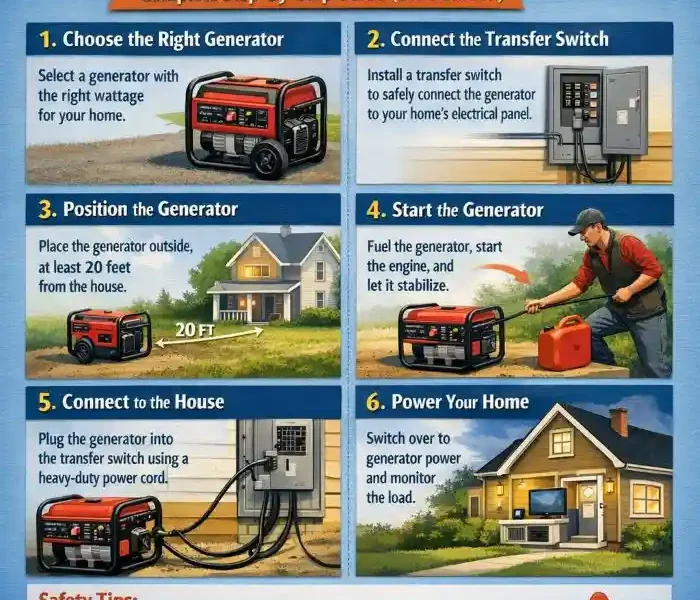
<p>Power outages rarely happen at a convenient time. A storm rolls through. The grid goes down. Temperatures climb or drop fast. Suddenly, you are trying to keep the refrigerator cold, the lights on, your phone charged, and maybe even a sump pump or medical equipment running.</p>
<p>That is where a generator can make a huge difference.</p>
<p>If you have ever found yourself wondering <a href="https://www.ankersolix.com/blogs/home-generator/how-do-you-connect-a-generator-to-your-home"><strong>how to use a generator to power a house</strong></a>, you are not alone. Many homeowners buy a generator before fully understanding how to connect it, how much power they need, or how to run it safely. That can lead to frustration, damaged appliances, and in some cases, serious danger.</p>
<p>The good news is that powering your home with a generator does not have to feel confusing. Once you understand the basics, the process becomes much easier. You need the right generator, the right connection method, and a clear plan for what you want to power.</p>
<p>In this complete guide, you will learn everything you need to know about <strong>how to use a generator to power a house</strong> safely and effectively. We will walk through generator types, safety rules, setup steps, fuel options, common mistakes, maintenance, and buying tips. You will also see practical examples that make the information easier to apply to your own home.</p>
<p>For many families, even a short outage can mean hundreds of dollars in food loss, water damage, discomfort, or downtime. A properly used generator helps you stay prepared instead of scrambling in the dark.</p>
<p>If you want dependable backup power and peace of mind, follow these steps and use this guide as your starting point.</p>
<h2 id="why-use-a-generator-for-home-power-">Why Use a Generator for Home Power?</h2>
<p><img class="aligncenter wp-image-6925 size-full" src="https://comeawayhome.co.uk/wp-content/uploads/2026/05/8b418150-fb5e-4429-9bcb-167006ae52c6x-ezgif.com-jpg-to-webp-converter.webp" alt="how to use a generator to power a house" width="700" height="700" /></p>
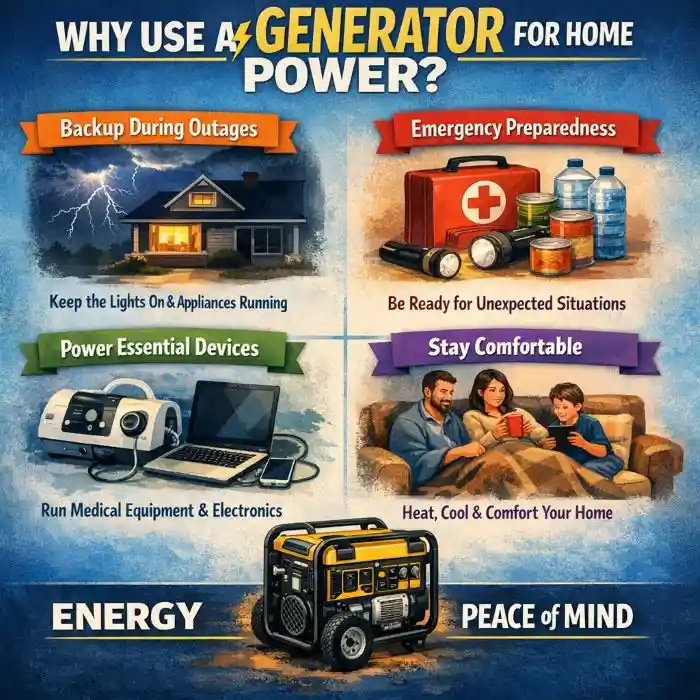
<p>A generator gives you <strong>control when the power grid fails</strong>. That is the biggest reason people invest in one. Instead of waiting and hoping the electricity comes back soon, you can keep key parts of your home running.</p>
<p>For some households, that means basic comfort. You keep the lights on, the refrigerator cold, and the Wi-Fi working. For others, it means something more serious. A generator may support a home office, medical equipment, a well pump, a freezer full of food, or a heating system during freezing weather.</p>
<p>Generators are especially useful in a few common situations:</p>
<ul>
<li><strong>Storm-related blackouts</strong></li>
<li><strong>Rolling power outages</strong></li>
<li><strong>Rural homes with unstable grid access</strong></li>
<li><strong>Off-grid or semi-off-grid living</strong></li>
<li><strong>Emergency backup for essential systems</strong></li>
</ul>
<p>Compared with battery backup alone, generators usually provide <strong>more wattage and longer runtime</strong>. Batteries are quiet and clean, but they can run out quickly if you are powering heavy appliances. Solar systems help too, but they depend on sunlight and battery capacity. A generator is often the most practical tool when you need strong, reliable backup power right away.</p>
<p>Another reason people choose generators is cost protection. A single extended outage can lead to spoiled groceries, burst pipes, water in the basement, or lost work time. In many cases, a generator helps avoid those losses.</p>
<p>When people compare <strong>portable vs. standby generators for whole-house power</strong>, the right answer depends on budget, power needs, and how automatic you want the system to be. Portable units are more affordable and flexible. Standby units offer convenience and can keep almost the entire <a href="https://comeawayhome.co.uk/how-much-land-do-you-need-to-build-a-house/">house</a> running with little effort from you.</p>
<p>In short, a generator is not just a machine. It is a backup plan that helps your home stay functional when everything else stops.</p>
<h2 id="types-of-generators-for-house-power">Types of Generators for House Power</h2>
<p>Not every generator works the same way. Before you learn <strong>how to use a generator to power a house</strong>, you need to understand the main generator types and what each one does best.</p>
<h3 id="portable-generators">Portable Generators</h3>
<p>Portable generators are the most common option for homeowners. They are popular because they are <strong>affordable, flexible, and widely available</strong>. Most portable models produce between <strong>3,000 and 10,000 watts</strong>, which is enough to run selected essentials like a refrigerator, lights, a few outlets, a microwave, or a sump pump.</p>
<p>These generators are best for <strong>partial house power</strong>, not always full-home coverage. You can move them where needed, store them in a garage or shed, and bring them out during an outage. That makes them a practical choice for homeowners who want backup power without a major installation project.</p>
<p>Still, portable models do come with trade-offs. They usually need manual startup. They require you to refuel them during long outages. They are also louder than many homeowners expect. Most importantly, they must be used outside and connected safely through a transfer switch, interlock kit, or heavy-duty extension cords for individual appliances.</p>
<p>If you want an entry point into backup power, portable generators are often the first place people start.</p>
<h3 id="inverter-generators">Inverter Generators</h3>
<p>Inverter generators are a special type of portable generator. They are designed to produce <strong>cleaner and more stable electricity</strong>, which makes them ideal for sensitive electronics like laptops, TVs, routers, and modern appliances with circuit boards.</p>
<p>They are usually <strong>quieter and more fuel-efficient</strong> than standard portable units. Many homeowners like them because they are easier on the ears and more convenient in neighborhoods where noise matters.</p>
<p>Most inverter generators produce between <strong>2,000 and 7,000 watts</strong>, so they are not always the best fit for large whole-house needs. But for selective backup power, they are a strong option.</p>
<p>If your priority is quiet operation, efficiency, and protecting electronics, an inverter generator deserves a close look.</p>
<h3 id="whole-house-standby-generators">Whole-House Standby Generators</h3>
<p>Standby generators are the premium option. These are permanently installed outside your home and connected directly to your electrical system through an <strong>automatic transfer switch</strong>. When the utility power goes out, the generator detects the outage and starts automatically.</p>
<p>That is the main advantage: <strong>speed and convenience</strong>. You do not have to wheel a unit outside, fill the tank, run cords, or start the engine yourself. The system handles the switch for you.</p>
<p>Standby generators usually range from <strong>10,000 to 20,000+ watts</strong>, and many can power most or all of a typical home. They often run on <strong>natural gas or propane</strong>, which means you do not have to keep filling a small gas tank every few hours.</p>
<p>They do cost much more upfront, and installation requires permits, code compliance, and professional electrical work. But if you want seamless backup power, especially for a larger home, this is often the best long-term solution.</p>
<p>Popular homeowners’ choices often include brands such as <strong>Generac</strong> and <strong>Kohler</strong>, though the best brand for you depends on dealer support, parts availability, and service in your area.</p>
<h3 id="generator-comparison-table">Generator Comparison Table</h3>
<table>
<thead>
<tr>
<th>Type</th>
<th>Wattage</th>
<th>Fuel</th>
<th>Cost</th>
<th>Best For</th>
</tr>
</thead>
<tbody>
<tr>
<td>Portable</td>
<td>3k–10k</td>
<td>Gasoline</td>
<td>$500+</td>
<td>Essentials and partial house power</td>
</tr>
<tr>
<td>Inverter</td>
<td>2k–7k</td>
<td>Gasoline/Propane</td>
<td>$800+</td>
<td>Sensitive electronics and quieter use</td>
</tr>
<tr>
<td>Standby</td>
<td>10k–20k+</td>
<td>Natural Gas/Propane</td>
<td>$4k+</td>
<td>Full-house or near full-house backup</td>
</tr>
</tbody>
</table>
<h2 id="safety-precautions-before-connecting">Safety Precautions Before Connecting</h2>
<p>Before you connect anything, stop and think about safety first. This is the most important part of learning <strong>how to use a generator to power a house</strong>. A generator can protect your family during an outage, but only when you use it correctly.</p>
<h3 id="carbon-monoxide-safety-comes-first">Carbon Monoxide Safety Comes First</h3>
<p>Generators produce <strong>carbon monoxide</strong>, a deadly gas you cannot see or smell. That is why you should <strong>never run a generator inside a house, garage, basement, crawlspace, or enclosed porch</strong>. Not even with the door open. Not even for a few minutes.</p>
<p>Always place the generator <strong>outside in a well-ventilated area</strong>, at least <strong>20 feet from the house</strong> if possible, and aim the exhaust away from doors, windows, and vents.</p>
<p>You should also have working <strong>carbon monoxide detectors</strong> inside the home, especially near sleeping areas.</p>
<h3 id="never-backfeed-your-house">Never Backfeed Your House</h3>
<p>One of the most dangerous mistakes homeowners make is trying to power their home by plugging a generator into a wall outlet. People sometimes call this a “backfeed” method. It is extremely dangerous and can injure utility workers, damage your electrical system, and create a fire hazard.</p>
<p>If you want to connect a generator to your house wiring, use one of the following:</p>
<ul>
<li><strong>A transfer switch</strong></li>
<li><strong>An interlock kit</strong></li>
<li><strong>A professionally installed standby generator system</strong></li>
</ul>
<p>These methods isolate your house from the utility grid and allow safe generator hookup.</p>
<h3 id="use-the-right-cords-and-equipment">Use the Right Cords and Equipment</h3>
<p>If you are powering appliances directly, use <strong>heavy-duty outdoor-rated extension cords</strong>. In many situations, <strong>12-gauge or thicker</strong> cords are the minimum safe choice. Thin cords can overheat, drop voltage, and damage equipment.</p>
<p>Also check that:</p>
<ul>
<li>The cord matches the generator outlet type</li>
<li>The cord length is reasonable</li>
<li>The cord is dry and free from cuts or damage</li>
</ul>
<h3 id="follow-local-codes-and-permit-rules">Follow Local Codes and Permit Rules</h3>
<p>If you are installing a transfer switch or standby generator, local building and electrical codes matter. Many areas require permits and inspection. That is not just paperwork. It helps make sure the system is safe and legal.</p>
<p>For permanent systems, you should work with a <strong>licensed electrician</strong> and, if needed, a licensed gas installer.</p>
<h3 id="basic-safety-checklist">Basic Safety Checklist</h3>
<p>Before startup, make sure you have the following:</p>
<ul>
<li><strong>Generator placed outdoors on level ground</strong></li>
<li><strong>At least 20 feet of clearance from the home when possible</strong></li>
<li><strong>Fuel stored safely in approved containers</strong></li>
<li><strong>Oil level checked</strong></li>
<li><strong>Fire extinguisher nearby</strong></li>
<li><strong>Dry conditions or a proper generator tent/cover rated for safe use</strong></li>
<li><strong>Transfer switch or interlock ready if connecting to the house</strong></li>
<li><strong>Carbon monoxide alarms working indoors</strong></li>
</ul>
<p>If you follow these basics, you dramatically lower the risk and make the rest of the setup much smoother.</p>
<h2 id="step-by-step-how-to-use-a-generator-to-power-a-house">Step-by-Step: How to Use a Generator to Power a House</h2>
<p>Now let’s get into the practical side. This is the part most homeowners care about most: <strong>how to use a generator to power a house step by step</strong>.</p>
<h3 id="step-1-calculate-your-power-needs">Step 1: Calculate Your Power Needs</h3>
<p>Start with a simple power audit. You need to know what you actually want to run during an outage. This matters because generators have limits, and buying or using the wrong size can lead to overloads.</p>
<p>Make a list of your must-have appliances. For example:</p>
<ul>
<li>Refrigerator: <strong>800 running watts</strong></li>
<li>Microwave: <strong>1,000 watts</strong></li>
<li>Sump pump: <strong>1,000 to 1,500 watts</strong></li>
<li>Lights: <strong>200 watts</strong></li>
<li>Router/modem: <strong>50 to 100 watts</strong></li>
<li>Window AC: <strong>1,000 to 1,500 watts</strong></li>
</ul>
<p>Also remember that some appliances need extra power for startup. This is called <strong>surge wattage</strong> or <strong>starting watts</strong>. Motors, compressors, and pumps usually need more power for a few seconds when they first turn on.</p>
<p>A useful rule is:</p>
<p><strong>Total watts needed = running watts + highest startup surge</strong></p>
<p>So if your appliances use 3,500 running watts total and your largest starting surge is 1,500 watts, you should plan for at least <strong>5,000 watts</strong> of generator capacity. A little extra breathing room is smart.</p>
<p>Do not try to power everything unless you have a generator sized for it. Most families are better off prioritizing essentials first.</p>
<h3 id="step-2-choose-and-prepare-equipment">Step 2: Choose and Prepare Equipment</h3>
<p>Once you know your power needs, get your equipment ready before the outage happens. This is where a lot of people lose time. They buy the generator but forget the accessories that make it usable.</p>
<p>You may need:</p>
<ul>
<li>A <strong>transfer switch</strong> or <strong>interlock kit</strong></li>
<li>A proper <strong>generator inlet box</strong></li>
<li>Heavy-duty extension cords if powering appliances directly</li>
<li>Fresh fuel or access to propane/natural gas</li>
<li>Extra oil and a funnel</li>
<li>The owner’s manual</li>
</ul>
<p>Check the oil level before each use. Confirm the battery is charged if your unit has electric start. If your generator has not been used in a while, do a test run so you know it starts properly.</p>
<p>Preparation is what turns a generator from “something you own” into “something that actually helps in an emergency.”</p>
<h3 id="step-3-safe-placement-and-startup">Step 3: Safe Placement and Startup</h3>
<p>When the outage happens, move your portable generator to a safe outdoor location. Set it on <strong>firm, level ground</strong> where it will stay dry and stable. If weather is bad, use a cover made specifically for safe generator operation. Never place it where exhaust can drift into the home.</p>
<p>Before starting it:</p>
<ol>
<li><strong>Turn the generator off</strong></li>
<li><strong>Check fuel and oil</strong></li>
<li><strong>Make sure all connected loads are off</strong></li>
<li><strong>Open the fuel valve if your model has one</strong></li>
<li><strong>Set the choke if needed</strong></li>
<li><strong>Start the generator</strong></li>
<li><strong>Let it warm up for a minute or two</strong></li>
</ol>
<p>Cold weather can make startup harder, so allow extra time and follow the manual closely.</p>
<p>If you smell fuel strongly, notice leaking fluid, or hear unusual engine sounds, shut it down and inspect it before going further.</p>
<h3 id="step-4-connect-to-house-power">Step 4: Connect to House Power</h3>
<p>This is the heart of the process. There are a few different ways to connect a generator to your home, and some are much safer than others.</p>
<h4 id="option-1-use-a-transfer-switch">Option 1: Use a Transfer Switch</h4>
<p>A <strong>transfer switch</strong> is one of the safest and most straightforward methods. It connects selected home circuits to generator power while isolating them from utility power.</p>
<p>With a manual transfer switch, you start the generator, plug it into the house inlet, and then switch the selected circuits from utility to generator. These circuits may include your refrigerator, furnace, lights, garage door opener, or sump pump.</p>
<p>An <strong>automatic transfer switch</strong> is usually part of a standby generator system. It senses an outage and switches power automatically.</p>
<p>This option is ideal if you want a clean and organized setup.</p>
<h4 id="option-2-use-an-interlock-kit">Option 2: Use an Interlock Kit</h4>
<p>An <strong>interlock kit</strong> works with your main electrical panel and prevents the main breaker and generator breaker from being on at the same time. This helps stop backfeeding and allows you to energize selected circuits from the panel.</p>
<p>Interlock kits are often more affordable than transfer switches, but they still require proper installation and code compliance. In most cases, a qualified electrician should handle the work.</p>
<p>This method can be a good fit for homeowners who want flexibility and already understand their panel layout.</p>
<h4 id="option-3-power-individual-appliances-directly">Option 3: Power Individual Appliances Directly</h4>
<p>If you do not have a transfer switch or interlock setup, you can use extension cords to power individual appliances directly from the generator. This method works best for short-term use and basic essentials.</p>
<p>You might plug in:</p>
<ul>
<li>Refrigerator</li>
<li>Freezer</li>
<li>Lamps</li>
<li>Phone chargers</li>
<li>Router</li>
<li>Small fan or space heater if wattage allows</li>
</ul>
<p>This method is simple, but it is less convenient. You may need to leave doors or windows cracked for cords, which is not ideal in bad weather. It is also easier to trip over cords or overload the generator if you are not tracking wattage carefully.</p>
<h4 id="important-rule">Important Rule</h4>
<p><strong>Never plug a generator directly into a house outlet.</strong> If you remember only one thing from this article, let it be that.</p>
<h3 id="step-5-power-on-and-manage-the-load">Step 5: Power On and Manage the Load</h3>
<p>After the generator is connected, begin turning on loads one at a time. Do not switch on everything at once. That can create a sudden surge and overload the unit.</p>
<p>A smart rule is to keep your generator running at <strong>no more than about 80% of its rated capacity</strong> for regular operation. That gives you some safety margin and helps the machine run more efficiently.</p>
<p>Prioritize essentials first:</p>
<ol>
<li>Refrigerator or freezer</li>
<li>Sump pump or well pump</li>
<li>Heating or cooling equipment</li>
<li>A few lights</li>
<li>Communications and device charging</li>
</ol>
<p>If the generator starts to struggle, reduce the load right away.</p>
<h3 id="step-6-shutdown-and-storage">Step 6: Shutdown and Storage</h3>
<p>When utility power returns, disconnect the load carefully and shut the generator down in the proper order.</p>
<p>For portable units:</p>
<ol>
<li><strong>Turn off connected appliances or circuits</strong></li>
<li><strong>Switch transfer equipment back to utility power</strong></li>
<li><strong>Let the generator run without load for a few minutes to cool down</strong></li>
<li><strong>Turn off the engine</strong></li>
<li><strong>Close the fuel valve if applicable</strong></li>
</ol>
<p>If you are storing the generator for more than a short period, stabilize or drain the fuel depending on manufacturer guidance. Clean the unit, check for wear, and store it in a dry place.</p>
<p>In cold climates, winterizing matters. Old fuel and neglected maintenance can cause hard starts when you need the generator most.</p>
<h3 id="visual-aid-suggestion">Visual Aid Suggestion</h3>
<p>If you turn this article into a business blog post, add a visual step graphic with icons for:</p>
<ol>
<li><strong>Wattage audit</strong></li>
<li><strong>Generator prep</strong></li>
<li><strong>Outdoor placement</strong></li>
<li><strong>Safe connection</strong></li>
<li><strong>Load management</strong></li>
<li><strong>Shutdown and storage</strong></li>
</ol>
<p>That kind of visual helps readers follow the process quickly during a real outage.</p>
<h2 id="fuel-types-and-efficiency-tips">Fuel Types and Efficiency Tips</h2>
<p>The fuel you choose affects runtime, storage, convenience, and maintenance. That is why fuel type matters when deciding <strong>how to use a generator to power a house</strong> effectively.</p>
<h3 id="gasoline">Gasoline</h3>
<p>Gasoline is common for portable generators because it is easy to find. The downside is that it has a shorter shelf life and can go stale if stored too long. It is also more difficult to store safely in large amounts.</p>
<p>A typical <strong>5-gallon tank</strong> may provide roughly <strong>8 to 12 hours of runtime at half load</strong>, depending on the model.</p>
<h3 id="propane">Propane</h3>
<p>Propane burns cleaner and stores much longer than gasoline. That makes it attractive for backup systems that may sit unused for months. It is common in standby systems and some dual-fuel portable models.</p>
<p>The trade-off is that propane often delivers slightly lower power output compared with gasoline.</p>
<h3 id="diesel">Diesel</h3>
<p>Diesel generators are known for durability and strong performance, especially in heavy-duty applications. They are less common in average residential use but can be a solid fit for larger homes or rural properties.</p>
<h3 id="solar-hybrid-systems">Solar-Hybrid Systems</h3>
<p>Some homeowners combine a generator with solar panels and battery storage. This setup can reduce fuel use and noise while still giving you backup power when sunlight or battery storage alone is not enough.</p>
<h3 id="efficiency-tips">Efficiency Tips</h3>
<p>A few simple habits can improve fuel economy and reduce wear:</p>
<ul>
<li><strong>Run only the circuits you truly need</strong></li>
<li><strong>Keep the air filter clean</strong></li>
<li><strong>Change oil on schedule</strong></li>
<li><strong>Do not overload the generator</strong></li>
<li><strong>Use eco-mode if your inverter generator offers it</strong></li>
<li><strong>Start large loads one at a time</strong></li>
</ul>
<p>Good maintenance and smart load management can improve performance noticeably and may even help you get <strong>up to 20% better fuel efficiency</strong> in real-world use.</p>
<h2 id="common-mistakes-and-troubleshooting">Common Mistakes and Troubleshooting</h2>
<p>Even a good generator can disappoint you if you use it the wrong way. Most problems come down to a few avoidable mistakes.</p>
<h3 id="common-mistakes-homeowners-make">Common Mistakes Homeowners Make</h3>
<p>The first big mistake is <strong>overloading the generator</strong>. People often assume the unit can run everything at once. Then the generator trips, struggles, or shuts down.</p>
<p>The second mistake is <strong>poor placement</strong>. Running a generator too close to the house creates a major carbon monoxide risk. Placing it on uneven or wet ground can also damage the unit or create electrical hazards.</p>
<p>Another common issue is <strong>neglecting maintenance</strong>. Old fuel, low oil, dead batteries, and dirty filters are some of the top reasons generators fail during emergencies.</p>
<p>And of course, the most dangerous mistake is <strong>trying to backfeed the house</strong> through a wall outlet. That should never happen.</p>
<h3 id="troubleshooting-table">Troubleshooting Table</h3>
<table>
<thead>
<tr>
<th>Issue</th>
<th>Cause</th>
<th>Fix</th>
</tr>
</thead>
<tbody>
<tr>
<td>No Start</td>
<td>Bad fuel, old battery, fuel valve closed</td>
<td>Add fresh fuel, charge battery, check fuel flow</td>
</tr>
<tr>
<td>Overload Shutdown</td>
<td>Too many appliances running</td>
<td>Reduce load, restart, add loads one at a time</td>
</tr>
<tr>
<td>Low Power</td>
<td>Dirty air filter or overloaded circuit</td>
<td>Clean/replace filter, remove some load</td>
</tr>
<tr>
<td>Engine Runs but No Output</td>
<td>Tripped breaker or faulty connection</td>
<td>Reset breaker, check cords and panel connection</td>
</tr>
<tr>
<td>Hard Starting</td>
<td>Old spark plug or cold weather</td>
<td>Replace spark plug, use proper startup procedure</td>
</tr>
</tbody>
</table>
<h3 id="quick-troubleshooting-tips">Quick Troubleshooting Tips</h3>
<p>If your generator <strong>will not start</strong>, begin with the basics. Check fuel, oil level, choke position, battery charge, and spark plug condition. Many modern generators also have low-oil shutdown protection, so even a slightly low oil level can stop the engine from running.</p>
<p>If the generator starts but <strong>does not provide power</strong>, inspect the circuit breaker on the unit. Then check cords, inlet connections, and transfer equipment.</p>
<p>If it <strong>keeps shutting down</strong>, the load may be too high. Remove non-essential devices and restart. Add loads gradually.</p>
<p>When in doubt, do not force it. Shut the unit down and inspect it carefully before trying again.</p>
<h2 id="maintenance-for-long-term-reliability">Maintenance for Long-Term Reliability</h2>
<p>A generator is only helpful if it works when you need it. That is why maintenance matters so much.</p>
<p>The best maintenance plan is a simple one you actually follow.</p>
<h3 id="routine-checks">Routine Checks</h3>
<p>For portable generators, inspect the unit regularly even when it is not in use. Look for fuel leaks, worn cords, rust, battery issues, or rodent damage if it has been stored for a long time.</p>
<p>Start the generator periodically so the engine stays in working condition. A short monthly or every-other-month test run can help you catch issues early.</p>
<h3 id="oil-filters-and-spark-plugs">Oil, Filters, and Spark Plugs</h3>
<p>Many generators need an <strong>oil change every 100 hours of use</strong>, though some models require it sooner. Always check your manual.</p>
<p>You should also inspect or replace:</p>
<ul>
<li><strong>Air filter</strong></li>
<li><strong>Spark plug</strong></li>
<li><strong>Fuel filter if applicable</strong></li>
<li><strong>Battery on electric-start models</strong></li>
</ul>
<p>These small parts have a big impact on reliability.</p>
<h3 id="fuel-care">Fuel Care</h3>
<p>Fuel problems are among the most common causes of generator failure. If you use gasoline, do not let old fuel sit in the tank too long. Use stabilizer when appropriate, and rotate stored fuel safely.</p>
<p>If your generator supports propane, storage can be easier over the long term.</p>
<h3 id="annual-service">Annual Service</h3>
<p>For standby generators, schedule <strong>annual professional service</strong>. These systems are more complex and often include automatic switching, battery charging, and fuel system components that should be checked by a technician.</p>
<p>Proper care can add years to the life of your generator and save you money by reducing breakdowns, emergency repairs, and replacement costs.</p>
<h2 id="cost-breakdown-and-buying-guide">Cost Breakdown and Buying Guide</h2>
<p>Generator costs vary widely, so it helps to know what you are really paying for.</p>
<p>A basic <strong>portable generator</strong> may cost anywhere from <strong>$400 to $2,000</strong>, depending on wattage, features, and build quality. Inverter models often cost more, but they offer quieter operation and cleaner power.</p>
<p>A <strong>whole-house standby generator</strong> is a bigger investment. The unit itself may cost several thousand dollars, and installed systems often land in the <strong>$5,000 to $15,000</strong> range or more depending on size, electrical work, gas hookup, pad installation, and permits.</p>
<p>When comparing options, ask yourself:</p>
<ul>
<li>How many circuits do I truly need to run?</li>
<li>Do I want manual or automatic backup power?</li>
<li>How often do outages happen in my area?</li>
<li>Can I manage fuel storage safely?</li>
<li>Do I want a temporary solution or a permanent one?</li>
</ul>
<p>In some homes, a generator can pay for itself after just a few major outages by preventing food loss, water damage, hotel stays, or missed work. The real value is not just the machine. It is the comfort, safety, and stability it gives you when the grid goes down.</p>
<h2 id="faq-can-i-plug-a-generator-directly-into-my-house-">FAQ: Can I Plug a Generator Directly Into My House?</h2>
<p>This is one of the most common questions homeowners ask, and the answer is simple:</p>
<p><strong>No, you should not plug a generator directly into your house through a wall outlet.</strong></p>
<p>Doing that creates a backfeed situation. Electricity can travel into the utility lines, putting line workers in danger and creating serious risks inside your home as well. It can also damage your wiring, appliances, and the generator itself.</p>
<p>The safe way to connect a generator to your home is through a <strong>transfer switch</strong>, <strong>interlock kit</strong>, or a professionally installed <strong>standby system</strong>. These methods separate generator power from utility power so electricity flows in the right direction.</p>
<p>If you only need to run a few appliances, you can also use <strong>heavy-duty extension cords</strong> directly from the generator to the appliances, as long as the cords are rated properly and the generator stays outdoors.</p>
<p>If you are unsure about your setup, do not guess. Ask a licensed electrician to review it. A proper installation may cost more upfront, but it protects your family, your home, and anyone working on the power lines outside.</p>
<h2 id="conclusion-and-next-steps">Conclusion and Next Steps</h2>
<p>Learning <strong>how to use a generator to power a house</strong> is really about two things: <strong>safety and preparation</strong>.</p>
<p>When you understand your power needs, choose the right generator, connect it the right way, and maintain it properly, you turn a stressful outage into a manageable inconvenience. That is a big difference. Instead of scrambling in the dark, you have a clear plan.</p>
<p>The most important takeaway is this: <strong>never cut corners with generator safety</strong>. Use outdoor placement, proper connection equipment, and realistic load planning every time.</p>
<p>If you are just getting started, begin with a home wattage audit. Figure out what matters most in an outage. From there, decide whether a portable generator, inverter generator, or standby system makes the most sense for your home and budget.</p>
<p>You can also pair this guide with your own outage checklist, backup fuel plan, and seasonal maintenance routine. The more prepared you are now, the easier the next outage will feel.</p>
<p><strong>Mastering how to use a generator to power a house helps you protect your home, your comfort, and your peace of mind.</strong></p>
<p><a href="https://comeawayhome.co.uk/">House</a></p>
Power outages rarely happen at a convenient time. A storm rolls through. The grid goes down. Temperatures climb or drop fast. Suddenly, you are trying to keep the refrigerator cold, the lights on, your phone charged, and maybe even a sump pump or medical equipment running.
That is where a generator can make a huge difference.
If you have ever found yourself wondering how to use a generator to power a house, you are not alone. Many homeowners buy a generator before fully understanding how to connect it, how much power they need, or how to run it safely. That can lead to frustration, damaged appliances, and in some cases, serious danger.
The good news is that powering your home with a generator does not have to feel confusing. Once you understand the basics, the process becomes much easier. You need the right generator, the right connection method, and a clear plan for what you want to power.
In this complete guide, you will learn everything you need to know about how to use a generator to power a house safely and effectively. We will walk through generator types, safety rules, setup steps, fuel options, common mistakes, maintenance, and buying tips. You will also see practical examples that make the information easier to apply to your own home.
For many families, even a short outage can mean hundreds of dollars in food loss, water damage, discomfort, or downtime. A properly used generator helps you stay prepared instead of scrambling in the dark.
If you want dependable backup power and peace of mind, follow these steps and use this guide as your starting point.
Why Use a Generator for Home Power?
A generator gives you control when the power grid fails. That is the biggest reason people invest in one. Instead of waiting and hoping the electricity comes back soon, you can keep key parts of your home running.
For some households, that means basic comfort. You keep the lights on, the refrigerator cold, and the Wi-Fi working. For others, it means something more serious. A generator may support a home office, medical equipment, a well pump, a freezer full of food, or a heating system during freezing weather.
Generators are especially useful in a few common situations:
- Storm-related blackouts
- Rolling power outages
- Rural homes with unstable grid access
- Off-grid or semi-off-grid living
- Emergency backup for essential systems
Compared with battery backup alone, generators usually provide more wattage and longer runtime. Batteries are quiet and clean, but they can run out quickly if you are powering heavy appliances. Solar systems help too, but they depend on sunlight and battery capacity. A generator is often the most practical tool when you need strong, reliable backup power right away.
Another reason people choose generators is cost protection. A single extended outage can lead to spoiled groceries, burst pipes, water in the basement, or lost work time. In many cases, a generator helps avoid those losses.
When people compare portable vs. standby generators for whole-house power, the right answer depends on budget, power needs, and how automatic you want the system to be. Portable units are more affordable and flexible. Standby units offer convenience and can keep almost the entire house running with little effort from you.
In short, a generator is not just a machine. It is a backup plan that helps your home stay functional when everything else stops.
Types of Generators for House Power
Not every generator works the same way. Before you learn how to use a generator to power a house, you need to understand the main generator types and what each one does best.
Portable Generators
Portable generators are the most common option for homeowners. They are popular because they are affordable, flexible, and widely available. Most portable models produce between 3,000 and 10,000 watts, which is enough to run selected essentials like a refrigerator, lights, a few outlets, a microwave, or a sump pump.
These generators are best for partial house power, not always full-home coverage. You can move them where needed, store them in a garage or shed, and bring them out during an outage. That makes them a practical choice for homeowners who want backup power without a major installation project.
Still, portable models do come with trade-offs. They usually need manual startup. They require you to refuel them during long outages. They are also louder than many homeowners expect. Most importantly, they must be used outside and connected safely through a transfer switch, interlock kit, or heavy-duty extension cords for individual appliances.
If you want an entry point into backup power, portable generators are often the first place people start.
Inverter Generators
Inverter generators are a special type of portable generator. They are designed to produce cleaner and more stable electricity, which makes them ideal for sensitive electronics like laptops, TVs, routers, and modern appliances with circuit boards.
They are usually quieter and more fuel-efficient than standard portable units. Many homeowners like them because they are easier on the ears and more convenient in neighborhoods where noise matters.
Most inverter generators produce between 2,000 and 7,000 watts, so they are not always the best fit for large whole-house needs. But for selective backup power, they are a strong option.
If your priority is quiet operation, efficiency, and protecting electronics, an inverter generator deserves a close look.
Whole-House Standby Generators
Standby generators are the premium option. These are permanently installed outside your home and connected directly to your electrical system through an automatic transfer switch. When the utility power goes out, the generator detects the outage and starts automatically.
That is the main advantage: speed and convenience. You do not have to wheel a unit outside, fill the tank, run cords, or start the engine yourself. The system handles the switch for you.
Standby generators usually range from 10,000 to 20,000+ watts, and many can power most or all of a typical home. They often run on natural gas or propane, which means you do not have to keep filling a small gas tank every few hours.
They do cost much more upfront, and installation requires permits, code compliance, and professional electrical work. But if you want seamless backup power, especially for a larger home, this is often the best long-term solution.
Popular homeowners’ choices often include brands such as Generac and Kohler, though the best brand for you depends on dealer support, parts availability, and service in your area.
Generator Comparison Table
| Type |
Wattage |
Fuel |
Cost |
Best For |
| Portable |
3k–10k |
Gasoline |
$500+ |
Essentials and partial house power |
| Inverter |
2k–7k |
Gasoline/Propane |
$800+ |
Sensitive electronics and quieter use |
| Standby |
10k–20k+ |
Natural Gas/Propane |
$4k+ |
Full-house or near full-house backup |
Safety Precautions Before Connecting
Before you connect anything, stop and think about safety first. This is the most important part of learning how to use a generator to power a house. A generator can protect your family during an outage, but only when you use it correctly.
Carbon Monoxide Safety Comes First
Generators produce carbon monoxide, a deadly gas you cannot see or smell. That is why you should never run a generator inside a house, garage, basement, crawlspace, or enclosed porch. Not even with the door open. Not even for a few minutes.
Always place the generator outside in a well-ventilated area, at least 20 feet from the house if possible, and aim the exhaust away from doors, windows, and vents.
You should also have working carbon monoxide detectors inside the home, especially near sleeping areas.
Never Backfeed Your House
One of the most dangerous mistakes homeowners make is trying to power their home by plugging a generator into a wall outlet. People sometimes call this a “backfeed” method. It is extremely dangerous and can injure utility workers, damage your electrical system, and create a fire hazard.
If you want to connect a generator to your house wiring, use one of the following:
- A transfer switch
- An interlock kit
- A professionally installed standby generator system
These methods isolate your house from the utility grid and allow safe generator hookup.
Use the Right Cords and Equipment
If you are powering appliances directly, use heavy-duty outdoor-rated extension cords. In many situations, 12-gauge or thicker cords are the minimum safe choice. Thin cords can overheat, drop voltage, and damage equipment.
Also check that:
- The cord matches the generator outlet type
- The cord length is reasonable
- The cord is dry and free from cuts or damage
Follow Local Codes and Permit Rules
If you are installing a transfer switch or standby generator, local building and electrical codes matter. Many areas require permits and inspection. That is not just paperwork. It helps make sure the system is safe and legal.
For permanent systems, you should work with a licensed electrician and, if needed, a licensed gas installer.
Basic Safety Checklist
Before startup, make sure you have the following:
- Generator placed outdoors on level ground
- At least 20 feet of clearance from the home when possible
- Fuel stored safely in approved containers
- Oil level checked
- Fire extinguisher nearby
- Dry conditions or a proper generator tent/cover rated for safe use
- Transfer switch or interlock ready if connecting to the house
- Carbon monoxide alarms working indoors
If you follow these basics, you dramatically lower the risk and make the rest of the setup much smoother.
Step-by-Step: How to Use a Generator to Power a House
Now let’s get into the practical side. This is the part most homeowners care about most: how to use a generator to power a house step by step.
Step 1: Calculate Your Power Needs
Start with a simple power audit. You need to know what you actually want to run during an outage. This matters because generators have limits, and buying or using the wrong size can lead to overloads.
Make a list of your must-have appliances. For example:
- Refrigerator: 800 running watts
- Microwave: 1,000 watts
- Sump pump: 1,000 to 1,500 watts
- Lights: 200 watts
- Router/modem: 50 to 100 watts
- Window AC: 1,000 to 1,500 watts
Also remember that some appliances need extra power for startup. This is called surge wattage or starting watts. Motors, compressors, and pumps usually need more power for a few seconds when they first turn on.
A useful rule is:
Total watts needed = running watts + highest startup surge
So if your appliances use 3,500 running watts total and your largest starting surge is 1,500 watts, you should plan for at least 5,000 watts of generator capacity. A little extra breathing room is smart.
Do not try to power everything unless you have a generator sized for it. Most families are better off prioritizing essentials first.
Step 2: Choose and Prepare Equipment
Once you know your power needs, get your equipment ready before the outage happens. This is where a lot of people lose time. They buy the generator but forget the accessories that make it usable.
You may need:
- A transfer switch or interlock kit
- A proper generator inlet box
- Heavy-duty extension cords if powering appliances directly
- Fresh fuel or access to propane/natural gas
- Extra oil and a funnel
- The owner’s manual
Check the oil level before each use. Confirm the battery is charged if your unit has electric start. If your generator has not been used in a while, do a test run so you know it starts properly.
Preparation is what turns a generator from “something you own” into “something that actually helps in an emergency.”
Step 3: Safe Placement and Startup
When the outage happens, move your portable generator to a safe outdoor location. Set it on firm, level ground where it will stay dry and stable. If weather is bad, use a cover made specifically for safe generator operation. Never place it where exhaust can drift into the home.
Before starting it:
- Turn the generator off
- Check fuel and oil
- Make sure all connected loads are off
- Open the fuel valve if your model has one
- Set the choke if needed
- Start the generator
- Let it warm up for a minute or two
Cold weather can make startup harder, so allow extra time and follow the manual closely.
If you smell fuel strongly, notice leaking fluid, or hear unusual engine sounds, shut it down and inspect it before going further.
Step 4: Connect to House Power
This is the heart of the process. There are a few different ways to connect a generator to your home, and some are much safer than others.
Option 1: Use a Transfer Switch
A transfer switch is one of the safest and most straightforward methods. It connects selected home circuits to generator power while isolating them from utility power.
With a manual transfer switch, you start the generator, plug it into the house inlet, and then switch the selected circuits from utility to generator. These circuits may include your refrigerator, furnace, lights, garage door opener, or sump pump.
An automatic transfer switch is usually part of a standby generator system. It senses an outage and switches power automatically.
This option is ideal if you want a clean and organized setup.
Option 2: Use an Interlock Kit
An interlock kit works with your main electrical panel and prevents the main breaker and generator breaker from being on at the same time. This helps stop backfeeding and allows you to energize selected circuits from the panel.
Interlock kits are often more affordable than transfer switches, but they still require proper installation and code compliance. In most cases, a qualified electrician should handle the work.
This method can be a good fit for homeowners who want flexibility and already understand their panel layout.
Option 3: Power Individual Appliances Directly
If you do not have a transfer switch or interlock setup, you can use extension cords to power individual appliances directly from the generator. This method works best for short-term use and basic essentials.
You might plug in:
- Refrigerator
- Freezer
- Lamps
- Phone chargers
- Router
- Small fan or space heater if wattage allows
This method is simple, but it is less convenient. You may need to leave doors or windows cracked for cords, which is not ideal in bad weather. It is also easier to trip over cords or overload the generator if you are not tracking wattage carefully.
Important Rule
Never plug a generator directly into a house outlet. If you remember only one thing from this article, let it be that.
Step 5: Power On and Manage the Load
After the generator is connected, begin turning on loads one at a time. Do not switch on everything at once. That can create a sudden surge and overload the unit.
A smart rule is to keep your generator running at no more than about 80% of its rated capacity for regular operation. That gives you some safety margin and helps the machine run more efficiently.
Prioritize essentials first:
- Refrigerator or freezer
- Sump pump or well pump
- Heating or cooling equipment
- A few lights
- Communications and device charging
If the generator starts to struggle, reduce the load right away.
Step 6: Shutdown and Storage
When utility power returns, disconnect the load carefully and shut the generator down in the proper order.
For portable units:
- Turn off connected appliances or circuits
- Switch transfer equipment back to utility power
- Let the generator run without load for a few minutes to cool down
- Turn off the engine
- Close the fuel valve if applicable
If you are storing the generator for more than a short period, stabilize or drain the fuel depending on manufacturer guidance. Clean the unit, check for wear, and store it in a dry place.
In cold climates, winterizing matters. Old fuel and neglected maintenance can cause hard starts when you need the generator most.
Visual Aid Suggestion
If you turn this article into a business blog post, add a visual step graphic with icons for:
- Wattage audit
- Generator prep
- Outdoor placement
- Safe connection
- Load management
- Shutdown and storage
That kind of visual helps readers follow the process quickly during a real outage.
Fuel Types and Efficiency Tips
The fuel you choose affects runtime, storage, convenience, and maintenance. That is why fuel type matters when deciding how to use a generator to power a house effectively.
Gasoline
Gasoline is common for portable generators because it is easy to find. The downside is that it has a shorter shelf life and can go stale if stored too long. It is also more difficult to store safely in large amounts.
A typical 5-gallon tank may provide roughly 8 to 12 hours of runtime at half load, depending on the model.
Propane
Propane burns cleaner and stores much longer than gasoline. That makes it attractive for backup systems that may sit unused for months. It is common in standby systems and some dual-fuel portable models.
The trade-off is that propane often delivers slightly lower power output compared with gasoline.
Diesel
Diesel generators are known for durability and strong performance, especially in heavy-duty applications. They are less common in average residential use but can be a solid fit for larger homes or rural properties.
Solar-Hybrid Systems
Some homeowners combine a generator with solar panels and battery storage. This setup can reduce fuel use and noise while still giving you backup power when sunlight or battery storage alone is not enough.
Efficiency Tips
A few simple habits can improve fuel economy and reduce wear:
- Run only the circuits you truly need
- Keep the air filter clean
- Change oil on schedule
- Do not overload the generator
- Use eco-mode if your inverter generator offers it
- Start large loads one at a time
Good maintenance and smart load management can improve performance noticeably and may even help you get up to 20% better fuel efficiency in real-world use.
Common Mistakes and Troubleshooting
Even a good generator can disappoint you if you use it the wrong way. Most problems come down to a few avoidable mistakes.
Common Mistakes Homeowners Make
The first big mistake is overloading the generator. People often assume the unit can run everything at once. Then the generator trips, struggles, or shuts down.
The second mistake is poor placement. Running a generator too close to the house creates a major carbon monoxide risk. Placing it on uneven or wet ground can also damage the unit or create electrical hazards.
Another common issue is neglecting maintenance. Old fuel, low oil, dead batteries, and dirty filters are some of the top reasons generators fail during emergencies.
And of course, the most dangerous mistake is trying to backfeed the house through a wall outlet. That should never happen.
Troubleshooting Table
| Issue |
Cause |
Fix |
| No Start |
Bad fuel, old battery, fuel valve closed |
Add fresh fuel, charge battery, check fuel flow |
| Overload Shutdown |
Too many appliances running |
Reduce load, restart, add loads one at a time |
| Low Power |
Dirty air filter or overloaded circuit |
Clean/replace filter, remove some load |
| Engine Runs but No Output |
Tripped breaker or faulty connection |
Reset breaker, check cords and panel connection |
| Hard Starting |
Old spark plug or cold weather |
Replace spark plug, use proper startup procedure |
Quick Troubleshooting Tips
If your generator will not start, begin with the basics. Check fuel, oil level, choke position, battery charge, and spark plug condition. Many modern generators also have low-oil shutdown protection, so even a slightly low oil level can stop the engine from running.
If the generator starts but does not provide power, inspect the circuit breaker on the unit. Then check cords, inlet connections, and transfer equipment.
If it keeps shutting down, the load may be too high. Remove non-essential devices and restart. Add loads gradually.
When in doubt, do not force it. Shut the unit down and inspect it carefully before trying again.
Maintenance for Long-Term Reliability
A generator is only helpful if it works when you need it. That is why maintenance matters so much.
The best maintenance plan is a simple one you actually follow.
Routine Checks
For portable generators, inspect the unit regularly even when it is not in use. Look for fuel leaks, worn cords, rust, battery issues, or rodent damage if it has been stored for a long time.
Start the generator periodically so the engine stays in working condition. A short monthly or every-other-month test run can help you catch issues early.
Oil, Filters, and Spark Plugs
Many generators need an oil change every 100 hours of use, though some models require it sooner. Always check your manual.
You should also inspect or replace:
- Air filter
- Spark plug
- Fuel filter if applicable
- Battery on electric-start models
These small parts have a big impact on reliability.
Fuel Care
Fuel problems are among the most common causes of generator failure. If you use gasoline, do not let old fuel sit in the tank too long. Use stabilizer when appropriate, and rotate stored fuel safely.
If your generator supports propane, storage can be easier over the long term.
Annual Service
For standby generators, schedule annual professional service. These systems are more complex and often include automatic switching, battery charging, and fuel system components that should be checked by a technician.
Proper care can add years to the life of your generator and save you money by reducing breakdowns, emergency repairs, and replacement costs.
Cost Breakdown and Buying Guide
Generator costs vary widely, so it helps to know what you are really paying for.
A basic portable generator may cost anywhere from $400 to $2,000, depending on wattage, features, and build quality. Inverter models often cost more, but they offer quieter operation and cleaner power.
A whole-house standby generator is a bigger investment. The unit itself may cost several thousand dollars, and installed systems often land in the $5,000 to $15,000 range or more depending on size, electrical work, gas hookup, pad installation, and permits.
When comparing options, ask yourself:
- How many circuits do I truly need to run?
- Do I want manual or automatic backup power?
- How often do outages happen in my area?
- Can I manage fuel storage safely?
- Do I want a temporary solution or a permanent one?
In some homes, a generator can pay for itself after just a few major outages by preventing food loss, water damage, hotel stays, or missed work. The real value is not just the machine. It is the comfort, safety, and stability it gives you when the grid goes down.
FAQ: Can I Plug a Generator Directly Into My House?
This is one of the most common questions homeowners ask, and the answer is simple:
No, you should not plug a generator directly into your house through a wall outlet.
Doing that creates a backfeed situation. Electricity can travel into the utility lines, putting line workers in danger and creating serious risks inside your home as well. It can also damage your wiring, appliances, and the generator itself.
The safe way to connect a generator to your home is through a transfer switch, interlock kit, or a professionally installed standby system. These methods separate generator power from utility power so electricity flows in the right direction.
If you only need to run a few appliances, you can also use heavy-duty extension cords directly from the generator to the appliances, as long as the cords are rated properly and the generator stays outdoors.
If you are unsure about your setup, do not guess. Ask a licensed electrician to review it. A proper installation may cost more upfront, but it protects your family, your home, and anyone working on the power lines outside.
Conclusion and Next Steps
Learning how to use a generator to power a house is really about two things: safety and preparation.
When you understand your power needs, choose the right generator, connect it the right way, and maintain it properly, you turn a stressful outage into a manageable inconvenience. That is a big difference. Instead of scrambling in the dark, you have a clear plan.
The most important takeaway is this: never cut corners with generator safety. Use outdoor placement, proper connection equipment, and realistic load planning every time.
If you are just getting started, begin with a home wattage audit. Figure out what matters most in an outage. From there, decide whether a portable generator, inverter generator, or standby system makes the most sense for your home and budget.
You can also pair this guide with your own outage checklist, backup fuel plan, and seasonal maintenance routine. The more prepared you are now, the easier the next outage will feel.
Mastering how to use a generator to power a house helps you protect your home, your comfort, and your peace of mind.
House