<p>If you have ever been kept awake by a steady <strong>chirp… chirp… chirp</strong> somewhere in the room, you already know how frustrating a single cricket can be. It is small, quick, and surprisingly hard to find. Most of the time, you hear it long before you see it. And somehow, the moment you move closer, it goes silent.</p>
<p>That is exactly why so many people search for <a href="https://www.instructables.com/How-to-catch-crickets/"><strong>how to catch a cricket in your house</strong></a>. The problem is not always a big infestation. Sometimes it is just one cricket that slipped inside through a small gap under a door, around a window, or near a utility opening. Still, even one cricket can feel like a much bigger issue when it keeps you up at night or jumps out from under the couch.</p>
<p>Crickets often move toward places that feel safe to them. That usually means <strong>dark corners, damp spots, cluttered areas, and quiet rooms</strong> where they can hide during the day. Basements, laundry rooms, garages, kitchens, and bathrooms are all common places to check. If the <a href="https://comeawayhome.co.uk/building-a-house/">house</a> has moisture problems or easy access points, crickets may find it even more inviting.</p>
<p>The good news is that catching one is usually very doable. You do not need to panic, and you do not need to turn your house upside down. With the right approach, you can <strong>find the cricket, catch it safely, and stop more from getting inside later</strong>.</p>
<p>In this guide, you will learn simple methods that really make sense in everyday life. We will cover how to locate the cricket, the fastest ways to catch it, easy homemade trap ideas, the best places to look, and practical prevention steps. If you want a clear, no-nonsense plan to <strong>catch a cricket indoors</strong> and keep your home quieter, you are in the right place.</p>
<h2 id="what-attracts-crickets-indoors-">What Attracts Crickets Indoors?</h2>
<p><img class="aligncenter wp-image-6878 size-full" src="https://comeawayhome.co.uk/wp-content/uploads/2026/05/hhhoo-ezgif.com-jpg-to-webp-converter.webp" alt="how to catch a cricket in your house" width="1024" height="1024" /></p>
<p>Before you catch the cricket, it helps to understand <strong>why it came inside in the first place</strong>. That makes the current problem easier to solve and future problems easier to prevent.</p>
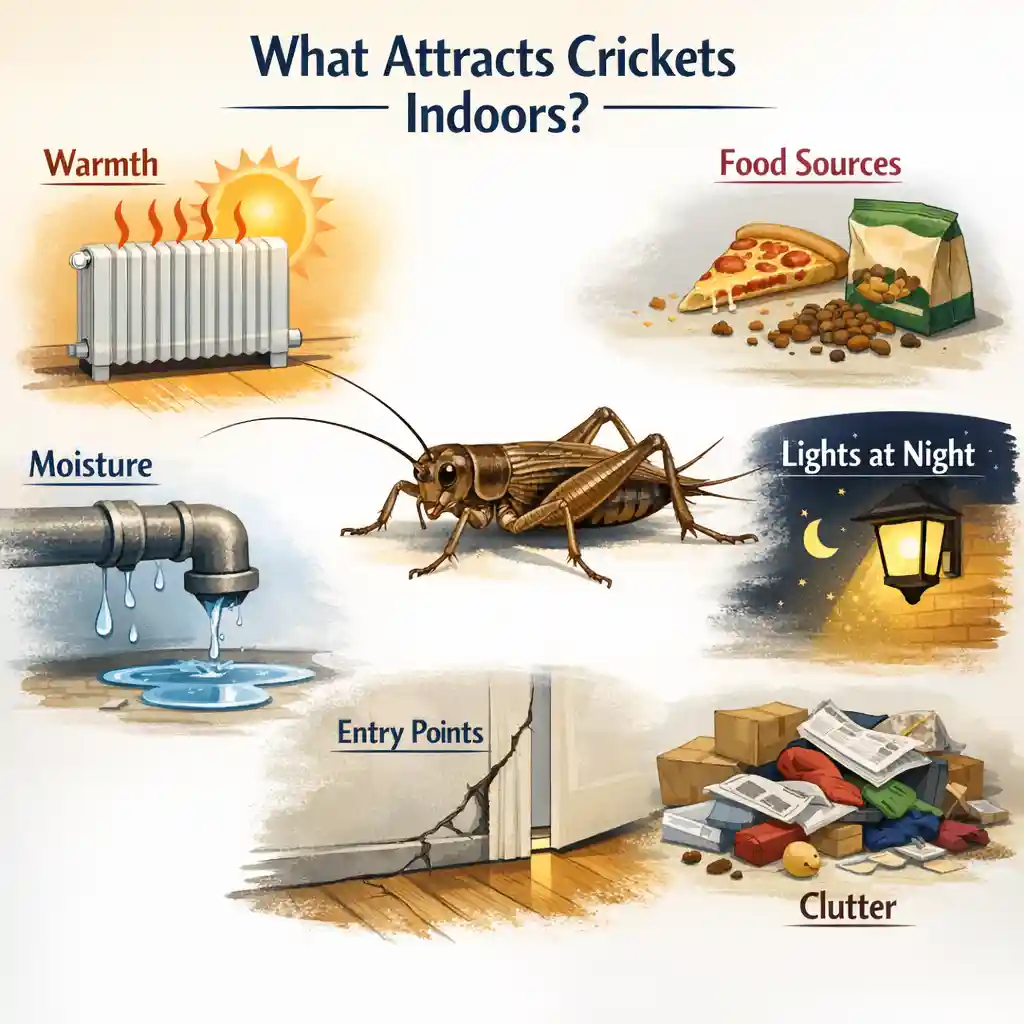
<p>Crickets do not enter homes just to annoy people. They usually come in because the space offers something they want. In many houses, that means <strong>shelter, warmth, moisture, and easy hiding spots</strong>. Your home may feel dry and comfortable to you, but to a cricket, even a slightly damp laundry room or a dark space behind the fridge can feel like a perfect place to settle.</p>
<p>One big reason crickets come inside is <strong>moisture</strong>. Damp spaces tend to attract all kinds of insects, and crickets are no exception. If you have a leaky pipe, a wet basement corner, condensation near appliances, or poor ventilation in a bathroom, those areas can become appealing. Moisture also creates a calmer environment where crickets can stay hidden without drying out.</p>
<p>Another reason is <strong>warmth</strong>. When outdoor temperatures shift, insects often look for more stable indoor conditions. A home offers that. Even in warmer seasons, a cricket may end up inside simply because it found an open path and stayed once it discovered safe cover.</p>
<p>Food can also play a role. Crickets are not picky. Small crumbs, food scraps, pet food, paper, fabric fibers, and organic debris can all help them survive. If you have cluttered storage boxes, dust buildup, or food left out overnight, you may be making the space more comfortable without realizing it.</p>
<p>Entry points matter too. Crickets do not need a wide-open door to get inside. They can come in through:</p>
<ul>
<li><strong>Gaps under doors</strong></li>
<li><strong>Cracks near windows</strong></li>
<li><strong>Openings around pipes and wires</strong></li>
<li><strong>Foundation cracks</strong></li>
<li><strong>Torn screens</strong></li>
<li><strong>Garage door edges</strong></li>
</ul>
<p>Once inside, they usually head straight for places where they will not be disturbed. That is why people often find them in <strong>basements, laundry rooms, garages, kitchens, closets, and rooms with large furniture or appliances</strong>.</p>
<p>And then there is the sound. One of the most useful clues a cricket gives you is its chirping. If you hear it at night, that noise can actually help you narrow down its location. In many cases, the sound is the only reason you realize there is a cricket in the house at all.</p>
<p>So if you are wondering why there is suddenly a cricket near your bedroom, in the hallway, or under the couch, the answer is usually simple: <strong>your house gave it moisture, cover, or a convenient way in</strong>. Once you understand that, you can solve the issue in a much smarter way.</p>
<h2 id="how-to-find-the-cricket-in-your-house">How to Find the Cricket in Your House</h2>
<p>Finding the cricket is often the hardest part. Catching it can be easy once you know where it is. The real challenge is that crickets are excellent at staying out of sight. They are small, fast, and usually active when your house is quiet.</p>
<p>The best approach is to <strong>work with their habits instead of against them</strong>.</p>
<h3 id="listen-before-you-search">Listen Before You Search</h3>
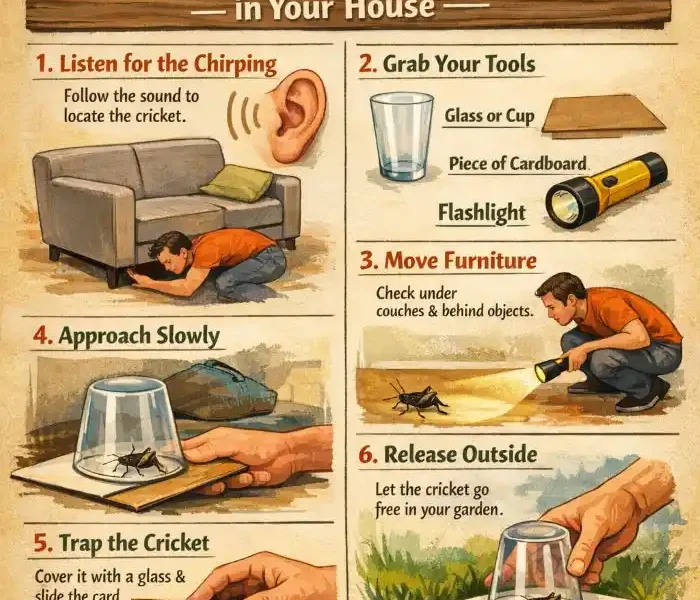
<p>Start by turning off anything that creates background noise. That means the TV, music, fans, or loud appliances if possible. Then pause and listen carefully. If the cricket is chirping, do not rush toward the sound right away. Stand still for a moment and try to figure out which direction it is coming from.</p>
<p>Sound can bounce around a room, especially in hallways, kitchens, and spaces with hard floors. So you may need to listen from more than one spot. Move slowly and stop often. The goal is to <strong>narrow the sound to one part of the room</strong>, not to chase it immediately.</p>
<p>Crickets often chirp more at night, which actually works in your favor. Late evening or nighttime is usually the best time to locate one because the house is quieter and the cricket is more active.</p>
<h3 id="turn-off-bright-lights">Turn Off Bright Lights</h3>
<p>Crickets prefer darker areas. If every light in the room is on, the cricket may stay hidden and quiet. Try dimming the space or using a flashlight instead of overhead lighting. This makes it easier to spot movement along the floor, baseboards, and under furniture.</p>
<p>A flashlight is especially useful because it lets you check tight spaces without making too much noise or disturbance. Shine the beam slowly under couches, beds, shelves, tables, and appliances.</p>
<h3 id="check-the-most-likely-hiding-spots">Check the Most Likely Hiding Spots</h3>
<p>Once you know the general area, begin inspecting places where a cricket would naturally hide. Focus on edges, shadows, and cluttered spaces. In most homes, the best places to check are:</p>
<ul>
<li><strong>Under furniture</strong></li>
<li><strong>Behind appliances</strong></li>
<li><strong>Along baseboards</strong></li>
<li><strong>Near door frames and windows</strong></li>
<li><strong>By sinks, drains, and damp corners</strong></li>
<li><strong>Inside laundry areas or utility rooms</strong></li>
<li><strong>In basements and garages</strong></li>
</ul>
<p>Crickets like to stay near surfaces rather than out in the open. That means you should pay close attention to the line where the floor meets the wall. They often travel along edges because it keeps them hidden.</p>
<h3 id="move-slowly-and-carefully">Move Slowly and Carefully</h3>
<p>This part matters more than people realize. If you stomp around, drag furniture, or make sudden movements, the cricket will likely jump or run to a new hiding place. Slow, quiet movement gives you a much better chance of catching it on the first try.</p>
<p>If you need to move a chair or small piece of furniture, do it gently. If the cricket jumps, try to keep your eyes on it rather than lunging. Many people lose it because they react too fast.</p>
<h3 id="use-a-simple-search-routine">Use a Simple Search Routine</h3>
<p>If you want a more organized way to find it, use this order:</p>
<ol>
<li><strong>Listen for the chirping</strong></li>
<li><strong>Narrow the sound to one room</strong></li>
<li><strong>Dim the lights</strong></li>
<li><strong>Use a flashlight</strong></li>
<li><strong>Search low, dark, hidden areas first</strong></li>
<li><strong>Pause often and listen again</strong></li>
</ol>
<p>That simple routine can save you a lot of frustration.</p>
<h3 id="be-patient">Be Patient</h3>
<p>A cricket may go quiet the moment you enter the room. That does not mean it left. It usually means it senses movement. Wait a few minutes. Stay still. In many cases, the chirping starts again once the cricket feels safe.</p>
<p>This is where patience gives you a real advantage. Instead of treating it like a race, think of it like a quiet observation game. The less you disturb the space, the easier it becomes to <strong>remove crickets from house areas</strong> without turning everything upside down.</p>
<h2 id="fastest-ways-to-catch-a-cricket">Fastest Ways to Catch a Cricket</h2>
<p>Once you find the cricket, you want a method that is simple, quick, and low-stress. Some people prefer to catch and release it. Others just want the easiest possible removal. The right method depends on where the cricket is, how visible it is, and how comfortable you are getting close to it.</p>
<p>Below are the fastest and most practical ways to catch one indoors.</p>
<h3 id="use-a-glass-and-paper-method">Use a Glass and Paper Method</h3>
<p>This is one of the oldest and easiest tricks, and it still works very well. If the cricket is sitting still on a floor, wall edge, or smooth surface, you can often trap it with a <strong>drinking glass, container, or clear cup</strong>.</p>
<h4 id="how-it-works">How It Works</h4>
<p>You place the glass over the cricket slowly. Then you slide a stiff piece of paper, cardboard, or thin magazine cover underneath the glass opening. Once the paper is fully under the rim, the cricket is trapped inside.</p>
<p>After that, you simply carry it outside and release it away from the house.</p>
<h4 id="step-by-step">Step-by-Step</h4>
<ol>
<li>Approach slowly and quietly.</li>
<li>Hold the glass above the cricket.</li>
<li>Lower it in one smooth motion.</li>
<li>Slide paper under the rim carefully.</li>
<li>Keep the paper flat and secure.</li>
<li>Take the cricket outside and release it.</li>
</ol>
<h4 id="why-this-method-works-so-well">Why This Method Works So Well</h4>
<p>It is fast, clean, and does not require bait or setup time. It is especially useful when the cricket is clearly visible and not hidden in a deep corner.</p>
<p>It also lets you avoid touching the insect directly, which many people prefer.</p>
<h4 id="tips-for-better-results">Tips for Better Results</h4>
<ul>
<li>Use a <strong>clear glass or plastic container</strong> so you can see the cricket.</li>
<li>Choose a <strong>stiff paper</strong> rather than a flimsy sheet.</li>
<li>Move slowly so the cricket does not jump at the last second.</li>
<li>If the cricket is on carpet, try to guide it to a harder surface first.</li>
</ul>
<p>This is often the best answer if someone asks for the quickest way to <strong>catch a cricket indoors without making a mess</strong>.</p>
<h3 id="set-a-sticky-trap">Set a Sticky Trap</h3>
<p>If the cricket keeps disappearing or you suspect there may be more than one, a <strong>sticky trap</strong> can be a very helpful option. These traps do the waiting for you.</p>
<h4 id="how-sticky-traps-work">How Sticky Traps Work</h4>
<p>A sticky trap is a flat surface coated with adhesive. You place it near areas where the cricket is active. When the cricket walks across it, it gets stuck.</p>
<p>These traps are useful when:</p>
<ul>
<li>You hear the cricket but cannot find it</li>
<li>The cricket is hiding in a cluttered room</li>
<li>You want to monitor activity overnight</li>
<li>You think there may be multiple crickets</li>
</ul>
<h4 id="where-to-place-them">Where to Place Them</h4>
<p>Set traps along walls and in spots where crickets are likely to travel. Good locations include:</p>
<ul>
<li><strong>Basements</strong></li>
<li><strong>Laundry rooms</strong></li>
<li><strong>Behind furniture</strong></li>
<li><strong>Near appliances</strong></li>
<li><strong>Garage corners</strong></li>
<li><strong>Along baseboards</strong></li>
<li><strong>Near doorways and utility openings</strong></li>
</ul>
<p>Crickets usually move along edges, so placing traps flat against the wall gives you the best chance of success.</p>
<h4 id="pros-of-sticky-traps">Pros of Sticky Traps</h4>
<p>They are easy to use and require very little effort once placed. They also help you confirm whether the problem is one cricket or several.</p>
<h4 id="things-to-keep-in-mind">Things to Keep in Mind</h4>
<p>Sticky traps should be placed where <strong>children and pets cannot reach them</strong>. You also need to check them regularly. If one catches a cricket, remove and dispose of it promptly.</p>
<p>If you want a low-effort <strong>cricket trap</strong> that works while you sleep, this is one of the strongest choices.</p>
<h3 id="try-a-jar-trap">Try a Jar Trap</h3>
<p>A jar trap is a simple homemade option that can work well when the cricket is active in one area but hard to grab directly.</p>
<h4 id="what-you-need">What You Need</h4>
<ul>
<li>A glass jar or smooth-sided container</li>
<li>A small bit of bait</li>
<li>A place to set it near cricket activity</li>
</ul>
<p>Crickets are curious and will move toward food or scent if the setup is inviting enough.</p>
<h4 id="how-to-set-it-up">How to Set It Up</h4>
<p>Place a little bait inside the jar and position it where you have heard or seen the cricket. You can leave the jar overnight in a dark area. Once the cricket enters, you can cover the jar and remove it.</p>
<p>The jar works best if the inside walls are smooth enough that the cricket cannot climb back out easily.</p>
<h4 id="good-places-for-a-jar-trap">Good Places for a Jar Trap</h4>
<ul>
<li>Near baseboards</li>
<li>In dark room corners</li>
<li>By a laundry area</li>
<li>Under a shelf</li>
<li>Near a known chirping spot</li>
</ul>
<h4 id="why-people-like-this-method">Why People Like This Method</h4>
<p>It is simple, inexpensive, and easy to make with items you already have at home. It is also a good choice if you do not want to chase the cricket around the room.</p>
<h3 id="compare-the-fastest-catching-methods">Compare the Fastest Catching Methods</h3>
<p>Here is a quick side-by-side look at the most useful options:</p>
<table>
<thead>
<tr>
<th>Method</th>
<th>Best For</th>
<th>Speed</th>
<th>Mess Level</th>
<th>Catch-and-Release Friendly</th>
<th>Effort Needed</th>
</tr>
</thead>
<tbody>
<tr>
<td>Glass and paper</td>
<td>Visible single cricket</td>
<td>Fast</td>
<td>Low</td>
<td>Yes</td>
<td>Low</td>
</tr>
<tr>
<td>Sticky trap</td>
<td>Hidden or multiple crickets</td>
<td>Medium</td>
<td>Low</td>
<td>No</td>
<td>Very low</td>
</tr>
<tr>
<td>Jar trap</td>
<td>Night activity in one area</td>
<td>Medium</td>
<td>Low</td>
<td>Usually yes</td>
<td>Low</td>
</tr>
<tr>
<td>Vacuum method</td>
<td>Quick cleanup when visible</td>
<td>Very fast</td>
<td>Medium</td>
<td>No</td>
<td>Low</td>
</tr>
</tbody>
</table>
<h3 id="choose-based-on-the-situation">Choose Based on the Situation</h3>
<p>You do not need one perfect method for every case. Use the method that fits what is happening in your home.</p>
<p>If the cricket is right there in front of you, the <strong>glass and paper</strong> approach is hard to beat.</p>
<p>If it vanishes every time you get close, use a <strong>sticky trap</strong> or <strong>jar trap</strong>.</p>
<p>If you just want immediate removal and do not want to deal with a container, the <strong>vacuum method</strong> may be the easiest.</p>
<p>The smartest move is often to combine methods. For example, search for the cricket at night, try the glass method if you spot it, and leave sticky traps nearby if it escapes again. That gives you both an immediate and a backup solution.</p>
<h2 id="natural-diy-methods">Natural DIY Methods</h2>
<p>If you prefer simple home solutions, there are several DIY methods that can help you catch or remove a cricket without making things complicated. These are especially useful when you want a low-cost option or do not have store-bought traps on hand.</p>
<h3 id="molasses-trap">Molasses Trap</h3>
<p>A molasses trap is a classic homemade idea because the sweet smell can attract crickets.</p>
<h4 id="how-to-make-it">How to Make It</h4>
<p>Take a jar, bowl, or deep container and add a small amount of <strong>molasses mixed with water</strong>. The scent can draw crickets toward the trap, especially in dark, quiet areas at night.</p>
<p>Place the trap near the spot where you have heard chirping or seen movement. Leave it overnight and check it in the morning.</p>
<h4 id="why-it-can-help">Why It Can Help</h4>
<p>The main benefit is that it is easy to make from basic kitchen supplies. You do not need special equipment, and you can set up more than one if needed.</p>
<h4 id="best-places-to-use-it">Best Places to Use It</h4>
<ul>
<li>Basement corners</li>
<li>Laundry room floors</li>
<li>Behind storage bins</li>
<li>Along garage walls</li>
<li>Near baseboards in quiet rooms</li>
</ul>
<p>This option works best when the cricket is active but not easy to catch by hand.</p>
<h3 id="soap-and-water-trap">Soap and Water Trap</h3>
<p>A shallow dish with soapy water is another low-cost option. It is simple, quick, and easy to place near likely hiding spots.</p>
<h4 id="how-to-set-it-up">How to Set It Up</h4>
<p>Fill a shallow bowl or dish with water and add a little dish soap. Set it on the floor near dark corners, walls, or damp areas where the cricket may travel.</p>
<p>The soap changes the surface tension of the water, which makes it harder for insects to stay afloat.</p>
<h4 id="when-to-use-it">When to Use It</h4>
<p>This method can help if you want an easy trap using things already in your home. It is not always the most immediate method, but it can work quietly in the background while you do other things.</p>
<h4 id="important-note">Important Note</h4>
<p>Keep this kind of trap away from pets and young children. Even simple homemade traps should be placed carefully.</p>
<h3 id="vacuum-method">Vacuum Method</h3>
<p>If the cricket is visible and you want the fastest removal possible, the vacuum method can be very effective.</p>
<h4 id="how-it-works">How It Works</h4>
<p>Use a vacuum hose attachment to quickly suck up the cricket when it appears. This is especially useful if the cricket is in a hard-to-reach spot like under a chair, near a baseboard, or behind a small piece of furniture.</p>
<h4 id="why-people-use-it">Why People Use It</h4>
<p>It is fast. There is no trap to build and no need to get very close with your hands.</p>
<p>This can be a practical solution if:</p>
<ul>
<li>You spot the cricket suddenly</li>
<li>You do not want to chase it</li>
<li>You want immediate removal</li>
<li>The cricket is in one contained area</li>
</ul>
<h4 id="what-to-do-afterward">What to Do Afterward</h4>
<p>If you use a vacuum, <strong>empty it right away</strong>. That step matters. You do not want the cricket remaining inside the vacuum bag or canister, especially if you are dealing with more than one insect.</p>
<h3 id="which-diy-method-is-best-">Which DIY Method Is Best?</h3>
<p>That depends on your goal.</p>
<p>If you want a passive trap, try <strong>molasses</strong> or <strong>soap and water</strong>.</p>
<p>If you want immediate action, use the <strong>vacuum method</strong>.</p>
<p>If you want a humane option, the <strong>glass and paper method</strong> from the earlier section is still the better choice.</p>
<p>The biggest advantage of DIY methods is flexibility. You can use what you already have at home and adjust based on how stubborn the cricket is being.</p>
<h2 id="best-places-to-look-for-crickets">Best Places to Look for Crickets</h2>
<p>When you are trying to <strong>remove crickets from house spaces</strong>, location matters just as much as method. Many people waste time searching open areas when the cricket is almost always hiding somewhere low, dark, and protected.</p>
<p>Crickets like edges, cover, and moisture. So instead of scanning the middle of the room, focus on the places that naturally give them shelter.</p>
<h3 id="the-most-common-indoor-hiding-spots">The Most Common Indoor Hiding Spots</h3>
<p>Start with these areas first:</p>
<ul>
<li><strong>Under appliances</strong></li>
<li><strong>Behind furniture</strong></li>
<li><strong>Inside basements and garages</strong></li>
<li><strong>Near sinks and drains</strong></li>
<li><strong>Around laundry machines</strong></li>
<li><strong>Along baseboards</strong></li>
<li><strong>Near windows and doors</strong></li>
<li><strong>Around utility entry points</strong></li>
</ul>
<p>A cricket may hide under the refrigerator, behind a washing machine, under a sofa, or beside a stack of storage boxes. These places stay quiet and undisturbed, which makes them ideal from the cricket’s point of view.</p>
<h3 id="damp-areas-need-extra-attention">Damp Areas Need Extra Attention</h3>
<p>If one part of your home tends to feel humid or slightly wet, check there carefully. This includes:</p>
<ul>
<li>Bathroom corners</li>
<li>Under sinks</li>
<li>Near water heaters</li>
<li>Basement walls</li>
<li>Mudrooms</li>
<li>Laundry spaces</li>
</ul>
<p>Even if the cricket wandered into another room later, damp areas are often where it first settled.</p>
<h3 id="why-edges-matter">Why Edges Matter</h3>
<p>Crickets usually prefer to move <strong>along walls instead of across open floors</strong>. That means your best chance of finding one is often at the edge of a room, not in the center.</p>
<p>So when you search, follow the wall line with a flashlight. Go slowly. Look into every shadow and gap.</p>
<p>If you are setting a <strong>cricket trap</strong>, these same areas are also the best places to put it.</p>
<h2 id="how-to-prevent-crickets-from-coming-back">How to Prevent Crickets from Coming Back</h2>
<p>Catching one cricket solves tonight’s problem. Prevention solves next week’s problem.</p>
<p>If you only remove the cricket but leave the cause untouched, another one may show up later. That is why prevention matters just as much as learning <strong>how to catch a cricket in your house</strong> in the first place.</p>
<p>The good news is that prevention does not need to be complicated. A few practical home habits can make a big difference.</p>
<h3 id="seal-entry-points">Seal Entry Points</h3>
<p>One of the smartest things you can do is block the ways crickets get inside.</p>
<h4 id="check-doors-and-windows">Check Doors and Windows</h4>
<p>Look for gaps around door frames, window edges, and sliding doors. Even small openings can be enough for insects to enter.</p>
<p>Use:</p>
<ul>
<li><strong>Weatherstripping</strong></li>
<li><strong>Door sweeps</strong></li>
<li><strong>Caulk</strong></li>
<li><strong>Screen repair patches</strong></li>
</ul>
<p>A door sweep is especially useful if you notice light or airflow under an exterior door. That gap is not just letting in air. It may also be inviting insects.</p>
<h4 id="inspect-the-foundation-and-wall-openings">Inspect the Foundation and Wall Openings</h4>
<p>Walk around the outside of your home and look at the base of the walls. Check for cracks in the foundation, gaps where pipes enter, or spaces around cable lines and vents.</p>
<p>These small openings often go unnoticed for a long time. Sealing them helps with more than crickets. It can also reduce drafts and keep out other pests.</p>
<h3 id="reduce-moisture">Reduce Moisture</h3>
<p>Because crickets are attracted to damp spaces, moisture control is one of the most effective long-term steps.</p>
<h4 id="fix-leaks-quickly">Fix Leaks Quickly</h4>
<p>A dripping pipe under the sink or a slow leak behind a washing machine may not seem urgent, but it creates the kind of environment insects like.</p>
<p>Check for:</p>
<ul>
<li>Dripping faucets</li>
<li>Pipe leaks</li>
<li>Condensation around appliances</li>
<li>Damp basement corners</li>
<li>Poorly ventilated bathrooms</li>
</ul>
<h4 id="use-a-dehumidifier-if-needed">Use a Dehumidifier if Needed</h4>
<p>If your basement, laundry room, or bathroom always feels humid, a dehumidifier can help dry the space out. Even a small improvement in moisture levels can make the area less attractive to crickets.</p>
<h4 id="improve-airflow">Improve Airflow</h4>
<p>Open windows when appropriate, use bathroom exhaust fans, and avoid letting wet towels or laundry sit too long in enclosed spaces.</p>
<p>Dry spaces are less inviting. It is that simple.</p>
<h3 id="remove-outdoor-attractions">Remove Outdoor Attractions</h3>
<p>Prevention starts outside too. If the space around your home gives crickets everything they need, they are more likely to wander in.</p>
<h4 id="cut-down-on-clutter">Cut Down on Clutter</h4>
<p>Remove piles of leaves, stacked wood, thick mulch against the house, overgrown plants, and outdoor clutter near the foundation. These areas create hiding spots right next to your home.</p>
<p>The closer the shelter is to your doors and walls, the easier it is for a cricket to end up indoors.</p>
<h4 id="be-smart-with-lighting">Be Smart with Lighting</h4>
<p>Outdoor lights can draw insects toward entry points. If possible, reduce bright lighting directly beside doors, or switch to less attractive bulb types if insect activity is high in your area.</p>
<h4 id="keep-the-perimeter-tidy">Keep the Perimeter Tidy</h4>
<p>A clean outdoor edge around the house makes it harder for insects to settle close by. Trim plants, sweep debris, and avoid letting damp organic material build up against the walls.</p>
<h3 id="keep-indoor-spaces-less-inviting">Keep Indoor Spaces Less Inviting</h3>
<p>Crickets are more likely to stay if your home gives them food, cover, and quiet hiding places.</p>
<h4 id="clean-up-crumbs-and-food-scraps">Clean Up Crumbs and Food Scraps</h4>
<p>Vacuum regularly, especially near the kitchen and dining area. Do not leave pet food out overnight if insect activity is a problem. Wipe counters and sweep corners where crumbs collect.</p>
<h4 id="reduce-clutter">Reduce Clutter</h4>
<p>Storage piles, cardboard boxes, laundry heaps, and unused items on the floor create easy hiding places. The more open and tidy a room is, the fewer places a cricket has to stay hidden.</p>
<h4 id="watch-fabric-and-paper-storage">Watch Fabric and Paper Storage</h4>
<p>Crickets can shelter around stored paper, fabric, and soft clutter. Keep these items organized and dry.</p>
<h3 id="build-a-simple-prevention-routine">Build a Simple Prevention Routine</h3>
<p>You do not need to do everything in one day. Start with a practical checklist:</p>
<table>
<thead>
<tr>
<th>Prevention Task</th>
<th>Why It Helps</th>
<th>How Often</th>
</tr>
</thead>
<tbody>
<tr>
<td>Seal door and window gaps</td>
<td>Blocks entry points</td>
<td>Check seasonally</td>
</tr>
<tr>
<td>Fix leaks</td>
<td>Reduces moisture attraction</td>
<td>As soon as found</td>
</tr>
<tr>
<td>Use a dehumidifier</td>
<td>Keeps damp rooms drier</td>
<td>Ongoing in humid areas</td>
</tr>
<tr>
<td>Clean crumbs and food debris</td>
<td>Removes food sources</td>
<td>Daily or weekly</td>
</tr>
<tr>
<td>Reduce clutter</td>
<td>Removes hiding spots</td>
<td>Weekly</td>
</tr>
<tr>
<td>Clear outdoor debris</td>
<td>Lowers outdoor shelter near the home</td>
<td>Monthly or seasonally</td>
</tr>
</tbody>
</table>
<p>The best prevention plans are the ones you can actually maintain. Small habits work better than big one-time efforts that never get repeated.</p>
<p>If you seal gaps, dry out damp spaces, clean regularly, and keep the area around your home tidy, you make it much harder for crickets to settle in.</p>
<h2 id="when-to-use-a-professional">When to Use a Professional</h2>
<p>In many cases, one cricket in the house is just that: <strong>one cricket</strong>. You catch it, clean up a few problem spots, and move on.</p>
<p>But sometimes the issue feels bigger. If you keep hearing chirping night after night, find crickets in several rooms, or notice repeated activity in damp areas, it may be time to consider professional help.</p>
<p>A pest control professional can be useful when:</p>
<ul>
<li>You see <strong>multiple crickets often</strong></li>
<li>Chirping keeps returning after removal</li>
<li>You suspect a larger hidden pest issue</li>
<li>There are moisture problems you cannot solve easily</li>
<li>The home has many visible entry points</li>
<li>The infestation seems concentrated in a basement, crawl space, or garage</li>
</ul>
<p>Professional help may also be worth it if you are dealing with a house that has long-term dampness, foundation gaps, or cluttered utility areas where insects can keep returning.</p>
<p>In short, if your cricket problem feels persistent instead of occasional, expert help can save time and frustration.</p>
<h2 id="safety-tips-for-catching-crickets">Safety Tips for Catching Crickets</h2>
<p>Catching a cricket is usually a low-risk task, but it still helps to be careful.</p>
<h3 id="avoid-harsh-chemical-sprays-first">Avoid Harsh Chemical Sprays First</h3>
<p>In most cases, you do not need strong chemicals to deal with one or two crickets. A glass, jar, sticky trap, or vacuum is usually enough. Sprays can create unnecessary mess, odor, and exposure in living spaces.</p>
<h3 id="be-careful-around-furniture-and-appliances">Be Careful Around Furniture and Appliances</h3>
<p>If you are checking behind a couch, refrigerator, washer, or shelf, move items slowly and safely. Do not strain yourself, and do not pull heavy appliances out too far unless you know how to do it safely.</p>
<h3 id="place-traps-thoughtfully">Place Traps Thoughtfully</h3>
<p>Sticky traps, bait jars, and water traps should be placed where <strong>pets and children cannot reach them</strong>. Even simple traps can become messy or unsafe if knocked over.</p>
<h3 id="protect-your-hands-if-needed">Protect Your Hands if Needed</h3>
<p>If you are uncomfortable handling containers or cleaning up traps, wear gloves. This is especially useful when dealing with sticky surfaces or vacuum cleanup.</p>
<h3 id="stay-calm">Stay Calm</h3>
<p>This may sound obvious, but it really matters. Crickets are startling when they jump unexpectedly, but they are usually more annoying than dangerous. A calm, slow approach is the best way to catch one cleanly and quickly.</p>
<h2 id="frequently-asked-questions">Frequently Asked Questions</h2>
<h2 id="how-do-i-catch-a-cricket-in-my-house-at-night-">How do I catch a cricket in my house at night?</h2>
<p>The easiest way is to <strong>turn off background noise, listen for chirping, and use a flashlight</strong> to locate the cricket. Once you find it, use a glass and paper method, a vacuum, or place a sticky trap near the area.</p>
<p>Night is often the best time because crickets are more active and easier to hear.</p>
<h3 id="what-is-the-easiest-cricket-trap-to-make-at-home-">What is the easiest cricket trap to make at home?</h3>
<p>A <strong>jar trap</strong> or a <strong>molasses trap</strong> is usually the easiest homemade option. Both use simple household items and can be set near walls or in dark corners overnight.</p>
<h3 id="why-is-there-a-cricket-in-my-bedroom-">Why is there a cricket in my bedroom?</h3>
<p>A cricket may wander into a bedroom because it entered through a nearby gap and found a quiet place to hide. Bedrooms can also offer dark corners under furniture, especially if the room stays quiet and undisturbed at night.</p>
<h3 id="do-crickets-mean-my-house-is-too-damp-">Do crickets mean my house is too damp?</h3>
<p>Not always, but dampness can definitely make a home more attractive to crickets. If you keep finding them in bathrooms, basements, or laundry rooms, moisture may be part of the problem.</p>
<h3 id="how-do-i-stop-crickets-from-coming-back-">How do I stop crickets from coming back?</h3>
<p>The best way is to combine <strong>removal and prevention</strong>. Catch the current cricket, then seal entry points, reduce moisture, clean up food debris, and clear clutter indoors and outdoors.</p>
<h2 id="conclusion">Conclusion</h2>
<p>If you are trying to figure out <strong>how to catch a cricket in your house</strong>, the simplest answer is this: <strong>find the sound, search the right hiding spots, and use an easy method that fits the situation</strong>.</p>
<p>If the cricket is visible, use the <strong>glass and paper method</strong>. If it keeps disappearing, try a <strong>sticky trap</strong> or <strong>jar trap</strong>. If you want fast cleanup, use a <strong>vacuum</strong>. Homemade options like <strong>molasses traps</strong> and <strong>soap-and-water traps</strong> can also help when you want a simple DIY solution.</p>
<p>Just as important, do not stop at removal. If you want lasting results, seal gaps, reduce moisture, clean up clutter, and make your home less inviting to future pests.</p>
<p>A quiet house usually starts with a few practical steps. Take them one at a time, and you can <strong>catch a cricket indoors</strong>, remove the problem, and keep the chirping from coming back.</p>
<p><a href="https://comeawayhome.co.uk/">House</a></p>
If you have ever been kept awake by a steady chirp… chirp… chirp somewhere in the room, you already know how frustrating a single cricket can be. It is small, quick, and surprisingly hard to find. Most of the time, you hear it long before you see it. And somehow, the moment you move closer, it goes silent.
That is exactly why so many people search for how to catch a cricket in your house. The problem is not always a big infestation. Sometimes it is just one cricket that slipped inside through a small gap under a door, around a window, or near a utility opening. Still, even one cricket can feel like a much bigger issue when it keeps you up at night or jumps out from under the couch.
Crickets often move toward places that feel safe to them. That usually means dark corners, damp spots, cluttered areas, and quiet rooms where they can hide during the day. Basements, laundry rooms, garages, kitchens, and bathrooms are all common places to check. If the house has moisture problems or easy access points, crickets may find it even more inviting.
The good news is that catching one is usually very doable. You do not need to panic, and you do not need to turn your house upside down. With the right approach, you can find the cricket, catch it safely, and stop more from getting inside later.
In this guide, you will learn simple methods that really make sense in everyday life. We will cover how to locate the cricket, the fastest ways to catch it, easy homemade trap ideas, the best places to look, and practical prevention steps. If you want a clear, no-nonsense plan to catch a cricket indoors and keep your home quieter, you are in the right place.
What Attracts Crickets Indoors?
Before you catch the cricket, it helps to understand why it came inside in the first place. That makes the current problem easier to solve and future problems easier to prevent.
Crickets do not enter homes just to annoy people. They usually come in because the space offers something they want. In many houses, that means shelter, warmth, moisture, and easy hiding spots. Your home may feel dry and comfortable to you, but to a cricket, even a slightly damp laundry room or a dark space behind the fridge can feel like a perfect place to settle.
One big reason crickets come inside is moisture. Damp spaces tend to attract all kinds of insects, and crickets are no exception. If you have a leaky pipe, a wet basement corner, condensation near appliances, or poor ventilation in a bathroom, those areas can become appealing. Moisture also creates a calmer environment where crickets can stay hidden without drying out.
Another reason is warmth. When outdoor temperatures shift, insects often look for more stable indoor conditions. A home offers that. Even in warmer seasons, a cricket may end up inside simply because it found an open path and stayed once it discovered safe cover.
Food can also play a role. Crickets are not picky. Small crumbs, food scraps, pet food, paper, fabric fibers, and organic debris can all help them survive. If you have cluttered storage boxes, dust buildup, or food left out overnight, you may be making the space more comfortable without realizing it.
Entry points matter too. Crickets do not need a wide-open door to get inside. They can come in through:
- Gaps under doors
- Cracks near windows
- Openings around pipes and wires
- Foundation cracks
- Torn screens
- Garage door edges
Once inside, they usually head straight for places where they will not be disturbed. That is why people often find them in basements, laundry rooms, garages, kitchens, closets, and rooms with large furniture or appliances.
And then there is the sound. One of the most useful clues a cricket gives you is its chirping. If you hear it at night, that noise can actually help you narrow down its location. In many cases, the sound is the only reason you realize there is a cricket in the house at all.
So if you are wondering why there is suddenly a cricket near your bedroom, in the hallway, or under the couch, the answer is usually simple: your house gave it moisture, cover, or a convenient way in. Once you understand that, you can solve the issue in a much smarter way.
How to Find the Cricket in Your House
Finding the cricket is often the hardest part. Catching it can be easy once you know where it is. The real challenge is that crickets are excellent at staying out of sight. They are small, fast, and usually active when your house is quiet.
The best approach is to work with their habits instead of against them.
Listen Before You Search
Start by turning off anything that creates background noise. That means the TV, music, fans, or loud appliances if possible. Then pause and listen carefully. If the cricket is chirping, do not rush toward the sound right away. Stand still for a moment and try to figure out which direction it is coming from.
Sound can bounce around a room, especially in hallways, kitchens, and spaces with hard floors. So you may need to listen from more than one spot. Move slowly and stop often. The goal is to narrow the sound to one part of the room, not to chase it immediately.
Crickets often chirp more at night, which actually works in your favor. Late evening or nighttime is usually the best time to locate one because the house is quieter and the cricket is more active.
Turn Off Bright Lights
Crickets prefer darker areas. If every light in the room is on, the cricket may stay hidden and quiet. Try dimming the space or using a flashlight instead of overhead lighting. This makes it easier to spot movement along the floor, baseboards, and under furniture.
A flashlight is especially useful because it lets you check tight spaces without making too much noise or disturbance. Shine the beam slowly under couches, beds, shelves, tables, and appliances.
Check the Most Likely Hiding Spots
Once you know the general area, begin inspecting places where a cricket would naturally hide. Focus on edges, shadows, and cluttered spaces. In most homes, the best places to check are:
- Under furniture
- Behind appliances
- Along baseboards
- Near door frames and windows
- By sinks, drains, and damp corners
- Inside laundry areas or utility rooms
- In basements and garages
Crickets like to stay near surfaces rather than out in the open. That means you should pay close attention to the line where the floor meets the wall. They often travel along edges because it keeps them hidden.
Move Slowly and Carefully
This part matters more than people realize. If you stomp around, drag furniture, or make sudden movements, the cricket will likely jump or run to a new hiding place. Slow, quiet movement gives you a much better chance of catching it on the first try.
If you need to move a chair or small piece of furniture, do it gently. If the cricket jumps, try to keep your eyes on it rather than lunging. Many people lose it because they react too fast.
Use a Simple Search Routine
If you want a more organized way to find it, use this order:
- Listen for the chirping
- Narrow the sound to one room
- Dim the lights
- Use a flashlight
- Search low, dark, hidden areas first
- Pause often and listen again
That simple routine can save you a lot of frustration.
Be Patient
A cricket may go quiet the moment you enter the room. That does not mean it left. It usually means it senses movement. Wait a few minutes. Stay still. In many cases, the chirping starts again once the cricket feels safe.
This is where patience gives you a real advantage. Instead of treating it like a race, think of it like a quiet observation game. The less you disturb the space, the easier it becomes to remove crickets from house areas without turning everything upside down.
Fastest Ways to Catch a Cricket
Once you find the cricket, you want a method that is simple, quick, and low-stress. Some people prefer to catch and release it. Others just want the easiest possible removal. The right method depends on where the cricket is, how visible it is, and how comfortable you are getting close to it.
Below are the fastest and most practical ways to catch one indoors.
Use a Glass and Paper Method
This is one of the oldest and easiest tricks, and it still works very well. If the cricket is sitting still on a floor, wall edge, or smooth surface, you can often trap it with a drinking glass, container, or clear cup.
How It Works
You place the glass over the cricket slowly. Then you slide a stiff piece of paper, cardboard, or thin magazine cover underneath the glass opening. Once the paper is fully under the rim, the cricket is trapped inside.
After that, you simply carry it outside and release it away from the house.
Step-by-Step
- Approach slowly and quietly.
- Hold the glass above the cricket.
- Lower it in one smooth motion.
- Slide paper under the rim carefully.
- Keep the paper flat and secure.
- Take the cricket outside and release it.
Why This Method Works So Well
It is fast, clean, and does not require bait or setup time. It is especially useful when the cricket is clearly visible and not hidden in a deep corner.
It also lets you avoid touching the insect directly, which many people prefer.
Tips for Better Results
- Use a clear glass or plastic container so you can see the cricket.
- Choose a stiff paper rather than a flimsy sheet.
- Move slowly so the cricket does not jump at the last second.
- If the cricket is on carpet, try to guide it to a harder surface first.
This is often the best answer if someone asks for the quickest way to catch a cricket indoors without making a mess.
Set a Sticky Trap
If the cricket keeps disappearing or you suspect there may be more than one, a sticky trap can be a very helpful option. These traps do the waiting for you.
How Sticky Traps Work
A sticky trap is a flat surface coated with adhesive. You place it near areas where the cricket is active. When the cricket walks across it, it gets stuck.
These traps are useful when:
- You hear the cricket but cannot find it
- The cricket is hiding in a cluttered room
- You want to monitor activity overnight
- You think there may be multiple crickets
Where to Place Them
Set traps along walls and in spots where crickets are likely to travel. Good locations include:
- Basements
- Laundry rooms
- Behind furniture
- Near appliances
- Garage corners
- Along baseboards
- Near doorways and utility openings
Crickets usually move along edges, so placing traps flat against the wall gives you the best chance of success.
Pros of Sticky Traps
They are easy to use and require very little effort once placed. They also help you confirm whether the problem is one cricket or several.
Things to Keep in Mind
Sticky traps should be placed where children and pets cannot reach them. You also need to check them regularly. If one catches a cricket, remove and dispose of it promptly.
If you want a low-effort cricket trap that works while you sleep, this is one of the strongest choices.
Try a Jar Trap
A jar trap is a simple homemade option that can work well when the cricket is active in one area but hard to grab directly.
What You Need
- A glass jar or smooth-sided container
- A small bit of bait
- A place to set it near cricket activity
Crickets are curious and will move toward food or scent if the setup is inviting enough.
How to Set It Up
Place a little bait inside the jar and position it where you have heard or seen the cricket. You can leave the jar overnight in a dark area. Once the cricket enters, you can cover the jar and remove it.
The jar works best if the inside walls are smooth enough that the cricket cannot climb back out easily.
Good Places for a Jar Trap
- Near baseboards
- In dark room corners
- By a laundry area
- Under a shelf
- Near a known chirping spot
Why People Like This Method
It is simple, inexpensive, and easy to make with items you already have at home. It is also a good choice if you do not want to chase the cricket around the room.
Compare the Fastest Catching Methods
Here is a quick side-by-side look at the most useful options:
| Method |
Best For |
Speed |
Mess Level |
Catch-and-Release Friendly |
Effort Needed |
| Glass and paper |
Visible single cricket |
Fast |
Low |
Yes |
Low |
| Sticky trap |
Hidden or multiple crickets |
Medium |
Low |
No |
Very low |
| Jar trap |
Night activity in one area |
Medium |
Low |
Usually yes |
Low |
| Vacuum method |
Quick cleanup when visible |
Very fast |
Medium |
No |
Low |
Choose Based on the Situation
You do not need one perfect method for every case. Use the method that fits what is happening in your home.
If the cricket is right there in front of you, the glass and paper approach is hard to beat.
If it vanishes every time you get close, use a sticky trap or jar trap.
If you just want immediate removal and do not want to deal with a container, the vacuum method may be the easiest.
The smartest move is often to combine methods. For example, search for the cricket at night, try the glass method if you spot it, and leave sticky traps nearby if it escapes again. That gives you both an immediate and a backup solution.
Natural DIY Methods
If you prefer simple home solutions, there are several DIY methods that can help you catch or remove a cricket without making things complicated. These are especially useful when you want a low-cost option or do not have store-bought traps on hand.
Molasses Trap
A molasses trap is a classic homemade idea because the sweet smell can attract crickets.
How to Make It
Take a jar, bowl, or deep container and add a small amount of molasses mixed with water. The scent can draw crickets toward the trap, especially in dark, quiet areas at night.
Place the trap near the spot where you have heard chirping or seen movement. Leave it overnight and check it in the morning.
Why It Can Help
The main benefit is that it is easy to make from basic kitchen supplies. You do not need special equipment, and you can set up more than one if needed.
Best Places to Use It
- Basement corners
- Laundry room floors
- Behind storage bins
- Along garage walls
- Near baseboards in quiet rooms
This option works best when the cricket is active but not easy to catch by hand.
Soap and Water Trap
A shallow dish with soapy water is another low-cost option. It is simple, quick, and easy to place near likely hiding spots.
How to Set It Up
Fill a shallow bowl or dish with water and add a little dish soap. Set it on the floor near dark corners, walls, or damp areas where the cricket may travel.
The soap changes the surface tension of the water, which makes it harder for insects to stay afloat.
When to Use It
This method can help if you want an easy trap using things already in your home. It is not always the most immediate method, but it can work quietly in the background while you do other things.
Important Note
Keep this kind of trap away from pets and young children. Even simple homemade traps should be placed carefully.
Vacuum Method
If the cricket is visible and you want the fastest removal possible, the vacuum method can be very effective.
How It Works
Use a vacuum hose attachment to quickly suck up the cricket when it appears. This is especially useful if the cricket is in a hard-to-reach spot like under a chair, near a baseboard, or behind a small piece of furniture.
Why People Use It
It is fast. There is no trap to build and no need to get very close with your hands.
This can be a practical solution if:
- You spot the cricket suddenly
- You do not want to chase it
- You want immediate removal
- The cricket is in one contained area
What to Do Afterward
If you use a vacuum, empty it right away. That step matters. You do not want the cricket remaining inside the vacuum bag or canister, especially if you are dealing with more than one insect.
Which DIY Method Is Best?
That depends on your goal.
If you want a passive trap, try molasses or soap and water.
If you want immediate action, use the vacuum method.
If you want a humane option, the glass and paper method from the earlier section is still the better choice.
The biggest advantage of DIY methods is flexibility. You can use what you already have at home and adjust based on how stubborn the cricket is being.
Best Places to Look for Crickets
When you are trying to remove crickets from house spaces, location matters just as much as method. Many people waste time searching open areas when the cricket is almost always hiding somewhere low, dark, and protected.
Crickets like edges, cover, and moisture. So instead of scanning the middle of the room, focus on the places that naturally give them shelter.
The Most Common Indoor Hiding Spots
Start with these areas first:
- Under appliances
- Behind furniture
- Inside basements and garages
- Near sinks and drains
- Around laundry machines
- Along baseboards
- Near windows and doors
- Around utility entry points
A cricket may hide under the refrigerator, behind a washing machine, under a sofa, or beside a stack of storage boxes. These places stay quiet and undisturbed, which makes them ideal from the cricket’s point of view.
If one part of your home tends to feel humid or slightly wet, check there carefully. This includes:
- Bathroom corners
- Under sinks
- Near water heaters
- Basement walls
- Mudrooms
- Laundry spaces
Even if the cricket wandered into another room later, damp areas are often where it first settled.
Why Edges Matter
Crickets usually prefer to move along walls instead of across open floors. That means your best chance of finding one is often at the edge of a room, not in the center.
So when you search, follow the wall line with a flashlight. Go slowly. Look into every shadow and gap.
If you are setting a cricket trap, these same areas are also the best places to put it.
How to Prevent Crickets from Coming Back
Catching one cricket solves tonight’s problem. Prevention solves next week’s problem.
If you only remove the cricket but leave the cause untouched, another one may show up later. That is why prevention matters just as much as learning how to catch a cricket in your house in the first place.
The good news is that prevention does not need to be complicated. A few practical home habits can make a big difference.
Seal Entry Points
One of the smartest things you can do is block the ways crickets get inside.
Check Doors and Windows
Look for gaps around door frames, window edges, and sliding doors. Even small openings can be enough for insects to enter.
Use:
- Weatherstripping
- Door sweeps
- Caulk
- Screen repair patches
A door sweep is especially useful if you notice light or airflow under an exterior door. That gap is not just letting in air. It may also be inviting insects.
Inspect the Foundation and Wall Openings
Walk around the outside of your home and look at the base of the walls. Check for cracks in the foundation, gaps where pipes enter, or spaces around cable lines and vents.
These small openings often go unnoticed for a long time. Sealing them helps with more than crickets. It can also reduce drafts and keep out other pests.
Reduce Moisture
Because crickets are attracted to damp spaces, moisture control is one of the most effective long-term steps.
Fix Leaks Quickly
A dripping pipe under the sink or a slow leak behind a washing machine may not seem urgent, but it creates the kind of environment insects like.
Check for:
- Dripping faucets
- Pipe leaks
- Condensation around appliances
- Damp basement corners
- Poorly ventilated bathrooms
Use a Dehumidifier if Needed
If your basement, laundry room, or bathroom always feels humid, a dehumidifier can help dry the space out. Even a small improvement in moisture levels can make the area less attractive to crickets.
Improve Airflow
Open windows when appropriate, use bathroom exhaust fans, and avoid letting wet towels or laundry sit too long in enclosed spaces.
Dry spaces are less inviting. It is that simple.
Remove Outdoor Attractions
Prevention starts outside too. If the space around your home gives crickets everything they need, they are more likely to wander in.
Cut Down on Clutter
Remove piles of leaves, stacked wood, thick mulch against the house, overgrown plants, and outdoor clutter near the foundation. These areas create hiding spots right next to your home.
The closer the shelter is to your doors and walls, the easier it is for a cricket to end up indoors.
Be Smart with Lighting
Outdoor lights can draw insects toward entry points. If possible, reduce bright lighting directly beside doors, or switch to less attractive bulb types if insect activity is high in your area.
Keep the Perimeter Tidy
A clean outdoor edge around the house makes it harder for insects to settle close by. Trim plants, sweep debris, and avoid letting damp organic material build up against the walls.
Keep Indoor Spaces Less Inviting
Crickets are more likely to stay if your home gives them food, cover, and quiet hiding places.
Clean Up Crumbs and Food Scraps
Vacuum regularly, especially near the kitchen and dining area. Do not leave pet food out overnight if insect activity is a problem. Wipe counters and sweep corners where crumbs collect.
Reduce Clutter
Storage piles, cardboard boxes, laundry heaps, and unused items on the floor create easy hiding places. The more open and tidy a room is, the fewer places a cricket has to stay hidden.
Watch Fabric and Paper Storage
Crickets can shelter around stored paper, fabric, and soft clutter. Keep these items organized and dry.
Build a Simple Prevention Routine
You do not need to do everything in one day. Start with a practical checklist:
| Prevention Task |
Why It Helps |
How Often |
| Seal door and window gaps |
Blocks entry points |
Check seasonally |
| Fix leaks |
Reduces moisture attraction |
As soon as found |
| Use a dehumidifier |
Keeps damp rooms drier |
Ongoing in humid areas |
| Clean crumbs and food debris |
Removes food sources |
Daily or weekly |
| Reduce clutter |
Removes hiding spots |
Weekly |
| Clear outdoor debris |
Lowers outdoor shelter near the home |
Monthly or seasonally |
The best prevention plans are the ones you can actually maintain. Small habits work better than big one-time efforts that never get repeated.
If you seal gaps, dry out damp spaces, clean regularly, and keep the area around your home tidy, you make it much harder for crickets to settle in.
When to Use a Professional
In many cases, one cricket in the house is just that: one cricket. You catch it, clean up a few problem spots, and move on.
But sometimes the issue feels bigger. If you keep hearing chirping night after night, find crickets in several rooms, or notice repeated activity in damp areas, it may be time to consider professional help.
A pest control professional can be useful when:
- You see multiple crickets often
- Chirping keeps returning after removal
- You suspect a larger hidden pest issue
- There are moisture problems you cannot solve easily
- The home has many visible entry points
- The infestation seems concentrated in a basement, crawl space, or garage
Professional help may also be worth it if you are dealing with a house that has long-term dampness, foundation gaps, or cluttered utility areas where insects can keep returning.
In short, if your cricket problem feels persistent instead of occasional, expert help can save time and frustration.
Safety Tips for Catching Crickets
Catching a cricket is usually a low-risk task, but it still helps to be careful.
Avoid Harsh Chemical Sprays First
In most cases, you do not need strong chemicals to deal with one or two crickets. A glass, jar, sticky trap, or vacuum is usually enough. Sprays can create unnecessary mess, odor, and exposure in living spaces.
Be Careful Around Furniture and Appliances
If you are checking behind a couch, refrigerator, washer, or shelf, move items slowly and safely. Do not strain yourself, and do not pull heavy appliances out too far unless you know how to do it safely.
Place Traps Thoughtfully
Sticky traps, bait jars, and water traps should be placed where pets and children cannot reach them. Even simple traps can become messy or unsafe if knocked over.
Protect Your Hands if Needed
If you are uncomfortable handling containers or cleaning up traps, wear gloves. This is especially useful when dealing with sticky surfaces or vacuum cleanup.
Stay Calm
This may sound obvious, but it really matters. Crickets are startling when they jump unexpectedly, but they are usually more annoying than dangerous. A calm, slow approach is the best way to catch one cleanly and quickly.
Frequently Asked Questions
How do I catch a cricket in my house at night?
The easiest way is to turn off background noise, listen for chirping, and use a flashlight to locate the cricket. Once you find it, use a glass and paper method, a vacuum, or place a sticky trap near the area.
Night is often the best time because crickets are more active and easier to hear.
What is the easiest cricket trap to make at home?
A jar trap or a molasses trap is usually the easiest homemade option. Both use simple household items and can be set near walls or in dark corners overnight.
Why is there a cricket in my bedroom?
A cricket may wander into a bedroom because it entered through a nearby gap and found a quiet place to hide. Bedrooms can also offer dark corners under furniture, especially if the room stays quiet and undisturbed at night.
Do crickets mean my house is too damp?
Not always, but dampness can definitely make a home more attractive to crickets. If you keep finding them in bathrooms, basements, or laundry rooms, moisture may be part of the problem.
How do I stop crickets from coming back?
The best way is to combine removal and prevention. Catch the current cricket, then seal entry points, reduce moisture, clean up food debris, and clear clutter indoors and outdoors.
Conclusion
If you are trying to figure out how to catch a cricket in your house, the simplest answer is this: find the sound, search the right hiding spots, and use an easy method that fits the situation.
If the cricket is visible, use the glass and paper method. If it keeps disappearing, try a sticky trap or jar trap. If you want fast cleanup, use a vacuum. Homemade options like molasses traps and soap-and-water traps can also help when you want a simple DIY solution.
Just as important, do not stop at removal. If you want lasting results, seal gaps, reduce moisture, clean up clutter, and make your home less inviting to future pests.
A quiet house usually starts with a few practical steps. Take them one at a time, and you can catch a cricket indoors, remove the problem, and keep the chirping from coming back.
House