Imagine you are looking at the current housing market. It is the middle of 2026, and the real estate landscape has shifted dramatically over the past couple of years. As a licensed professional, you help clients buy and sell properties every single day. You know the local neighborhoods, you understand how to stage a living room to perfection, and you negotiate contracts in your sleep.
But now, you want to move. You are staring at your own property, doing the math on a standard 6% commission fee, and wondering if you really need to pay another professional to do the exact job you do for a living. You find yourself asking a very common question: Can a real estate agent sell their own home without breaking the rules?
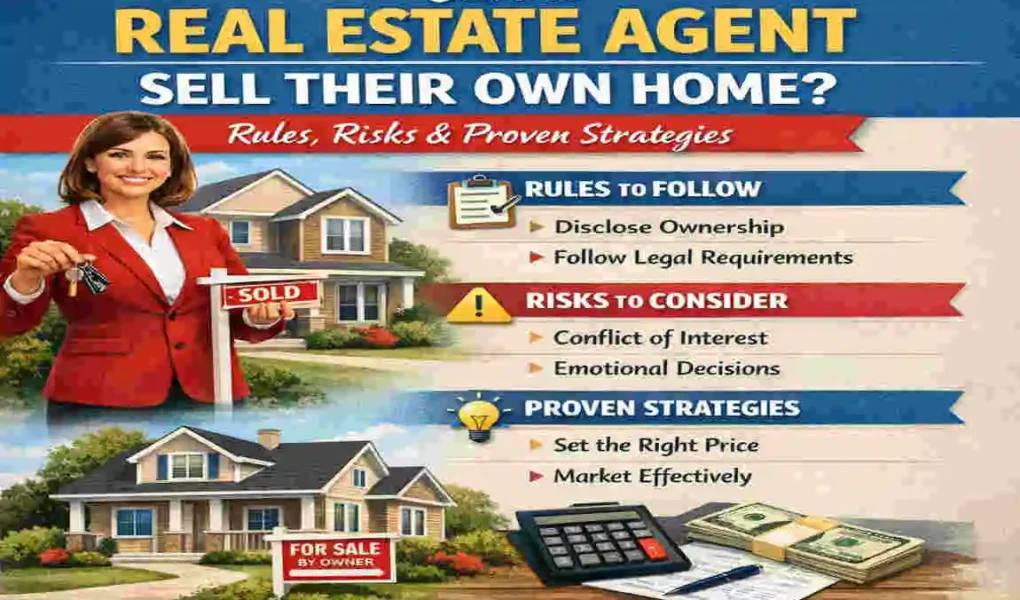
The short answer is yes. You absolutely can sell your own property. However, it is not as simple as just throwing a sign in your front yard and waiting for the offers to roll in. Because you hold a professional license, you are held to a much higher legal and ethical standard than the average homeowner.
| Aspect | Pros | Cons |
|---|---|---|
| Legality | Allowed in most states with disclosure | Varies by state; dual agency banned in 10+ states |
| Commissions | Save 2.5-3% seller’s side ($15K+ on $600K home) | May owe reduced fee to brokerage |
| MLS Access | List on MLS via brokerage | Broker approval often required |
| Risks | Professional marketing edge | Emotional bias, lawsuits from conflicts |
| Insurance | Standard tools available | Higher E&O liability; some forfeit coverage |
| 2026 Trends | Post-NAR: More self-sales viable | Buyer agent agreements add complexity |
Can Real Estate Agents Legally Sell Their Own Homes?

Let us dive right into the legalities. When you ask, “Can a real estate agent sell their own home?” the law generally says yes, but it comes with strict conditions. You cannot simply pretend to be an average “For Sale By Owner” (FSBO) seller. You must operate with complete transparency.
State-by-State Licensing Rules
The most important thing to understand is that real estate laws vary wildly depending on where you live. Most states allow you to act as your own agent, provided your license is active, and you explicitly disclose your status to everyone involved in the transaction.
Let us look at a few examples of how different states handle a real estate agent listing their own property:
- California: The Golden State allows you to sell your own home, but they are incredibly strict about dual agency. If you end up representing the buyer of your home, you must provide extensive written dual-agency disclosures. You have to prove that you are not taking advantage of the buyer.
- Florida: In Florida, you generally cannot just list your home independently if your license is tied to a specific broker. Your broker must approve the listing, and it usually has to run through the brokerage system, even if it is your personal asset.
- Texas: Texas allows agents to sell their own homes in a manner very similar to a standard FSBO. However, the Texas Real Estate Commission requires you to state in writing that you are a licensed agent before you enter into any contract of sale.
Furthermore, we have to consider the 2026 updates. Post-NAR settlement, mandatory buyer agent agreements are now the law of the land. This significantly affects self-sales. Even if you are selling your own house, you must navigate how you will compensate a buyer’s agent, and you must put those terms in writing upfront before you even show the property.
Brokerage Policies and Conflicts
Beyond state laws, you must answer to your managing broker. If you work for a real estate agency, you signed an independent contractor agreement. That document dictates what you can and cannot do with real estate transactions.
Many brokerages have strict internal rules about personal transactions. Some companies outright prohibit you from listing your own home without paying the brokerage a cut, because they carry the liability insurance (Errors and Omissions insurance) for your actions. If you make a mistake, they get sued.
Other brokerages are much more flexible. They might waive their standard split and only charge you a small flat transaction fee to process the paperwork. This is a massive pro for you. It allows you to ask, “Can a real estate agent sell their own home via the local Multiple Listing Service (MLS)?” and get a resounding yes. You get all the marketing power of the MLS without paying the hefty listing side commission.
Before you put a sign in the yard, sit down with your broker. Have an open conversation about their policies, fees, and the level of oversight they require for personal sales.
Key Risks When a Real Estate Agent Sells Their Own Home
Just because you are allowed to sell your house does not mean it is entirely risk-free. When you step into the dual role of homeowner and professional agent, the lines can get incredibly blurry. You need to protect yourself from these major pitfalls.
Dual Agency and Ethical Pitfalls
The biggest danger zone in agent self-sales is dual agency. Dual agency occurs when you act as the seller’s agent (for yourself) and the buyer’s agent for the person purchasing your home.
In a normal transaction, this is already a delicate balancing act. But when you own the house? It is an ethical minefield. How can you negotiate the highest price for yourself while simultaneously advocating for the buyer to get the lowest price? You cannot. It is a massive conflict of interest.
Because of these extreme dual agency risks, acting as a dual agent is outright banned in more than a dozen states. Even in states where it is legal, it is highly discouraged.
If a buyer feels they were tricked into overpaying because they trusted you as their agent, they will sue you. We have seen numerous case studies in 2025 in which agents had their licenses suspended or permanently revoked for failing to explain the conflict of interest to an unrepresented buyer properly. Always encourage buyers to get their own representation.
Pricing and Market Mistakes
You tell your clients to leave their emotions at the door when selling a house. But when it is your own home, taking your own advice is incredibly difficult.
The most common mistake agents make is overpricing their personal property. You remember the blood, sweat, and tears you put into building that backyard deck. You value the memories made in the living room. Buyers do not care about your memories; they only care about the market value. Overpricing due to emotional attachment is a fast track to a stagnant listing.
Conversely, some agents underprice their homes. They lack objectivity, get impatient, and want the deal done quickly so they can move on to their paying clients.
In the 2026 real estate market, we are seeing higher inventory levels than we did a few years ago. Buyers have options. Data shows that when agents let their emotions dictate the price, their self-listed homes sit on the market 20% longer than professionally priced homes.
Legal and Financial Liabilities
When you sell a home, you must fill out a seller’s disclosure form. You must list every known defect, from a basement that floods during heavy rain to a quirky electrical outlet in the guest room.
When an average homeowner forgets to disclose a minor issue, it might be chalked up to an honest mistake. But when a licensed real estate professional fails to disclose a defect, courts view it as intentional fraud. Buyers and judges hold you to an expert standard. If you hide something, the legal and financial liabilities could ruin your career.
Additionally, do not forget the tax implications. Selling your primary residence comes with specific capital gains tax rules. While you might save money on commissions, you need to ensure you are consulting with a CPA to understand exactly how the profit from your home sale will impact your yearly tax burden, especially since you are a 1099 independent contractor.
Proven Strategies for Agents Selling Their Own Home Successfully
Now that we have covered the rules and the risks, let us focus on how to win. Can a real estate agent sell their own home and actually maximize their profit? Yes, by stepping out of the “homeowner” mindset and stepping fully into the “listing agent” mindset. Here are the proven strategies to succeed in 2026.
Prep Your House Like a Pro
Do not cut corners just because you own the place. You need to prep your house exactly as you would for your most demanding, high-paying luxury client.
Start by completely depersonalizing the space. Take down your family portraits, remove your kids’ artwork from the refrigerator, and pack away your personal collections. You want buyers to walk in and picture their own family living there, not yours.
Next, run your pricing comps with cold, hard logic. Use the advanced tools you have access to, like professional MLS data, Zillow analytics, or CoreLogic reports. Look at the data objectively. What did the house down the street actually sell for, not what it was listed for?
Finally, invest in top-tier visuals. Because you are saving on the listing commission, spend a fraction of that savings on the best real estate photographer in your city. Get professional before-and-after photos, twilight exterior shots, and high-resolution images. Visuals are the single most important factor in getting buyers through the front door.
MLS Listing and Marketing Hacks
Once the house is ready, you need a marketing strategy. In the past, some agents tried to sell their homes as “pocket listings”—keeping the sale off the public market and only sharing it within their private network.
In the buyer-scarce market of 2026, a pocket listing is usually a mistake. You need maximum exposure. You want a full MLS listing.
When you write your listing description, use your industry expertise to make it shine. Write SEO-optimized listing copy that highlights exactly what modern buyers are searching for (e.g., “dedicated home office,” “energy-efficient appliances,” “smart home integration”).
Lean heavily into digital strategies. The modern buyer is scrolling on their phone. Create engaging, short-form virtual tours for platforms like TikTok and Instagram Reels. Use targeted Facebook and Instagram ads to push your listing directly to people in your area who have recently searched for mortgage rates or moving companies.
Negotiate and Close Smartly
When the offers start rolling in, you need to navigate the new post-NAR settlement landscape carefully.
The biggest hurdle for an FSBO for agents is dealing with the buyer’s agent. Even though you are saving the listing side of the commission, you should absolutely offer a competitive commission (usually 2% to 3%) to the agent who brings you a qualified buyer. If you refuse to pay a buyer’s agent, they will show their clients other homes. State this compensation offer clearly and legally, in accordance with your local 2026 guidelines.
Finally, here is the ultimate insider secret: hire a neutral transaction coordinator.
A transaction coordinator is an independent professional who handles all the paperwork, deadlines, and escrow communications. By handing the paperwork over to a third party, you remove yourself from the daily emotional friction of the deal. It keeps the transaction smooth, professional, and entirely compliant, protecting you from those dual agency risks we discussed earlier.
Real-Life Case Studies: Agents Who Nailed It And One Who Didn’t
To truly understand how this works in practice, let us look at some real-world examples from the current market. These case studies highlight the massive rewards of doing it right and the devastating consequences of doing it wrong.
Success Story: The Florida Agent Who Saved $25K
Consider the story of Sarah, a mid-level producing agent based in Orlando, Florida, in late 2025. She decided to sell her upgraded, four-bedroom family home, which she valued at $600,000.
Instead of paying a standard 6% commission ($36,000) to another agent, Sarah cleared the sale with her broker, paid a $500 flat transaction fee, and listed the property herself on the MLS. She offered a generous 2.5% commission ($15,000) to any agent who brought a buyer.
Sarah treated her home like a prized client. She hired a professional stager and ran highly targeted social media ads. Within two weeks, a buyer’s agent brought her a full-price offer.
Because Sarah managed the listing side herself, she kept an extra $20,500 in her own pocket. She used those massive savings to cover the down payment on her next, larger home. She followed the rules, fully disclosed her license status on every document, and walked away a massive winner.
Failure Story: The California Dual Agency Disaster
On the opposite end of the spectrum, we have a cautionary tale from California. Mark, a veteran agent, listed his own $1.2 million luxury condo.
An unrepresented buyer saw Mark’s yard sign and called him directly. Eager to save both sides of the commission, Mark offered to write up the contract for the buyer. He acted as a dual agent, representing himself as both the seller and the buyer.
Mark failed to provide the buyer with the mandatory, extensive dual agency disclosure forms required by California law. Furthermore, he “forgot” to mention that the condo’s HVAC system was on its last legs.
Three months after moving in, the HVAC system died. The buyer discovered Mark was a licensed agent who had owned the property. Feeling deeply deceived, the buyer sued. Mark lost the lawsuit, was forced to pay for a new $15,000 HVAC system, and was hit with a staggering $50,000 penalty from the state real estate commission for ethical violations.
Comparing the Data: Agent Self-Sale vs. Traditional Sale
How do agent self-sales stack up against traditional listings across the board? Let us look at the average metrics for 2026:
MetricAgent Self-SaleTraditional Sale (Hired Agent)
Average Days on Market : 45 Days , 32 Days
Average Commission Savings $15,000+ $0
Success Rate (Closing in 2026) 78% 85%
Risk of Emotional Pricing High Low
The Ultimate Lesson: Disclosure is king. Sarah succeeded because she was transparent and cooperative. Mark failed because he was greedy and hid his professional status. If you are going to sell your own home, you must prioritize absolute honesty above all else.
Trends Impacting Agent Self-Sales

The real estate industry is evolving faster than ever. As we navigate 2026, several major trends are directly impacting how real estate agents handle their own property portfolios.
First, we are officially in the era of low commissions. The days of guaranteed, easy 6% splits are over. As consumers negotiate fees down, agents are feeling the financial pinch. This is pushing a wave of professionals to go solo and keep every penny they can from their personal assets.
Second, technology has leveled the playing field. You no longer have to guess what your luxury home is worth. Advanced AI pricing tools, like those developed by HouseCanary, use predictive analytics to tell you exactly what a buyer will pay for your home on any given Tuesday. Furthermore, accessible drone technology allows you to shoot sweeping, cinematic neighborhood tours of your own home for a fraction of what it cost five years ago.
Looking ahead, industry analysts predict a massive 25% increase in agent FSBOs by the end of 2027. As the legal dust settles from recent lawsuits and agents become more comfortable with a la carte real estate services, taking control of your own home sale will become the absolute industry standard.
FAQs: Can a Real Estate Agent Sell Their Own Home?
When agents consider listing their own properties, the same questions come up again and again. Here are the clear, straightforward answers you need.
Is it ethical to sell my own home? Yes, it is perfectly ethical, provided you are completely transparent. The National Association of Realtors Code of Ethics explicitly states that you must disclose your status as a real estate professional in writing to all parties involved in a transaction where you have a personal interest.
Do I need to hire a real estate lawyer? While it is not legally required in every state, hiring a real estate attorney is highly recommended. For a small flat fee, a lawyer will review your contracts and ensure your disclosures are bulletproof, protecting you from the heavy liability that comes with selling your own asset.
Can I save the entire real estate commission? Usually, no. While you save the “listing side” of the commission (typically 2.5% to 3%), you still need to pay your brokerage any required fees. You should strongly consider offering a “buyer’s side” commission to attract agents with qualified buyers ready to purchase.
Should I put “Owner/Agent” on my yard sign? Yes. In many states, this is actually a legal requirement. Even if it is not legally mandated in your specific town, putting “Owner/Agent” on the yard sign and in the first line of the MLS description is the smartest way to ensure immediate transparency with the public.
Can I list my home on the MLS if I do not want to use my broker? If you want to bypass your current broker entirely (and your independent contractor agreement allows it), you can use a flat-fee MLS listing service. You pay a few hundred dollars to a separate brokerage simply to put your house on the local MLS, giving you total control over the sale.