If you have ever looked at a house listing and thought, “That number seems too high” or “This home feels bigger than the listing says,” you are not alone. Many people guess wrong when trying to figure out a house’s square footage.
That matters more than most people realize.
Square footage affects home value, taxes, appraisals, renovation budgets, insurance, and even buyer confidence. If the number is off, the results can follow you into a sale, a refinance, or a remodeling project. A home that is too large may create trouble later. A home that is measured too small may leave money on the table.
The good news is that calculating the sq ft of a house is not as complicated as it sounds. You do not need to be an architect or a contractor. You just need a clear method, the right tools, and a little patience.
Why Square Footage Matters
Square footage is more than just a number on paper. It is one of the first things people notice in a real estate listing. It is also one of the biggest factors in how a home is priced and compared to others.
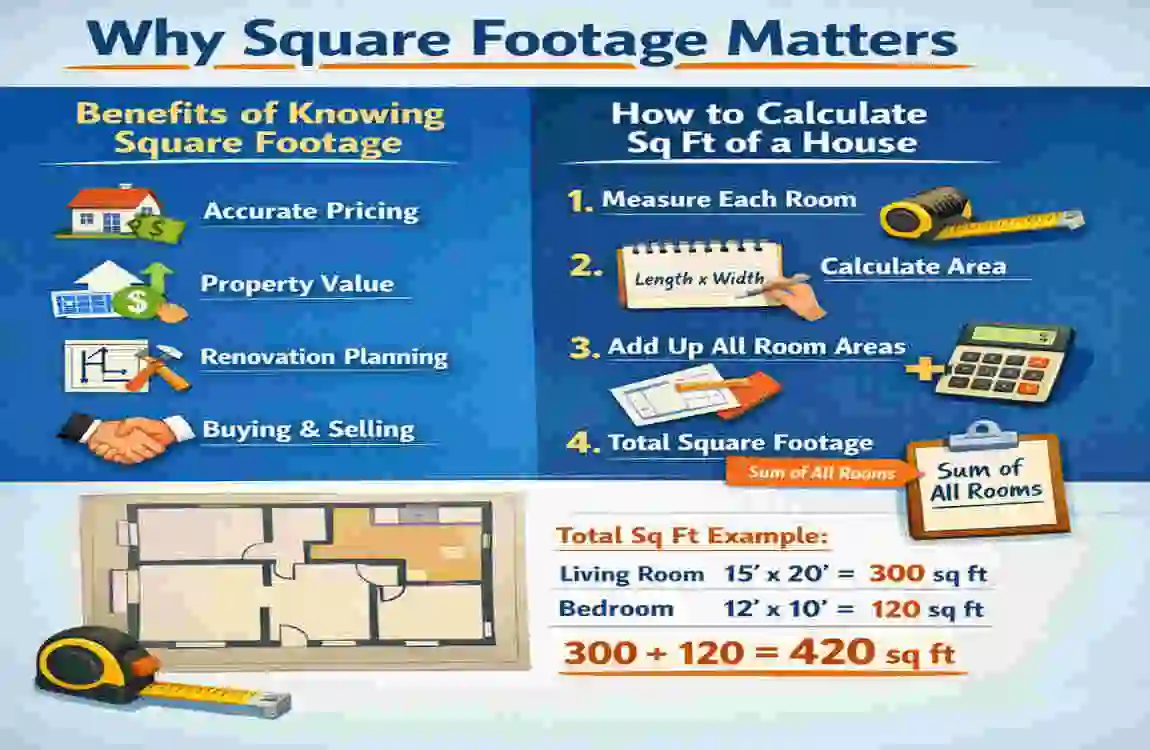
Square footage helps set value.
When buyers compare homes, they often start with size. A larger home usually commands a higher price. However, the exact price difference depends on the market, neighborhood, layout, and condition. Two houses with the same square footage can still have very different values if one has a better layout or more updates.
This is why learning how to calculate a house’s sq ft matters so much. The number shapes how buyers see the home before they ever step inside.
Square footage affects taxes and insurance.
Local tax assessments and insurance estimates may rely on the reported size of the home. If the square footage is wrong, you could pay too much or too little. Either way, the mistake can create problems later. A clean, accurate measurement helps keep records consistent.
Square footage matters for renovations
If you are replacing flooring, painting, adding heating, or planning a remodel, you need the right number. Material estimates depend on the area. A small error can lead to wasted money or delays because you bought too little.
Square footage helps buyers fairly compare homes.
If you are shopping for a house, square footage helps you compare options side by side. It can also help you understand whether a home is priced fairly for its size. That does not mean size is everything, but it is one of the first filters most buyers use.
Square footage supports better planning.
Flippers, landlords, and homeowners all use square footage when planning improvements. It helps answer practical questions like:
- How much flooring do I need?
- How much paint should I buy?
- Will the furniture fit?
- Is the layout worth the asking price?
The more accurate the measurement, the easier it becomes to make smart decisions.
Tools Needed for Measurement
Before you learn how to calculate the sq ft of a house, gather the right tools. You do not need anything fancy, but a few basic items will make the job easier and more accurate.
A measuring tape or laser measurer
A steel tape measure works well for most homes. A 25- to 30-foot tape is usually enough for regular rooms. If you want faster and easier measurements, a laser measurer is very useful. It can reduce guesswork and help you measure long distances without needing another person to hold the other end.
If you are measuring a large home or a room with unusual corners, a laser tool can save a lot of time.
A sketchpad or floor plan app
You need a place to outline each floor. This does not need to be perfect. It just needs to help you track the rooms and dimensions as you go.
You can use:
- Plain paper
- Graph paper
- A notes app
- A floor plan app
- A home measurement app
A simple sketch is often enough for a first pass.
A calculator
This sounds obvious, but it matters. You will use a calculator to multiply length by width, break irregular shapes into parts, and add up totals. A phone calculator is fine.
Painter’s tape or sticky notes
These are optional, but helpful. You can mark rooms, corners, or measurements as you move through the house. That makes it easier to keep track of what you have already measured.
Comfortable shoes and good lighting
This is not a glamorous part of the process, but it matters. You may need to walk through every room, go up and down stairs, and move furniture aside. Good lighting helps you see corners and edges more clearly. Comfortable shoes make the job easier if the house is large.
Quick tips before you start
- Measure during the day if possible.
- Clear clutter from walls and corners.
- Take photos if you need to remember room shapes.
- Measure in the same units throughout the home.
- Write everything down immediately.
If you stay organized from the start, calculating the sq ft of a house becomes much easier.
Step-by-Step Guide: How to Calculate the Sqft of a House
This is the core of the process. Once you understand these steps, you can measure almost any home with confidence.
Prepare and sketch the floor plan.
Start by drawing a rough sketch of each floor of the house. If the home has a basement, attic, or multiple levels, treat each level separately.
Do not worry about making the sketch pretty. The goal is to create a simple map that helps you track measurements.
Break the home into basic shapes. Most rooms are rectangles or squares, even if they contain small bump-outs or closets. You can always measure those extra parts separately later.
What to include in your sketch
- Living room
- Bedrooms
- Kitchen
- Bathrooms
- Hallways
- Closets
- Finished bonus rooms
What to label
- Room name
- Length
- Width
- Notes about unusual corners
- Door openings
- Areas you may exclude later
This first step helps you stay organized. When you know the layout, you can move through the home logically instead of guessing from room to room.
Measure rectangular rooms
Most of your measurements will take place here. A rectangle is the easiest shape to measure because the formula is simple:
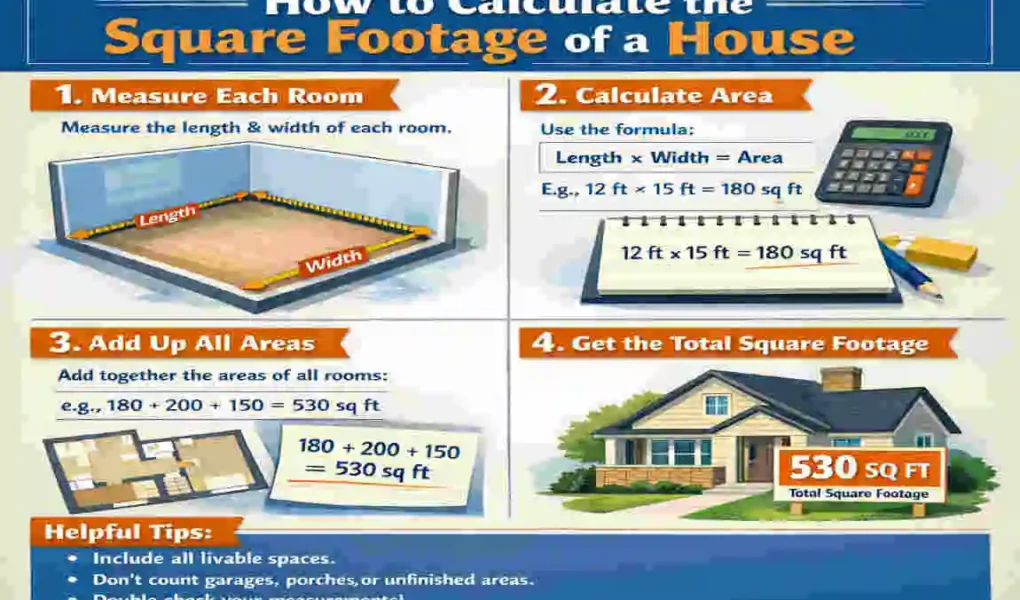
Length × Width = Square Footage
For example, if a bedroom is 15 feet long and 20 feet wide:
15 × 20 = 300 square feet
That is it.
How to measure correctly
Measure from wall to wall. Use the same method for every room so your numbers stay consistent. If a room is not perfectly square, measure the longest possible length and width, then note the uneven sections separately.
If your measurement falls between feet, round to the nearest half-foot. For example:
- 12 feet 4 inches can be written as 12.5 feet
- 9 feet 6 inches can be written as 9.5 feet
That keeps the math simpler and still gives you a useful result.
Example
Let us say your living room measures:
- Length: 18 feet
- Width: 14 feet
Then:
18 × 14 = 252 square feet
That one room adds 252 square feet to the home total.
Handle irregular shapes
Not every room is a neat rectangle. Some rooms have corners, cutouts, curves, or angled walls. That is normal. The trick is to divide the room into smaller shapes and calculate each part separately.
L-shaped rooms
An L-shaped room can be split into two rectangles.
For example:
- Section 1: 30 × 25 = 750 sq ft
- Section 2: 12 × 20 = 240 sq ft
Add them together:
750 + 240 = 990 sq ft
This method is simple and works well for kitchens, family rooms, or open spaces with a cutout.
Rooms with alcoves or bump-outs
If a room has a small bump-out, measure the main area first, then measure the extra section and add it in.
For example:
- Main room: 16 × 18 = 288 sq ft
- Alcove: 4 × 6 = 24 sq ft
Total:
288 + 24 = 312 sq ft
Circular or curved spaces
These are less common in homes, but they do appear in towers, sunrooms, or architectural features. For circles, you can use the formula:
π × radius²
If the space is more like a half-circle, divide the circle result by two. If math like this feels uncomfortable, you can also ask a professional to verify it.
Triangular spaces
Use:
½ × base × height
This is useful for some stair landings, roof areas, or angled rooms.
The best approach
When a room looks complicated, do not try to solve it all at once. Break it into parts. That is the safest and easiest way to learn how to calculate the sq ft of a house without getting overwhelmed.
Decide what to include and what to exclude
This is where many people make mistakes.
Not every square foot in or around a house counts as living area. You need to focus on the spaces that are actually part of the home’s finished, usable interior.
Usually included
- Finished bedrooms
- Finished bathrooms
- Kitchens
- Living rooms
- Dining rooms
- Finished hallways
- Finished closets
- Finished bonus rooms
Usually excluded
- Unfinished basements
- Unfinished attics
- Garages
- Porches
- Patios
- Unfinished storage areas
- Crawl spaces
- Open decks
Some areas may be included only if they meet local rules and are fully finished. For example, a basement that is heated, finished, and used as a living space may be counted in some situations, but not in others. This is why consistency matters.
Finished versus unfinished
A room is generally counted as a living area if it is part of the home’s usable interior and finished to a standard similar to the rest of the house. If it still looks like a workshop, storage room, or raw structure, it should not usually be included.
When in doubt, write it down separately and verify later.
Add everything together and verify the total
Now that each room has been measured, add the totals together.
For example:
- Living room: 300 sq ft
- Kitchen: 200 sq ft
- Bedroom 1: 150 sq ft
- Bedroom 2: 145 sq ft
- Bathroom: 67 sq ft
Total:
300 + 200 + 150 + 145 + 67 = 862 sq ft
That gives you the house’s total measured square footage.
Double-check your math
Once you finish, go back and review each room:
- Did you measure every space once?
- Did you accidentally count any area twice?
- Did you include unfinished space by mistake?
- Did you forget a hallway, closet, or nook?
This last review is important. It only takes a few minutes, but it can save you from a major mistake.
Example Table: Room Measurements Made Simple
Here is a simple example of how your calculations might look.
Room Type Example Dimensions Square Footage Calculation
Living Room 15 × 20 ft 300 sq ft
Kitchen 10 × 12 ft 120 sq ft
Bedroom 1 12 × 13 ft 156 sq ft
Bedroom 2 11 × 13 ft 143 sq ft
Bathroom 8 × 10 ft 80 sq ft
L-Shaped Hallway (6 × 10) + (4 × 8) 92 sq ft
Total – 891 sq ft
This table shows how easy it becomes once you break the home into smaller pieces.
Common Mistakes and How to Avoid Them
Even simple measurements can go wrong if you rush. Learning what not to do is just as important as learning how to calculate a house’s square feet.
Measuring the wrong side of the wall
One common mistake is mixing up interior and exterior measurements. If you use the wrong method, your final number can be off by a surprising amount.
For DIY home measurements, stay consistent. Measure the same way throughout the house. If you are creating a personal estimate, interior wall-to-wall measuring is often the easiest approach. If a professional or local rule uses another method, follow that standard instead.
Forgetting hallways and closets
Small spaces are easy to overlook. But a hallway, closet, or laundry nook still adds to the total if it is finished and part of the living area. If you leave these out, the final number will be too low.
Counting unfinished areas
A garage is not the same as a bedroom. A raw attic is not the same as a finished bonus room. Do not count unfinished space just because it is attached to the house.
Ignoring sloped ceilings
Some rooms, especially in attics or upper floors, have sloped ceilings. Those spaces may not count fully unless they meet height requirements in your area. If a room has a low ceiling in part of the space, note it and check local rules if accuracy matters.
Guessing instead of measuring
This is probably the biggest mistake of all. Guessing feels faster, but it usually creates problems later. Even a small estimating error can affect a sale, repair plan, or valuation.
Not measuring twice
If a room matters, measure it twice. That simple habit catches many mistakes before they become bigger problems.
Easy ways to avoid errors
- Use the same measuring method in every room
- Write down numbers right away
- Label each room clearly
- Take photos of unusual spaces
- Review your total before using it
If you want accuracy, slow down a little. That always helps.
Advanced Methods for Pros
If you are a homeowner, the basic method may be enough. But if you want a more polished or professional result, there are more advanced ways to measure.
Exterior measurements for multi-story homes
Some professionals use exterior measurements for certain types of homes, especially larger multi-story properties. This approach can be faster because it reduces the number of interior walls you need to track. But it can also require careful adjustment for wall thickness and attached spaces.
This is one reason appraisers and real estate professionals often follow standardized methods. They want every property measured consistently.
Measuring each floor separately
For homes with more than one level, measure each floor separately. Then add the totals together.
For example:
- First floor: 1,000 sq ft
- Second floor: 800 sq ft
- Finished basement: 400 sq ft
Total:
2,200 sq ft
This is a clean and practical way to handle larger homes.
Subtracting stair space when needed
In some cases, stairs are not counted the same way as a living area. If you are using a professional standard, the stair footprint may be treated differently. If you are measuring for your own planning, just keep your method consistent and note how you handled them.
Using professional software
Some tools can help you create more accurate floor plans. These tools may use your phone camera, laser input, or room-scanning technology to estimate dimensions more quickly.
That does not mean they replace careful checking, but they can save time.
When to bring in a professional
You may want a professional measurement if:
- You are selling a home
- The size appears disputed
- The home has unusual architecture
- You need official paperwork
- You are preparing for an appraisal or tax review
For everyday planning, though, a careful DIY method is often enough.
Online Sqft Calculators and Apps
If you want a faster way to estimate square footage, online tools and apps can help. They are especially useful for comparing rooms, checking math, or building a quick floor plan.
What these tools do well
- Speed up calculations
- Help with irregular room shapes
- Reduce math mistakes
- Save room measurements for later
- Create a basic digital floor plan
What they do not do well
- They can still make mistakes if your measurements are wrong
- They may not match local measurement rules
- They may not handle unusual home layouts perfectly
- Some tools require practice before they feel easy to use
A simple comparison table
Tool Type: Main Strength: Best For
Basic calculator, Fast math , Homeowners doing manual measurements
Floor plan app , Visual layout , People sketching multiple rooms
Phone scanning app , Quick room capture , busy users who want speed
Online sqft calculator, Easy total estimate , Simple room-by-room calculations
The best use of tools
The smartest approach is to use tools as helpers, not as replacements for careful measuring. A calculator can do the math, but you still need accurate room sizes. An app can speed things up, but it cannot fix bad input.
If you are learning how to calculate the sq ft of a house for the first time, start with simple tools. That will help you understand the process before you rely on automation.
Legal and Regional Variations
This part is important because square footage is not always measured the same way everywhere.
Different areas may use different rules.
Some places follow national standards, while others use local rules or industry customs. That means a house may be listed one way in one context and another way in a different context.
For example:
- Some regions count basements only if they are finished
- Some areas have special rules for ceiling height
- Some places treat porches and sunrooms differently
- Some markets include only the above-grade living area in the main listing number
Metric conversion
If you need to convert square feet into square meters, the standard conversion is:
1 square foot = 0.0929 square meters
That means:
- 100 sq ft = 9.29 sq m
- 500 sq ft = 46.45 sq m
- 1,000 sq ft = 92.9 sq m
This can be helpful if you are comparing international listings or working with metric-based materials.
Why local rules matter
If your goal is to sell or appraise a home, local rules matter more than personal preference. A number that feels right to you may not match what an appraiser or agent uses. That is why it helps to understand the local standard before you publish a measurement.
Best approach
If you need the number for casual planning, a DIY measurement is usually fine.
If you need the number for legal, financial, or sales purposes, verify it against the rules in your area.
Real Estate Applications of Square Footage
Square footage is not just a math exercise. It plays a direct role in real estate decisions every day.
Selling a home
When sellers list a home, the square footage often becomes one of the first things buyers see. A clear, accurate number helps the listing feel more trustworthy. It also makes it easier for buyers to compare the home against similar properties.
Buying a home
As a buyer, square footage helps you understand what you are paying for. It gives you a way to compare homes on the same scale, especially when the finish quality is similar.
Renovating a home
If you are planning a remodel, square footage helps with budgeting. Flooring, paint, drywall, insulation, and many other materials are priced by the square foot. A correct number keeps your estimate realistic.
Renting or investing
For landlords and investors, square footage supports rent pricing, repair planning, and return estimates. It can also help with tenant expectations and property comparisons.
Insurance and tax planning
Accurate records can help avoid confusion later. A home that is badly mismeasured may create a mismatch between what is reported and what actually exists. That can lead to unnecessary back-and-forth with insurers or local agencies.
In short, how to calculate the sq ft of a house is useful far beyond the home itself. It affects the decisions people make around it, too.
Practical Tips for Better Accuracy
If you want cleaner results, these habits will help.
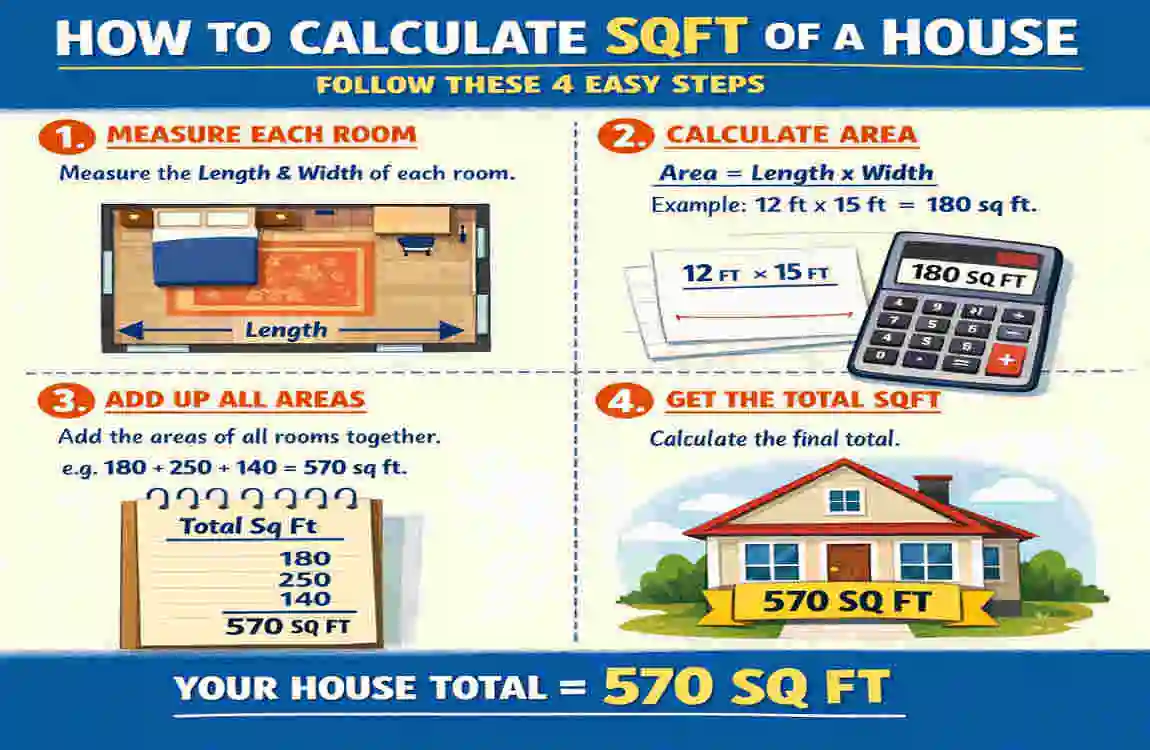
Measure room by room
Do not try to calculate the entire house in one shot. Work one room at a time. That keeps your notes organized and reduces mistakes.
Use the same unit everywhere.
Pick feet and stick with feet. Mixing feet, inches, and yards makes the math harder and increases the chance of errors.
Keep a written record.
Even if you use an app, write down the main numbers. A backup record helps if the device battery dies or the app resets.
Mark special spaces clearly
Label any area that is unfinished, partially finished, or excluded. That way, you will remember why you left it out later.
Recheck the total square footage after adding.
Look at the final number one more time. A simple addition error is easy to miss and easy to fix if you catch it early.
Ask someone else to review it.
A second pair of eyes can be very helpful. Another person might notice a skipped closet or a room you counted twice.
FAQ: How to Calculate Sqft of a House
How do you calculate the square footage of a house with vaulted ceilings?
For vaulted ceilings, focus on the floor area, not the ceiling height. The square footage is the area of the floor. If a room has a sloped ceiling, count only the usable area in accordance with local rules and any applicable measurement standard. If the space has height restrictions, it may not all count as living area.
Does a garage count as square footage?
Usually, no. A garage is normally excluded from the home’s living square footage unless it has been fully converted into finished living space. That conversion is recognized under the relevant standard. A finished garage conversion is a different matter, so check the rules before including it.
How do I calculate square footage for a two-story house?
Measure each floor separately. Add the first-floor total to the second-floor total. If there is a finished basement or finished attic, decide whether it should be counted based on local rules and the purpose of the measurement.
What is the difference between square feet and square meters?
Square feet is a U.S.-style measurement unit. Square meters is the metric version used in many other countries. To convert, multiply square feet by 0.0929. That gives you square meters.
Do closets count in square footage?
If a closet is finished and part of the living area, it usually counts. Small spaces still matter if they are inside the finished interior of the home.
Should I measure from the inside or outside of the walls?
For a DIY estimate, many homeowners use interior wall-to-wall measurements because they are simple and easy to repeat. For official or professional purposes, the method may be different. The key is to stay consistent and follow the standard required for your situation.